Stop Limit Order Robinhood: A Quick Guide
Learn how the stop limit order robinhood works, when to use it, and practical strategies to control risk and improve execution on stocks and options.

January 4, 2026
Wallet Finder

January 4, 2026

Ever heard the term 'rug pull' in crypto circles? It's one of the most common—and devastating—scams. A rug pull is a nasty exit scam where a crypto project's developers abandon it, taking investors' money with them.
Imagine investing in a groundbreaking startup. The team is charismatic, marketing is slick, and hype is through the roof. Then, you wake up to find their website gone, social media deleted, and the founders have vanished with every dollar. That’s a crypto rug pull. Your once-promising tokens are now worthless, their value plummeting to zero almost overnight.
A rug pull gets its name from "pulling the rug out from under someone." It’s a perfect metaphor for how investors feel when developers they trusted suddenly disappear, leaving them with nothing. These scammers build fake credibility with aggressive marketing to get people to buy their new token.
Once they've collected enough cash, they pull the plug. They might drain money from the liquidity pool, dump their massive stash of tokens on the market, or steal funds locked in smart contracts. The outcome is always the same: a catastrophic price crash, often wiping out over 90% of the token's value in hours. For more detail, there are great technical breakdowns of cryptocurrency rug pulls available.
A rug pull is fundamentally an act of betrayal. Developers build a community, promise innovation, and then exploit that trust for personal gain, leaving a trail of financial destruction.
Learning to spot the signs of a rug pull is your first line of defense. While methods can differ, most scams share common traits. These red flags are often hiding in plain sight, disguised by hype and FOMO.
Here's a breakdown of defining features you'll typically find in a rug pull scheme.
Recognizing these characteristics early can be the difference between avoiding a scam and becoming another statistic.
Not all rug pulls follow the same script. Scammers use a few distinct methods to pull the rug out. Understanding how these scams work is the first step toward spotting them.
The typical process moves from manufactured excitement straight to an abrupt exit.
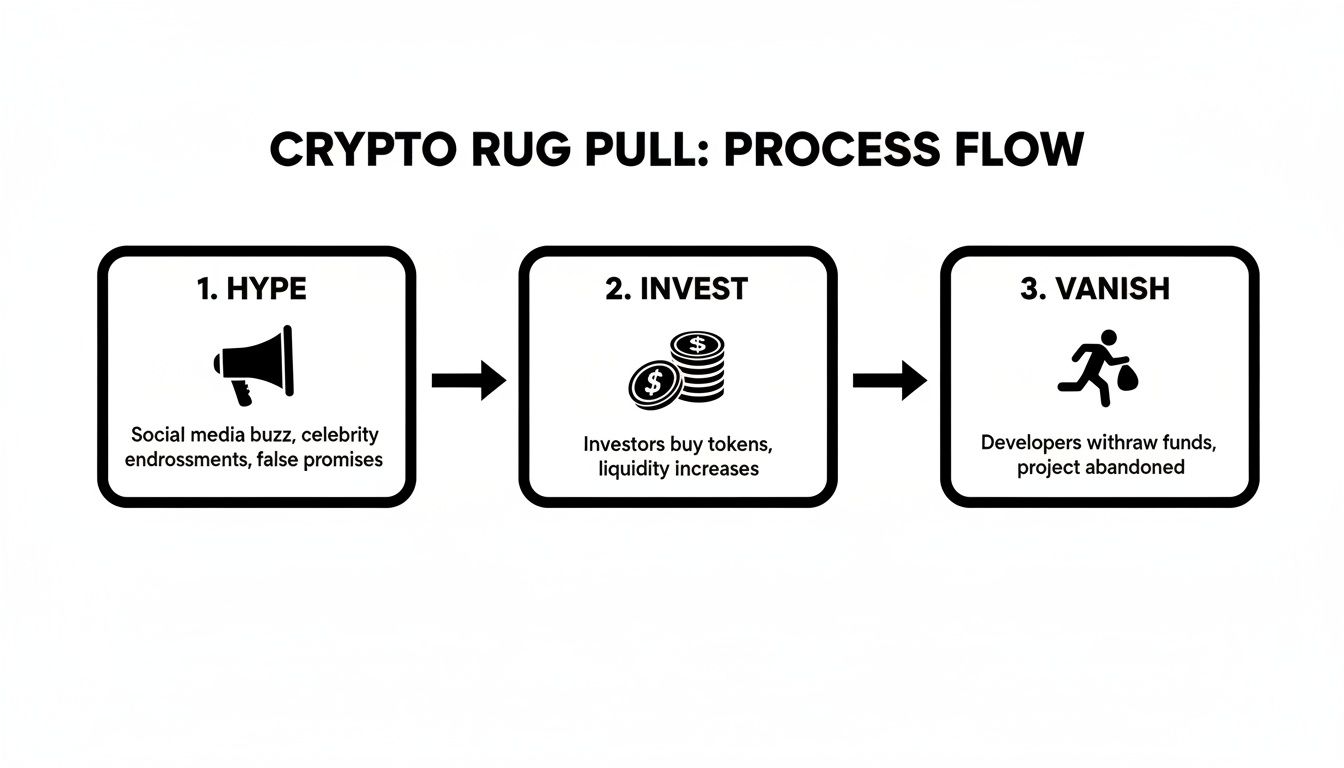
This three-step cycle shows how scammers play on community hype to attract capital before disappearing. Let’s break down the three main types of rug pulls.
The most common and technical type is the liquidity pull. To make a new token tradable on a decentralized exchange (DEX), developers create a liquidity pool. They pair their new token with an established crypto like Ethereum (ETH) and lock them in a smart contract.
This pool allows users to swap ETH for the new token. Scammers wait until a ton of investor ETH has flooded into the pool. Then, they suddenly withdraw all the liquidity, snatching the valuable ETH and leaving behind worthless project tokens.
A liquidity pull is like a currency exchange owner running off with all the U.S. dollars, leaving customers holding a currency that can no longer be traded. It makes selling impossible and instantly drains the token's value.
A simpler but equally devastating method is the token dump, or "sell-off." Here, developers hold a massive percentage of the total token supply from the start. They generate hype and wait for the price to climb as investors buy in.
Once the price peaks, the developers "dump" their entire stash on the market in one massive sell-off. This flood of supply instantly crashes the token's price, often by 99% or more. Other investors are left with worthless assets while the founders walk away with millions.
Perhaps the most devious type is the honeypot scam. Here, malicious code is baked into the token's smart contract. The contract is written to allow users to buy the token but stops them from ever selling it.
Investors purchase the token, watch its price go up, and think their investment is doing great. But when they try to cash out, the transaction fails. Only the developers' wallet address is whitelisted to sell. For a deeper look, it's worth exploring smart contract security.
Figuring out if a project is a potential rug pull takes detective work. Scammers almost always leave clues in how they present their project and in the blockchain data itself. Learning to spot these is the single most important skill to protect your crypto.
Think of it like buying a used car. You’d check for dents and listen for a weird engine noise (off-chain), but you’d also want the vehicle history report to check for accidents (on-chain data). You need both to avoid buying a lemon.

Warning signs can be split into two camps: signals in the project's community and communications (off-chain) and hard evidence from the blockchain (on-chain).
While off-chain signs are great for a gut check, on-chain data is where you find undeniable proof.
Off-chain red flags are the qualitative signals from how a project presents itself. They are often the fastest and easiest things to check. Here is an actionable checklist:
This is where you move past what the team says and verify things with data from the blockchain. On-chain analysis uncovers the risks they'd rather you not see. Use automated tools and crypto scam checkers to do the heavy lifting.
The blockchain doesn't lie. Scammers are great at making slick websites and faking social media engagement, but they can't hide shady on-chain activity like unlocked liquidity or giving all the tokens to their friends.
Here are the big on-chain indicators you can't afford to ignore:
To understand what a rug pull is, you have to look at the money involved. These aren't small-time annoyances. They're a multi-billion dollar problem that has wiped out investors worldwide, especially as decentralized finance (DeFi) has taken off.
The boom in DeFi protocols accidentally rolled out the red carpet for scammers. Creating and listing new tokens on decentralized exchanges became incredibly easy, which meant fraudulent developers could launch projects with almost zero accountability.
The sheer scale of these scams tells you everything: the easier it is to create a project, the more work you, the investor, have to do. Scammers love environments where hype drowns out fundamentals.
The financial damage from rug pulls is staggering. The year 2021 was a turning point—rug pulls made up 37% of all crypto scam revenue. That’s around $2.8 billion snatched from investors, a massive jump from just 1% in 2020.
This spike went hand-in-hand with the DeFi boom, where rug pulls became the scam of choice. Countless new tokens were minted for the sole purpose of draining investors' money. For a deeper dive into the numbers, check out the full crypto crime report from Chainalysis.
Knowing how much money is on the line makes it clear why due diligence is so critical.
Scammers are incredibly good at adapting. They pivot their tactics to whatever is new and hot, targeting whatever trend has investor FOMO (Fear Of Missing Out) at a fever pitch.
Here’s a quick look at how rug pulls have changed with the times:
Knowledge is your best defense, and on-chain analysis tools are your secret weapon. While red flags in whitepapers and shady social media are helpful, the blockchain holds the undeniable truth. Platforms like Wallet Finder.ai are built to turn this raw data into actionable intelligence.
Instead of just reacting after a scam, you can get ahead by vetting projects before you invest. It’s like having a private investigator for the blockchain. You can dig into the digital footprints of creators, track developer wallets, and spot suspicious activity long before the rug gets pulled.
On-chain tools pull back the curtain on complex blockchain transactions. They let you see who holds the most tokens, when team wallets are moving huge sums, and how experienced traders are positioning themselves.
Here’s an actionable list of checks you can perform with these tools:
On-chain analysis is the ultimate lie detector. A team can promise you the world, but their wallet activity reveals their true intentions. Large, unexplained token movements don't lie.
Let's make this concrete. Imagine you're sizing up a new DeFi token. Instead of just taking their website at face value, fire up a tool like Wallet Finder.ai. In seconds, you can visualize who holds what and how the money is flowing, answering the critical questions that protect your capital.
This is what it looks like inside a platform like Wallet Finder.ai, which makes it easy to track wallets.

The interface translates complex blockchain events into a clear dashboard, highlighting key metrics like PnL and trade history for specific wallets. This lets you identify traders who consistently sidestep rug pulls and make profitable moves, giving you a blueprint for safer strategies.
Ultimately, these tools empower you to shift from passive speculation to data-driven investing.
Just spotting red flags isn't enough. You need a disciplined, proactive approach to investing. Think of it as a framework that naturally weeds out sketchy projects.
The cornerstone is simple: portfolio diversification. Don't put all your eggs in one basket. By spreading your capital across different assets, you ensure a single scam won't zero out your portfolio.
Next is your research process. You have to dig deep and think for yourself, because relying on social media hype is a fast track to getting wrecked. Prioritize projects with transparent, publicly doxxed teams. And most importantly, insist on seeing a third-party smart contract audit.
Finally, get a handle on the psychological side of trading. Master your emotions and resist FOMO (Fear Of Missing Out). Scammers are experts at creating a sense of urgency to pressure you into jumping in without thinking.
The most profitable move is often the one you don't make. Patience and diligence are your greatest assets in a market designed to trigger impulsive decisions.
History shows scams surge when the market gets hot. The NFT boom of 2021-2022 unleashed a tidal wave of rug pulls. Platforms like Pump.fun have seen a staggering 98.6% of new tokens in 2024 flagged as scams. These trends make it clear why a disciplined framework is essential. You can dig deeper into crypto rug pull trends over on Coincub.
A huge part of this is learning to recognize different tricks scammers pull. To get up to speed, check out our guide on common DeFi wallet scams. By making these habits second nature, you build a robust defense that protects your capital.
We get it. It’s a lot to take in. Here are answers to common questions about rug pulls.
To be blunt: probably not. Recovering funds after a rug pull is incredibly difficult, bordering on impossible.
Because crypto transactions are decentralized and often anonymous, once scammers have your money, there’s usually no way to get it back. This harsh reality is why prevention and doing your homework upfront are everything.
Absolutely not. Innovation drives crypto forward, and many new projects are legitimate.
However, the risk is always higher with brand-new, unaudited projects—especially if the team is anonymous and their marketing feels too aggressive. You have to treat every new investment with a healthy dose of skepticism and run it through the red flag checklist.
A smart contract audit from a reputable firm is a huge green flag, but it's not a silver bullet. An audit checks the code for bugs and security holes; it can't verify the team's true intentions.
Think about it: a project can have a perfectly secure contract, but if the founders hold a massive chunk of the token supply, there’s nothing stopping them from dumping it on the market. That's why you always need to pair audit checks with your own on-chain analysis.
Ready to turn raw blockchain data into a real trading advantage? Wallet Finder.ai is built to help you track smart money, dig into developer wallets, and catch suspicious activity before it’s too late. See what the top traders are doing in real time and protect your capital.