SOL Address Lookup: Find Smart Money & Winning Trades

Wallet Finder

Blank calendar icon with grid of squares representing days.

April 9, 2026

You spot a Solana token after the move. The chart is vertical, the timeline is full of victory laps, and the same question hits every trader at some point. Who bought this early, and how did they find it before everyone else?

A good sol address lookup gives you the first real answer.

Not the social answer. Not the influencer thread. The on-chain answer. You can inspect the wallet activity, see what was bought, when it was bought, what else that wallet traded, and whether the trader behind it looks skilled or just lucky. That shift matters. It turns Solana from a blur of fast-moving tokens into a market you can study.

Why a SOL Address Lookup Is a Trader's Superpower

Most new traders use address lookup like a search bar. They paste in a wallet, check the balance, scan a few transfers, then leave. That is useful, but it barely scratches the surface.

A trader uses lookup differently. They use it to answer practical questions:

  • Who accumulated before the breakout
  • Who sold too early
  • Which wallets keep showing up in strong launches
  • Whether a big buyer is a real operator, a bot, or a treasury wallet
  • What kind of risk that wallet takes repeatedly

That is where the edge starts.

What a wallet history tells you

A wallet is a behavior log. If you read enough of them, patterns become obvious.

One wallet sprays tiny buys into dozens of fresh tokens and rarely holds anything. Another enters fewer names, sizes up with conviction, adds on dips, and exits in pieces instead of panic selling. Those are not the same trader profile, even if both happen to catch one winning token.

The value of a sol address lookup is not just visibility. It is context.

A single profitable trade tells you almost nothing. A repeatable pattern across multiple trades tells you what to monitor.

Why this matters more on Solana

Solana moves fast. Wallet behavior becomes visible before a narrative fully spreads across social channels. That makes public address data especially valuable for memecoin traders, DeFi traders, and anyone trying to learn from smart money instead of reacting late.

When you start reading wallets well, you stop asking, “Should I ape this candle?” and start asking, “Which wallets built this position, how do they usually trade, and does this move fit their normal playbook?”

That is a better question. It leads to better entries, better filters, and far fewer emotional decisions.

The Essential SOL Address Lookup Toolkit

Before you try to identify profitable wallets, you need to get fluent in the basic tools. If you cannot read a wallet page cleanly, you will misread signals later.

The first layer is the explorer.
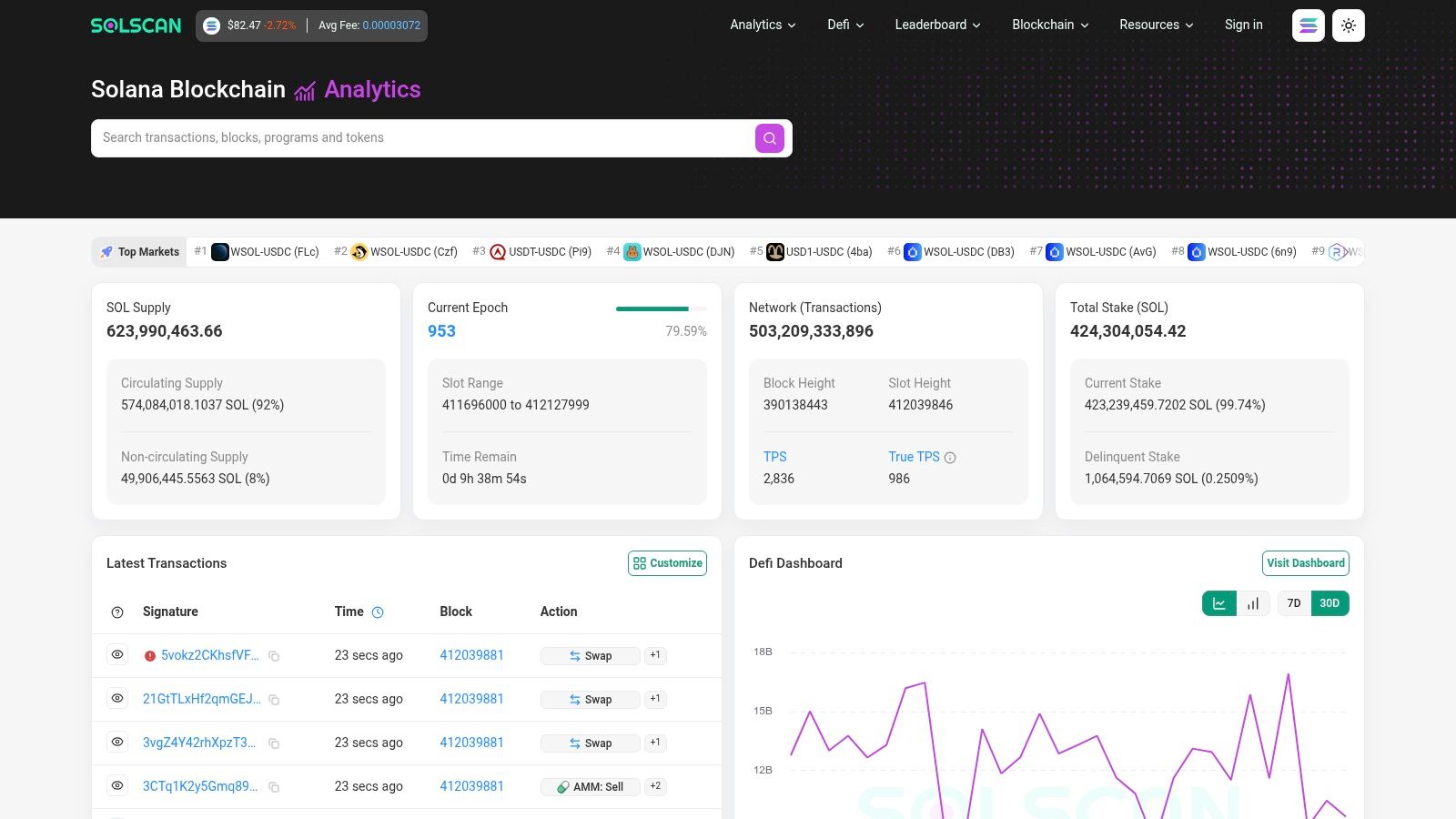
Screenshot from https://solscan.io/

Start with the right tools

The core stack for basic sol address lookup usually includes:

ToolBest useWhat to check first
Solana ExplorerRaw on-chain verificationAddress type, signatures, instructions
SolscanFast human-readable reviewToken holdings, transfers, activity tabs
OKLinkSupplemental analytics viewBlock data, address activity context
CoinTracker, CoinLedger, CoinStatsPortfolio-style wallet summariesHoldings, trade history, tax-style visibility

These tools all let you inspect a public wallet without needing private keys. That is enough for most research workflows.

What to read on the wallet page

When you paste an address into Solscan or Solana Explorer, do not skim randomly. Read the page in a fixed order.

  1. Confirm the address type
    Make sure you are looking at the wallet or token account you intended to inspect.

  2. Check the current SOL balance
    This helps frame whether the wallet is active, dormant, or likely used only as a routing account.

  3. Review SPL token holdings
    Here, you spot concentration, recent bets, and whether the wallet holds positions or just flips quickly.

  4. Open recent transactions
    Look for swaps, transfers, repeated interactions with the same programs, and bursts of activity around launches.

  5. Trace counterparties and timing
    Timing often matters more than size. A wallet that consistently enters before broader volume arrives deserves a closer look.

One reason these tools matter is scale. According to Glassnode Studio’s Solana active address chart, the network recently recorded 5,553,843 active addresses in a 24-hour period, and verified data also notes 33.9 million monthly active users from Token Terminal, surpassing Ethereum. At that level of activity, manual guesswork stops working.

For a deeper comparison of analysis platforms, this breakdown of the best Solana wallet analyzers is useful: https://www.walletfinder.ai/blog/best-solana-wallet-analyzer

What basic explorers do well, and where they stop

Explorers are excellent for verification. They tell you what happened on-chain.

They are less useful for ranking. They do not naturally tell you which wallets are worth your attention, which traders are consistent, or who keeps winning across different tokens. That gap matters once you stop looking up wallets you already know and start trying to discover wallets you should know.

A quick walkthrough helps if you are still getting used to explorer layouts:

Use explorers to verify facts, not to infer skill too early. Raw activity is visible. trader quality is something you still need to evaluate.

From Lookup to Discovery Finding Smart Money Wallets

Looking up a wallet is passive. Finding a wallet worth tracking is active.

The better workflow usually starts with a token that already has your attention. Maybe it is trending, maybe volume is accelerating, maybe the liquidity profile looks cleaner than most fresh launches. From there, you work backward to the traders.

Infographic

The practical workflow

A proven method for finding smart money involves filtering tokens on Dexscreener, using the Top Traders tab, and then validating historical PnL, win rates (showing consistent performance), and hold times on a specialist tracking tool. That workflow is described in the Solana developer guide on lookup tables, which is also the reference tied to the verified method in the brief.

Here is the process in plain trading terms.

1. Start with the token, not the wallet

Open Dexscreener and narrow your view to Solana tokens that look worth studying. The brief’s verified workflow specifically calls out filtering for 24-hour volume increase and liquidity above $500K.

That step matters because random low-quality pools produce random wallets. Better token selection gives you a better wallet sample.

2. Open Top Traders and ignore the obvious traps

The Top Traders tab is useful, but it is noisy.

Some addresses are pure sellers. Some are snipers. Some are routing flow in ways that look profitable on one token but do not represent a copyable strategy. Excluding pure sellers is part of the verified process for a reason. You want wallets that built and managed positions.

3. Click through into the wallet record

Once a trader stands out, click into the maker address and inspect the trading record. You are no longer asking whether this wallet touched a good token. You are asking whether the wallet behaves well across trades.

Useful follow-up questions:

  • Do they buy early or chase momentum
  • Do they scale in or all-in immediately
  • Do they repeatedly hit strong tokens, or just one
  • Do they hold long enough for conviction to matter
  • Do exits look disciplined

4. Validate the full history before you track anything

Many traders get sloppy at this point. One attractive wallet page is not enough.

Review historical PnL, win rate, hold time, and whether the wallet’s activity looks organic. The verified workflow also flags common failure patterns. Very high transaction counts can indicate bot behavior. Tiny scattered positions across many names often indicate noise rather than skill. One-token dependence can hide a weak overall process.

That is why serious traders move from isolated lookups into broader tracking systems. If you want a detailed guide to that transition, this walkthrough is useful: https://www.walletfinder.ai/blog/how-to-track-wallets-on-solana

What usually works and what usually fails

Here is the trade-off most newer traders learn the hard way.

ApproachWhat happens
Copy the top wallet from one hot tokenYou often end up following luck, bots, or one-off timing
Track wallets with repeatable entries and exits across tradesYou get a more durable watchlist
Judge wallets only by realized profit on one chartYou miss risk management, sizing, and strategy quality
Validate by hold time, trade selection, and consistencyYou identify traders with actual process

The core goal

You are not trying to find a hero wallet.

You are building a small, high-trust watchlist of addresses whose behavior makes sense. Some will be early accumulators. Some will be momentum traders with clean exits. Some will be selective swing traders. The point is not to copy every move. The point is to know whose moves deserve your attention when the market starts moving.

Strong wallet discovery is less about one big score and more about filtering out addresses that should never have made your watchlist in the first place.

Decoding On-Chain Wallet Activity Like a Pro

Once a wallet clears the first filter, the hard part begins. A transaction list can look impressive and still hide weak execution.

What separates a useful wallet from a misleading one is not just profit. It is the shape of that profit.

A cartoon detective with a magnifying glass examining a glowing book showing a digital transaction trail.

Top wallet tracking platforms provide instant access to any public address’s SOL balances, full trade histories, and PnL-impacting trades, revealing details like entry timing, exit timing, and win streaks. That matters on a network with 5.8 million unique active addresses, as described on CoinTracker’s Solana wallet page.

Read these signals together

Looking at any one metric in isolation creates bad conclusions.

PnL

PnL tells you whether the wallet made money. It does not tell you how.

A wallet can show strong PnL because it caught one extreme move. Another wallet can show steadier PnL because it compounds smaller wins with cleaner exits. The second profile is often more useful to study.

Win rate

A high win rate is appealing, but context matters.

A trader can maintain a strong win rate by taking tiny quick profits while carrying hidden downside elsewhere. Another trader may post a lower win rate while making much larger gains on winners than losses on losers. Neither metric should stand alone.

Hold time

Hold time often reveals strategy faster than profit does.

Short hold times can indicate scalping, fast momentum trading, routing activity, or bot-like behavior. Longer holds can indicate conviction, but they can also indicate poor discipline. The key is whether hold time is consistent with the wallet’s results.

What the wallet’s structure reveals

A strong wallet usually leaves clues in position sizing and diversification.

SignalWhat it can imply
Repeated meaningful size in selected tokensConviction and screening discipline
Tiny size across many namesNoise, testing, or undirected gambling
Immediate exits after entryScalping, sniping, or low-conviction trading
Layered exits into strengthProcess-driven trade management
Large inactive balances with little tradingStorage wallet, treasury, or non-trading account

Three wallet archetypes

The lucky hitter

This wallet looks brilliant on one token and average everywhere else.

You will usually see scattered history, uneven sizing, and no clear repeatable behavior. These wallets attract attention because the outlier win is easy to notice. They rarely deserve a long-term tracking spot.

The bot-shaped wallet

This wallet may show rapid turnover, huge activity density, and mechanical behavior.

That does not automatically make it useless, but it usually makes it harder to copy. If the edge depends on speed, automation, or routing logic, a manual trader cannot reproduce it.

The process trader

This is the profile worth studying.

The entries make sense. The wallet revisits certain setups. Sizing has logic. Exits are not random. Even when the trader loses, the loss pattern still looks controlled. That consistency is what you want.

The best wallets are not always the most exciting. They are the easiest to understand.

A simple review framework

When I evaluate a wallet, I want answers to five questions:

  1. Is the profit concentrated in one trade or spread across multiple trades?
  2. Does the wallet size up only when conviction appears high?
  3. Are losses cut, or do bad trades linger?
  4. Is the activity human-copyable, or does it depend on bot speed?
  5. Would I understand this trader’s style after reviewing ten trades?

If the answer to the last question is no, the wallet usually stays off the watchlist.

Best Practices for Advanced Wallet Tracking

Finding a good wallet is research. Monetizing that research requires operations.

That means alerts, filtering, verification, and discipline. Without those, even a strong sol address lookup workflow turns into a folder full of saved addresses you never act on in time.

A digital illustration of a young person in a hoodie interacting with glowing cryptocurrency market interface screens.

Why basic monitoring breaks down

Most explorers are built for inspection, not live decision-making.

That is the core limitation. Most explorers offer basic lookups, but copy traders need wallet discovery ranked by profitability metrics like PnL and win rates. The verified brief ties that gap to this YouTube reference about winning strategies in real time, where advanced filtering is positioned as the missing layer.

If you track active Solana wallets manually, three problems appear fast:

  • Too much noise from wallets that are active but not useful
  • Bad timing because you only notice trades after the move
  • Weak verification because labels and transaction patterns can be misleading

Build a tighter tracking system

Use alerts for specific actions

Do not rely on memory or casual checking.

The best setup watches for concrete events, such as buys, swaps, or sells from a short list of addresses you already trust. That lets you react when behavior changes, not hours later.

Segment your watchlists

Keep separate groups.

A wallet that specializes in fresh memecoin entries should not sit in the same mental bucket as a swing trader who rotates larger DeFi positions. Segmentation reduces confusion when multiple alerts hit at once.

For advanced screening ideas, this guide is worth reviewing: https://www.walletfinder.ai/blog/advanced-filters-for-whale-wallet-tracking

Re-verify wallets regularly

Wallet quality drifts.

A trader can be sharp for a stretch, then change strategy, lean into lower-quality launches, or become impossible to follow. Re-checking recent behavior matters more than preserving an old thesis.

Verification and privacy rules that save mistakes

Best practiceWhy it matters
Check if the address is a trader, not an exchange or treasuryYou do not want to copy operational flows
Review more than one token historySingle-token winners distort reality
Look for strategy consistencyRepeatable behavior is more actionable than random wins
Avoid exposing your own wallet publicly during researchPublic blockchains remember everything
Keep notes outside the explorerContext disappears fast when markets get busy

A wallet is worth tracking only if you can explain why it wins and under what conditions its edge is likely to fail.

The goal is not maximum coverage. It is clean signal. A smaller watchlist with strong filters beats a giant list of impressive-looking addresses every time.

Your Solana Address Lookup Questions Answered

Can I look up any Solana wallet address?

Yes. Public Solana addresses can be inspected with explorers and wallet analytics tools. You can review balances, token holdings, and transaction history as long as the activity is on-chain and tied to that public address.

Can I see who owns the wallet in real life?

Usually, no.

A sol address lookup shows public blockchain activity, not a legal identity. Sometimes labels or public disclosures make a wallet easier to contextualize, but the chain itself does not give you a person’s name by default.

What is the difference between a wallet address and a token account?

A wallet address is the main public account you think of as the user’s address.

A token account is a separate account structure used to hold a specific SPL token. This is one reason new users sometimes get confused when explorer pages show multiple related accounts around one wallet’s activity.

Are all transactions visible forever?

On-chain activity is public and designed to be inspectable. In practice, that means transfers, swaps, and many other interactions can be reviewed long after they happen through explorers and analytics platforms.

That permanence is useful for research, but it also means your own activity creates a long-lived trading record if you use public wallets carelessly.

Why does one wallet look different across tools?

Different platforms present the same underlying activity in different ways.

One explorer may emphasize raw instructions. Another may group swaps, show token PnL more clearly, or apply labels that improve readability. If a wallet matters, verify it across more than one tool before drawing conclusions.

What is the biggest mistake beginners make?

They confuse visibility with skill.

A wallet can be active, early, or large without being worth copying. The better question is whether the wallet’s history shows a strategy you can understand, verify, and realistically act on.


If you want to move beyond basic explorer searches and discover wallets worth tracking, Wallet Finder.ai is built for that job. It helps traders find profitable wallets, inspect full trading histories, filter by performance signals like returns and win streaks, and monitor smart money moves in real time across Solana and other major chains.