Spark Token Price: Actionable Analysis for 2026

Wallet Finder

Blank calendar icon with grid of squares representing days.

April 20, 2026

Spark dropped 86.60% from its all-time high to roughly $0.02499 by mid-April 2026 according to KuCoin SPK price data. That single fact changes how professionals should approach the spark token price. This isn't a token you evaluate with a lazy chart glance and a recycled prediction thread.

SPK had an explosive launch, a sharp unwind, and then signs of stabilization. That pattern usually attracts two very different groups: traders looking for a rebound trade, and long-horizon DeFi investors looking for a protocol token whose value may reconnect with usage. Both groups can make money. Both groups can also get trapped if they focus only on candles.

The edge isn't in guessing the next green day. The edge is in understanding what moves SPK, how protocol usage feeds into token demand, and which wallets are positioning before the move becomes obvious.

Decoding the Spark Token Price Puzzle

SPK rallied about 244% within roughly a month of launch, then gave back almost all of that move over the following months. That kind of price history attracts the wrong kind of certainty. Traders either fixate on the early breakout and call every dip a bargain, or they treat the drawdown as proof that every rally should be sold.
A magnifying glass examining a volatile red market graph represented on a series of jigsaw puzzle pieces.

Both reactions miss how DeFi governance tokens usually trade after launch. Early price action is often a mix of thin liquidity, incentive-driven positioning, exchange discovery, and fast-rotating momentum capital. That makes the opening chart useful as a record of who showed up first. It does not make it a reliable map for where SPK should trade next.

Why the chart alone misleads

A sharp decline can reflect repricing rather than failure. A flat range can hide distribution from larger holders or quiet accumulation from wallets building size before liquidity improves. SPK sits in a zone where traders need more than support and resistance lines.

A better read starts with market structure:

  • Launch flows matter: SPK's first move was strong enough to pull in short-horizon traders who usually exit as soon as volatility compresses.
  • The long decline matters more: extended weakness in a governance token often signals that the market is resetting growth assumptions, incentive expectations, and supply overhang.
  • The bounce off the lows matters: SPK did not disappear after the unwind. Buyers defended lower levels, which keeps the token in the category of tradable recovery candidates rather than abandoned listings.

My rule on names like this is simple. Treat SPK as a protocol-linked trading instrument with event risk, supply risk, and on-chain signal value. That framing is much more useful than arguing over whether it is "cheap" relative to a past high.

The more useful question

The key question is not whether SPK once traded much higher. It is why demand appears in one area, fades in another, and whether that behavior is being led by informed wallets or retail reaction.

For SPK, price usually makes more sense when three datasets line up. Protocol activity. Token supply mechanics. Wallet behavior on-chain. If one of those starts diverging, the chart can look stable right before a break.

That is where traders can gain an edge. Instead of asking whether spark token price will bounce, track whether high-quality wallets are accumulating before volume expands, whether liquidity is deep enough to absorb exits, and whether new buying is tied to actual protocol traction or just short-term speculation.

Use this framework:

  1. Check whether protocol usage is strengthening or stalling.
  2. Track whether skilled wallets are adding, trimming, or rotating out.
  3. Measure whether market depth can support a real move.
  4. Watch supply-related pressure that can cap rallies.

That process is slower than chasing green candles. It is also how traders avoid buying a reflex rally that smart money is already selling into.

What Is Spark (SPK) and Why Does It Matter

SPK is the governance token of the Spark protocol on Ethereum. Spark itself is a DeFi protocol built around stablecoin capital efficiency, with core products including SparkLend and Spark Savings. If you're trading the spark token price seriously, you need to think like a protocol analyst first and a chartist second.
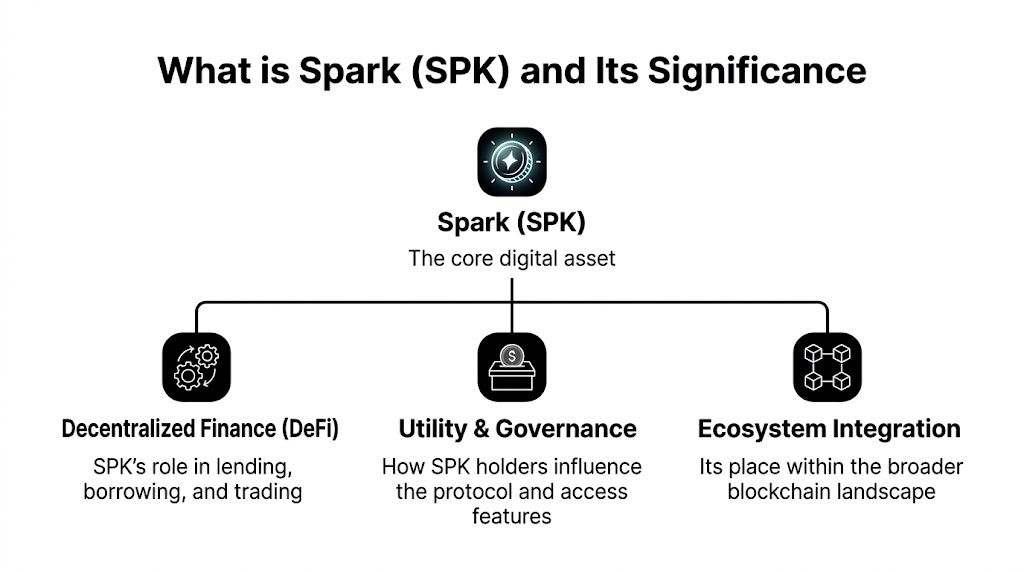
A diagram explaining the role and significance of the Spark SPK digital asset in decentralized finance.

According to Kraken's Spark market overview, SPK trades around $0.0245 to $0.0304, has a circulating supply of 2.57 billion SPK out of a 10 billion total supply, carries a market cap around $63M, and a fully diluted valuation around $245M. The same source notes that 17% was made available at launch, with the remaining supply vesting over time, which is critical for understanding both risk and valuation.

What the protocol actually does

Spark isn't trying to be a generic token with vague ecosystem language. Its utility comes from governance within a protocol focused on stablecoin yield optimization.

At a practical level, traders should think about Spark in three layers:

  • SparkLend: a lending and borrowing venue tied to stablecoin activity.
  • Spark Savings: a yield-focused module for stablecoin deposits.
  • Governance layer: the part that connects protocol growth to SPK holder influence.

That structure matters because governance tokens usually trade best when the underlying protocol is doing something economically relevant. Stablecoin yield and lending are relevant. That doesn't guarantee price appreciation, but it gives SPK a more concrete analytical basis than many thinly traded governance names.

The tokenomics that traders can't ignore

Most retail traders look at price and maybe market cap. Professionals always add two more checks: circulating supply and fully diluted valuation.

Here's the quick framework.

MetricWhat it tells youWhy it matters for SPK
PriceWhat the market pays nowUseful, but incomplete on its own
Circulating supplyHow much supply is currently tradableHelps estimate actual float and near-term pressure
Market capCurrent token value based on circulating supplyBetter than price alone for peer comparison
Total supplyMaximum token baseImportant for future dilution analysis
FDVValuation if total supply were in the marketCrucial for judging whether current pricing understates future supply risk

For SPK, the gap between market cap and FDV is large enough that you can't ignore dilution. That's not automatically bearish. It means the token should be valued with future supply considerations, not with spot-price optimism.

A governance token with useful protocol exposure can still underperform if the market expects future supply to outpace future demand.

Why SPK matters beyond its chart

SPK matters because its demand isn't just speculative. The token sits next to protocol governance, and Kraken's data explicitly ties SPK demand to Total Value Locked growth in the protocol ecosystem. In plain English, if more capital uses Spark's lending and savings products, SPK has a stronger reason to matter.

That creates a cleaner fundamental loop than what you get with many low-conviction DeFi assets. It also means traders have a measurable thesis to test. You don't need to guess from narratives alone. You can watch whether the protocol is becoming more useful.

A useful mental model is simple:

  1. Users deposit or borrow through Spark modules.
  2. Protocol activity grows.
  3. Governance becomes more relevant.
  4. SPK utility gets harder to dismiss.

That doesn't mean price always follows instantly. Markets often lag, overshoot, or front-run fundamentals. But it gives SPK a reason to trade as more than a meme around old highs.

The Core Drivers Behind SPK Price Movement

Most SPK commentary gets stuck at predictions. That's backward. The better approach is to identify the small set of variables that repeatedly push the token around. For SPK, the center of gravity is protocol adoption.

According to Guardarian's SPK market analysis, a 10% increase in Spark protocol TVL has empirically driven a 5% to 15% SPK price uplift. The same source says borrowing utilization rates between 80% and 90% are the sweet spot, while utilization above 95% can signal liquidation risk that hurts SPK.

TVL is the first screen

For a governance token tied to DeFi activity, TVL is not a vanity metric. It helps tell you whether capital is entering the system or leaving it. When TVL rises for the right reasons, SPK usually gets a stronger fundamental bid because governance becomes attached to a larger economic base.

That doesn't mean every TVL increase is bullish. You need to distinguish between sticky deposits and short-lived farming behavior. But if you're not tracking TVL, you're trading SPK with one eye closed.

A practical workflow looks like this:

  • Check TVL trend direction: rising, flat, or declining.
  • Check whether that move is abrupt or persistent: one-day spikes are less trustworthy.
  • Compare TVL changes with price reaction: if TVL improves before price, you may have a lead indicator.
  • Watch whether price rallies without TVL support: that often signals a weaker move.

Utilization is where the quality of demand shows up

Utilization rates tell you whether the lending side of the protocol is functioning efficiently. For SPK, the 80% to 90% range matters because it suggests healthy demand for borrowing without immediately pushing the system into stress.

When utilization gets too high, the setup changes. Above the 95% level cited by Guardarian, the market has to consider liquidation pressure and governance responses to risk. That's not a clean bullish condition anymore.

Many traders make a mistake here. They treat strong borrowing demand as automatically positive. It isn't. In DeFi, demand is only good when it's balanced.

Healthy DeFi token price action usually comes from efficient usage, not from stressed usage.

Sentiment matters, but only after fundamentals

SPK still trades in a broader crypto environment. Risk appetite, ETH strength, and stablecoin rotation all affect how buyers behave. But broad market tone is secondary here. Use it as a filter, not as the thesis.

If you want a cleaner framework for reading crowd behavior around tokens and DeFi sectors, this guide to crypto market sentiment analysis is useful as a companion lens. It helps separate protocol-driven moves from purely emotional ones.

The metrics that deserve a spot on your dashboard

Below is the compact version I use for governance tokens like SPK.

Price DriverImpact on PriceMetric to Monitor
Protocol adoptionRising usage can improve token demandTVL trend
Lending efficiencyBalanced borrowing tends to support healthier token behaviorBorrow utilization rates
Stress conditionsOverextended lending can trigger negative repricingUtilization above risk thresholds
Speculative participationCan accelerate both rallies and reversalsVolume behavior relative to price
Governance relevanceStronger protocol activity can raise governance importanceProtocol activity and participation signals

What works and what doesn't

What works in SPK analysis:

  • Watching on-chain and protocol metrics before price confirms
  • Treating TVL and utilization as leading context
  • Separating healthy demand from stressed demand
  • Comparing rally quality against protocol improvement

What doesn't:

  • Buying because the token is down from ATH
  • Assuming all yield-related narratives are durable
  • Ignoring lending stress because the chart still looks fine
  • Using only technical indicators on a governance token tied to live protocol activity

The spark token price moves fastest when fundamentals, positioning, and sentiment align. Your job is to find that alignment early, not explain it after the move.

On-Chain Analysis Spotting Smart Money with Wallet Finder.ai

SPK's sharp repricing in mid-2025 made one point obvious. Traders who tracked wallet accumulation had a better read than traders who waited for the chart to clean up.

The recurring edge in smaller DeFi names is not finding a perfect valuation model. It is identifying which wallets are building size before the narrative becomes crowded. SPK fits that pattern well because order books can move fast, liquidity can thin out, and early positioning often shows up on-chain before it shows up in price commentary.

According to Phemex's SPK price analysis, one overlooked angle is tracking wallets that accumulated SPK below $0.05 before its mid-July 2025 move toward roughly $0.14, with some showing win streaks over 70%. Profitable wallets often reveal conviction earlier than charts do.

A cartoon detective uses a magnifying glass to investigate a blockchain network displayed on a laptop screen.

Why wallet tracking beats reactive chart reading

A chart shows the result. Wallet flows show the process.

That distinction matters more in SPK than in larger, slower names. If several high-quality wallets start buying into weakness, or add on quiet days while participation is still low, that is often more useful than a late breakout signal on the daily chart.

The filter is the hard part. Active wallets are not automatically smart money. The useful cohort usually shares a few traits:

  • consistent realized gains across multiple trades
  • entries before obvious social or media attention
  • disciplined sizing relative to liquidity
  • exits that protect gains instead of round-tripping them

When those wallets start clustering into SPK while the protocol backdrop improves, the setup deserves attention.

The professional workflow

Good on-chain work is less about copying addresses and more about ranking behavior. Start with the token. Then identify the wallets that have handled similar setups well before.

Start with wallet quality, not wallet visibility

Public attention is a poor screen. Trade history is a much better one.

Review each wallet with a simple framework:

  1. Entry timing: did the wallet buy before momentum and headlines expanded?
  2. Exit behavior: did it scale out into strength or hold too long?
  3. Consistency: does the PnL come from repeated good decisions or one outlier win?
  4. Position sizing: is the wallet sizing in line with token liquidity and volatility?

For SPK, the most informative wallets are often the ones that add during dull sessions, not the ones that appear after a breakout screenshot starts circulating.

Group wallets by behavior

One wallet can be early and still be wrong. A cohort acting the same way is more informative.

Wallet TypeWhat to look forWhy it matters for SPK
Early accumulatorsBuying before attention risesCan signal conviction ahead of breakout attempts
Rotation tradersMoving between DeFi namesUseful when SPK trades as part of a broader sector rotation
Liquidity-sensitive tradersSmaller, precise entries and exitsHelpful in thinner markets where execution quality matters
Governance-focused walletsLonger holding periods around protocol developmentsBetter for spotting demand that is not purely speculative

This approach reduces noise. It also keeps traders from building a thesis around a single transfer.

Execution note: Copy the pattern, not the fill. The wallet you are watching may have better routing, lower fees, or a different time horizon.

Turning wallet data into trade decisions

Wallet tracking works best as a confirmation layer. It should sharpen a thesis, not replace one.

For SPK, the higher-quality setups usually line up across four areas:

  • Protocol context: conditions are improving in a way that supports demand
  • Wallet behavior: proven wallets begin accumulating or re-accumulating
  • Market structure: selling pressure stops accelerating
  • Liquidity: the market can absorb your size without forcing a bad entry

That stack is where the edge starts to appear. Without it, wallet watching turns into storytelling.

Traders who want a sharper framework for reading transaction flow should study this guide to on-chain analysis methods. The practical goal is to read transfers as positioning decisions, not isolated data points.

Mistakes that ruin the edge

The biggest mistake is chasing the visible version of smart money. By the time a wallet cluster is obvious on social feeds, the first leg is often gone.

Other common errors are easier to fix:

  • Ignoring context: a strong wallet can still be wrong on SPK
  • Forgetting liquidity constraints: copying entries in a thinner market can damage your average
  • Reading every buy as directional: some wallets hedge elsewhere, and the hedge is not always visible on-chain
  • Overweighting one address: one wallet is a clue, not a complete signal

A simple test helps. Remove the wallet signal from the setup and ask whether the trade still makes sense. If the answer is no, the thesis is weak.

A practical SPK smart-money checklist

Before acting on SPK wallet activity, check five things:

  • Wallet quality is proven: not just active, but repeatedly competent
  • Buys are clustered: multiple capable wallets carry more weight than one
  • Entries happen early: before the move becomes obvious to the broader market
  • Protocol conditions agree: wallet activity should confirm the broader setup
  • The exit is defined first: smart money often sells sooner than late entrants expect

Used properly, wallet tracking shifts SPK analysis from reaction to anticipation. In a token where narrative, liquidity, and positioning can change quickly, that shift is where traders get paid.

Where to Buy Spark and Key Exchanges

SPK trades on both centralized and decentralized venues, and your choice of venue should depend on execution quality, access, and how quickly you need to move. For most traders, centralized exchanges are the easiest entry point because order books are clearer and fiat ramps are simpler. DEXs matter more when you want self-custody or direct on-chain execution.

Choosing a venue that fits your style

If you're trading spark token price actively, focus on a few practical questions first:

  • Liquidity quality: tighter books usually reduce slippage.
  • Regional access: some platforms are easier to use depending on where you trade.
  • Execution tools: limit orders matter more than market orders in volatile names.
  • Custody preference: some traders want exchange convenience, others want wallet control.

The research material associated with SPK repeatedly references Kraken and Binance as active venues, and decentralized traders will often look to Ethereum-based DEX routing when they want on-chain execution. Venue availability can change, so verify listings and pair support before funding an account.

A practical exchange comparison

Venue typeBest forTrade-off
Centralized exchangeFaster onboarding, clearer order books, easier executionCustody sits with the exchange unless you withdraw
Decentralized exchangeSelf-custody and direct on-chain accessSlippage and routing quality can vary
Broker or swap appSimple spot access for smaller usersOften less control over precise execution

One useful companion read if you're comparing decentralized execution options is this guide to choosing a DEX exchange app. It helps frame when a DEX is the right tool and when it isn't.

What usually works best

For active SPK trading, I prefer venues where I can control entries with limit orders and quickly assess depth before placing size. For investors building a small position over time, the exact venue matters less than disciplined execution.

Good habits include:

  • Use limit orders when possible
  • Check order-book depth before sizing up
  • Split larger entries instead of forcing one fill
  • Move tokens off-platform if your plan is longer term

The exchange is just the rail. Your edge still comes from timing, wallet reads, and protocol context.

Understanding the Risks and Volatility of SPK

A token with a small circulating float against a much larger max supply can stay volatile far longer than traders expect. That setup matters in SPK because price can react to future issuance schedules, not just current demand.

A student character navigating a path filled with obstacles representing market swings, regulatory changes, and tech risks.

SPK carries the usual DeFi token risks, but the bigger mistake is treating those risks as abstract. They show up in fills, in funding rates of sentiment across the sector, and in wallet behavior before the chart fully breaks. Traders who already track smart wallets should apply the same discipline on exits. If tracked wallets start reducing exposure into strength while supply discussions are heating up, that is often a warning, not random noise.

Supply risk changes the whole trade

The market does not wait for new tokens to hit circulation before repricing. It often discounts expected token releases early, especially when holders assume recipients may sell or hedge. That can cap momentum even during otherwise constructive protocol periods.

The practical question is simple. Who gets the tokens, when do they get them, and what is their likely behavior once they do?

That matters more in SPK than in large-cap assets with deep two-sided liquidity. A trader buying a breakout without checking release schedules can end up paying peak momentum prices right before supply becomes the dominant narrative.

Liquidity risk is where good theses get damaged

SPK can trade cleanly for stretches, then turn disorderly fast. A range that looks stable on the chart may rest on thin bids, fragmented venue liquidity, or a handful of active wallets supporting flow.

That is why I treat liquidity as a position-sizing input, not a footnote. If book depth is shallow and on-chain transfers into exchanges start rising, the right adjustment is usually smaller size, wider invalidation, or no trade at all. Conviction does not fix slippage.

SPK can sell off hard without any protocol failure. Weak liquidity, nervous positioning, and supply overhang are enough.

Four risk buckets worth tracking

Protocol risk

Spark still depends on smart contracts, governance decisions, integrations, and collateral assumptions holding up under stress. If confidence in protocol operations weakens, SPK can reprice even before any direct token impact becomes visible.

Supply risk

Low float versus total supply keeps dilution in focus. Traders should monitor vesting calendars, treasury movements, and transfers from known allocation wallets. Wallet tracking adds an edge here because distribution often starts showing up on-chain before the broader market focuses on it.

Market risk

SPK is still a smaller governance asset inside a risk-on sector. If BTC loses trend, ETH weakens, or DeFi beta gets sold broadly, SPK usually does not get a free pass. Correlation rises quickly when traders move to cash or majors.

Execution risk

Execution errors are expensive in tokens like this. Chasing a breakout after visible wallets have already bought, entering size during thin hours, or assuming you can exit at the mid can turn a good read into a bad trade.

Here's a useful explainer to keep handy while evaluating token risk and market structure:

Risk management that actually helps

Risk control in SPK is mostly about process.

  • Size for liquidity, not for conviction: if the book cannot absorb your order cleanly, reduce size.
  • Watch smart money on exits as closely as entries: distribution from tracked wallets often matters more than public sentiment.
  • Separate a momentum trade from a longer protocol thesis: they need different time horizons and different stop logic.
  • Monitor exchange inflows and treasury-linked wallets: those flows can shift the market before price fully reflects the change.
  • Predefine the invalidation level: thin tokens punish traders who decide risk after the move starts.

The traders who handle SPK well are not the ones making the boldest prediction. They are the ones reading wallet flow, supply timing, and liquidity together before the crowd notices the risk.

Conclusion Your Edge in Trading Spark Token

The spark token price isn't hard to misunderstand. That's why so many traders do. They stare at the drawdown, compare it with the launch peak, and jump straight into prediction mode. That approach misses the variables that matter.

SPK is better traded through a layered process. Start with protocol reality. Watch whether Spark is attracting and retaining meaningful usage. Then check whether wallet behavior confirms that view. Finally, assess whether liquidity and supply conditions make the trade worth taking.

The framework that holds up

The most durable SPK process is simple:

LayerKey question
ProtocolIs underlying usage improving in a way that matters?
TokenAre supply and valuation conditions supportive or dangerous?
WalletsAre capable traders entering before the crowd notices?
ExecutionCan you enter and exit without handing away edge?

If one of those layers is missing, the trade gets weaker. If all four line up, SPK becomes much more interesting.

The edge in SPK doesn't come from louder predictions. It comes from earlier evidence.

That matters because governance tokens often move in stages. First, specialists notice protocol changes. Then smart wallets position. Then broader market participants react. By the time the average trader sees a clean breakout, much of the informational edge is already gone.

SPK can still reward traders from here. It can also trap anyone who treats it like a simple mean-reversion coin. The difference usually comes down to process. Watch the protocol, respect supply, follow the wallets that matter, and execute with discipline.


If you want to trade SPK with stronger evidence instead of guesswork, Wallet Finder.ai gives you a practical way to track profitable wallets, inspect their full trading history, monitor entry and exit behavior, and act on real-time smart money signals before the crowd catches up.