Blockchain Data Visualization: A Trader's Guide to Alpha

Wallet Finder

Blank calendar icon with grid of squares representing days.

June 4, 2026

You're probably doing some version of the same routine most DeFi traders do when they get serious. One tab has Etherscan or Solscan open. Another has a token chart. A third has a wallet you suspect is worth following. Then you start clicking through swaps, approvals, bridges, LP positions, and transfer histories, trying to answer one simple question.

What is this wallet doing?

That's where blockchain data visualization stops being a nice feature and starts becoming a trading tool. Good visuals compress noisy on-chain history into something you can act on. They help you see whether a wallet is accumulating, rotating, distributing, bridging, or just farming attention. For copy traders and smart money hunters, that difference matters.

From Raw Data to Trading Alpha

Block explorers are useful for verification. They're bad at pattern recognition.

A single transaction page can tell you what happened in one block. It usually can't tell you whether the same wallet has been building a position for days, whether several related wallets are moving together, or whether funds came from a CEX before a coordinated buy. Traders lose time because they're forced to reconstruct a story from fragments.

That's the practical problem blockchain data visualization solves. It turns wallet activity into sequences, clusters, flows, and timelines. Instead of reading raw logs, you start seeing behavior.

What raw explorer work misses

A trader looking at a memecoin or early DeFi launch usually wants answers to a short list of questions:

  • Who bought first: Did known profitable wallets enter before the crowd?
  • Where funds came from: Was capital bridged in, withdrawn from an exchange, or rotated from another token?
  • How conviction looks: Is the wallet scaling in, taking one-shot exposure, or trimming into strength?
  • Whether activity is isolated: Is one wallet moving, or is a cluster of related wallets doing the same thing?

Those questions are hard to answer in raw tables. They become much easier when the data is visual.

Practical rule: If you can't explain a wallet's behavior in one sentence after five minutes of review, you don't need more tabs. You need a better visual model.

The edge isn't that visuals look cleaner. The edge is speed. In active markets, the trader who identifies a wallet pattern first gets the better entry, the cleaner copy trade, or the earlier exit.

That's also why serious on-chain work now sits closer to analytics than to casual blockchain browsing. If you want a broader foundation for how this stack works, this guide to blockchain data analytics is a useful companion to the trading side.

What alpha looks like in visual form

The best setups often start as simple visual cues:

  • A repeated buyer appears across multiple winning launches
  • Several wallets fund from the same source and buy within a tight window
  • A wallet that usually scales out slowly exits much faster than normal
  • DEX activity spikes, but only a small holder cluster is driving it

Those are not “charting” insights in the usual sense. They're behavior insights. Blockchain data visualization gives you a way to see them before they're obvious from price alone.

Decoding On-Chain Activity Visually

Think of raw blockchain data as a giant spreadsheet where every row is technically important and almost none of it is immediately readable. You have addresses, timestamps, token amounts, contract calls, approvals, pool interactions, and transfers. Everything is there. Very little is clear.

Visualization is what turns that spreadsheet into a usable trading interface.
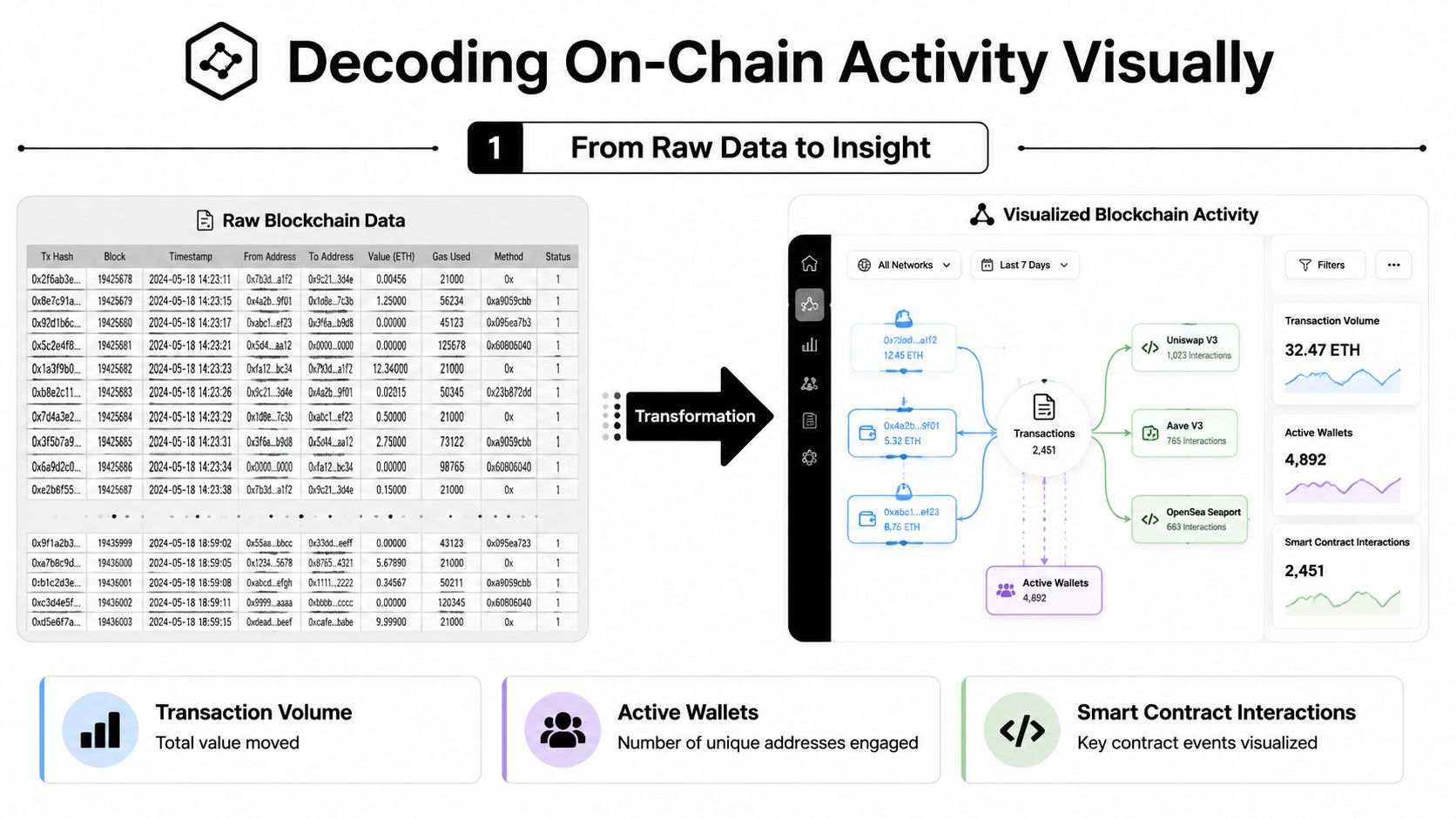
A diagram illustrating the transformation of raw blockchain transaction data into a visual analytics dashboard interface.

The core objects you need to read

For trading, four building blocks matter most:

On-chain objectWhat it isWhy traders care
TransactionsIndividual actions recorded on-chainShow entries, exits, transfers, and swaps
AddressesWallets or entities interacting on-chainReveal repeat actors, clusters, and copy-trade targets
Smart contractsPrograms handling swaps, staking, bridges, LP activityExplain what the wallet was actually trying to do
Blocks and timestampsThe sequence and timing of activityHelp you judge urgency, coordination, and reaction speed

When you visualize these together, a wallet stops looking like a list of hashes. It starts looking like a strategy.

That's why the research base in this field matters. A systematic review found that transaction flow and social network visualizations each accounted for 27% of published research, while blockchain structure visualizations made up 23% of the reviewed work, according to the IEEE systematic review on blockchain visualization. For traders, that lines up with what matters in practice. Movement and relationships tell you more than static summaries.

What visuals reveal that tables hide

A table can tell you that Wallet A sent funds to Wallet B. A visual can show that Wallet A funded four other wallets, that all five hit the same token, and that two of them exited through the same path later.

That's a different level of understanding.

Here's what strong blockchain data visualization usually exposes:

  • Flow: where money moved before and after a trade
  • Clustering: which wallets behave like a coordinated group
  • Timing: whether buys were staggered, reactive, or synchronized
  • Context: whether a transaction was a standalone action or part of a larger sequence

If you want one format that bridges charts and intuition, this explanation of blockchain transaction heatmaps is useful because it shows how dense activity becomes readable once location and intensity are visualized instead of listed.

The point of visualization isn't to simplify reality into a pretty dashboard. It's to preserve the important complexity and remove the useless complexity.

That's the difference between data you inspect and data you can trade on.

Metrics That Matter for Profitable Trading

Most traders start with price and volume because those are visible everywhere. On-chain traders need a narrower set of metrics. The right metrics tell you who is acting, how aggressively they're acting, and whether the move has structural support behind it.

The list below is the dashboard I'd build around first.

An infographic listing six essential decentralized finance KPIs for successful cryptocurrency trading and market analysis.

The trading metrics worth watching

MetricWhat to look forWhat it can signal
Wallet PnL and win profileRealized and unrealized outcomes across prior tradesWhether a wallet is worth copying or just had one lucky hit
Exchange inflows and outflowsAssets moving toward or away from centralized exchangesPotential sell pressure, inventory rotation, or fresh deployable capital
Smart money netflowNet buying versus net selling from wallets you already trustWhether strong operators are accumulating or distributing
Holder distributionHow concentrated the token is across top wallets and clustersFragility, crowding risk, or cleaner ownership structure
Gas fees and congestionRising execution cost around a token or chainPanic, launch frenzy, liquidation pressure, or high competition
Liquidity depthChanges in available DEX liquidityWhether a move can absorb size or will slip violently

How to interpret them like a trader

Wallet PnL and win profile matters because copy trading is selection first. If you don't rank wallets by consistency, not just one visible score, you'll end up following noise. A wallet that survives different market conditions is usually more informative than one wallet attached to one viral trade.

Exchange flows are useful because they tell you where inventory may go next. Large movements toward exchanges deserve caution. Persistent withdrawals can mean capital is being positioned for on-chain deployment, especially if they're followed by DEX activity.

Smart money netflow is one of the cleanest visual overlays you can use. If profitable wallets are adding while price is still early, that's different from a breakout fueled mostly by retail chase.

What usually works better than price-only analysis

Many traders overreact to visible candles and underreact to wallet behavior. That's backward.

A useful order of operations is:

  1. Find the wallets first
  2. Check whether they're buying, holding, or exiting
  3. Inspect where funds came from
  4. Review token holder structure
  5. Then bring in price and momentum context

Trading note: A token can look strong on price while the best wallets are already distributing into the move. If your visuals don't show wallet behavior beside price, you're trading half-blind.

The practical edge comes from combining these metrics, not reading them in isolation. Rising volume without strong-wallet participation is often less interesting than steady volume with selective accumulation. Deep liquidity with no real demand can still go nowhere. High wallet PnL means little if the wallet's recent behavior shows late entries and fast exits.

What matters is convergence. When multiple on-chain metrics point in the same direction, your visual stack starts producing something useful: conviction with context.

The Analyst's Visual Toolkit

Different visual formats answer different trading questions. Most mistakes happen when traders use one chart type for everything. A wallet timeline, a flow map, and a network graph are not interchangeable.

Use the right visual for the question in front of you.

A digital artist analyzing blockchain network metrics and market trends using a futuristic holographic interface in space.

Price overlays for timing decisions

Use this to see whether on-chain behavior leads price or follows it.

The simplest high-value format is a price chart with wallet events overlaid on top. Mark buys, sells, exchange withdrawals, bridge inflows, or contract interactions directly against price action. This helps answer whether a wallet was early, reactive, or late.

This format works well when you're studying:

  • Entry quality of a target wallet
  • Distribution behavior into strength
  • Whether repeated buys supported a trend
  • How fast a wallet cuts a failed trade

What doesn't work is stuffing too many event types into one chart. If everything is highlighted, nothing is. Keep overlays limited to actions that change your trade decision.

Sankey and flow diagrams for money movement

Use this to see where funds came from and where they went next.

According to the TRM Labs overview of blockchain analytics, the strongest on-chain visualizations are built on a graph-based transaction model, and network graphs plus Sankey diagrams are especially effective for tracing flows and wallet clusters. That matches what traders learn quickly in practice. A clean flow diagram can reveal a whole funding path in seconds.

Sankey diagrams are especially good for:

Trading questionWhy Sankey helps
Did this wallet fund from a CEX?You can trace capital from source to destination visually
Was the token buy part of a broader rotation?The flow width helps show relative capital movement
Did profits exit back to one hub?Return paths become obvious when mapped as streams

Row-based exports break down. You can read transfers one by one, but you won't feel the shape of the move.

Network graphs for wallet clusters

Use this to see who is connected to whom.

For smart money hunting, this is the closest thing to x-ray vision. Network graphs help you identify related wallets, repeated counterparties, common funding sources, and coordinated behavior around launches or exits.

A strong network graph can help you spot:

  • Wallet families funded by the same address
  • Shared behavior across addresses trading the same token set
  • Bridges between ecosystems when capital rotates cross-chain
  • Potential obfuscation paths where money is deliberately hop-routed

The common mistake is reading every line as proof of meaningful coordination. Some connections are operational, not strategic. You still need to judge whether the relationship matters for the trade you're considering.

A short walkthrough helps here:

Wallet timelines for behavior reading

Use this to see how a wallet behaves over time.

This is the most underrated format for copy traders. A timeline shows cadence. Does the wallet ape in immediately or scale across several windows? Does it trim into every spike? Does it hold until liquidity fades? Those are style clues, not just trade logs.

Don't just ask whether a wallet wins. Ask how it wins. The timeline usually tells you whether the edge comes from speed, patience, concentration, or selective participation.

If I had to choose one toolkit order for most traders, it would be price overlays first, timelines second, Sankey diagrams third, network graphs fourth. That sequence moves from simplest execution insight to deeper investigative work.

Designing Your On-Chain Command Center

Most dashboards fail for one reason. They answer no specific question.

A cluttered screen full of wallet tables, token charts, gas widgets, and random leaderboards feels powerful, but it usually slows decisions. A useful command center starts with one task. Find profitable early buyers. Monitor exit risk on copied wallets. Track capital rotating into one ecosystem. Pick one.

Build around a single trading objective

Start with the question, then choose the visuals.

If your goal is to find new tokens that profitable wallets are buying, your command center should prioritize wallet discovery, recent buy activity, trade timing, and alerting. It should not give equal weight to unrelated metrics just because they're available.

Screenshot from https://www.walletfinder.ai

A practical layout often works like this:

  • Top row for immediate signals such as tracked wallet buys, sells, or sudden token concentration shifts
  • Center panel for the main visual, usually wallet activity or token flow
  • Side panel for filters like chain, PnL profile, token age, or recent activity
  • Alert area for events that require action, not just awareness

Prioritize hierarchy over completeness

The industry moved from basic explorers toward more flexible analytics tooling. An arXiv review notes that Dune Analytics and Flipside Crypto provide SQL-based querying and visualization, while Arkham Intelligence, Footprint Analytics, Dapplooker, and Wallet Finder.ai provide no-code visualization, making real-time dashboard building more accessible to non-developers, as described in the arXiv review of blockchain data analytics tools.

That shift is useful only if you control the hierarchy.

Here's what to emphasize visually:

Design choiceGood useBad use
ColorFlag buy vs sell, risk vs opportunityColoring everything brightly
SizeShow relative trade importanceLet large but irrelevant widgets dominate
OrderingPut urgent signals firstSorting by vanity metrics
FiltersRemove noise before it hits the screenAdding every possible filter by default

If you're building a dashboard for live decision-making, this piece on real-time visualization for DeFi traders is worth reviewing because alert design matters as much as chart design.

A dashboard should reduce decisions, not create more of them.

That's why alerts matter. Real-time alerts turn a visual system into an execution system. Without them, you're still polling the market manually. With them, your command center can surface only the moments when a tracked wallet, token, or cluster takes an action worth your attention.

Common Visualization Traps to Avoid

Better visuals don't automatically produce better trades. They can just make bad assumptions look more convincing.

The hard part of blockchain data visualization isn't building the chart. It's avoiding false confidence when the chart appears to tell a clean story.

The traps that cost traders money

The biggest mistake is overfitting. A wallet bought three winners, so you assume the next buy matters just as much. A network cluster appears around a token, so you label it coordinated smart money. Sometimes the pattern is real. Sometimes you're forcing coherence onto noise.

A close second is confirmation bias. Traders often decide they like a token, then use visuals to justify the trade. They highlight supportive wallets, ignore distribution, and explain away exit signals. A dashboard can become a machine for self-deception if you only use it to validate positions you already want.

Watch for these failure modes:

  • Noise worship: treating every spike in activity as meaningful
  • Single-wallet obsession: copying one visible wallet without checking broader context
  • Chain blindness: missing what happened before the funds arrived on your current chain
  • Analysis paralysis: opening more views instead of narrowing the decision

Multi-chain reality changes the job

A key challenge in blockchain analytics is handling real-time, multi-chain activity. Many guides stop at chart creation and don't address scalability, filtering noise, and making data usable quickly enough for copy trading, as discussed in this analysis of real-time blockchain visualization challenges.

That gap is real in trading.

If a wallet bridges from one ecosystem, splits funds, then buys on another, a single-chain view gives you a partial story. If your dashboard can't help you filter and prioritize, more data won't help. It will just delay your reaction.

Good analysts don't ask, “What does the chart show?” They ask, “What decision does this chart justify, and what evidence would disprove it?”

That question protects you from the cleanest-looking mistakes.

Your Blockchain Visualization Questions Answered

Do I need to code to use blockchain data visualization

No. You can still go deep with SQL tools, but you don't need programming skills to start reading wallets, flows, timelines, and dashboards. No-code tools are now good enough for most copy trading and smart money monitoring workflows.

Why isn't a block explorer enough

A block explorer is for lookup. Visualization is for interpretation.

Explorers help you confirm one transaction, contract call, or wallet transfer. They don't aggregate behavior well. They also don't make clusters, sequences, or repeated patterns obvious. If you're trying to follow strategy rather than verify history, you need a visual layer.

What's the fastest way to find smart money wallets

Start with wallets that show consistent profitability, recent activity, and a trade history you can inspect. Then check whether their wins come from one-off luck or a repeatable style.

A practical process looks like this:

  1. Filter for profitable wallets with enough history to judge
  2. Study recent entries and exits, not just headline outcomes
  3. Map their funding paths and repeat counterparties
  4. Track them in real time instead of checking manually

Which visual should I learn first

Start with a wallet timeline or a price chart with on-chain overlays. Those two formats usually improve decision-making fastest because they connect action to timing. Network graphs and Sankey diagrams become more valuable once you're tracing relationships and flows in detail.

Can blockchain data visualization predict price

No. It won't predict the future with certainty.

What it does give you is a better probabilistic read on behavior. You can see where capital is coming from, which wallets are acting, how coordinated a move looks, and whether the strongest operators are entering or exiting. That won't remove risk, but it can improve timing and reduce blind spots.

What should I avoid when copying wallets

Don't copy a wallet just because it made money before. Check holding style, position sizing, entry speed, chain preference, and exit discipline. Some wallets are impossible to mirror well because they move too fast, size too aggressively, or trade illiquid names where late followers get poor execution.


If you want a practical way to apply this, Wallet Finder.ai helps traders discover profitable wallets, inspect full trading histories, filter for specific behavior, and track wallet activity with real-time alerts across major ecosystems. It's a straightforward way to turn blockchain data visualization into an actual copy-trading workflow.