AI Crypto Trading Signals: A Trader's Guide for 2026
Unlock the power of AI crypto trading signals. Learn to evaluate signal quality, avoid common pitfalls, and use on-chain data to make smarter DeFi trades.

June 3, 2026
Wallet Finder


You place a trade, confirm the wallet prompt, and everything looks normal. The price moves your way, the chart says you were right, and then the actual loss shows up somewhere else. A malicious contract drained approvals, a fake mobile app intercepted traffic, or the platform froze at the worst moment.
That's why trading skill and platform security can't be separated. In a market this large, weak security isn't a side issue. The global online trading platform market was valued at USD 10.82 billion in 2025 and is projected to reach USD 11.57 billion in 2026, according to Fortune Business Insights' online trading platform market report. When that much capital flows through online platforms, every weak login flow, every sloppy mobile implementation, and every bad contract interaction becomes expensive.
Crypto traders often focus on entries, exits, and copy-trading signals. The more painful lesson is that a good trade on an insecure stack is still a bad setup. If you want to understand how losses happen beyond price action, start with this breakdown of smart contract hacking risks in DeFi.
Crypto losses often look like trading losses at first. They aren't always. Sometimes the token was fine, but the platform wasn't. Sometimes the platform was fine, but the wallet approval gave a hostile contract broad access. Sometimes neither failed technically, but execution quality, custody, or settlement broke the outcome.
A common example is the “clean trade, messy aftermath” pattern. You swap into a token on a fast-moving market. The transaction confirms. Hours later, you discover an approval is still live, a bridge contract you used has a weakness, or a fake interface copied the authentic app closely enough to trick you once.
That confusion happens because traders often define security too narrowly. They ask, “Can I log in safely?” when they should ask three separate questions:
Security failures in trading rarely announce themselves. They hide inside normal-looking actions.
A secure trading platform protects more than your password. It reduces the chance of intercepted data, account takeover, unauthorized order activity, and poor handling of sensitive financial information. In crypto, it also shapes how safely you interact with smart contracts, wallets, and settlement systems.
Traders get confused because “secure” sounds like a badge. It isn't. It's a moving target. A platform can have a polished interface and still expose users through weak mobile app validation, unclear custody practices, or poor operational controls.
The practical takeaway is simple. Don't treat security like a one-time box to check before depositing funds. Treat it like part of your trading process, the same way you treat position sizing, slippage, and liquidity.
A secure trading platform isn't just an app with a login screen and a lock icon. It's a system with multiple layers working together. If one layer fails, another should limit the damage.
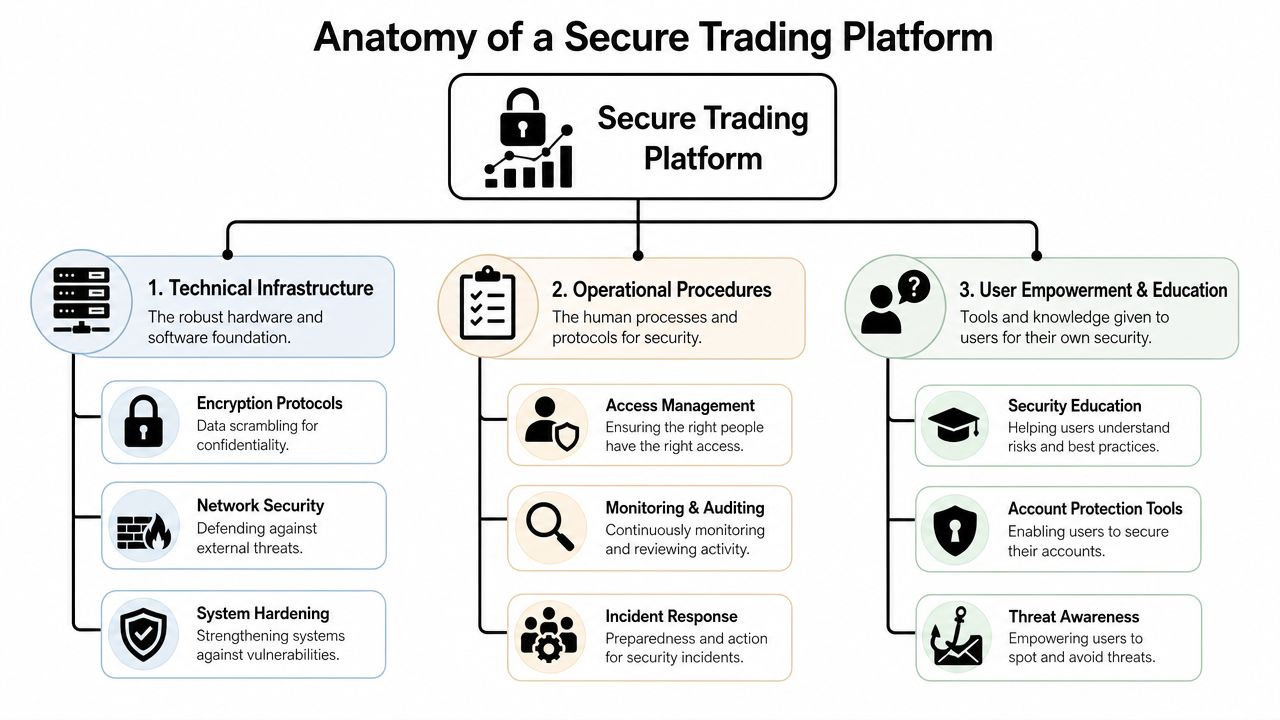
The easiest mental model is a fortress.
| Pillar | What it means in plain language | What you should expect |
|---|---|---|
| Technical infrastructure | The walls, locks, and foundation | Encryption, authentication, session controls |
| Operational procedures | The guards and patrol routines | Monitoring, review processes, incident response |
| User empowerment and education | The map and training given to the traveler | Clear warnings, permission visibility, safer defaults |
This framing matters because traders often overweight the first pillar and ignore the other two. Strong encryption helps, but it won't save you from signing a malicious approval you didn't understand. Good login security helps, but it won't fix poor liquidity or unclear custody.
At minimum, the platform should use layered authentication and strong transport protection. That includes multi-factor authentication, end-to-end SSL/TLS for data in transit, and 256-bit AES for sensitive data at rest, as described in TradeFundrr's overview of trading platform security controls.
In plain language, that means:
A lot of traders assume security is purely technical. It isn't. Human processes are part of the defense. Teams need to detect unusual logins, suspicious order activity, and account changes that don't fit a user's normal behavior.
Assessing many platforms proves challenging. They may advertise security features, but they're vague about how they monitor misuse, review incidents, or limit damage after a compromise.
Practical rule: If a platform explains only the technology and says nothing about monitoring, access controls, or audits, your picture is incomplete.
In DeFi, security extends beyond the platform itself. You're also exposed to smart contracts, token permissions, oracle assumptions, bridge design, and mempool behavior. That means a secure trading setup includes safer interaction design, not just safer account access.
A useful way to think about it is this. The platform can secure the front door, but the road outside still matters. In crypto, traders spend a lot of time on that road.
The phrase “platform security” gets thrown around loosely. It helps to break it into parts you can inspect.

A password alone is weak because attackers don't need to hack your brain. They just need to steal a credential, trick you into entering it, or hijack a session.
A historical snapshot shows why layered protection became necessary. An IOActive review of trading applications found that over 75% of reviewed web-based platforms supported 2FA, while 32% of mobile apps did not properly verify SSL certificates, exposing users to man-in-the-middle attacks, according to IOActive's assessment of trading technology security. That's a useful reminder that a polished app can still fail at basic transport security.
If you're trying to understand modern login stacks and identity controls, this breakdown of AWS Cognito authentication in practice helps show how secure session and identity systems are commonly handled.
In centralized environments, the platform may hold assets on your behalf. In DeFi, you usually keep control through your wallet. Neither model is automatically safer. They shift the risk.
With custodial platforms, you depend on the operator's controls, segregation practices, and withdrawal processes. With self-custody, you remove one large counterparty risk but take on private key management, wallet hygiene, and contract interaction risk.
That's why “not your keys, not your coins” is useful but incomplete. Self-custody lowers one category of risk while increasing the importance of your own operational discipline.
Smart contracts are automated rule sets. If the rules are flawed, the platform can behave exactly as coded and still harm you.
Think of a contract like a vending machine. If the internal wiring is wrong, pushing the correct button doesn't guarantee the correct outcome. The machine may dispense the wrong item, lock your funds, or let someone else trigger a hidden path.
Warning signs include:
A safe-looking interface doesn't make an unsafe contract safe.
MEV confuses many newer traders because it doesn't always look like theft. Often it looks like worse execution.
A simple analogy works. You're standing in a grocery line with your cart ready. Someone sees what you're buying, pays extra to cut ahead of you, and changes what's left on the shelf before your turn. On-chain, a similar thing can happen when others observe pending transactions and reorder around them.
That can lead to worse fills, sandwich attacks, or failed swaps in volatile conditions. It's part security, part market structure. If a platform ignores transaction routing, slippage controls, or execution quality, users still bear the cost.
A short explainer can help if you want the mechanics in visual form:
Good defenses aren't just preventive. They also detect unusual behavior early. That can include suspicious logins, abnormal order placement, unfamiliar devices, or wallet interactions that don't fit your normal pattern.
The key idea is simple. Security isn't only about keeping attackers out. It's also about spotting trouble quickly enough to limit what they can do.
Most traders evaluate a platform by interface quality, fees, and token coverage. Security requires a harder set of questions. Some are technical. Some are legal. Some are operational.
The SEC advises investors to verify a platform's regulatory status, and notes that platforms trading digital asset securities may need to register as a national securities exchange, ATS, or broker-dealer. That's why compliance belongs in any serious review of a platform's security profile, as outlined in the SEC statement on online platforms trading digital assets.
| Category | What to Check | Why It Matters |
|---|---|---|
| Account protection | MFA options, device management, session handling, login alerts | Reduces account takeover risk |
| Data security | Clear use of SSL/TLS for traffic and strong encryption for stored data | Protects sensitive information in transit and at rest |
| Custody model | Whether the platform is custodial, non-custodial, or hybrid | Tells you who controls assets and where responsibility sits |
| Smart contract exposure | Whether you interact with audited contracts, visible permissions, and understandable signing prompts | Limits hidden on-chain risk |
| Operational controls | Monitoring, withdrawal review, suspicious activity response, incident transparency | Shows whether the team can contain damage |
| Regulatory status | Registration, jurisdiction, legal disclosures, user protection language | Helps distinguish supervised operations from unclear ones |
| Execution quality | Slippage controls, routing quality, market depth, order reliability | Protects against hidden trading losses |
| Settlement and liquidity | How trades settle, whether liquidity appears stable, whether large trades can execute smoothly | Reduces operational and counterparty risk |
| Public documentation | Security documentation, risk disclosures, clear explanations of limitations | Serious teams explain trade-offs plainly |
| User controls | Approval management, transaction review, whitelists, alerting options | Gives you tools to reduce your own exposure |
Use this short list as a first pass:
Checkpoint: A secure trading platform isn't the one with the most badges. It's the one whose risks you can actually map.
A lot of public reviews stop at “supports 2FA” or “uses encryption.” That's necessary, but shallow. Traders also need to know whether the venue is supervised, how it handles liquidity stress, and what kind of execution or settlement problems can still hurt them even if no hacker is involved.
The goal isn't to find a perfect platform. It's to avoid unknown risk.
Even the best platform can't protect you from every bad signature, reused password, or fake support message. Personal security is the layer you control directly.
If you keep meaningful funds in crypto, separate your trading activity from long-term storage. Many experienced traders use one wallet for active execution and another for assets they don't need to touch often. That way, one rushed interaction doesn't expose everything.
A few habits matter more than most:
Many losses happen because users approve what they don't understand. The interface may say “connect” while the wallet prompt asks for a signature with broader consequences.
Before approving anything, pause and ask:
If you can't answer those questions, don't sign yet.
Phishing in crypto rarely looks amateurish anymore. Fake support accounts, cloned sites, and direct messages built around urgency are common because they work.
A few simple rules help:
If someone can make you panic, they can often make you sign.
A platform can be technically sound and still expose you through poor liquidity, unreliable settlement, or weak trade handling. Institutional market participants evaluate these factors because a secure environment also needs stable execution and dependable settlement, as discussed in BlockFills' perspective on security, reliability, and platform must-haves.
For everyday traders, that means personal security includes trade discipline:
One of the most overlooked parts of a secure trading routine is monitoring what already happened. Traders focus heavily on entry, but good security often starts with visibility after the fact.

Wallet tracking tools are often framed as alpha tools. They're also useful for security hygiene. If you can monitor your own wallet activity closely, unusual transfers, token approvals, or unexpected swaps become easier to spot.
That matters because crypto incidents aren't always dramatic. Sometimes the first sign of a problem is a small transaction you didn't expect, a test movement, or an approval to a spender you don't recognize.
For traders who want to build that habit, a crypto wallet tracker guide is a practical place to start.
This matters for copy traders in particular. If you mirror another wallet without understanding its behavior, you may inherit its risk profile. A wallet can look profitable while relying on aggressive position sizing, low-liquidity entries, or risky contract interactions that don't fit your setup.
Useful review points include:
A good monitoring workflow should not require surrendering private keys. Observation is useful. Key exposure is dangerous.
That distinction matters. Security-first tooling lets you watch wallets, receive alerts, and study on-chain behavior without giving a third party signing power over your assets. For active traders, that's the right balance between insight and control.
| Question | Answer |
|---|---|
| Is a CEX safer than a DEX? | They expose you to different risks. A CEX concentrates custody and operational risk with the platform. A DEX reduces custody dependence but increases the importance of wallet hygiene, contract review, and transaction awareness. |
| Does 2FA make a platform secure? | No. It helps, but it only covers one part of the problem. You still need strong transport security, operational controls, and safe contract interaction design. |
| Are insurance funds a full safety net? | Usually not. They may cover certain platform-specific losses or liquidation events, but they often have limits and exclusions. Read the actual terms instead of assuming broad protection. |
| Can a platform be 100% secure? | No. Security is risk reduction, not perfection. Good platforms lower the chance and impact of failure, but they can't remove every technical, operational, or market-structure risk. |
| What should I check first on a new platform? | Start with custody, authentication, contract transparency, and whether the team clearly explains how it handles user protection, execution, and incident response. |
A secure trading platform isn't just one with strong locks. It's one you continuously evaluate, use carefully, and monitor while you trade.
If you want a practical way to add ongoing visibility to your trading workflow, Wallet Finder.ai helps you track wallet activity, study on-chain behavior, and monitor trades without giving up control of your private keys. For DeFi traders, that kind of visibility can turn security from a one-time check into a daily habit.