Smart Contract Hacking: Avoid DeFi Exploits in 2026

Wallet Finder

Blank calendar icon with grid of squares representing days.

June 1, 2026

More than $2.17 billion had already been stolen from cryptocurrency services by mid-July 2025, surpassing all of 2024 according to DeepStrike's summary of Chainalysis reporting. If you trade DeFi, that isn't background noise. That's direct counterparty risk sitting inside your wallet.

Most writing about smart contract hacking talks to developers. Traders need a different lens. You usually aren't reading Solidity line by line before every swap, LP deposit, or vault allocation. You're trying to answer faster questions. Is this protocol structurally risky? Is something abnormal happening on-chain right now? Should I reduce exposure before the crowd notices?

That's the practical gap that matters. A contract can look clean in a marketing thread and still expose you to admin abuse, oracle manipulation, reentrancy, or a live exploit chain that only becomes obvious in transaction flow. Security in DeFi isn't just about whether code was audited before launch. It's also about whether users can detect bad behavior after launch, when real capital is at risk.

Practical rule: Treat every new protocol like an open vault in a public square. Everyone can inspect it, everyone can interact with it, and attackers only need one working path.

The Billion-Dollar Threat in Your Wallet

Smart contract risk shows up first in behavior, not headlines. Traders who wait for a post-mortem or team announcement are usually late.

The useful question is simpler: what can you see on-chain before a protocol freezes, pauses, or starts bleeding funds?

What traders need to watch

A trader cannot audit every contract before every position. You can monitor a small set of signals that tend to show up before losses become obvious to the wider market.

Focus on patterns like these:

  • Privilege concentration: A single wallet, or a tight cluster of wallets, controls upgrade keys, pause rights, mint functions, or treasury access.
  • Liquidity dependence: The token relies on one main pool, one bridge route, or one venue for price discovery. That makes exits harder during stress.
  • Strange transaction sequences: A new or previously inactive address begins sending complex, repeated calls across several contracts in quick succession.
  • Treasury movement during volatility: Protocol-controlled wallets move funds, shift collateral, or pull liquidity without a clear public explanation.
  • Silent parameter changes: Fee settings, collateral factors, oracle sources, or reward emissions change on-chain before the team explains why.

One abnormal transaction does not prove an exploit. A cluster of abnormal signals deserves attention.

Secure code and safe capital are different things

Audits help. They do not protect a trader from weak operations, rushed upgrades, compromised keys, or bad monitoring.

Many incidents look messy before they look catastrophic. You see failed transactions, odd admin activity, sudden contract interactions from fresh wallets, then a pause, then liquidity leaving. By the time the protocol account posts a warning, faster wallets have already reduced exposure.

That is why smart contract hacking matters as a live monitoring problem for market participants. The edge is not perfect certainty. The edge is seeing enough early stress signals to step aside before everyone else does.

Why Smart Contracts Are Prime Targets

A smart contract is like a glass cash vault with a robot cashier bolted to the front. Everyone can see how it works. Everyone can test the edges. If the machine has a flaw, it will keep following its flawed rules until funds are gone or someone with the right permissions intervenes.
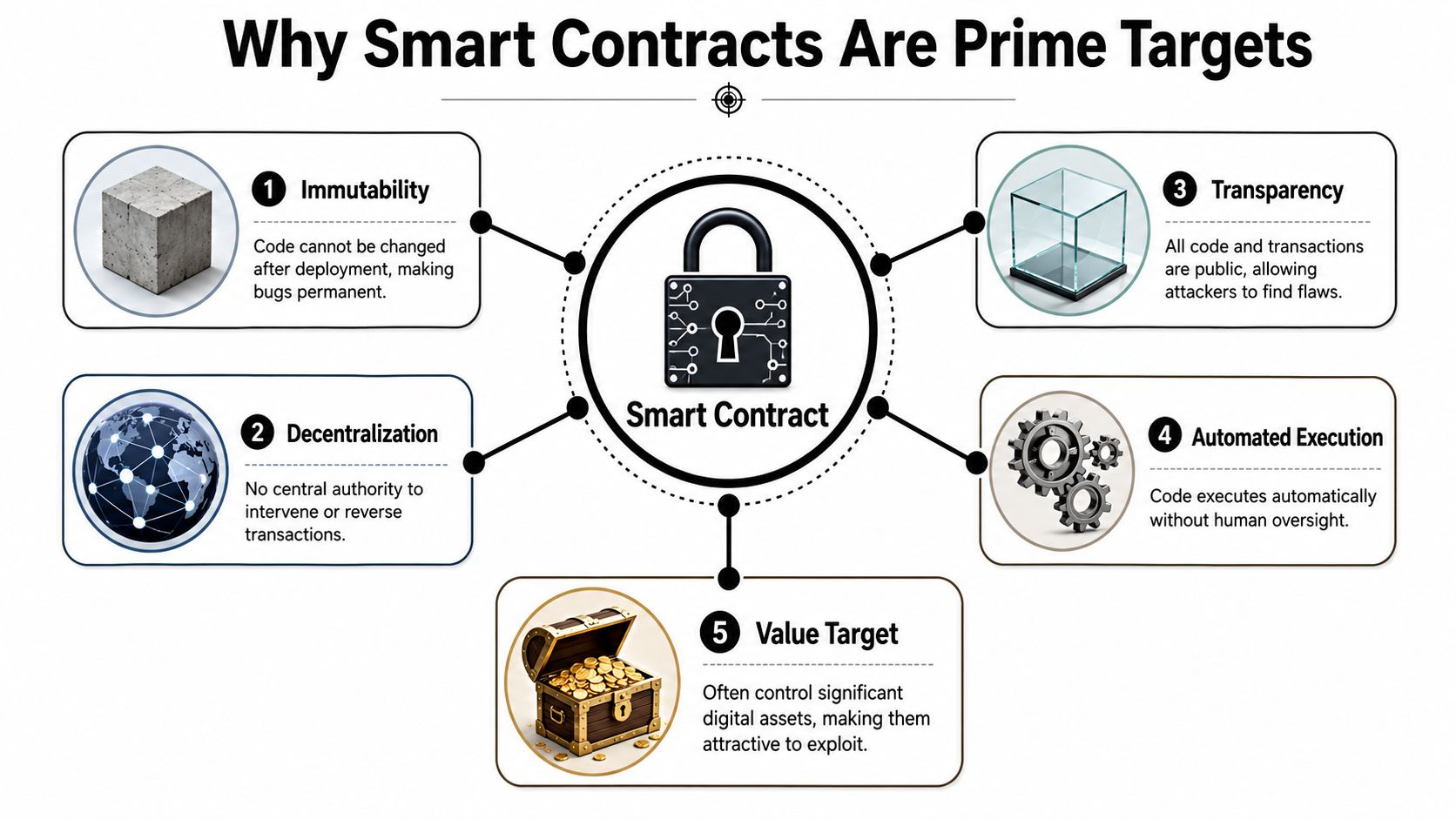
An infographic titled Why Smart Contracts Are Prime Targets explaining five security risks for blockchain technology.

A large-scale study cited by Capital Tech reported that roughly 1 in 20 smart contracts were at risk of hacking, and Ethereum reportedly had over 32,000 vulnerable contracts due to poor coding practices, as summarized by Capital Tech's review of smart contract hacking. That matters because vulnerabilities don't stay isolated. In DeFi, copied code, immutable deployments, and public execution turn one design mistake into a broad attack surface.

The features that create the risk

Immutability helps users trust that rules won't change casually. It also means bad rules can stay live. If a contract ships with a flaw and lacks a safe upgrade path, users may be stuck choosing between known risk and immediate exit.

Transparency is excellent for verification. It's also excellent for attackers. Public code and public transactions let them test assumptions, map privileged addresses, and rehearse exploit paths without asking permission.

Composability creates DeFi's best products and some of its sharpest edges. One protocol borrows liquidity from another, relies on pricing from another, routes collateral through another, and exposes itself to the weakest dependency in the chain.

Why money pools attract specialized attackers

Attackers don't need to attack every contract. They target contracts that combine three properties:

  • Large balances under automation
  • Clear external call surfaces
  • Economic logic that can be manipulated

That's why vaults, bridges, lending markets, AMMs, wrappers, and upgradeable systems draw so much attention. They hold value, expose repeatable logic, and often depend on assumptions that break under stress.

Public code doesn't make a protocol safe. It makes the attack surface visible to both defenders and adversaries.

What this means for a trader

You don't have to reject all smart contracts. You do have to stop treating them like ordinary apps.

Before you deposit capital, ask simple questions. Can the rules change? Who can change them? What external data does the protocol trust? What happens if one component in the stack behaves unexpectedly? Those questions catch more real risk than a homepage badge that says “audited.”

The Hacker's Playbook of Common Attacks

Attackers exploit contract logic, pricing assumptions, permissions, and transaction ordering. For traders and on-chain analysts, the edge comes from recognizing how those attacks look before the team posts an incident update.

The attack classes stay fairly consistent. The useful question is what each one leaves behind on-chain.

Attack VectorHow It WorksWhat Traders Can Watch For
ReentrancyA contract calls out before updating its own accounting, which lets an attacker enter the same flow again and pull funds multiple timesRepeated calls through the same function path, fast balance drops from one vault, and internal traces that repeat in a pattern a normal withdrawal should not produce
Flash loan attackBorrowed capital is used inside one transaction to distort state, trigger bad accounting, and get repaid before the block closesOne transaction interacts with several protocols, creates sharp temporary balance changes, and leaves the attacker flat on the loan by the end
Oracle manipulationA protocol trusts a price source that can be pushed out of line long enough to exploit minting, borrowing, or liquidation logicSudden price gaps on a thin venue, protocol actions based on that gap, and little confirmation from deeper markets
Access control bugSensitive functions are callable by the wrong address, or admin authority is weaker than users assumedPrivileged function calls from an unexpected wallet, ownership transfers, or a single EOA controlling too many critical permissions
Integer or accounting flawMath or share accounting breaks and lets users mint, withdraw, or redeem more than intendedSupply jumps, impossible exchange rates, withdrawals that exceed deposits, or accounting outputs that do not reconcile across related contracts
Front-running and MEV abuseAttackers use transaction ordering to insert transactions around user flow and capture valueSandwich patterns around larger swaps, repeated failed user trades, and slippage that looks too severe for the pool size
Proxy or upgradeability flawUpgrade mechanisms, delegatecall patterns, or implementation changes let an attacker alter logic or take controlNew implementation addresses, rushed upgrades, unexplained admin transactions, or logic changing without clear notice

Reentrancy still matters because it is easy to miss in real time

Reentrancy is an old bug class, but it still shows up because many traders only watch top-level transfers. The actual signal is usually inside the call trace.

A normal withdrawal should follow a clean sequence. State updates. Assets move. The interaction ends. In a reentrancy event, the same path can repeat before balances are settled. That creates a drain pattern that looks mechanical. If a vault starts sending assets out in rapid loops tied to one caller or one transaction tree, assume the reported TVL and the withdrawable balance may already be diverging.

Flash loans and oracle attacks usually announce themselves inside one block

A flash loan is just financing. The problem starts when that borrowed capital hits a shallow pool or a weak pricing dependency.

The footprint is often obvious once you know what to scan for:

  • One transaction borrows, swaps, posts collateral, redeems, and repays.
  • A smaller pool moves sharply while larger reference venues barely react.
  • A lending market or minting contract accepts the distorted price long enough to issue value on bad terms.

This matters well before a confirmed exploit. If a token relies on thin liquidity for price discovery, traders are exposed to the same weakness attackers are studying.

Access control and upgrade risk deserve more attention from market participants

Some failures have no exotic exploit path. A compromised admin key can push a malicious implementation. A poorly protected role can pause redemptions, change fee routes, or mint against users. By the time the public notices, the privileged transaction is already final.

That is why I treat admin activity as a trading signal, not just a governance detail. Watch ownership transfers, role grants, proxy upgrades, timelock bypasses, and emergency function calls. If a protocol can change core behavior immediately, smart contract risk and operator risk are the same problem.

When screening newer tokens or obscure launches, basic contract behavior checks still help. A practical honeypot scanner guide for checking sell restrictions and trap-like token logic can filter out obvious cases before you spend time on deeper analysis.

Fast exploit detection starts with boring habits. Monitor privileged transactions, implementation changes, abnormal pool movements, and multi-step transactions that do too much at once.

Lessons Learned from Major DeFi Exploits

A single exploit can erase more market confidence in a day than months of audits and marketing can build. For traders, that changes the job. The goal is not just knowing what failed after the post-mortem. It is spotting the signals early enough to cut exposure, avoid bad entries, or reassess correlated positions.

A timeline graphic outlining three major historical DeFi exploits and the security lessons learned from each.

The biggest incidents tend to teach the same market lesson. Losses cluster around a small number of high-value targets where one mistake, one bad assumption, or one compromised control point can cascade fast. By the time the team posts a statement, the useful information is often already on-chain in the form of unusual contract calls, fund movements, and rushed routing behavior.

What the major cases actually teach

The technical exploit path matters, but the practical lesson for analysts is usually broader than the bug class itself. Large DeFi failures often share the same operating conditions:

  • Too much value in one place: the payout is large enough to justify custom tooling and patient preparation.
  • A narrow trust assumption: one price feed, one privileged role, one upgrade path, or one accounting edge case carries outsized risk.
  • Execution speed: once the path opens, the attacker chains calls quickly and moves assets before humans react.
  • Exit planning: funds rarely sit still. They are swapped, bridged, split across wallets, or pushed through venues with enough liquidity to absorb size.

Those patterns matter because they are observable. A trader does not need to reverse-engineer every opcode in real time to recognize that a protocol is entering a dangerous state.

Old exploit categories still show up in new forms

The DAO remains useful because it taught the core lesson behind reentrancy. If a contract lets value leave before state is updated correctly, the accounting can be abused repeatedly inside one transaction. Traders are not auditing for that line by line, but they should remember what follows when this class of bug hits. Drains happen fast, governance turns chaotic, and tokens tied to the protocol often reprice before there is any clean public explanation.

Oracle and flash loan incidents taught a different lesson. A protocol can look orderly under normal conditions and still fail under adversarial pricing. That usually appears on-chain as a sharp, localized price move, a burst of borrowing, and then minting, borrowing, or liquidation activity that only makes sense if one input was temporarily wrong. If I see that sequence in a thin market, I assume the protocol is being tested at minimum.

The analyst's takeaway from exploit history

Case studies are useful because they sharpen pattern recognition. The question is simple. What could market participants have seen before the headlines caught up?

In many incidents, the answer is operational rather than theoretical:

  • A wallet with no history suddenly interacts with core contracts using complex calldata
  • A protocol contract receives a burst of calls outside its normal user pattern
  • Assets leave treasury, vault, or pool addresses along routes that ordinary users do not use
  • On-chain behavior changes before the team changes its messaging, pauses functions, or acknowledges an issue

That is a key lesson from major DeFi exploits. Smart contract risk is not just a developer problem. For traders and on-chain analysts, it is a monitoring problem. The edge comes from tracking where value can break, then watching for the transaction patterns that usually appear right before the market fully understands what is happening.

How to Spot Red Flags On-Chain

Most public coverage stays stuck at pre-launch auditing. The live edge is post-deployment monitoring. That's where traders can still protect capital after a protocol is already in use. As noted in AdGuard's discussion of smart contract vulnerabilities and monitoring gaps, real losses often depend on spotting transaction patterns and anomalies before an exploit fully propagates.

A detective examines blockchain transaction data on a glowing digital screen to investigate suspicious crypto activities.

Start with behavior, not branding

A polished front end tells you almost nothing. Start on the block explorer. Check the contract tab, recent transactions, internal transactions, holders, privileged roles, proxy relationships, and event logs. If the protocol is too complex to inspect manually, use explorer labels, DEX analytics, wallet tracking tools, and alerting systems to reduce the noise.

The key is to watch patterns across addresses and time, not isolated transactions.

Red flags that deserve immediate scrutiny

  • Fresh wallet, complex execution: A newly funded address starts calling contracts through routers, proxies, or helper contracts in ways typical users don't.
  • Privilege in a plain wallet: Admin or upgrade authority sits with a single externally owned account instead of a multisig or governance process.
  • Unexplained implementation changes: A proxy points to a new implementation without clear public notice or review.
  • Treasury movement before public messaging: Funds leave treasury, insurance, or reserve wallets while the team is still silent.
  • Approval spikes: Users or operational wallets issue broad token approvals to contracts that don't fit normal workflow.
  • Pool-specific price dislocation: One venue shows a dramatic move while broader markets stay relatively calm.
  • Repeated failed interactions: Many users start hitting reverted transactions around the same function, often a clue that something changed or a condition is being abused.

Watch the wallets that matter, not just the token chart. Exploits often announce themselves in wallet behavior before price catches up.

A practical workflow for traders

Use Etherscan or the relevant chain explorer first. Confirm the contract address, inspect recent calls, and identify whether you're dealing with a proxy. Then look at DEX activity on tools that show pool-level flow, not only aggregate price candles.

If you track smart money or protocol-linked addresses, set alerts for admin wallets, treasury wallets, deployers, and top LPs. Wallet Finder.ai can help with wallet tracking and alerting around on-chain activity, while explorers and charting tools help validate whether those wallet actions align with normal protocol behavior.

A quick visual walkthrough helps if you're building your own monitoring habits:

What usually doesn't work

Relying on announcements is too slow. Waiting for influencers to flag an issue is worse. Looking only at audits also misses operational failure modes. Audits tell you what someone reviewed at a point in time. They don't tell you whether the current implementation is unchanged, whether permissions are sane, or whether a live exploit path has just opened.

For active traders, the useful habit is simple. Before entering size, inspect. After entering, keep monitoring. If something feels structurally off, reduce first and ask deeper questions after.

Evaluating a Project's Security Posture

Good projects leave evidence. Weak projects leave slogans. If you're deciding where to park capital, you want externally verifiable signs that the team takes security seriously in practice, not only in launch week marketing.

A security checklist for evaluating decentralized finance projects featuring five critical criteria for assessing blockchain safety.

What a stronger security posture looks like

The first thing I want to see is whether the team makes reviewable material easy to find. Public repos, readable docs, disclosed contract addresses, and clear architecture notes lower information asymmetry. Opaque systems can still be legitimate, but they force you to trust more and verify less.

Then I look at control surfaces.

  • Admin design: Are sensitive functions governed by multisig control, timelocks, or transparent governance?
  • Upgrade discipline: Can implementations change suddenly, or do users have time to react?
  • Bug reporting path: Is there a visible bounty or responsible disclosure route?
  • Incident communication: Has the team shown it can explain technical issues clearly when pressure hits?

Audit reports are a starting point

An audit matters most when it's public, current enough to match deployed contracts, and specific about unresolved issues. A badge on a homepage isn't useful by itself. Read whether the findings involve access control, external calls, upgradeability, pricing assumptions, or trust in off-chain actors.

If you want a framework for interpreting what audit coverage does and doesn't tell you, this guide to security audit services is a helpful reference point.

A simple due diligence screen

Before putting real capital into a DeFi project, ask:

  1. Can I verify the deployed contracts?
  2. Can one address pause, upgrade, mint, or drain?
  3. Would users have warning before a major contract change?
  4. Does the team publish security material that matches what's on-chain?
  5. If something breaks, do they have a credible response path?

Projects don't need to be perfect. They do need to show that they've thought beyond launch. The safest-looking opportunities are often the ones where teams make security legible from the outside.

Your Action Plan for Safer DeFi Investing

Smart contract hacking isn't a niche developer issue. It's part of trading risk. The better view is to treat every protocol like a live system with code risk, operator risk, and market structure risk all interacting at once.

A workable process doesn't need to be complicated. It needs to be repeatable.

  • Verify the contract: Confirm the correct address, proxy setup, and privileged roles before you touch the protocol.
  • Check the control model: If one wallet can change everything quickly, size your exposure accordingly.
  • Read the environment: Look at pool liquidity, routing dependence, and whether pricing can be distorted in one venue.
  • Monitor after entry: Track admin wallets, treasury activity, and unusual transaction sequences while your capital is live.
  • React early: If contract behavior turns abnormal, reduce risk first. Waiting for perfect confirmation usually costs more.

Security in DeFi is shared, but losses are personal. Your wallet bears the result of your own diligence.

One more point matters outside the contract itself. A lot of users protect protocol risk carefully and then lose funds to the simplest failure mode of all: bad wallet hygiene. If you want to tighten that side of the stack, review these practical habits around private key security.


Wallet Finder.ai helps traders monitor on-chain wallet behavior, token activity, and trading flows across major ecosystems. If your edge comes from spotting risk and reacting early, Wallet Finder.ai gives you a way to track the wallets and movements that often matter before the broader market catches on.