Strip Chat Token Price: A Trader's 2026 Guide

Wallet Finder

Blank calendar icon with grid of squares representing days.

April 14, 2026

You’re probably here because you saw a chart, a contract address, or a reseller listing and typed strip chat token price into search, expecting one clean answer.

Instead, you found a mess.

Some references point to the platform’s own spendable currency. Others point to unrelated crypto tokens on Solana or Ethereum. Then there’s a separate token called Strip Finance (STRIP) that has its own market history and nothing to do with the platform currency. Traders lose money in this kind of confusion before they ever place a trade. They buy the wrong asset, trust the wrong ticker, or assume a tiny quote means cheap upside rather than broken liquidity.

This is the core task here. Separate the instruments first. Then decide whether you’re looking at a consumer token market, a reseller spread, or a micro-cap on-chain trade with rug-pull risk attached.

Your Guide to a High-Risk High-Reward Token

The typical path looks like this. A trader spots a niche token name with familiar branding, checks a chart, sees a microscopic market cap, and starts doing mental math on upside. In degen circles, that instinct is common enough that Wallet Finder’s explainer on https://www.walletfinder.ai/blog/what-is-a-degen reads like a field guide to the behavior.

The problem is that strip chat token price can refer to assets with completely different mechanics.

One version is a platform currency used inside a centralized product. Another is a Solana meme token. Another is an Ethereum micro-cap with effectively no trading activity. Another, Strip Finance (STRIP), is a utility token for an NFT pricing protocol with a long drawdown history and its own exchange listings.

Those are not small distinctions. They determine whether price is set by a platform, by gray-market resellers, or by a handful of wallets in a thin pool.

Practical rule: If you can’t say who issued the token, where it trades, and what the contract address is, you’re not ready to trade it.

That’s a common mistake. They start with the chart. They should start with identity.

For this niche, the useful workflow is simple:

  • Identify the asset first: Platform currency, Solana memecoin, Ethereum micro-cap, or unrelated utility token.
  • Check the market structure: Centralized pricing behaves differently from thin DEX liquidity.
  • Verify concentration risk: A token held by a tiny number of wallets trades very differently from one with broader distribution.
  • Track wallets before entries: On-chain flows tell you more than social chatter in these markets.
  • Treat all upside as conditional: In micro-caps, a quote on screen doesn’t guarantee executable liquidity.

That’s the lens that makes this market tradable at all. Without it, you’re not analyzing a token. You’re guessing at a label.

Untangling the Strip Chat Token Landscape

The cleanest way to think about this market is to split it into platform currency and speculative crypto tokens.

The platform currency exists for spending inside a closed ecosystem. The crypto tokens trade on-chain and behave like speculative assets. They may share branding or naming cues, but they’re not interchangeable.
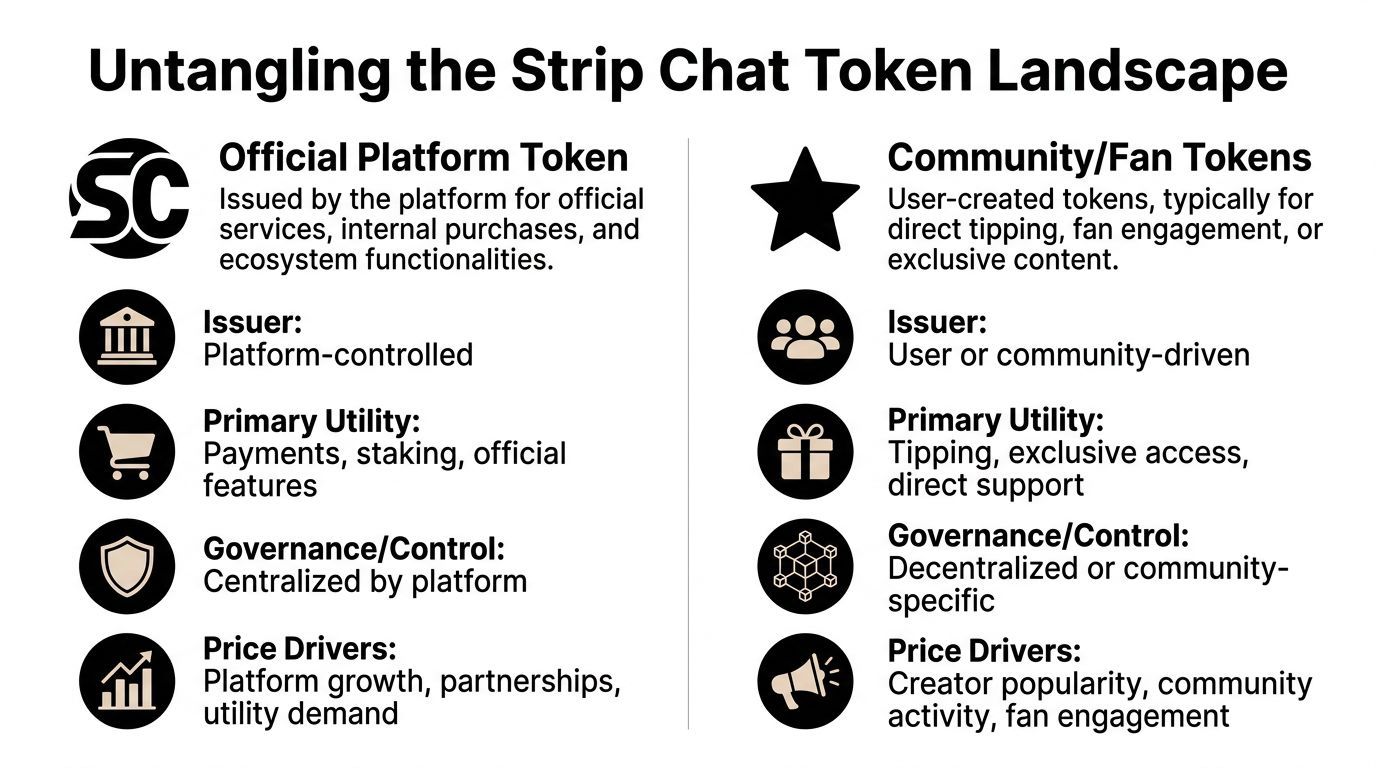
A comparison chart outlining the differences between official platform tokens and community-driven fan tokens in the industry.

Platform currency versus crypto token

If you’re checking strip chat token price, ask these questions in order:

  1. Is this bought directly from a platform website for use inside that platform?
  2. Is this a token with a contract address on a public chain?
  3. Is the token affiliated with the brand, or just using the name?
  4. Is there a live pool and active wallet activity, or only a quote page?

The search term lumps all of that together. Trading them as if they’re one market is how people buy the wrong thing.

Platform Currency vs. Crypto Tokens A Breakdown

AttributeOfficial Platform TokenSpeculative Crypto Tokens (e.g., SCT)
Primary purposeSpend inside the platform ecosystemTrade on-chain for speculation
IssuerPlatform-controlledToken creator or community deployer
Where you get itDirect platform purchase or reseller marketDEX or token wallet interface
Main price driverPlatform pricing and secondary reseller demandLiquidity, hype, wallet concentration, trader flows
Key verification stepConfirm official purchase channelConfirm exact contract address
Main riskOverpaying via resellersIlliquidity, manipulation, rug risk

The three crypto names you need to separate

The crypto side is where confusion gets expensive.

A Solana-based StripChat (SCT) had a $3.9K market cap as of April 13, 2026 and was held by only 2 wallets, according to the Phantom token page at https://phantom.com/tokens/solana/6yky5TKN3p2M3FZoKB9f1Mf6fUeUuk3uzLT9W9FWnGMJ. That isn’t broad market participation. That’s extreme concentration.

An Ethereum-based STRIPCHAT COIN had a market cap of $0.22 with effectively inactive trading conditions, based on CoinBrain’s token page at https://coinbrain.com/coins/eth-0x89fd01e0d29736508f5dd6af9795509c94d58210. That’s not a typo. It’s a reminder that some “priced” tokens are barely markets at all.

Then there’s Strip Finance (STRIP), which is a utility token for the Stripto ecosystem. It trades under a separate thesis tied to NFT pricing utility and exchange listings, not the same branding impulse that drives the meme tokens.

Verify the chain, verify the contract, then verify whether the asset is even the one you meant to research.

If you skip that sequence, the phrase strip chat token price becomes a trap instead of a search query.

What Really Moves the Strip Chat Token Price

The biggest mistake traders make is assuming all “token prices” move for the same reasons.

They don’t.

For the platform currency, pricing starts centrally. Users buy for utility, not for chart speculation. But the interesting wrinkle appears in secondary markets, where reseller pricing can diverge sharply from the direct channel.

A hand pointing at a rising Bitcoin price chart labeled with supply and demand dynamics.

The platform currency follows a different logic

One useful data point comes from reseller pricing research. Direct purchases may price a token at about $0.096, while third-party resellers charge about $0.127 for a similar amount, a 30%+ premium, according to the analysis at https://rewarble.com/insight/how-to-buy-stripchat-tokens.

That matters for two reasons.

First, it shows that “token price” can include a convenience premium rather than a market-clearing crypto price. Second, it creates a legitimate research angle. If secondary buyers repeatedly pay more than direct buyers, that spread may reflect urgency, payment friction, geography, account constraints, or reseller inventory dynamics.

This is not classic DEX arbitrage unless the transfer and redemption mechanics allow it. But it is still a pricing inefficiency worth studying.

Crypto tokens move on flow, not brand familiarity

The on-chain versions react to a completely different set of forces:

  • Narrative bursts: Adult-themed branding and novelty can pull in short-term buyers.
  • Pool fragility: In tiny pools, small buys can move price harder than most traders expect.
  • Wallet concentration: When a few wallets control supply, the chart can become a hostage situation.
  • DEX visibility: A token can trend before it becomes meaningfully tradable.

That’s why a trader looking up strip chat token price needs to stop asking, “Is it going up?” and start asking, “Who can move it?”

When a token’s holder base is tiny and liquidity is thin, the chart reflects wallet behavior more than broad demand.

The practical takeaway is simple. For platform currency, watch pricing channels. For crypto tokens, watch liquidity, concentration, and wallet flows. Those are different games. They only look similar from a distance.

Assessing Liquidity Pools and Extreme Trading Risks

A lot of traders say they understand micro-cap risk. Fewer understand what that means at execution time.

A primary danger isn’t only that price drops. The danger is that you can’t get out when you want to.

Illiquidity changes everything

The Ethereum-based STRIPCHAT COIN is a useful warning sign. CoinBrain showed it at a $0.22 market cap with 24-hour volume of effectively zero, and that level of illiquidity means even a very small trade can distort the quote or leave you stuck in the position at https://www.walletfinder.ai/blog/crypto-liquidity-pool.

A token like that may still show a live price. That doesn’t mean there’s a market you’d trust with size.

Here’s what usually breaks first:

  • Entry quality: The displayed quote may not match your fill once slippage hits.
  • Exit reality: Selling can be far harder than buying.
  • Signal quality: A move on the chart may come from one wallet, not a wave of demand.
  • Risk control: Stop-loss thinking doesn’t translate cleanly into pools that barely trade.

Centralization is not a side issue

The Solana example covered earlier shows the other structural risk. If a token is held by only a couple of wallets, you’re not trading with a crowd. You’re trading around potential whale intent.

That changes how you should read every candle.

A green candle on a healthy market may suggest momentum. A green candle on a hyper-centralized micro-cap may mean one wallet bought from another, or one holder nudged the chart to attract attention.

Red flag: If wallet concentration is obvious and turnover is weak, don’t confuse movement with liquidity.

What works and what doesn’t

What works:

  • Small test orders: Use tiny probes to see whether execution matches the quote.
  • Contract verification: Name-based trading is reckless in duplicated token niches.
  • Pre-trade wallet review: Know who holds the supply before you care about the chart.
  • Patience: Waiting for cleaner flow is often the trade.

What doesn’t:

  • Market buying on excitement
  • Assuming you can scale out later
  • Treating a tiny market cap as automatic upside
  • Ignoring holder concentration because the meme is strong

If you trade these assets at all, structural risk has to matter more than story.

Building Your On-Chain Monitoring Dashboard

Once you’ve identified the exact asset, the next step is surveillance. Not prediction. Surveillance.

For a token niche this messy, a dashboard should answer three questions fast: am I tracking the right contract, who’s touching it, and is activity changing in a way that matters?

A happy young developer in a hoodie points at a digital screen showing cryptocurrency wallet tracking features.

Start with contract-level watchlists

Use https://www.walletfinder.ai/blog/check-on-chain as the mental model here. The important habit is to track contract addresses, not just token names.

A practical dashboard setup looks like this:

  1. Create one watchlist per chain
    Keep Solana and Ethereum assets separate. Name collisions happen often, and chain separation removes avoidable confusion.

  2. Label each asset by thesis
    Mark one as “platform-related naming memecoin,” another as “utility token,” another as “watch only.” A label forces discipline.

  3. Save the exact contract and trading venue context
    If a token only matters on a specific DEX pair, note that. Name-only tracking creates false confidence.

  4. Add wallet activity views before price views
    In fragile markets, wallet flow often tells you more than a chart.

What your dashboard should display first

Don’t overload the screen. For this niche, the first layer should stay narrow.

Dashboard elementWhy it matters
Contract identityPrevents confusion between unrelated tokens with similar names
ChainEthereum and Solana assets trade under different conditions
Recent wallet interactionsHelps spot whether activity is broadening or staying isolated
Trade history snapshotsShows whether entries are clustered or sporadic
Alert statusEnsures you won’t miss meaningful wallet moves

A lot of traders build dashboards backwards. They lead with chart widgets and social feeds. For micro-caps, that’s the wrong order. Lead with verifiable on-chain identity and transaction flow.

Add review notes, not just alerts

A good dashboard isn’t only automated. It also includes your own judgment.

Keep a short notes field for each asset:

  • Why you’re tracking it
  • What invalidates the idea
  • Which wallets matter
  • What kind of activity would change your view

That sounds basic, but it prevents one of the most common failures in memecoin trading. People remember the ticker and forget the thesis.

Later, when a wallet enters or exits, context matters. A dashboard without context becomes another noisy feed.

A short walkthrough helps when you’re setting this up for the first time:

The goal is simple. By the time you consider an entry, your workspace should already tell you whether you’re watching a real setup or a mislabeled distraction.

Finding Actionable Signals with Wallet Finder ai

Tracking a token is passive. Trading well requires signals.

In this niche, the strongest signals usually come from wallet behavior under tight conditions. Not from influencer posts, not from logo familiarity, and not from a chart that only looks active because the pool is thin.

An animated man intensely studies a glowing signal graph on a computer monitor through a magnifying glass.

Focus on traders, not tokens

A strong workflow starts by finding wallets with a history of navigating micro-caps better than average. The point isn’t to worship “smart money.” It’s to identify repeatable operator behavior.

Look for wallets that show:

  • Consistent category activity: They trade similar high-risk tokens, not random everything.
  • Clean timing: Their entries happen early enough to matter, not after the move is obvious.
  • Disciplined sizing: Their position size changes with conviction and liquidity conditions.
  • Real exits: They take profit or cut risk instead of round-tripping every spike.

That mix matters more than one flashy win.

Separate signal from contamination

In tiny markets, bad copying is easy. A wallet can be profitable overall and still be a poor model for a specific token. Maybe they got in through private information, creator proximity, or very early deployment flow that you cannot replicate.

So the usable signal isn’t just “wallet bought token.” It’s closer to this:

  • Did the wallet buy after public liquidity existed?
  • Was the position sized like a real trade rather than a dust punt?
  • Did similar wallets also appear?
  • Did turnover improve after the entry?
  • Was the buy followed by actual market participation?

A wallet alert is a starting point. It isn’t permission to ape blindly.

Build alert logic that respects market structure

For a niche like this, broad alerts create noise. Better alert logic is selective.

Use alerts around:

Alert typeBest use
Tracked wallet buysDetect fresh conviction from wallets you already trust
Tracked wallet sellsSpot distribution before the chart fully reacts
Repeated interactionsNotice when the same wallet family returns to the asset
Cross-chain attentionCatch narrative spillover when traders rotate themes

The key is speed with filters. You want immediate notice of relevant wallet movement, but only from wallets that have earned your attention.

How to turn signals into decisions

Once a signal fires, don’t rush the trade. Run a short decision loop:

  1. Confirm the contract.
  2. Check whether the buying wallet has a pattern you trust.
  3. Review recent activity around the token.
  4. Decide whether this is a trade, a watch, or a pass.
  5. Size for liquidity, not for fantasy upside.

That final step matters most. In micro-caps, trade management usually matters more than direction. Even a correct thesis can become a bad trade if you size it as though exits are guaranteed.

Conclusion Trading Niche Tokens with an Edge

The phrase strip chat token price sounds simple. It isn’t.

It can mean a platform currency, a reseller market spread, a Solana memecoin, an Ethereum dust-cap token, or an unrelated utility token with its own history. The edge starts when you stop treating those as one market.

The practical path is straightforward. First, identify the exact asset and contract. Second, evaluate whether the structure is tradable at all. Third, monitor wallets and flows before deploying capital. That turns a confusing niche into a research process.

The biggest advantage in these markets doesn’t come from being louder or faster on social media. It comes from reading on-chain behavior before the crowd notices what’s changing.

Key takeaways:

  • Differentiate first: Similar names do not mean similar assets.
  • Respect structure: Thin liquidity and concentrated holders can break normal trading assumptions.
  • Watch wallets, not headlines: The best signals often come from who is buying, not who is posting.
  • Use alerts selectively: More alerts usually means more noise.
  • Size for exits: If liquidity is weak, your position should reflect that reality.

That’s how you approach niche tokens with discipline. Not by chasing labels, but by tracking behavior.

Frequently Asked Questions

Is the official platform token the same as the crypto token?

No. The platform currency is used inside a centralized ecosystem. The crypto tokens trade on-chain and can be completely unaffiliated, even if they use similar naming. Treat them as separate instruments unless you’ve verified otherwise.

Can you lose everything trading these tokens?

Yes. A similarly named utility token, Strip Finance (STRIP), reached $2.47 in 2021 and later fell more than 99.9% to $0.00003193 before a partial recovery, according to CoinMarketCap’s Stripto page at https://coinmarketcap.com/currencies/stripto/. That doesn’t prove every related token will do the same, but it does show how brutal downside can be in small and thin crypto markets.

Is a tiny market cap always bullish?

No. A tiny market cap can mean early opportunity, but it can also mean weak liquidity, weak participation, poor holder distribution, or an abandoned token. Small size by itself is not a thesis.

Should you copy-trade every wallet that touches a token like this?

No. Copy trading only makes sense when the wallet’s behavior is repeatable and the trade is still executable after the alert. In micro-caps, some entries are only attractive for the first wallet in, not the wallets following behind.

Are reseller token prices useful for traders?

They can be. Reseller premiums can reveal demand, urgency, or payment friction. But they are not the same thing as a DEX market, so you shouldn’t read them with the same assumptions.

Is trading these tokens legal?

That depends on your jurisdiction, the venue, and the asset itself. You need to handle local compliance, tax treatment, and platform rules yourself. If a token’s status is unclear, caution is better than speed.


If you want to trade this niche with more discipline, Wallet Finder.ai gives you the infrastructure to track profitable wallets, inspect trade history, build targeted watchlists, and react to real on-chain signals instead of hype. That edge matters most in thin, confusing markets where contract verification, wallet behavior, and timing decide the outcome.