Tosa Inu Prices A Trader's Data-Driven Guide for 2026

Wallet Finder

Blank calendar icon with grid of squares representing days.

April 28, 2026

More than 95% drawdowns are common in micro-cap memecoins. With tosa inu prices, that headline risk is only half the problem. The other half is figuring out which Tosa Inu a trader is evaluating.

A single search can surface inactive Ethereum pairs, separate Solana tokens, and BSC variants that share the same name or a near-identical ticker. Price alone is not enough. If the contract, chain, and liquidity venue are unclear, the chart has limited value and execution risk rises fast.

One Tosa Inu variant posted a sharp run into its 2022 peak and later gave back almost all of that move. Other variants followed different paths because they are different assets with different holder bases, supplies, and market depth. Treating them as one tradeable narrative leads to bad entries, false conviction, and poor risk sizing.

At Wallet Finder.ai, we approach Tosa Inu as a fragmented token set, not a single clean market. That changes the workflow. Serious traders need to verify the exact contract first, then check where liquidity sits, who is buying, and whether smart money is rotating into that specific pair or just a similarly named token on another chain.

Tosa Inu Prices And The Memecoin Maze

Most traders approach tosa inu prices like a standard token lookup problem. Search the ticker, open a chart, check the last traded price, and decide whether the move looks early or late. That workflow breaks fast with Tosa Inu.

The term Tosa Inu refers to multiple memecoin variants across different chains. Some are Ethereum-style DEX tokens under the TOS label. Some use TOSA on Solana or BSC. They aren't interchangeable, and a move in one doesn't validate anything about another. That's the first filter serious traders need.

Why the name itself is a risk factor

A fragmented memecoin name creates three practical problems:

  • Wrong asset risk: You buy the wrong contract because the symbol matches what you saw on social media.
  • False momentum reads: A chart spike on one chain gets misread as a signal for another token.
  • Bad execution: You route through a thin pool and discover too late that the token isn't the one you researched.

Many retail losses often begin not with a dramatic rug, but with a simple identification error.

Practical rule: If the token name is common, the contract matters more than the ticker.

Tosa Inu sits in the part of the market where liquidity is thin, data quality is uneven, and narratives travel faster than verification. That doesn't make it untradeable. It means you need a stricter process than you would for a large cap token with unified exchange listings and cleaner market data.

Understanding The Tosa Inu Token Ecosystem
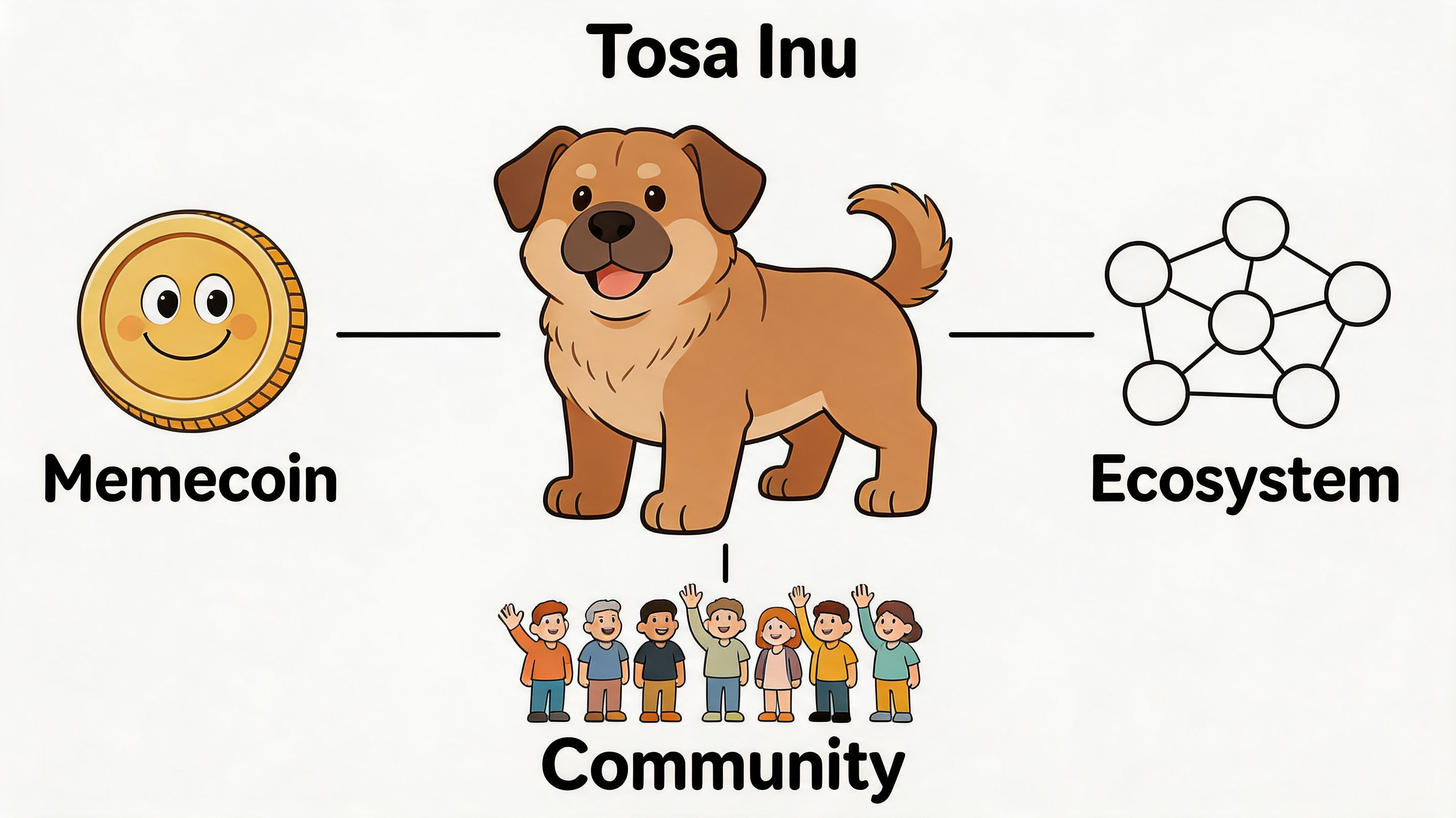
A diagram shows a Tosa Inu dog connected to a memecoin, an ecosystem network, and a community.

A memecoin like Tosa Inu usually trades on story, community attention, and short bursts of liquidity rather than a durable business model. That's normal for the category. What isn't normal for newer traders is how often the same name appears on several chains at once.

When traders discuss tosa inu prices, they may be referring to completely different markets. Ethereum-based variants tend to live in older meme token infrastructure with fragmented tracker coverage. Solana variants can appear cheap to trade and easy to access through wallet-native interfaces. BSC versions often add tax and reflection mechanics that materially change execution.

A simple way to categorize Tosa Inu tokens

Use this framework before looking at any chart:

  1. Chain first
    Ask whether the token lives on Ethereum, Solana, or BSC. This determines wallet support, gas model, DEX venue, and contract format.

  2. Symbol second
    TOS and TOSA look close enough to confuse people. They are not the same by default.

  3. Mechanics third
    Some variants are plain meme tokens. Others use burns, taxes, or reflections. Those mechanics affect short-term trading behavior.

  4. Community last
    A loud community can create opportunity, but it can't fix poor liquidity or broken routing.

What traders often miss

A price move on one Tosa Inu token doesn't create intrinsic value for the others. The shared branding can attract traffic, but it can also create noise. In practice, that means every analysis starts with token verification, not price prediction.

The best memecoin traders don't just ask whether a token can move. They ask whether they're even looking at the right token.

That's especially true in low-activity names where dormant pools, abandoned trackers, and recycled branding all sit in the same search results.

Decoding Tosa Inu Variants And Contract Addresses

If you trade micro-cap meme tokens on DEXs, the contract address is your real ticker. The name is only a label. That's why Tosa Inu requires a contract-first workflow.

One useful benchmark comes from the BSC-side tokenomics. TosaInu BSC (TOSA) has a fixed max and total supply of 420 quadrillion, with self-reported circulating supply at 82.26 quadrillion, plus 1% reflections and a 4% marketing tax per transaction, according to BeInCrypto's Tosa Inu profile. Those mechanics aren't small details. They directly affect entry cost, exit cost, and how fast a low-volume move can fade.

Tosa Inu Token Variants Comparison

Token Name / SymbolBlockchainContract Address (Abbreviated)Total Supply
Tosa Inu / TOSEthereum-style DEX variantVerify on chain before trading599.89 trillion
Tosa Inu / TOSASolana8qMj...jebz998.21 million
TosaInu BSC / TOSABSCVerify on chain before trading420 quadrillion

The table is a trading prompt, not a whitelist. Only the Solana contract address is explicitly available in the verified dataset. For the others, the safe move is to verify the exact contract on a block explorer and cross-check the liquidity pool before signing a swap.

What the tokenomics imply in practice

  • Ethereum-style TOS: Massive supply and dormant trading can make the chart look deceptively stable when it's inactive.
  • Solana TOSA: A cleaner supply picture can make PnL easier to track, but that doesn't remove the liquidity problem.
  • BSC TOSA: Reflection and marketing tax can reward holders on paper while making quick in-and-out trading harder.

For traders who still rely on token names in search bars, mistakes become expensive. A clean workflow starts with how to verify a token contract address, then moves to pool quality, holder behavior, and only then to price action.

Analyzing Historical Tosa Inu Price Performance

The historical chart of Tosa Inu shows a familiar memecoin lifecycle. Attention arrives fast, trading activity clusters into a short window, and then price discovery weakens once that early crowd moves on.

For traders, the main takeaway is not the old peak itself. It is the market structure behind that peak. In micro-cap tokens, a vertical move often says more about temporary order-flow imbalance than lasting demand. That matters across the Tosa Inu ecosystem because ETH-style, Solana, and BSC variants can all carry the same branding while trading under very different liquidity conditions.

How to read the pattern without getting trapped by it

A legacy spike creates two bad habits. Traders anchor to a previous high, and they overestimate how easy it will be to exit if momentum returns.

A better read is practical. Ask what kind of participation produced the move, whether that participation persisted, and whether current volume is real enough to support a round-trip trade. If those answers are weak, the chart is a warning about execution risk, not a map to upside.

Here is the setup I watch for in tokens like Tosa Inu:

  • Short-lived rallies need follow-through: A single burst in a quiet market can come from a few wallets, not broad conviction.
  • Old highs are context, not targets: Distance from a previous top does not make a token cheap.
  • Inactive periods matter: Long stretches of weak trading usually mean slower price discovery and wider slippage once size hits the pool.
  • Variant confusion distorts chart reading: A trader looking at one Tosa Inu chart may assume it represents the whole project, when it may only reflect one chain's isolated liquidity.

That last point gets missed often. Fragmented branding creates fragmented narratives. One Tosa Inu pair can look dead while another gets a brief speculative bid, and that can produce false confidence if you are not matching the chart to the exact contract and pool.

This is why historical performance should be used as a filter, not a prediction tool. At Wallet Finder.ai, I treat these charts as a first pass for identifying failed hype cycles, wallet concentration risk, and the kind of thin participation that makes smart-money tracking more useful than raw candle watching alone.

Key Market Metrics To Watch For Tosa Inu

An infographic detailing four key metrics for evaluating Tosa Inu cryptocurrency market health.

Price alone hides the part that hurts traders most. Execution. In micro-cap names like Tosa Inu, a token can display a quote and still be difficult to trade in size.

The clearest example is the Solana variant. As of April 22, 2026, Tosa Inu (TOSA) on Solana had a market capitalization of $1.6K, based on a total and circulating supply of 998.21 million tokens, according to Phantom's Solana token page for TOSA. That's not just "small." It's the kind of market profile where one participant can distort the chart.

The four metrics that matter most

MetricWhy it matters for tradersWhat a weak reading usually means
Market capitalizationGives rough scaleA tiny cap can be easier to move, but also easier to manipulate
Trading volumeShows whether participants are activeLow activity often means poor fills and stale price discovery
LiquidityDetermines how easily you can enter and exitThin pools create slippage and failed assumptions
Holder distributionReveals concentration riskA few large wallets can dominate direction

How to use these metrics together

Don't isolate one metric. A tiny market cap with weak liquidity isn't "early" by default. It may be inactive. Likewise, a holder count can look broad while the meaningful supply still sits in a few wallets or pools.

If I had to rank the metrics operationally for a memecoin trade, I'd put liquidity first, then recent trading activity, then holder concentration, then market cap. Market cap gets the headlines. Liquidity decides whether you can trade.

Where To Find Tosa Inu Trading Pairs And Exchanges

Tosa Inu variants usually live where most micro-cap memes start and often stay. On decentralized exchanges. That means you won't get the convenience of a deep centralized order book, and you won't get standardized listings across every version of the token.

Ethereum-style variants typically route through Uniswap or an aggregator that pulls from Ethereum pools. Solana variants are more likely to surface through wallet-integrated swap flows and Solana DEX infrastructure. BSC variants usually require the same contract-first discipline, but with extra caution if taxes apply.

A practical venue checklist

  • Use the chain-native route: Match the token to the chain before opening a swap screen.
  • Check the pool, not just the token page: A token can exist while its usable liquidity is poor.
  • Review slippage settings carefully: Too low and the trade fails. Too high and you become the exit liquidity.
  • Prefer aggregators when available: They can improve routing, but they don't solve a bad underlying pool.

For traders exploring the broader meme segment, this guide to top meme coins is a useful comparison point because it shows how venue quality and token quality often diverge.

The absence of major centralized exchange support isn't a minor inconvenience here. It's part of the risk model. You are your own execution desk, compliance layer, and final reviewer before every swap.

Advanced On-Chain Analysis For Professional Traders

A common notion is that Tosa Inu is too small for serious analysis. That's only half true. It's too small for lazy analysis. It's exactly the kind of token where disciplined on-chain work can separate a valid setup from random noise.

A good example is the price fragmentation across trackers. Crypto.com reports TOS at $9.589e-11, while BloFin lists $2.40e-10, implying spreads above 150% from illiquid AMM pools, and the same dataset notes 0% 24h changes and N/A volumes as signs of stalled momentum on Crypto.com's Tosa Inu price page. In a normal market, that discrepancy would be odd. In micro-cap DEX trading, it's a warning and sometimes an opportunity.

What professionals look at beyond the chart

  • Tracker divergence: If two platforms disagree sharply, ask whether they're indexing the same pool, the same chain, or stale trades.
  • Holder concentration: A small cluster of wallets can create artificial momentum or pin the market.
  • Pool behavior: Liquidity adds and removals often matter more than social sentiment.
  • Transaction sequencing: The order of buys, sells, and wallet transfers can reveal whether activity is organic.

Data fragmentation doesn't automatically create arbitrage. Sometimes it just exposes broken assumptions.

What works and what doesn't

A simplistic strategy says, "If the spread is large, buy the cheap venue and sell the expensive one." That often fails because the displayed quote may not be executable at meaningful size. Slippage, taxes, stale data, and gas or routing delays can erase the edge.

What works better is a forensic process:

  1. Confirm the contract and chain.
  2. Inspect the actual liquidity source.
  3. Compare recent swaps, not just quoted prices.
  4. Watch whether the wallets entering the token have a history of profitable meme rotations.

If you do this often, a dedicated guide to on-chain analysis helps frame the workflow. The point isn't to make Tosa Inu look cleaner than it is. The point is to stop bad data from becoming a bad trade.

How To Track Smart Money With Wallet Finder.ai

The main problem with tosa inu prices isn't a lack of charts. It's signal overload mixed with low-quality data. Wallet Finder.ai is useful here because it doesn't start with the token page. It starts with wallet behavior.

A logo for Wallet Finder AI showing a cartoon dog and a tracking workflow process diagram.

Build a Tosa Inu watchlist the right way

The first step is creating a watchlist around specific contracts, not just the Tosa Inu name. Because multiple variants exist, grouping by label alone creates noise. A clean watchlist separates the Ethereum-style TOS, the Solana TOSA address, and any BSC variant you're monitoring.

That lets you see whether activity is concentrated in one version or scattered across unrelated tokens sharing branding. In practice, that distinction matters more than most chart overlays.

Filter for wallets that actually matter

Wallet Finder.ai's strength is in wallet discovery and trade history review. For a token like Tosa Inu, I'd filter for wallets that show a repeatable pattern in speculative tokens rather than wallets that only touched the asset once.

Look for:

  • Memecoin familiarity: Wallets that have rotated through similar low-liquidity assets before.
  • Consistent exits: Not just big winners, but evidence they know how to reduce exposure before momentum dies.
  • Position discipline: Oversized bets in micro-caps often signal recklessness, not edge.
  • Recent activity: Dormant "smart money" isn't useful for live decisions.

Use alerts as execution prep, not trading commands

Real-time Telegram and push alerts are most useful when they support a plan you've already built. If a tracked wallet buys Tosa Inu, the alert should trigger a review, not an automatic market order.

I treat alerts as prompts to answer four questions fast:

QuestionWhy it matters
Is this the exact contract I'm tracking?Prevents copy errors across variants
Did the wallet buy into live liquidity?Screens out meaningless test swaps
Has volume actually improved on chain?Helps separate signal from isolated activity
What's my exit before entry?Stops reactive trades

Smart money tracking works best when you mirror the process, not just the transaction.

Export the data and study patterns offline

For professional traders and quant researchers, exportable datasets are where the platform becomes more than a dashboard. You can review entry timing, holding windows, repeated wallet clusters, and how profitable addresses behave in dead versus active meme markets.

That matters with Tosa Inu because these tokens often don't provide enough clean headline data on their own. The edge comes from reconstructing behavior around them. Which wallets entered first. Which wallets scaled out. Which buyers were followed by real participation, and which ones traded into silence.

What this improves in practice

Wallet Finder.ai helps remove three failure points that show up repeatedly in obscure meme trades:

  • Contract confusion
  • Late reaction to wallet flows
  • Overreliance on public chart narratives

It won't make a weak token strong. It will make your process sharper. In this part of the market, that's the difference between informed speculation and random clicking.

Mirroring Trades A Practical Step-By-Step Guide

Copy trading a token like Tosa Inu only works if you treat it as selective mirroring. Blind duplication is where most traders get hurt. The wallet you follow may have better entry speed, lower fees, faster reaction time, and a very different risk tolerance than you do.

A workable mirroring workflow

  1. Find a relevant wallet

Start in Discover Wallets and look for traders with a history in low-cap memes, not just one lucky spike. A wallet that has traded similar names is more informative than one with a broad portfolio and a single Tosa Inu touch.

  1. Inspect the full trade history

    Review how that wallet enters. Does it scale in, ape immediately, or test with a small buy first? Then review exits. The best wallets often trim into strength instead of waiting for the final top.

  2. Set wallet-specific alerts

    Once the wallet passes review, set alerts for buys, swaps, and sells. This gives you context in real time rather than forcing you to monitor explorers manually.

  3. Mirror with your own rules

    Don't match size mechanically. Use smaller exposure in tokens with thin liquidity and uncertain execution. If taxes or reflections apply, account for them before you trade.

  4. The key adjustment most traders skip

    Mirroring isn't just copying an entry. It's adapting the trade to your constraints.

    A practical checklist before you act on an alert:

    • Confirm the same contract: Especially important with Tosa Inu variants.
    • Check the current pool condition: A wallet may have entered when liquidity was better.
    • Define the invalidation point: If the trade thesis was wallet-led momentum, decide what breaks that thesis.
    • Plan the exit path: Selling into a thin pool can be harder than buying into one.

    The best mirror trades usually come from wallets you understand well enough to disagree with. If you know why they entered, why they sized the trade that way, and what would make you pass, you're using copy trading as analysis. That's when it starts to become durable.

    A Trader's Quick Reference And Risk Checklist

    Keep this checklist next to any Tosa Inu trade ticket:

    • Verify the exact contract: Never trade from name search alone.
    • Match token to chain: TOS and TOSA can point to different ecosystems and different risks.
    • Check liquidity before price: A quote doesn't guarantee a usable exit.
    • Review token mechanics: Reflection, burns, and marketing tax change execution.
    • Inspect holder behavior: Concentrated ownership can flip a chart fast.
    • Treat old highs as history, not targets: Memecoin peaks attract anchors and bad assumptions.
    • Use alerts as prompts: Review the trade. Don't auto-follow it.
    • Decide size before entry: Micro-cap memes punish oversized conviction.
    • Write the exit plan down: Profit-taking and invalidation should exist before the swap.
    • Assume data can be wrong: Cross-check tracker quotes against on-chain activity.

    If even one of those checks fails, waiting is usually the better trade.

    Frequently Asked Questions About Tosa Inu

    Is Tosa Inu a good long-term investment

    It doesn't fit the profile of a conservative long-term hold. Tosa Inu variants are better treated as high-risk speculative assets where liquidity, community attention, and execution quality matter more than a traditional investment thesis.

    Why are there so many different Tosa Inu tokens

    Because memecoin branding is easy to reuse across chains. Different developers and communities can launch unrelated tokens with similar names or symbols. That's why contract verification matters more than branding.

    How can I buy Tosa Inu more safely

    Start with the exact contract address, confirm the chain, inspect the liquidity pool, and review token mechanics before swapping. If the data looks fragmented or stale, passing is a valid decision.

    Can I rely on tracker prices alone

    No. In micro-cap DEX tokens, displayed prices can lag, reflect thin pools, or differ across platforms. Use tracker quotes as a starting point, then confirm what's happening on chain.

    Is smart money tracking useful for Tosa Inu

    Yes, but only if you use it to add context. Wallet activity can help you spot early participation, but it doesn't remove contract risk, slippage, or liquidity problems.


    If you trade memecoins by following names, you'll stay confused. If you track contracts, wallet flows, and execution quality, you'll make better decisions faster. Wallet Finder.ai helps you discover profitable wallets, monitor smart money in real time, review full trade histories, and build alert-driven workflows across Ethereum, Solana, Base, and more. For traders navigating chaotic markets like Tosa Inu, that's the difference between reacting late and acting with evidence.