Trader Joe DEX: A Guide to Trading & Yield Farming
Explore the Trader Joe DEX with our in-depth guide. Learn about JOE tokenomics, Liquidity Book, fees, and how to find profitable trades on Avalanche & Arbitrum.

April 16, 2026
Wallet Finder

April 16, 2026

You’re probably looking at trader joe dex for one of three reasons. You want lower slippage on active trades. You want to farm without spraying capital across dead ranges. Or you want a cleaner way to watch what skilled on-chain traders are doing instead of guessing from social posts.
That’s the right lens.
Trader Joe matters because its design is built around where trades happen, not around leaving your liquidity smeared across irrelevant prices. For traders, that can mean tighter execution. For LPs, that can mean more fees from the same capital if the range selection is right. For stakers, it creates a more direct tie between protocol usage and rewards than the usual token incentive loop.
It’s not a magic machine. If you place liquidity in the wrong bins, chase noisy wallets, or ignore interface risk, you can still lose money efficiently. But if you understand the mechanics, Trader Joe gives you better tools than many general-purpose DEXs.
Most DEX users learn the same lesson the expensive way. A trade looks fine in the quote box, then execution lands worse than expected because liquidity is too thin or too broadly distributed.
Trader Joe was built to reduce that problem on chains like Avalanche and Arbitrum by making liquidity more concentrated and more usable. The platform’s core edge is the Liquidity Book, which groups liquidity into discrete bins rather than using the older full-range AMM design.
That sounds technical. In practice, it changes how you trade and how you provide liquidity.
If you’re swapping, the main question is simple. Can the pool absorb your order cleanly without forcing you through a lot of shallow liquidity? Trader Joe’s structure is designed to help with that. If you’re LPing, the question changes. Can you place capital where volume is likely to hit instead of funding a huge empty curve? That’s where Trader Joe becomes interesting.
A second layer is the token model. JOE isn’t just a governance badge. On the platform’s current design, 100% of Liquidity Book trading fees in USDC go to veJOE stakers, which gives the staking side a direct connection to trading activity rather than a purely inflationary reward loop. That’s one of the few parts of DeFi tokenomics that deserves close attention.
Then there’s the practical edge most articles skip. Trader Joe is fully on-chain. That means traders can study liquidity placement, swap timing, and staking behavior by wallet. The opportunity isn’t only understanding the DEX. It’s learning who uses it well.
Practical rule: Don’t treat Trader Joe like “just another swap venue.” Treat it like a market structure with visible participant behavior.
That distinction matters. On trader joe dex, the edge usually comes from execution quality, range selection, and wallet analysis, not from blindly farming the loudest pool.
A good way to think about AMM design is this. Traditional liquidity can feel like a wide, shallow river. There’s water everywhere, but not much depth where you need it. Trader Joe’s Liquidity Book is closer to a canal. Narrower. Deeper. More usable where traffic moves.
That difference starts with bins.
Trader Joe’s Liquidity Book AMM organizes liquidity into discrete bins rather than a continuous curve. That structure lets LPs concentrate capital in specific price zones, and it enables zero price-impact trades when an order stays within a single bin’s liquidity depth. For mid-sized trades, the model can reduce slippage by up to 10x compared with some competitors, and stablecoin LPs have shown 15% to 25% higher effective APRs from auto-compounding fees and better capital efficiency, according to QuickNode’s overview of Trader Joe’s Liquidity Book.
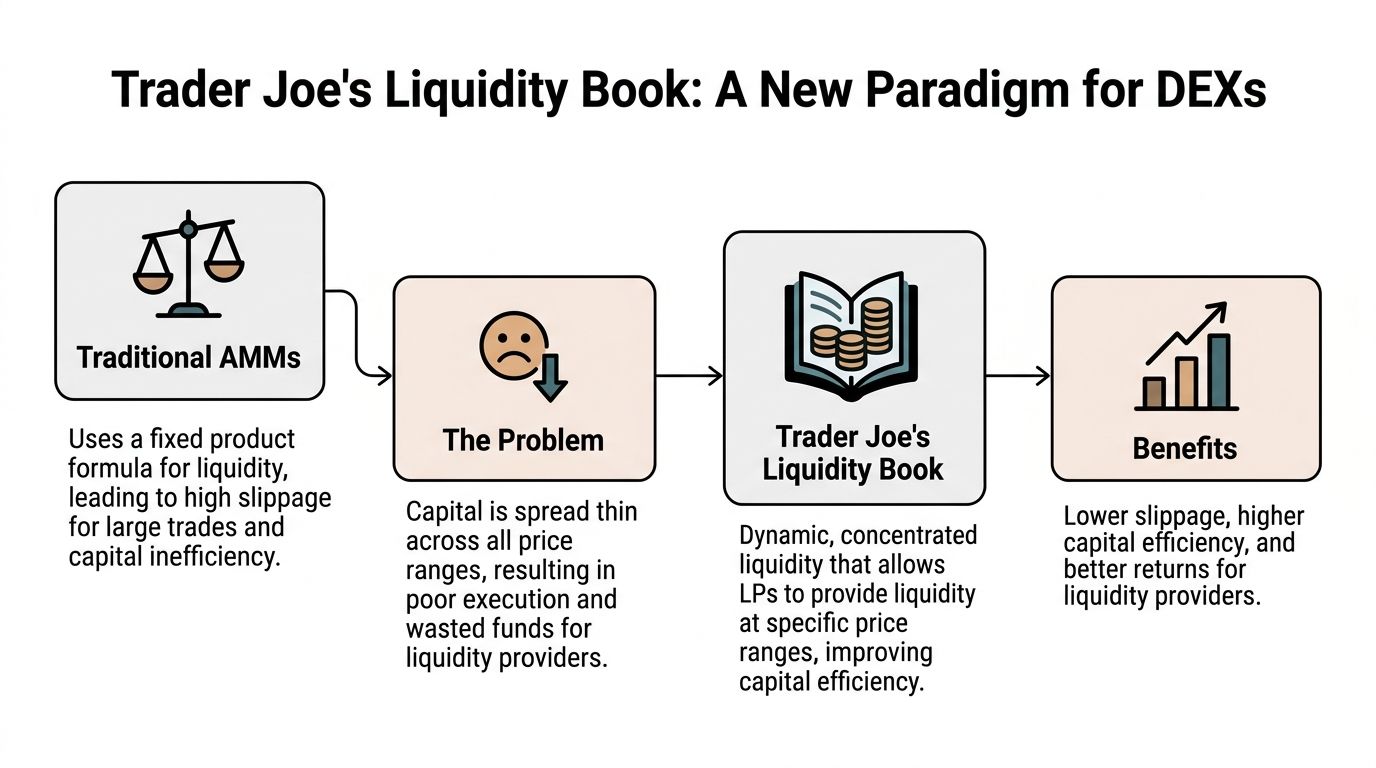
If you’ve used concentrated liquidity elsewhere, that still doesn’t mean Trader Joe behaves the same way. The bin model changes how you think about positioning. You’re not only selecting exposure. You’re choosing where execution quality is likely to be strongest.
For a useful primer on the mechanics behind liquidity pools in general, this guide on crypto liquidity pools is a solid companion.
For swappers, the immediate benefit is cleaner execution when liquidity is stacked near the active price.
That matters most in these situations:
The mistake is assuming every Trader Joe pool is automatically efficient. It isn’t. The architecture is strong, but pool quality still depends on where LPs choose to sit.
The Liquidity Book gives LPs far more control than passive full-range provision.
That control cuts both ways.
What works
What doesn’t
Liquidity Book rewards active judgment. It doesn’t reward laziness with better branding.
A lot of LPs underestimate that. Trader Joe makes capital more efficient, but efficiency only helps if the capital is placed intelligently.
Use this checklist before entering a pool:
| Question | Why it matters |
|---|---|
| Is this pair mean-reverting or trending? | Mean-reverting pairs suit tighter placements better |
| Where is volume likely to cluster? | Fees come from activity, not from elegant theory |
| Can I monitor the position? | Narrow concentration needs more attention |
| Am I LPing or expressing a market view? | On Trader Joe, those can overlap more than people admit |
If you remember one thing, remember this. Trader Joe’s edge comes from depth where price lives, not from abstract AMM complexity.
The interface is straightforward, but the platform gets more useful once you stop treating every tab as separate. On trader joe dex, swaps, liquidity, farming, staking, and order tools all connect to the same question. Where is capital most productive right now?

Swapping is the first touchpoint, and it’s where Trader Joe often wins users.
The practical process is simple. Connect a wallet, choose the chain, pick the pair, review route and price impact, then execute. The strategic part is what is often overlooked. On Trader Joe, pair selection matters more because liquidity quality can differ sharply by market and chain.
Use these habits:
For active traders, the right question isn’t “Can I swap here?” It’s “Is this the cleanest venue for this specific pair right now?”
The platform starts to get interesting.
LPing on Trader Joe isn’t passive in the old AMM sense. You select bins and shape exposure. That means your job is closer to inventory management than simple yield farming.
A practical workflow looks like this:
Here’s the core trade-off. Tighter placement can improve fee capture, but it also increases management burden. Wider placement lowers maintenance, but it dilutes the capital-efficiency edge that brought you to Trader Joe in the first place.
Farms can add another layer of return, but they shouldn’t override your position logic.
A bad habit in DeFi is choosing pools from incentive banners first and risk structure second. On Trader Joe, that usually backfires. If the pair is unstable or your liquidity sits in poor bins, incentives won’t fix weak fee generation or adverse price movement.
What tends to work better:
If you can’t explain why volume should hit your chosen range, you’re farming blind.
Staking belongs in a different bucket from LPing. With LPing, you’re managing price placement. With veJOE, you’re taking a view on protocol usage and fee flow.
That makes staking useful for traders who want exposure to the exchange’s activity without constantly managing bins.
The key discipline is matching lockup and thesis. If you think Trader Joe will continue to attract sticky trading activity across supported chains, staking can make sense. If you only want tactical short-term flexibility, LPing or spot trading may fit better.
Limit orders matter more than they get credit for. They let you be patient in volatile markets instead of crossing the spread with pure urgency.
Use them when:
A lot of bad swaps are emotional. Limit tools reduce that.
A quick walkthrough helps if you’re new to the layout:
| Feature | Primary Use Case | Key Benefit on Trader Joe |
|---|---|---|
| Swap | Entering or exiting positions | Better execution when liquidity is concentrated well |
| Liquidity Book pools | Providing liquidity in chosen ranges | More precise capital deployment through bins |
| Farms | Adding incentives to LP positions | Extra yield layer when the base setup is already sound |
| veJOE staking | Earning from protocol activity | Exposure to fee distribution without managing bins directly |
| Limit orders | Controlled entries and exits | More disciplined execution in volatile conditions |
Desk note: The best Trader Joe users don’t use every feature. They use the few that match their edge.
Most DEX tokens promise alignment. Very few make that alignment concrete enough to matter.
JOE is more interesting than the average exchange token because the staking side is tied directly to platform activity. Trader Joe’s model distributes 100% of Liquidity Book trading fees in USDC to veJOE stakers, and the same framework has pushed staking participation to more than 60% of circulating supply, according to CoinMarketCap’s explainer on JOE.

A lot of DeFi reward systems recycle emissions and call it demand. That can work for a while, then the math turns against holders.
Trader Joe’s staking design is better because it links rewards to actual trading fees paid through the Liquidity Book. That doesn’t eliminate token risk, but it does give stakers something cleaner to evaluate.
For a broader framework on how to think about staking design across protocols, this piece on staking in DeFi is worth reading.
Here’s the practical version of the model:
The important part is behavioral. When a token gives holders a direct claim on platform fee flow, the staking decision becomes closer to evaluating a business than chasing a narrative.
That doesn’t mean you should ignore price risk. You still need to ask whether platform usage is durable and whether the token’s market structure suits your time horizon.
JOE also gains from LayerZero-based omnichain utility, which extends usage across ecosystems like Arbitrum and Monad in the cited source. For traders, that matters because protocol relevance is stronger when it’s not pinned to a single venue.
A token tied to one chain can become hostage to that chain’s momentum. A token with broader utility has a better chance of staying part of the conversation.
Use this filter before staking:
| Good fit | Poor fit |
|---|---|
| You want fee-linked exposure to protocol activity | You need constant liquidity and fast rotation |
| You have a medium-term view on Trader Joe usage | You’re only interested in short tactical trades |
| You don’t want to manage LP bins daily | You prefer direct control over trade timing |
The cleanest reason to stake JOE is simple. You want exposure to a DEX that pays fee-derived rewards in a stable asset, and you believe the protocol can keep attracting order flow.
Trader Joe isn’t the best DEX for every job. That’s exactly why it’s useful to understand.
The right comparison isn’t “Which protocol wins?” The right comparison is “Which market structure fits this trade?”
Uniswap V3 remains the reference point for concentrated liquidity. It’s broad, familiar, and widely integrated. For many pairs, it’s the default venue traders check first.
Trader Joe’s edge is more specific. Its Volume-to-TVL efficiency ratio often outpaces competitors like Uniswap V3 because the Bin step model behaves more like a traditional CEX order book, allowing higher trading volume with less locked capital, according to CoinBureau’s review of Trader Joe.
That matters if you care about capital efficiency more than pure brand gravity.
Use Trader Joe over Uniswap V3 when:
Use Uniswap V3 when:
Curve is a different animal. It’s built for specific liquidity profiles, especially stable and correlated assets.
If your goal is a large stablecoin swap and Curve has the best depth for that route, use Curve. There’s no prize for being ideological.
Trader Joe becomes more compelling when:
Curve is often better when the market structure is mostly about minimizing slippage on tightly correlated assets. Trader Joe is often better when the setup rewards active liquidity placement and execution awareness.
| Use case | Better default starting point | Why |
|---|---|---|
| Large stablecoin swap | Curve | Strong fit for correlated assets |
| General-purpose popular pair | Uniswap V3 | Broad market presence and familiarity |
| Active LP strategy on volatile pair | Trader Joe | Bin-based concentration can be more expressive |
| Wallet-based strategy replication | Trader Joe | Bin positions create readable on-chain behavior |
A seasoned trader doesn’t marry one DEX.
The smarter approach is venue selection by task.
The best venue is the one that fits the trade’s shape, not the one with the loudest community.
That’s the key comparison. Trader Joe excels when your edge depends on efficient local liquidity and visible on-chain positioning. It’s less compelling if you just want a generic swap venue and don’t plan to use its structure.
The biggest mistake traders make on Trader Joe is stopping at the interface.
The platform is on-chain. That means every strong LP, disciplined swing trader, and careful veJOE participant leaves a footprint. The advantage isn’t just understanding the Liquidity Book. It’s identifying who uses it well, then separating skill from luck.

You want three categories of behavior.
A strong LP on Trader Joe isn’t just earning. They’re placing bins with intent.
Watch for:
The goal isn’t to clone every move. It’s to recognize patterns in how good LPs respond to market structure.
Some wallets consistently enter early, size well, and exit before liquidity deteriorates.
What matters most:
A wallet that buys early but exits badly isn’t smart money. It’s incomplete information.
Staking and governance-related movement can also matter, especially when a wallet repeatedly signals conviction before broader participation catches up.
That doesn’t make every veJOE whale worth following. It just gives you another behavior set to compare with swaps and LP changes.
Use a process, not a vibe.
For learning the mechanics of monitoring wallet activity more systematically, this guide on track crypto wallets is useful.
Trader Joe deactivated its frontend after a November 2023 frontend exploit, and the incident did not impact core smart contracts, according to this report on the exploit response. The more interesting angle for traders is what happened afterward. A strong risk-adjusted approach is to study wallets that stayed profitable and showed good security hygiene post-incident.
That gives you a better filter.
Don’t just ask, “Who made money?”
Ask, “Who made money without acting recklessly?”
Most copy traders fail by copying outputs instead of behaviors.
A better method is to track:
| Signal | Why it matters |
|---|---|
| Consistent bin adjustments | Shows active LP skill rather than passive luck |
| Controlled position sizing | Helps distinguish professionals from gamblers |
| Repeated use of Trader Joe for key entries | Suggests the wallet values execution here |
| Survival through risk events | Filters out wallets that only performed in calm markets |
Good copy trading isn’t copying transactions. It’s copying decision quality.
That’s the alpha on trader joe dex. Not the existence of smart wallets, but the fact that their positioning style is visible if you know what to monitor.
Trader Joe is easy to access if you already use DeFi. The main risk at the start isn’t complexity. It’s rushing through setup and making a careless first transaction.
There’s a funny parallel with the retail Trader Joe’s brand. It built its reputation on efficiency, and by 1995 its stores generated about $1,000 per square foot, nearly double the supermarket industry average of around $570, while revenue grew from $133 million in 1988 to over $20 billion in 2023 at a 15% CAGR, according to Encyclopedia.com’s company history. The DEX version attracts people for a similar reason. They want cleaner use of capital.
A safe first trade looks like this:
If your first trade feels boring, that’s good. Boring is how you stay solvent long enough to use the advanced parts of the platform.
Trader Joe earns a place in a serious DeFi stack for three reasons.
First, the Liquidity Book gives traders and LPs a sharper instrument than broad passive AMMs. Second, veJOE staking creates a more usable link between protocol activity and holder rewards than the usual farm-and-dump model. Third, the platform’s on-chain transparency makes it unusually good for studying execution and liquidity behavior by wallet.
That combination is hard to ignore.
What matters going forward isn’t whether Trader Joe becomes the only DEX you use. It won’t. What matters is whether it keeps being the right venue for the kinds of trades and strategies where local liquidity concentration, fee-linked staking, and readable wallet behavior create an edge.
For active traders, that edge is practical. Better swaps. Better LP placement. Better signals from watching who’s consistently right.
For researchers and copy traders, the opportunity is even clearer. Trader Joe doesn’t just expose market prices. It exposes participant behavior.
Use that.
A lot of DeFi users stay stuck at the interface level. The better approach is to treat trader joe dex as both a venue and a dataset. That’s where the next layer of advantage usually sits.
Wallet Finder.ai helps traders turn that on-chain data into action. You can use Wallet Finder.ai to identify profitable wallets, monitor swaps and liquidity behavior, build watchlists, and react faster when smart money moves across DeFi.