Crypto Wallet Ratings: How to Find & Copy Top Traders
Unlock the power of crypto wallet ratings. Learn how to analyze performance metrics like PnL, risk, and win rate to find and copy-trade top DeFi wallets.

May 26, 2026
Wallet Finder

May 26, 2026

Most traders hit the same wall. You find a wallet that caught a move early, check the profit, and think you've found smart money. Then the next few trades are sloppy, the position sizing is erratic, and the account turns out to be either lucky, inactive, or impossible to copy in real time.
Raw PnL is where bad wallet selection starts. A single outsized win can make a weak trader look elite. A noisy memecoin wallet can look brilliant for a week and untradeable the week after. Manual review helps, but once you're scanning large sets of addresses across multiple chains, intuition stops scaling.
That's where wallet ratings become useful. A good rating system turns messy onchain behavior into a structured view of skill, discipline, and repeatability. It doesn't answer every question for you, but it gets you much closer to the wallets worth deeper work.
Onchain data is transparent, but that doesn't make it easy to use. Traders still have to separate deliberate execution from random outcomes, active operators from abandoned wallets, and genuine edge from copied flows.
That problem matters more now because digital wallets are no longer a fringe interface. Juniper Research estimates 4.5 billion digital wallet users worldwide in 2025, rising to 6 billion by 2030, a projected 35% increase over five years according to Juniper Research's digital wallet forecast. In practical terms, any rating framework now sits inside a market where wallet usage is mainstream, not niche.
A trader reviewing addresses by hand usually overweights the most visible signals:
That workflow creates a classic screening problem. You don't need more wallets. You need better filters.
Practical rule: Treat discovery and validation as separate tasks. A wallet can be interesting before it is copyable.
A rating gives you a tighter first pass. Instead of asking, “Did this wallet make money?” you start asking better questions:
That shift is what improves trading outcomes. Better screening cuts wasted review time, reduces false positives, and helps you build a watchlist around behavior instead of hype.
A useful way to think about wallet ratings is to treat them like a trader's credit file. Not in the lending sense, but in the sense that one number summarizes a history of behavior. The number alone isn't enough, but it tells you where to investigate.
In Web3, one common model is a 0 to 100 composite score built from behavioral evidence. Formo describes Wallet Score as a reputation metric based on onchain activity, wallet labels, attestations, and proof-of-personhood, used to assess trustworthiness, engagement, and long-term value. The same source notes that these systems are designed as quantitative ranking tools rather than simple pass or fail labels. You can review that framing in Formo's explanation of wallet score methodology.
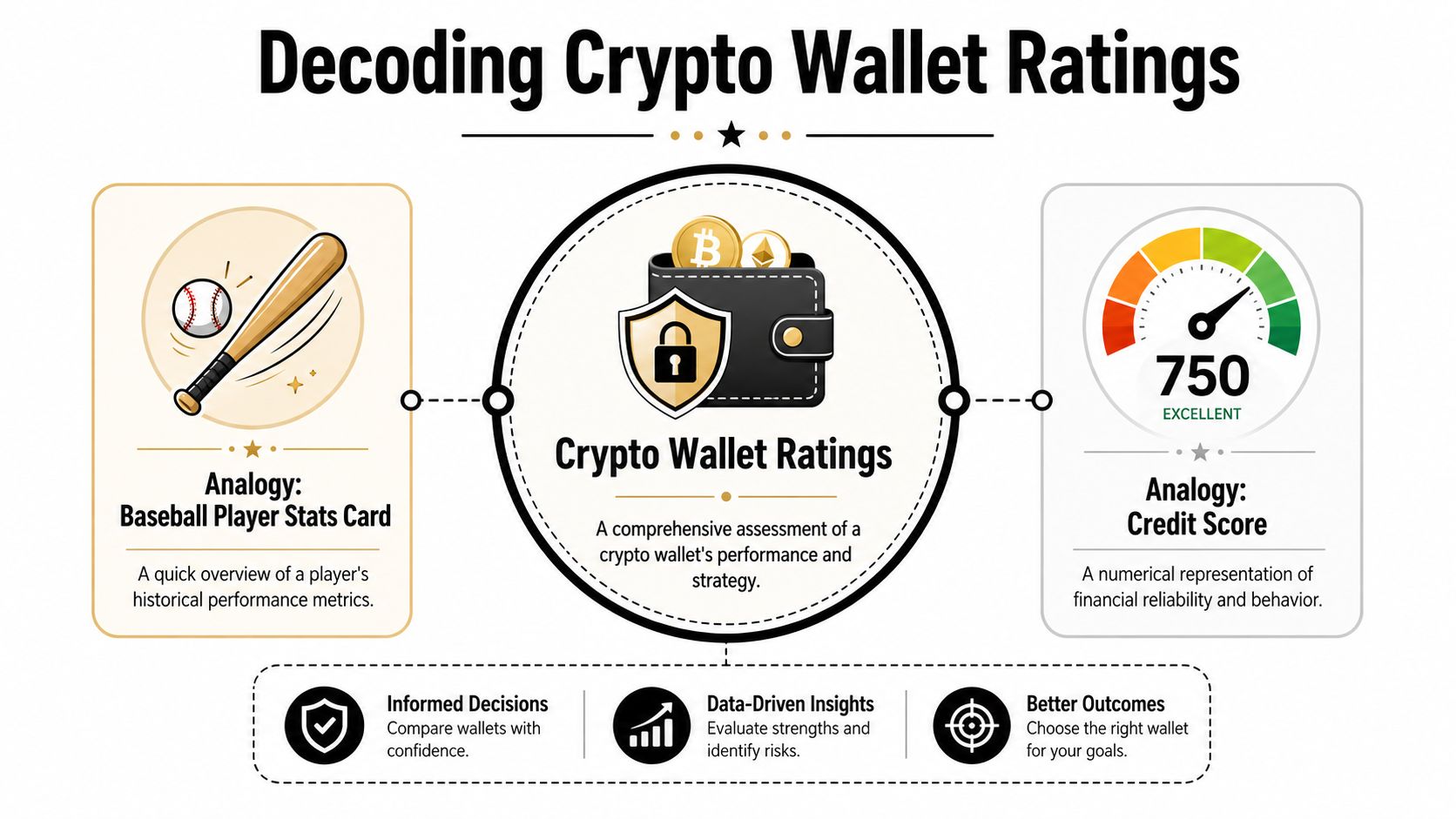
A leaderboard usually sorts wallets by one output, most often profit. That's fast, but it's blunt. It rewards extreme outcomes and hides process quality.
A rating model is stronger because it can combine multiple dimensions. Another industry description referenced by Formo notes five broad buckets commonly used in wallet scoring:
| Dimension | What it captures | Why it matters |
|---|---|---|
| User activity | Participation and usage patterns | Helps separate active operators from dormant addresses |
| Developer behavior | Technical or builder-linked signals | Adds context when a wallet is tied to ecosystem work |
| Financial metrics | Capital movement and economic behavior | Improves assessment beyond a simple profit snapshot |
| Adoption | Breadth of use or integration | Suggests whether the wallet is meaningful in context |
| Community strength | Social or network-linked credibility | Useful when filtering low-signal or synthetic accounts |
For copy trading, a wallet rating should answer three practical questions.
Can this wallet be trusted as a signal source?
You want evidence of real behavior, not manufactured activity.
Is the activity strong enough to matter?
A wallet with sparse history can look clean because there isn't enough data to expose weakness.
Does the behavior fit your strategy?
A wallet may score well overall but still be a poor fit if you trade shorter timeframes, lower liquidity pairs, or tighter risk.
Good wallet ratings don't replace judgment. They compress the search space so your judgment is used on the right candidates.
A trading-oriented score needs to go beyond generic reputation signals. If you're trying to identify wallets worth following, six pillars matter most: returns, consistency and risk, win rate, position sizing and conviction, trade timing, and portfolio diversity.
The best models don't treat these pillars equally in every context. A swing wallet and a sniper wallet can both be valuable, but the signal only holds if you understand why the score is high.

| Metric | What It Measures | Why It's Critical for Traders |
|---|---|---|
| Returns | Profitability across closed and open positions | Shows whether the wallet actually creates value |
| Consistency and risk | Stability of outcomes and downside control | Helps filter wallets that are profitable but chaotic |
| Win rate | Share of successful trades | Adds context to strategy quality, but never stands alone |
| Position sizing and conviction | How capital is allocated across ideas | Reveals discipline and whether sizing supports the edge |
| Trade timing | Quality of entries and exits | Distinguishes early, deliberate action from late chasing |
| Portfolio diversity | Concentration across assets and themes | Helps identify fragility, style drift, and hidden risk |
Returns answer the first question everyone asks. Did this wallet make money?
That matters, but only as a starting filter. Strong total PnL or ROI tells you there may be signal worth studying. It doesn't tell you whether the process is copyable. A wallet that made most of its gains from one thin token can rank high on returns and still be dangerous to mirror.
In practice, use returns to narrow the field, not to make the decision.
A common shortcoming of weak wallet analysis is that a trader can post impressive gains while swinging through large drawdowns, chasing reversals, or rotating capital with no clear control of downside.
A high-quality wallet score should reward steadier outcomes and punish unstable equity curves. If you use risk-adjusted measures such as Sharpe-like or Sortino-like logic, the goal is simple. Favor wallets that produce gains without repeated deep damage to capital.
A related concept is drawdown. You don't need a wallet that never loses. You need one whose losing periods still look intentional.
Desk note: If a wallet only looks good at the end of the chart, it's probably not a strong signal source.
For a practical framework on what to review in profitable wallets, the guide on key metrics for identifying profitable wallets is a useful benchmark.
A visual walkthrough helps here:
A high win rate feels safe. It often isn't.
Some excellent traders run lower win rates because they cut losers quickly and let winners run. Some weak wallets show a flattering win rate because they scalp tiny gains and eventually absorb one oversized loss.
Read win rate alongside average winner quality, loss containment, and holding behavior. A score should treat win rate as supporting evidence, not as the core signal.
Sizing tells you whether the trader understands conviction. Good wallets usually size differently when conditions differ. They don't spray equal amounts into every token, and they don't repeatedly commit too much capital to low-liquidity noise.
Look for signs that larger allocations line up with stronger setups, cleaner timing, or repeated areas of expertise. When sizing is random, the wallet usually is too.
Two wallets can buy the same asset and have very different informational value. One entered before expansion. The other bought after momentum was already obvious.
That's why timing should influence rating quality. You want wallets that tend to enter before the crowd and manage exits with discipline. Late entries and emotional exits create slippage for the original trader and even worse execution for anyone copying them.
Diversification isn't always good by default. Some of the strongest wallets specialize. But a score should still examine whether a wallet is overly dependent on one sector, one token type, or one style regime.
Use diversity as a diagnostic tool:
The rating should capture whether diversification reflects skill or drift.
Numbers become more useful when you attach them to behavior. In practice, most wallets cluster into a few recognizable archetypes. The labels below are simplified, but they help teams avoid judging every address by the same template.

This wallet trades selectively. Activity is low, but the entries are sharp and usually early. The trade history often shows patience, then a concentrated burst of action around a small set of opportunities.
Mini-dashboard view:
The trap with the sniper is overconfidence. Because the wallet avoids noise, every trade can look deliberate. But low activity makes false positives harder to detect.
This is usually the most useful wallet type for systematic follow-up. The wallet doesn't need perfect entries. It needs repeatable exposure management, sensible holds, and exits that preserve edge.
What stands out is balance. The trader might not lead every move, but the wallet often scores well across multiple dimensions at once.
| Trait | Typical reading | Interpretation |
|---|---|---|
| Returns | Solid | Good enough to matter |
| Consistency | Stable | Often the strongest part of the profile |
| Win rate | Moderate | Fine if losses stay controlled |
| Sizing | Structured | Capital tends to match conviction |
| Timing | Good, not perfect | Still copyable because process is coherent |
For most desks, this archetype is easier to operationalize than the more extreme profiles.
This wallet is noisy, opportunistic, and sometimes spectacular. It may have many failed attempts mixed with a handful of outsized wins.
The score should not ignore this kind of wallet, but it should interpret it carefully:
Some wallets are valuable because they predict narratives. Others are valuable because they execute well. Don't confuse the two.
If your process treats all three archetypes the same, the rating model will mislead you.
A rating is only useful if it changes what you do next. The practical move is to turn scores into a screening process, then into a watchlist, then into execution rules.
Don't begin by reviewing top-ranked wallets manually. Set minimum standards first so you eliminate obvious noise.
A workable checklist looks like this:
The filtering logic matters more than the exact threshold. Tight filters reduce clutter. Loose filters improve idea flow. The right setting depends on whether you want copyable execution or early narrative discovery.
When traders build watchlists, they often chase the highest output wallets first. That usually leads to unstable copying results.
A better order of operations is:
That sequence improves follow-through. It also keeps the team from loading into wallets that look good only in hindsight.
For a practical screening workflow, the article on five steps for screening profitable wallets maps cleanly to this process.
A strong watchlist usually combines different wallet types instead of chasing one style.
Consider structuring it this way:
That mix gives you flexibility. It also helps when one style stops working.
Execution filter: If you can't explain how you'd copy the wallet before the alert arrives, it probably doesn't belong on your active list.
Before acting on any wallet, inspect recent behavior. Some wallets degrade subtly. Others shift style, reduce activity, or start trading assets that don't fit your own execution constraints.
A rating should open the door. The recent tape decides whether you walk through it.
Most wallet analysis breaks at the implementation step. Traders agree on what they want to see, then end up juggling explorers, spreadsheets, and fragmented alert tools. That slows decision-making and makes it harder to compare wallets consistently.
A platform built for wallet research should map directly to the rating logic above. The important features are straightforward: wallet discovery, multi-metric filtering, transparent trade history, and alerts tied to actual activity.

Using Wallet Finder.ai, a trader can move from broad discovery into targeted review without rebuilding the process for each chain. The platform tracks blockchain wallets across major ecosystems, surfaces trading histories, and lets users filter by factors such as returns, consistency, recent gains, and wallet behavior.
That matters because each stage of the scoring model needs a matching interface:
A tool can compress research time. It can't replace judgment.
Use the platform for what software is good at: aggregating, sorting, surfacing, and monitoring. Use your own process for what still requires trader discretion: deciding whether a wallet's style is copyable, whether the recent regime supports the strategy, and whether the execution quality translates to your size and speed.
That division of labor is what makes wallet ratings practical. The model creates structure. The tool makes that structure usable day to day.
Wallet ratings are powerful, but they can still mislead you if you treat them like truth instead of a decision aid.
The first risk is survivorship bias. You notice the wallets that made it through the screen. You don't see all the failed wallets that used the same style and disappeared. The second risk is overfitting. A wallet can score well because it matched one market regime unusually well, then lose relevance when conditions change.
There's also signal fabrication. In crypto, some wallets are designed to look attractive from a distance. Fragmented activity, selective visibility, and shallow history can create the illusion of quality if the rating model is too simple.
A strong operating rule is to treat ratings as the start of research, not the end.
Use these checks before assigning real capital:
The traders who stay ahead don't just find strong wallets. They keep re-underwriting them.
Wallet research works best when discovery, filtering, and monitoring happen in one repeatable workflow. If you want a tool built for that job, Wallet Finder.ai lets you screen onchain wallets, inspect full trading histories, build watchlists, and track live activity so wallet ratings become something you can use in a trading process.