Your Guide to the Crypto 2FA Code
Secure your assets with our guide to the crypto 2FA code. Learn how to set up, manage, and recover 2FA to protect your portfolio from hackers.

April 6, 2026
Wallet Finder

March 8, 2026

If you've ever dipped your toes into decentralized finance (DeFi), you know it can feel like the Wild West. Thousands of tokens launch daily across dozens of blockchains, and keeping track is a massive headache. Before tools like Dexscreener came along, it was like navigating a global market with no flight tracker—just a chaotic mess of individual exchanges.
Dexscreener cuts through that noise. Think of it as your all-in-one command center for real-time data from decentralized exchanges (DEXs). It pulls in live prices, trading volumes, and liquidity information from hundreds of sources and puts it all into a single, clean dashboard.
This isn't just about convenience; it's about giving regular traders the same kind of comprehensive market view that was once incredibly difficult and expensive to get.
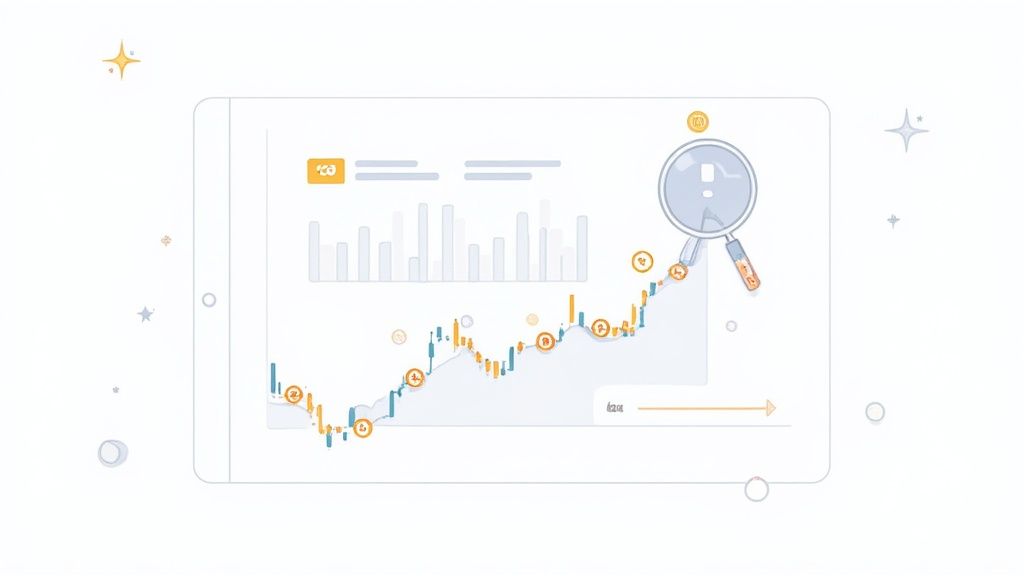
A quick look at the main dashboard gives you a powerful overview. You can immediately see which token pairs are trending, what new coins have just been listed, and which ones are soaring (or crashing) across different networks. It’s all designed to help you spot opportunities the second they appear.
The real magic of Dexscreener is how it aggregates and presents on-chain data. Instead of jumping between a dozen different websites to check prices on Uniswap, then PancakeSwap, then Raydium, you get one unified source of truth.
This unlocks a ton of actionable advantages for traders:
By centralizing all this info, Dexscreener gives you the big-picture context you need to trade smarter. After all, decentralized exchanges are the very foundation of DeFi. If you want a deeper dive into how they work, check out our guide on what a DEX does.
At its core, Dexscreener makes on-chain data accessible to everyone. It translates the raw, complex information from the blockchain into simple, actionable insights, leveling the playing field for retail traders.
The platform has quickly become an indispensable tool for anyone serious about DeFi. It monitors over 80 blockchain networks and hundreds of DEXs, tracking literally thousands of tokens in real time. This incredible scope makes it one of the most complete analytics platforms out there.
To give you a clearer picture, here’s a quick breakdown of what makes Dexscreener so essential for modern traders.
Dexscreener's feature set is built around one goal: turning the firehose of on-chain data into something a trader can act on immediately. Its real-time charts and data form the foundation — every token pair page delivers live candlestick charts, order books, and a transaction feed that updates within seconds of each on-chain confirmation, giving traders the current market picture they need to make timely decisions rather than acting on stale information.
That live data spans an exceptionally wide surface. Multi-chain coverage across more than 80 blockchains — including Ethereum, Solana, and Base — means traders are not forced to jump between chain-specific tools to see what is happening across the broader DeFi ecosystem. Everything lives in a single interface.
For traders who cannot watch the screen constantly, the watchlists and price alerts system handles the monitoring work automatically. You define the assets you care about and the price levels that matter, and the platform notifies you when conditions are met rather than requiring you to check manually. The New Pairs and Gainers/Losers sections complement this by surfacing the market's most active edges — newly listed tokens the moment they receive liquidity, and the day's biggest movers — so early opportunities are visible before they reach mainstream attention.
Advanced filtering ties the discovery layer together. Sorting and filtering by liquidity, volume, age, and blockchain lets traders define their own criteria and surface only the pairs that match, cutting through the noise of thousands of simultaneous listings. Finally, the platform's built-in security information — flagging low liquidity, smart contract risks, and other common warning signs — provides a first line of defense against scams directly within the same workflow, without requiring a separate tool for basic risk screening.
This combination of features turns what would otherwise be a chaotic flood of information into a structured, manageable, and ultimately profitable resource for traders of all levels.
To really get what Dexscreener is all about, you have to roll up your sleeves and dive into its core features. Think of these tools as the engine room of the platform, turning a firehose of raw blockchain data into a personalized market dashboard that actually makes sense. It’s way more than a simple price checker; it's about building a proactive, informed trading strategy.
The first thing you'll notice is the real-time charting. Every token pair page is dominated by a detailed candlestick chart that tells you the story of its price action. This isn't just some basic line graph. It’s a powerful tool for visualizing market sentiment, spotting trends, and nailing down your potential entry or exit points with a lot more confidence.
Beyond the charts, the real magic is in the customization. Dexscreener isn’t trying to drown you with every single token out there. Instead, it’s designed to help you find the exact pairs that fit your specific strategy, and that's where its screening and filtering tools really come into play.
The "New Pairs" section, for instance, is a goldmine for anyone hunting for that next moonshot. It's a live feed of tokens the second they get listed on a DEX.
You get a clean list of newly created trading pairs, which you can then filter by blockchain and other key metrics.

Right away, you can see critical data like liquidity, age, and initial price moves. This lets you vet brand-new opportunities in seconds.
This is where things get powerful. You can set up custom filters to automatically weed out the junk—like pairs with dangerously low liquidity or those with suspicious-looking launch pumps. For example, you could create a filter for tokens on the Base network that are less than 24 hours old but have already pulled in over $50,000 in liquidity.
Finding a promising token is only half the battle; you also have to keep tabs on it. Dexscreener gives you two essential tools for this: Watchlists and Price Alerts.
By combining powerful filters with custom watchlists and alerts, you shift from being a reactive market observer to a proactive strategist. You define your ideal conditions and let the tool do the heavy lifting of monitoring the market for you.
The platform also integrates advanced charting tools from TradingView, letting you layer on technical indicators like moving averages (MA) and the relative strength index (RSI) for deeper analysis. On top of that, you can use customizable screeners with metrics like volume, price change, liquidity, and market cap across its massive network of 60+ chains and hundreds of DEXes.
If you want to see how Dexscreener stacks up against other powerful platforms, check out our guide on the 7 best DeFi analytics tools for crypto traders. This combination of real-time data and advanced tools makes Dexscreener a powerhouse for any serious trader.
Staring at a Dexscreener token page for the first time can feel like trying to read another language. But once you know where to look, all that complex data starts to tell a pretty clear story about a token’s health and momentum. This is the whole point of using a tool like Dexscreener—to cut through the noise and make smarter decisions.
The screen is really broken down into three main zones:

Get a handle on these three sections, and you'll be able to size up a token in seconds.
The chart gives you the history, but the data panel is the "right now." It's a snapshot of the token's current vitals, giving you crucial context for the price wicks you see on the chart. If you ignore these numbers, you’re flying blind.
Here are the must-know metrics to lock in on:
These aren't just random numbers; they’re vital signs. A token with $5 million in liquidity is playing in a totally different league than one with $5,000.
A classic rookie mistake is getting fixated on price alone. Price can be manipulated easily, especially with low-cap coins. Metrics like liquidity and trading volume paint a much more honest picture of where a token actually stands.
If the data panel is the token's vitals, the live transaction feed is its real-time pulse. Every single buy (green) and sell (red) pops up here the second it's confirmed on the blockchain. It's your ground-level view of what the market is feeling right now.
This feed lets you see the size of each trade, whether it’s a bunch of small fish or a few big whales moving the price. A long stream of big green buys? That's a good sign of bullish momentum building up. A flood of tiny red sales? That could be panic setting in or traders taking profits.
By just watching this feed for a minute, you can often get a gut feeling for a token’s next move before the chart even has time to catch up.
Dexscreener isn't a one-size-fits-all tool. Its real magic comes alive when you bend its features to fit your specific trading style. Whether you’re a degen hunting for the next 100x gem or a methodical analyst studying market undercurrents, the platform has a path for you.
The trick is knowing which buttons to push. A trader chasing explosive, short-term flips will use the platform completely differently than someone researching long-term trends. Let’s break down a few practical playbooks for different kinds of traders.
If you live for the adrenaline rush of new token launches, Dexscreener is your command center. Your goal is simple: find promising projects the second they’re born, long before they hit the crypto news circuit.
Your entire strategy hinges on the "New Pairs" filter. Think of it as a live, unfiltered feed of every new token the moment it gets liquidity on a decentralized exchange.
Here's an actionable plan:
The name of the game isn't just being first; it's being the first to spot a real project. Use liquidity and transaction diversity as your first line of defense against the most common scams.
Swing traders aren't looking for instant flips; they’re trying to ride a wave of momentum over a few days or weeks. Your goal is to spot established tokens with clear trends and capitalize on the bigger price swings. For you, Dexscreener’s charts and alerts are indispensable.
Here is a practical workflow:
The on-chain researcher, or crypto analyst, plays a different game entirely. You’re less concerned with hourly price wicks and more interested in the story the blockchain is telling. Who is buying? Who is selling? What is the "smart money" up to?
Your strategy is all about dissecting transaction data:
Every trader has a different goal, and Dexscreener provides the right tool for each job. The key is matching the feature to the objective.
Here's that table rewritten as prose:
Different trading goals call for different corners of the Dexscreener feature set. The New Token Hunter is chasing high-potential launches before they gain broader attention, which makes the New Pairs filter and live transaction feed the primary tools. A practical strategy here is filtering for new pairs on Base with more than $10,000 in liquidity and then watching the transaction feed for diverse buyer activity — many unique wallets rather than a handful cycling capital back and forth — as the early signal of genuine interest.
The Swing Trader is playing a longer game, looking to capture medium-term price movements over days or weeks rather than minutes. Price alerts and the integrated TradingView charts are the core tools for this style. A typical workflow involves identifying a key resistance level on the chart using moving averages, then setting a price alert at that level so the platform handles the monitoring and triggers action only when the setup actually materializes.
The On-Chain Researcher is less interested in price mechanics and more focused on understanding what informed, high-capital participants are actually doing. The live transaction feed and top traders view are the entry points here — specifically, scanning for large recurring buy orders from a single wallet address, which can indicate systematic accumulation by a wallet with a track record worth following. From there, copying that address into a dedicated wallet tracker completes the picture by revealing the wallet's full history and broader portfolio behavior.
Ultimately, whether you're sniping new launches or analyzing established assets, these strategies show how a single tool can serve wildly different needs, giving you a crucial edge in your on-chain analysis.
While Dexscreener gives you an incredible amount of raw data, it’s critical to remember what it is—and what it isn’t. Think of it as a highly advanced scanner, not a security guard. It shows you everything happening on-chain, the good and the bad, without making any judgments.
This means the responsibility to tell the difference between a real project and a scam falls squarely on your shoulders. The platform is purely an analytics tool, not a vetting service. Just because a hot new token pops up on Dexscreener doesn't mean it's safe or legitimate. The data is only the starting point for your own research, not the final word.
The decentralized world can be a bit of a minefield, with everything from outright scams to just poorly designed projects. The great thing is, Dexscreener’s data can help you spot the warning signs before you even think about putting money in. You just have to know what to look for.
Here's a checklist of common red flags:
Dexscreener gives you the tools to identify these risks, but it won't hold your hand. Your greatest asset is skepticism. Always assume a new token is a risk until your research proves otherwise.
Dexscreener's powerful position in the market has made it a major player. As a profitable venture within the crypto infrastructure, its revenue metrics show it competes directly with other top DeFi analytics platforms. This success is fueled by millions of users who rely on it daily across dozens of blockchain ecosystems. You can see just how well it’s doing with these in-depth revenue metrics on TokenTerminal.
Ultimately, a sustainable trading strategy involves using its data as one piece of a much larger puzzle. Combine what you find on Dexscreener with actual project research—read the whitepaper, check the team's background, and see what the community is saying. This balanced approach is your best defense out there.
Look, the best traders don’t just make trades; they build systems. Dexscreener is an amazing tool on its own, but it becomes a real powerhouse when you plug it into a bigger on-chain research workflow. It’s fantastic for the discovery phase—that initial hunt for tokens with hot volume and surging interest. But that's just step one.
The real magic, the alpha, happens when you connect that discovery power with deep wallet analysis. A pro-level workflow takes you from staring at charts to building a full-blown strategy for tracking traders who actually move markets. It’s the difference between chasing hype and acting with cold, hard conviction.
This process is straightforward but incredibly effective for turning a promising token into a trade you can believe in.
Following a structured process like this helps you build a much more resilient crypto trading strategy. This infographic breaks down a basic risk management flow to keep in mind as you work.

As the visual shows, it’s all about spotting red flags early, properly validating the project, and then trading safely. This integrated approach—combining Dexscreener's discovery features with the deep dive of wallet tracking—is the foundation of solid on-chain analysis. It’s how you turn raw, noisy data into a genuine trading edge.
Every serious DeFi trader eventually runs into the same question: Dexscreener is clearly useful, but is it the best option for my specific workflow? The answer depends on exactly what you need from an analytics platform. Dexscreener, DEXTools, and Birdeye are the three most widely used on-chain analytics tools in 2025, and each makes different trade-offs between breadth, depth, cost, and specialization. Understanding those trade-offs precisely means you can build a toolkit that matches the way you actually trade rather than defaulting to whichever platform you happened to discover first.
The comparison below goes deeper than surface-level feature lists. It examines how each platform performs on the specific tasks that matter most to active traders — token discovery speed, security screening depth, wallet tracking capability, chain coverage, and the practical cost of unlocking the features that make a real difference.
Dexscreener's core competitive advantage is breadth and accessibility. Its coverage of over 80 blockchain networks is the widest of any free analytics platform, and its automatic listing of new token pairs within seconds of liquidity pool creation makes it the fastest discovery surface in the market. When a new token launches on Solana, Base, or any of the dozens of supported chains, it appears on Dexscreener's New Pairs feed before it is visible on any competing platform's equivalent view.
The free tier provides access to essentially the full feature set that most traders use daily — real-time charts with TradingView integration, the new pairs feed, advanced filter combinations, watchlists, price alerts, and the live transaction feed. This is a meaningful differentiator. Competing platforms restrict their most useful features behind paid tiers, which creates a real cost barrier for traders who are not yet generating consistent returns. Dexscreener removes that barrier entirely for core functionality.
Where Dexscreener trades off depth for breadth is in its security screening layer. The platform surfaces basic liquidity metrics and flags certain risk indicators, but it does not offer the comprehensive trust scoring system that DEXTools provides, nor the integrated portfolio-level risk view that Birdeye specializes in. For a trader whose primary workflow is rapid new-token discovery and initial screening, Dexscreener handles the job better than any alternative. For a trader who needs deep security validation as part of the same interface, a secondary tool is necessary.
The platform's sniper bot detection on Solana — which identifies automated bots frontrunning new token launches — is a genuinely unique feature with no direct equivalent on competing platforms, though its current limitation to Solana reduces its utility for multi-chain traders.
DEXTools positions itself as the professional-grade option in the analytics space, and its feature set reflects that ambition. The platform's DEXT Score — a composite trust metric combining liquidity, holder distribution, contract audit status, trading history, and community verification signals — provides a single numerical judgment on a token's security profile that Dexscreener's individual data points require you to assemble manually. For traders who want a pre-packaged risk assessment rather than raw data to interpret themselves, this is a meaningful time saver.
The platform's Smart Dex trading terminal integrates analytics and execution in the same interface, eliminating the workflow step of moving between Dexscreener for analysis and a DEX front-end for execution. For high-frequency traders where that context-switch creates meaningful friction, Smart Dex is a practical advantage.
DEXTools' primary cost is its pricing model. Full access to the features that make it meaningfully better than Dexscreener — particularly the DEXT Score, advanced pool explorer, and Smart Dex — requires either holding a minimum balance of DEXT tokens or paying for a premium subscription. The free tier provides basic data that does not differentiate it from Dexscreener. This creates a real question about value: for traders who would otherwise use Dexscreener for free and complement it with dedicated security checkers like Token Sniffer or Honeypot.is, paying for DEXTools premium is only worthwhile if the convenience of integrated security scoring justifies the cost.
Chain coverage is also narrower than Dexscreener. DEXTools supports the major EVM networks and Solana comprehensively but has less depth on newer or emerging chains where Dexscreener's broader indexing provides an advantage for traders following new ecosystem activity.
Birdeye was built primarily around the Solana ecosystem before expanding to additional chains, and its Solana analytics remain the deepest of any platform in the comparison. For traders whose activity is concentrated on Solana — where memecoin volume and new project launches are particularly high — Birdeye's token intelligence, wallet tracking integration, and portfolio management tools are collectively more powerful than either Dexscreener or DEXTools on that specific chain.
The platform's wallet tracking and trader portfolio view is its clearest functional advantage over Dexscreener. While Dexscreener surfaces individual large transactions in the live feed and allows manual address lookups, Birdeye builds out a more structured view of tracked wallets' complete portfolio composition, historical performance, and current positions. For a trader whose primary strategy involves following specific high-performance wallets rather than scanning for new tokens, Birdeye's wallet intelligence layer provides more structured data in a single view.
The trade-off is chain breadth and new-token discovery speed. Birdeye's strength is depth on a focused set of chains rather than instant coverage of new listings across 80 networks. For traders who operate primarily on Solana and prioritize wallet intelligence over broad market scanning, it is the strongest single-platform option. For traders who need cross-chain visibility and the fastest new-pair discovery, Dexscreener remains the starting point.
The most efficient professional workflow treats these platforms as complementary layers rather than competing alternatives. Dexscreener handles the discovery layer — finding new tokens quickly across the widest possible chain coverage, with its free filters screening out the lowest-quality listings by liquidity and transaction count thresholds. DEXTools handles security depth when a token passes initial discovery screening and requires a more rigorous trust assessment before a larger position is considered. Birdeye handles wallet intelligence on Solana-focused strategies, providing the structured portfolio view of tracked wallets that Dexscreener's transaction feed does not match.
The critical point is that this full stack is available at zero subscription cost for most traders. Dexscreener and Birdeye's core features are free. DEXTools' DEXT Score and basic analytics are accessible without a paid tier if you hold a minimal DEXT balance, which at current prices is a modest outlay. A trader building this workflow is not choosing between platforms — they are using each for the task where it genuinely excels.
One of the most practically important things to understand about Dexscreener — and the topic that competitor guides in this space almost universally avoid — is the relationship between paid promotions, boosted listings, and the trending sections that most traders use as a discovery signal. Understanding this relationship does not make Dexscreener less useful. It makes you a substantially better user of the platform because you stop treating every trending signal as organic and start filtering for the ones that are.
This section covers exactly how the promotion system works, what it means for the quality of tokens appearing in high-visibility sections, and how to distinguish paid visibility from genuine market momentum.
Dexscreener operates a transparent paid promotion model where token projects can purchase Boosts — a system that increases a token's visibility score and moves it higher in the trending rankings. Boosted tokens display a visual flame indicator next to their listing. The more boosts a token has purchased, the more prominently it appears in the trending sections that traders scan for discovery signals.
The platform requires advertisers to complete a KYC verification process and charges meaningful fees for boost placements. This creates a cost barrier that filters out some low-effort scam projects — launching and funding a boost campaign requires more resources than simply deploying a contract and creating a liquidity pool. However, it does not filter out well-funded scam operations, which exist in meaningful numbers in the current DeFi environment and can easily afford boost fees as a cost of attracting victims to their token.
The practical implication is that the trending section on Dexscreener reflects a combination of organic trading activity and purchased visibility. A token can achieve a high trending rank through either genuine trader interest generating volume, paid boosts purchasing position, or — most commonly — a combination of both, where a project uses boosts to achieve initial visibility and then synthetic volume generation to sustain it. The trending rank alone cannot tell you which combination is responsible for a token's position.
The metrics that reveal the difference between organic and paid trending are available on Dexscreener itself, but they require looking at more than the trending rank. A token with genuine organic momentum will show several characteristics that a boosted-but-artificial listing typically does not.
Unique buyer count is the most reliable signal. A trending token with 200 unique buyers in the last hour is generating real, distributed interest. A trending token with a high boost flame count but only 15 to 20 unique buyers in the same window is almost certainly combining paid visibility with wash trading between a small number of controlled wallets. Dexscreener displays unique buyer and seller counts directly on the token pair page — this number should be your first check on any trending token rather than the trending rank itself.
Buy-to-sell ratio diversity provides a second filter. On a genuinely popular token, the live transaction feed will show a mix of transaction sizes from many different wallet addresses. On a artificially boosted token, you will often see a distinctive pattern: clusters of same-sized buy transactions from different addresses in rapid succession, which is the signature of automated wallet cycling, followed by much larger sell transactions from a small number of addresses. Watching the feed for 60 to 90 seconds before acting on any trending discovery provides a basic but effective behavioral screen.
Liquidity-to-market-cap ratio is the third signal. A token with a $2 million market cap and only $40,000 in liquidity — a ratio of 50:1 — is structurally vulnerable to price collapse on relatively small sell pressure. Organic retail interest in a token tends to build liquidity and market cap in a more proportional relationship. An extremely high market cap relative to liquidity, especially in a newly trending token, is a characteristic sign of artificial price inflation rather than genuine accumulation.
When you see the flame icon next to a token on Dexscreener, it tells you one specific thing: the project has invested money in purchasing visibility on the platform. It does not tell you whether the project is legitimate, whether the token has genuine holder demand, or whether the trending position reflects real market activity. Treating the boost flame as a positive signal — which many new traders implicitly do, associating paid promotion with project confidence — is a mistake that the platform's own documentation does not encourage but that the visual design can inadvertently reinforce.
The correct interpretation of a boost flame is neutral. It is a data point indicating that the project has marketing resources and chose to spend them on Dexscreener visibility. Combined with strong unique buyer counts, proportional liquidity depth, diverse transaction sizes, and a clean contract verification, a boosted token can be a legitimately interesting discovery. Without those supporting signals, a boost flame should increase rather than decrease your skepticism, since well-funded scam operations are specifically incentivized to invest in the visibility infrastructure that attracts traders who trust trending signals uncritically.
Using Wallet Finder alongside Dexscreener trending data provides an important additional filter layer: if a token is appearing in Dexscreener's trending section but no verified high-performance wallets have established positions in it, that absence of smart money participation is a meaningful signal that the trending position may be primarily promotional rather than reflecting genuine informed buying.
Got questions? You're not alone. When you're diving into a new tool, a few things are bound to pop up. Here are some quick, straightforward answers to the most common questions traders ask about Dexscreener.
Yes, it's about as accurate as you can get. Dexscreener taps directly into the blockchains themselves, which means the prices, transaction histories, and liquidity numbers you see are pulled straight from the source. Everything updates within seconds of a new block being confirmed on-chain.
Of course, no system is perfect. If a specific blockchain is experiencing serious network congestion, you might see a slight delay. But for the most part, you can trust that what you’re looking at is a live, accurate picture of what's happening in the market.
Nope. This is a big one to remember: Dexscreener is strictly an analytics and charting tool. Think of it as your command center for market intelligence, not a trading terminal. Its entire purpose is to help you find opportunities and dig into token data.
When you're ready to buy or sell a token you've found, you'll need to head over to the actual decentralized exchange (DEX) where the token's liquidity pool lives—like Uniswap, Raydium, or PancakeSwap—and connect your own crypto wallet to make the trade.
Dexscreener gives you the map and the compass, but you still have to drive the car. It shows you where to go, but the actual trading happens on the DEX itself.
Amazingly, yes. All the core functionality that makes Dexscreener so powerful is completely free. That includes all the must-have features for solid on-chain analysis:
The platform supports itself with ads, which is how they keep these incredible tools available to every trader without a subscription fee. This commitment to free access is a huge reason why it has become such a staple in the DeFi community.
The two platforms take meaningfully different approaches to security. Dexscreener provides raw on-chain data — liquidity figures, holder concentration, transaction history, and basic risk flags — and leaves the interpretation to the trader. DEXTools provides the DEXT Score, a composite trust metric that aggregates multiple security signals into a single numerical rating, which requires less manual interpretation but also abstracts away the underlying data that experienced traders often want to see directly.
For most traders, the practical workflow is to use both rather than choosing between them. Dexscreener's speed and breadth make it the better discovery tool — it indexes new tokens faster and across more chains. Once a token passes initial discovery screening on Dexscreener, a DEXTools check provides a more structured security assessment before committing capital. The full Dexscreener feature set is free. DEXTools requires either a DEXT token balance or a paid subscription to access its most differentiated features. For traders who prefer a single-platform workflow and are willing to interpret raw security data themselves, Dexscreener combined with a dedicated honeypot checker covers the majority of use cases at zero cost.
The flame icon next to a token on Dexscreener indicates that the project has purchased promotional boosts, which increases its visibility score and positions it higher in the trending rankings. The boost system is transparent — Dexscreener requires KYC verification from advertisers and charges fees for placement — but it means that the trending sections of the platform reflect a combination of organic trading activity and paid positioning rather than purely organic market signals.
A boost flame is a neutral data point, not a positive one. It tells you the project has marketing resources; it tells you nothing about the project's legitimacy, the token's fundamental quality, or whether the trending position reflects genuine trader demand. Always check unique buyer counts, liquidity depth, and the live transaction feed independently of the trending rank before acting on any boosted token discovery. If no verified high-performance wallets have established positions in a heavily boosted token, treat that absence as a cautionary signal.
Dexscreener does not currently offer native wallet-based alerts — its alert system is built around price levels and token pair activity rather than specific wallet addresses. You can identify large transactions from a specific wallet by watching the live transaction feed on a token pair page, or by manually looking up a wallet address in the transaction history, but these are reactive research actions rather than proactive alert triggers.
For real-time notification when a specific wallet executes any trade — buy, sell, or swap — across any token, a dedicated wallet tracking platform is necessary. This is the core use case for Wallet Finder.ai, which allows you to build a watchlist of verified high-performance wallets and receive Telegram or push notifications the moment those wallets confirm a new transaction on-chain. The combination of Dexscreener for broad market scanning and Wallet Finder for smart money wallet alerts covers both discovery vectors in a single workflow — market-wide signal scanning and targeted tracking of wallets with demonstrated early-entry track records.
Ready to turn your on-chain discoveries into actionable strategies? Wallet Finder.ai helps you find and track the smartest wallets in DeFi. See what the pros are trading, get real-time alerts, and mirror their moves before the market catches on. Start your 7-day trial and elevate your trading today at https://www.walletfinder.ai.