Unlocking Yield Farming Rewards

Wallet Finder

Blank calendar icon with grid of squares representing days.

February 27, 2026

Yield farming rewards are incentives paid to users who lend or stake their crypto in a DeFi protocol. Think of it as earning a supercharged interest rate on your digital assets for helping a decentralized financial ecosystem function. These rewards, typically paid in the protocol's native token, compensate you for providing the essential liquidity that powers token swaps, lending, and other services.

The Foundation of Yield Farming Rewards

Yield farming is a symbiotic relationship: you provide the capital a DeFi protocol needs to operate, and in return, the protocol rewards you for it. Without liquidity providers like you, a DeFi platform is just inert code. You are the one who brings it to life.

Imagine a new currency exchange. To function, it needs an initial supply of different currencies. In DeFi, you are the one supplying those assets, and the yield farming rewards are your payment for keeping the market liquid and efficient.

Why Protocols Pay for Liquidity

DeFi platforms offer rewards as a strategic investment in their own growth and stability. The liquidity you provide, locked in what are called liquidity pools, is the lifeblood of their operations.

Here’s an actionable breakdown of why your liquidity is so valuable:

  • Enabling Trades: Decentralized exchanges (DEXs) like Uniswap require deep pools of tokens to facilitate instant swaps without causing drastic price fluctuations.
  • Powering Lending: Lending protocols like Aave need a large reserve of assets for users to borrow against. Your deposits create this supply.
  • Building Credibility: High rewards attract capital, which increases the protocol's Total Value Locked (TVL). A high TVL is a key metric that signals trust and reliability to the broader market.

By offering attractive rewards, protocols create a growth flywheel: more rewards attract more liquidity, which enhances the platform's utility, which in turn draws in more users and even more capital.

The Give-and-Take Exchange

The system is a clear value exchange. As a liquidity provider (LP), you lock your crypto into a smart contract, accepting certain risks. In return, the protocol gives you a share of the value generated, which can come from:

  • A portion of trading fees paid by users.
  • Newly minted reward tokens distributed as an incentive.

Understanding this fundamental transaction is your first step. You're not just a passive holder; you're an active participant fueling a new financial paradigm. Now, let's explore how these rewards are generated and how you can maximize them.

The Mechanics of Earning Your Rewards

So, how does a protocol actually generate and distribute those yield farming rewards? It's not a single mechanism but a combination of methods, each contributing to your overall return. Understanding these engines is key to building a strategic approach.

At its core, the process is straightforward: you deposit your assets, and the protocol rewards you.
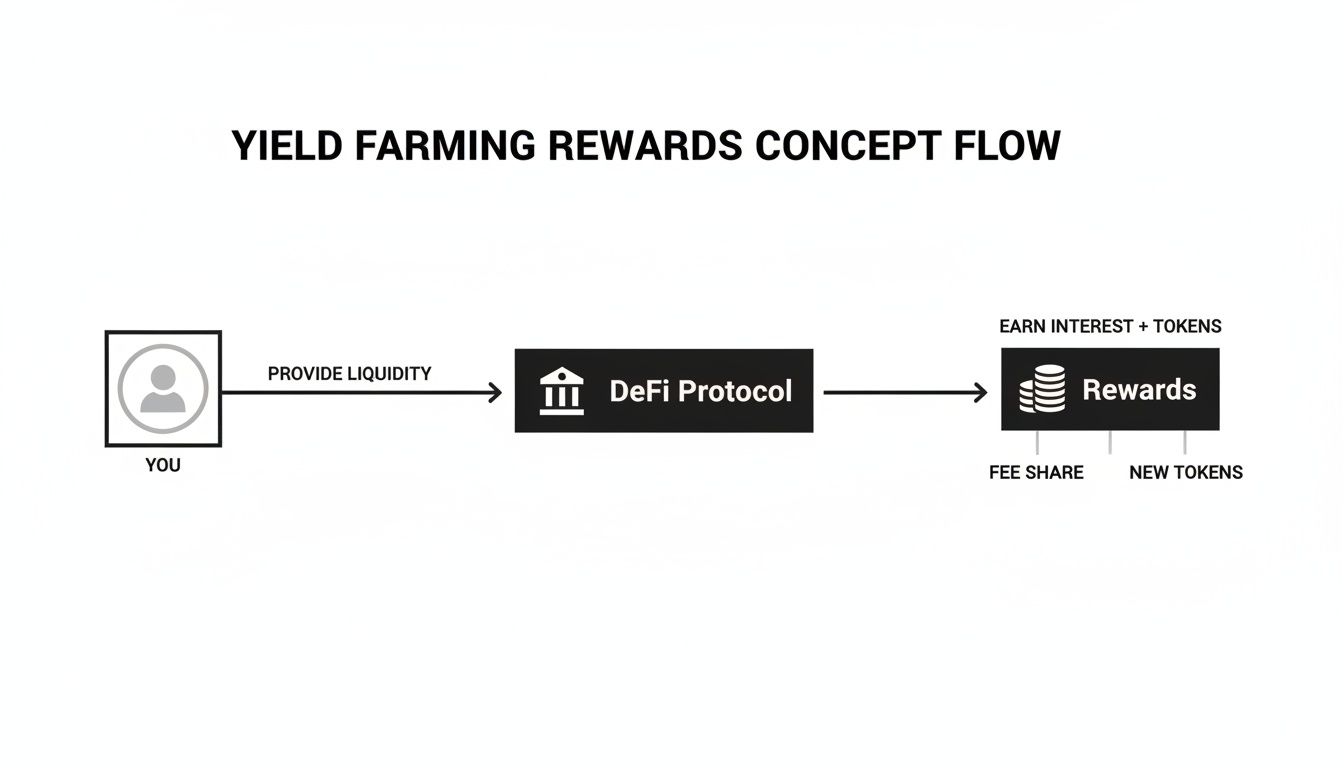
A flow diagram illustrating the yield farming rewards concept in DeFi, from user liquidity to token earnings.

This flow highlights that your assets are the fuel for the DeFi machine, and the rewards are the direct output of providing that fuel.

Liquidity Mining: The Core Reward Engine

The most common method is liquidity mining. This typically involves depositing a pair of assets (e.g., ETH and USDC) into a liquidity pool on a DEX. In return, you earn a percentage of the trading fees generated every time someone swaps between those two tokens.

However, the primary incentive often comes from an additional layer: the protocol distributes its own native governance tokens to liquidity providers. This dual-reward system (fees + token emissions) was the catalyst for the explosive "DeFi Summer" of 2020.

During that period, the total value locked (TVL) in yield farming skyrocketed past $1 billion by July 2020, a tenfold increase in just one month. Farmers chased APYs exceeding 100% on stablecoin pairs and even 1,000% or more in highly incentivized pools. You can learn more about the history of yield farming on WalletFinder.ai.

Staking: A Simpler Path to Rewards

If managing asset pairs seems complex, staking offers a more direct route. It usually involves locking up a single token in a protocol.

The purpose of staking can vary:

  • Network Security: On Proof-of-Stake blockchains, staking helps secure the network.
  • Revenue Sharing: In DeFi protocols, staking the native token can grant you a share of the platform's revenue.
  • Governance: Staking can give you voting rights on protocol upgrades and decisions.

Rewards are often more predictable than with liquidity mining, though potentially lower.

Understanding Emission Schedules and Tokenomics

The emission schedule dictates the rate at which new reward tokens are created and distributed. This is a critical factor influencing the long-term sustainability of your rewards.

Think of an emission schedule as a pre-programmed faucet. It opens wide initially to attract liquidity quickly, then gradually closes to prevent over-inflation and protect the token's value.

A high initial emission can lead to astronomical short-term APYs but is unsustainable. A savvy farmer always analyzes a protocol's tokenomics to understand the emission schedule, ensuring they aren't farming a token that is inflating itself to zero.

Advanced Multipliers: Boosts and veTokens

Innovative protocols have developed mechanisms to reward their most committed users beyond a flat APY. These systems can significantly increase your share of rewards.

Here are two popular models:

  • Boosts: Your reward rate is "boosted" based on the amount of the protocol's native token you hold or stake. This aligns your incentives with the protocol's success.
  • veTokens (Vote-Escrowed Tokens): Pioneered by Curve Finance, this model involves locking the native token for a set period (weeks to years). In return, you receive a "veToken." A longer lock-up yields more veTokens, which translates directly to a larger share of platform fees and rewards.

These mechanisms create a more stable and dedicated user base by ensuring the most long-term-oriented participants receive the greatest rewards.

How to Realistically Calculate Your Returns

DeFi protocols often advertise tantalizing three-digit APYs, but these figures can be misleading. To accurately gauge a farm's profitability, you must look beyond the headline number and understand how your yield farming rewards are actually calculated.

Start by mastering the difference between two fundamental metrics: APR and APY.

An image comparing APR (Annual Percentage Rate) showing linear growth with APY (Annual Percentage Yield) depicting exponential growth over time.

The Difference Between APR and APY

APR and APY describe your potential earnings in fundamentally different ways.

  • APR (Annual Percentage Rate): This is the simple, non-compounded interest rate. If a farm offers a 100% APR on a $1,000 investment, you can expect to earn $1,000 in rewards over one year, assuming the rate remains constant.
  • APY (Annual Percentage Yield): This metric includes the powerful effect of compounding. APY shows the return you would get if you continuously reinvested your earnings back into the pool, allowing your rewards to generate their own rewards.

Because it accounts for this snowball effect, APY is always higher than APR for the same base rate. The more frequently you compound, the larger the difference. For more detail, read our guide on what APY means in the world of crypto.

Key Takeaway: APR is your base return. APY is your potential return with active compounding. Always verify which metric a protocol is using.

APR vs APY: The Power of Compounding Rewards

Let's illustrate with a clear example. You deposit $10,000 into a pool with a base 50% APR. Your actual return depends entirely on your compounding frequency.

This table shows how different compounding schedules impact the final return (APY) on an initial $10,000 investment.

Compounding FrequencyCalculationEnd-of-Year BalanceEffective APY
No Compounding (APR)$10,000 * (1 + 0.50)$15,00050.00%
Compounded Monthly$10,000 * (1 + 0.50/12)^12$16,47064.70%
Compounded Weekly$10,000 * (1 + 0.50/52)^52$16,48364.83%
Compounded Daily$10,000 * (1 + 0.50/365)^365$16,48764.87%

As shown, daily compounding transforms a 50% APR into a nearly 65% APY. This is the core principle that drives many successful yield farming strategies.

The Biggest Wildcard: Reward Token Volatility

Even a perfectly calculated APY is not the full picture. The single most significant variable affecting your profitability is the price volatility of the reward token.

Consider this common scenario:

  1. You enter a new farm with a 1,000% APY.
  2. You invest $5,000 and earn a large quantity of the protocol's native token (FARMTOKEN).
  3. Due to the high emissions required to pay this APY, the supply of FARMTOKEN skyrockets, and its price crashes by 95%.

Your massive pile of reward tokens is now worth a fraction of its initial value, potentially less than the gas fees you paid. A high APY is meaningless if the asset you're earning is rapidly depreciating. Always evaluate the tokenomics and market stability of the reward token before committing capital.

Navigating the Hidden Risks and Tax Headaches

The allure of high APYs in yield farming can be powerful, but significant rewards always come with significant risks. Entering the field without understanding these dangers can lead to substantial losses. Protecting your capital requires awareness of everything from market mechanics to malicious actors.

An illustration detailing yield farming risks, including smart contract risk, impermanent loss, and tax Codkins.

This is your guide to the most common pitfalls that can turn profits into pain.

Understanding Impermanent Loss

Impermanent loss (IL) is one of the most unique and misunderstood risks in DeFi. It occurs when you provide liquidity to a two-asset pool, and the price of one asset changes relative to the other.

The automated market maker (AMM) must maintain a constant balance of value between the two tokens in the pool. If one token's price increases, the AMM sells it to buy more of the other token to rebalance. This leaves you with more of the underperforming asset and less of the outperforming one. If you withdraw your funds at this point, the total value may be less than if you had simply held the original assets in your wallet.

Impermanent loss is the opportunity cost of providing liquidity. The loss is "impermanent" because it is only realized upon withdrawal, but it can easily negate all the yield farming rewards you've earned.

Smart Contract Risk and Rug Pulls

You are entrusting your funds to code. A single vulnerability in a protocol's smart contracts can be devastating.

Here are the key risks to assess:

  • Smart Contract Bugs: Even audited protocols can have undiscovered exploits. A hacker can drain a liquidity pool in minutes, leaving providers with nothing.
  • Rug Pulls: This is outright theft where anonymous developers launch a protocol, attract liquidity with high APYs, and then withdraw all the funds and disappear.
  • Economic Exploits: An attacker may manipulate market conditions (e.g., via flash loans) to drain a pool's value without directly hacking the code.

Actionable Tip: Always verify if a project has been audited by reputable firms, check the team's public reputation, and be wary of unaudited projects with anonymous teams promising unrealistic returns.

The Inescapable Reality of Taxes

Taxes are a frequently overlooked but critical risk. In most jurisdictions, claimed yield farming rewards are considered taxable income at their market value on the day you receive them.

Failing to track this can create a significant tax liability and legal complications. Every claim, swap, and sale is a taxable event. Meticulous record-keeping is non-negotiable. For guidance, learn how to calculate your crypto profit and loss for accurate reporting. Proper tracking from the start will save you immense stress later.

Proven Strategies to Maximize Your Farming Rewards

Knowing the theory is one thing; applying it to increase your returns is another. Strategic farmers don't just deposit and hope. They use specific tactics to maximize the value of their yield farming rewards. This requires a deliberate playbook for managing both your capital and your earnings.

The first critical decision is what to do with your reward tokens.

Farm and Dump vs. Farm and Hold

As rewards accumulate, you face two primary strategic choices:

  • The 'Farm and Dump' Strategy: This risk-averse approach involves immediately selling reward tokens for stable assets (USDC, DAI) or blue-chip crypto (ETH, BTC). This locks in profits, protects you from reward token volatility, and provides fresh capital for compounding or redeployment.
  • The 'Farm and Hold' Strategy: This is a more speculative, higher-risk play. You hold the reward tokens, betting on the protocol's future success and a corresponding increase in the token's value. A correct bet can lead to exponential gains, but an incorrect one exposes you to significant downside.

Your choice should align with your belief in the project's long-term potential and your personal risk tolerance.

Capital Rotation: The Art of Chasing Yield

The DeFi landscape is dynamic. A farm offering 300% APY today may drop to 50% next week as new capital flows in. The most adept farmers practice capital rotation—actively moving funds between protocols to capture the highest available yields.

This active strategy involves:

  1. Constantly monitoring yields across different platforms and chains.
  2. Identifying new, under-farmed opportunities.
  3. Calculating whether the potential gain from switching outweighs the transaction (gas) fees.

Capital rotation requires vigilance and a proactive mindset. You are not just a passive investor; you are an active manager of your capital, always seeking the most productive use for it.

Using Yield Aggregators to Automate Gains

Manually compounding and rotating capital is time-consuming and can be expensive due to gas fees. Yield aggregators (or "robo-advisors") automate this process for you.

Platforms like Yearn Finance and Beefy Finance offer "vaults" that handle the heavy lifting:

  • Auto-Compounding: They automatically harvest rewards and reinvest them at optimal intervals, maximizing your APY and minimizing gas costs.
  • Strategy Optimization: Vaults often employ complex, pre-programmed strategies to find the best yields across multiple platforms, effectively performing capital rotation on your behalf.

For those who want to maximize returns without constant manual intervention, yield aggregators are an indispensable tool.

Reading On-Chain Signals to Find Opportunities

Elite farmers get ahead by analyzing on-chain data to identify promising opportunities before they become mainstream.

Here are key on-chain signals to monitor:

  • Rising Total Value Locked (TVL): A consistent increase in a protocol's TVL indicates growing confidence and capital inflow, suggesting a potentially sustainable farm.
  • 'Smart Money' Inflows: Tracking the wallets of successful farmers and crypto VCs provides powerful insights. When these wallets deploy significant capital into a new farm, it's a strong signal of a potential high-alpha opportunity.

The yield farming market cap reached $20.21 billion in early 2024, a 4.32% jump in 24 hours. Data from Wallet Finder.ai shows that traders who mirror top farmers achieve win rates over 70%. You can explore the thriving yield farming market at CoinMarketCap.

Using On-Chain Data to Find Alpha

Theory and risk management are foundational, but the edge is won through actionable data. The most successful farmers use on-chain analysis to move from reacting to the market to anticipating it. The blockchain is a public ledger of every profitable (and unprofitable) move—a resource you can leverage to your advantage.

Tools like Wallet Finder.ai act as a search engine for on-chain intelligence, helping you find and learn from the best traders in the space.

Identifying Top-Performing Wallets

The most effective strategy shift is from chasing hot pools to following successful people. A powerful wallet discovery tool allows you to filter through millions of addresses to find those with a proven track record of maximizing their yield farming rewards.

Here’s an actionable list of what to filter for:

  • Total Profit (PnL): Find wallets with the highest absolute profit from DeFi activities.
  • Win Rate: Isolate traders who consistently pick winners.
  • Recent Performance: Identify who is currently on a hot streak or has just entered a promising new farm.

This approach grounds your decisions in the proven actions of successful market participants.

A leaderboard view like this instantly highlights top performers, giving you a starting point for deeper analysis.

Reverse-Engineering a Winning Strategy

Once you've identified a top-performing wallet, your goal is to deconstruct its strategy. By analyzing its transaction history, you can gain a deep understanding of its playbook. For a detailed guide, read our article on how to track crypto wallets effectively.

Become a detective by asking these key questions:

  1. What protocols and pools do they use?
  2. How much capital do they allocate per position?
  3. What are their entry and exit points? Do they take profits systematically?
  4. How do they manage their rewards? Do they sell immediately or hold?

Answering these questions provides a battle-tested blueprint you can adapt to your own strategy.

On-chain data analysis is a superpower in DeFi. During the 2021 bull run, wallets that analyzed past APYs and rotated strategies outperformed buy-and-hold by up to 400%. Wallet Finder.ai aggregates activity from Ethereum, Solana, and Base, surfacing wallets that have farmed over $1 million in rewards from protocols like Convex Finance. Discover more about top DeFi yield farming platforms on QuickNode.

Setting Up Real-Time Alerts

The final step is to move from historical analysis to real-time action. The best opportunities are time-sensitive. By the time a new farm is trending on social media, the highest yields are often gone.

Set up real-time alerts for the top-performing wallets you follow. Imagine receiving an instant notification the moment a whale with an 80% win rate deploys $2 million into a new, obscure protocol. This alert is your signal, giving you the opportunity to investigate and potentially co-invest before the market catches on. It transforms the public blockchain into your personal alpha feed.

Common Questions About Yield Farming

Navigating yield farming can be complex. Here are clear, actionable answers to some of the most frequently asked questions.

How Much Money Do I Really Need to Start?

While there is no official minimum, your starting capital must be sufficient to cover transaction (gas) fees and still generate meaningful returns.

Network TypeRecommended MinimumRationale
High-Fee (e.g., Ethereum)$2,000 - $5,000+Gas fees can be $50-$100+ per transaction, which would erode profits on a small deposit.
Low-Fee (e.g., Base, Solana)$100 - $500Transaction fees are pennies, making it feasible to experiment and compound with smaller amounts.

Starting small on a low-fee chain is a great way to learn the mechanics without risking significant capital.

Are Yield Farming Rewards Guaranteed?

Absolutely not. The advertised APY is a dynamic, real-time estimate, not a fixed-rate promise. It is constantly changing based on several factors:

  • Reward Token Price: If the value of the token you're earning falls, your APY in dollar terms decreases.
  • Liquidity Inflows: As more farmers enter a pool, the fixed rewards are split among more participants, reducing individual shares.
  • Emission Schedules: Many protocols are programmed to decrease reward payouts over time to ensure long-term sustainability.

Treat APY as a current snapshot, not a future guarantee. Your realized returns will likely differ.

Is Farming on Stablecoins Completely Safe?

Farming with stablecoins (e.g., in a USDC-DAI pool) is an excellent way to mitigate impermanent loss, as both assets are pegged to $1. However, it is not risk-free. You are still exposed to:

  1. Smart Contract Risk: A bug or exploit in the protocol's code could lead to a total loss of funds.
  2. De-Peg Risk: The stablecoin itself could lose its $1 peg due to issues with its reserves, a bank run, or systemic market events.

How Often Should I Compound My Rewards?

The optimal compounding frequency is a trade-off between maximizing your APY and minimizing gas costs. Compounding too often on a high-fee network can cost you more than you earn.

A practical rule of thumb is to claim and reinvest when the transaction fee is 1-2% or less of the rewards' value. This is where yield aggregators provide immense value by socializing gas costs and auto-compounding efficiently for all users.


Ready to stop guessing and start mirroring the pros? Wallet Finder.ai gives you the on-chain intelligence to discover top-performing wallets, reverse-engineer their strategies, and get real-time alerts on their every move. Find your alpha today at https://www.walletfinder.ai.