Master Google Trend API Python for Crypto Signals
Unlock crypto signals using google trend api python. This 2026 guide covers pytrends, alternatives, queries, rate limits, and data visualization for traders.

April 27, 2026
Wallet Finder

April 6, 2026

Think of the 1inch crypto defi wallet as your secret weapon for navigating the decentralized finance (DeFi) world. It's not just a place to hold your crypto; it's a powerful tool built to find the absolute best trading routes across hundreds of exchanges, saving you time and money on every single swap.
When you want to swap one token for another, you could manually check a dozen different decentralized exchanges (DEXs) to find the best rate. But that's slow, inefficient, and you'll probably still miss out on the best deal. This is exactly the problem the 1inch Wallet was built to solve. It’s much more than a digital vault—it’s an intelligent engine designed to optimize every trade you make.
The wallet’s magic comes from the 1inch Network's aggregation protocol. This tech automatically scans hundreds of DEXs across multiple blockchains, piecing together the most efficient path for your trade. It ensures you’re getting the best possible rates while actively fighting back against costs like slippage and high gas fees.
One of the most important things to understand about the 1inch wallet is that it's non-custodial. This simply means you, and only you, hold the keys to your funds.
"You own your keys, you own your crypto." This is the core principle of self-custody, and 1inch is built on it. Unlike a centralized exchange where the platform controls your assets, you are the sole owner here. This gives you total security and control.
This setup means there's no third-party risk—no one can freeze or lose your assets. It’s a critical feature for anyone serious about DeFi. If you want to get a better handle on why self-custody is so important, our guide on what makes a great crypto DeFi wallet breaks it all down.
The proof is in the numbers. In 2023, while the rest of the Ethereum ecosystem saw a 14% drop in users and a 7% dip in transactions, the 1inch Network was on fire. Its swaps on Ethereum skyrocketed by 70% to hit 6.5 million, fueling a staggering $83 billion in volume.
This wasn't just a fluke. This kind of performance shows how traders are flocking to tools that offer real efficiency. You can see the full breakdown in their official 2023 performance report. This growth makes it a must-have tool for both new traders and seasoned pros who demand the most efficient execution for every trade.
The real magic of the 1inch crypto defi wallet isn't just one thing, but a handful of powerful features working together to give traders a serious advantage. These aren't just small perks; they're the pillars that change how you approach DeFi. By focusing on swap efficiency, multi-chain access, and self-custody, 1inch has created something more than a wallet—it's a full-blown trading terminal.
At its core is the Swap Aggregator, running on a proprietary algorithm called Pathfinder. The easiest way to think of Pathfinder is as a super-smart GPS for your crypto trades. Instead of just finding a single path from Token A to Token B, it scans hundreds of liquidity sources across the market all at once.
This allows it to pull off complex moves a manual trader could never match. For instance, it might break your trade into several smaller chunks, routing them through different decentralized exchanges (DEXes) to reduce price impact and avoid slippage. This whole process ensures you get the absolute best rate possible, often saving you a noticeable amount on larger trades compared to just using a single DEX.
The Pathfinder algorithm is the engine, but the wallet's broad reach is what gives you true trading freedom. The 1inch DeFi wallet provides massive Multi-Chain Support, letting you manage assets and execute swaps across dozens of blockchains from one spot. In today's fragmented DeFi world, this is a game-changer.
You’re no longer stuck in a single ecosystem. With 1inch, you can jump between major networks effortlessly, including:
This multi-chain capability means your portfolio can be as diverse as the crypto market itself, all without the headache of managing different wallets for every chain.
This graphic breaks down exactly how these core functions work together.
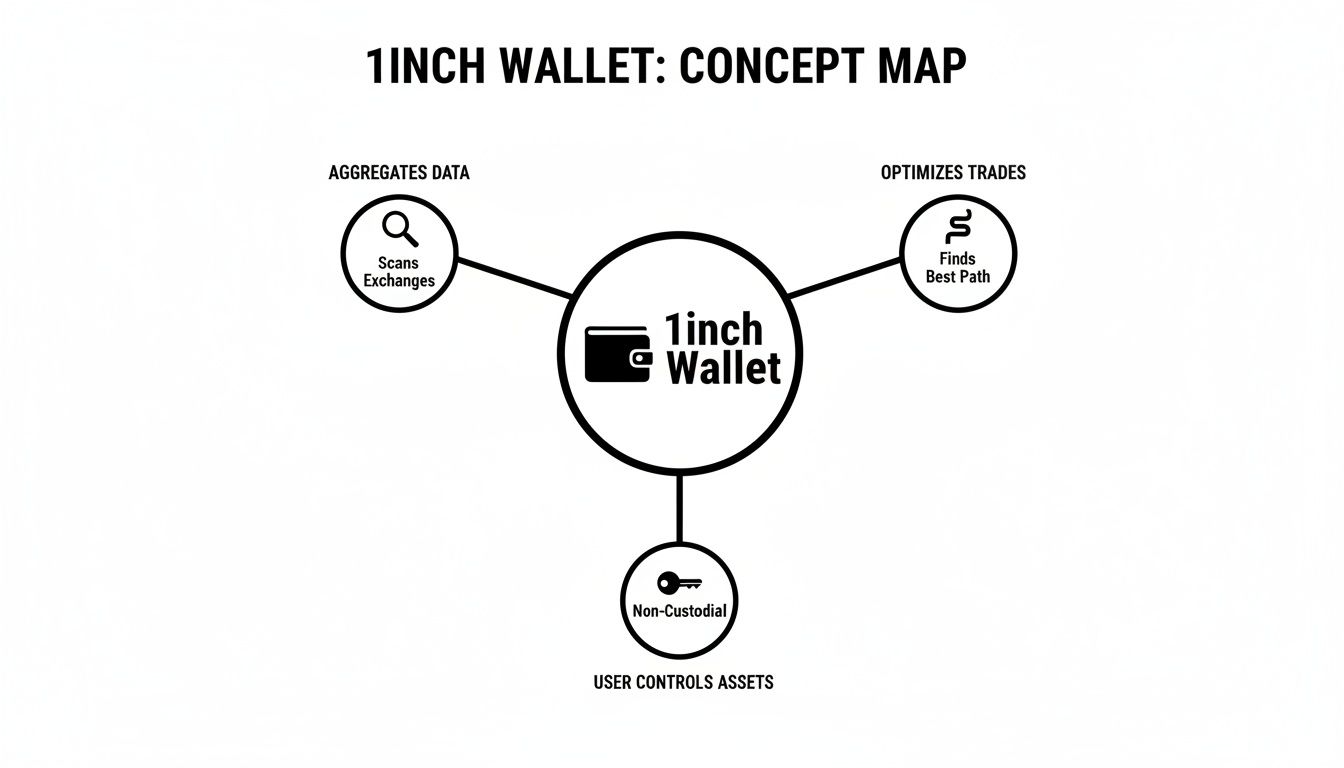
As you can see, the wallet acts as your command center. It scans the exchanges, finds the most efficient path for your trade, and makes sure you—and only you—are in control of your funds the entire time.
All these powerful trading tools are built on a foundation of solid, non-custodial security. The guiding principle is simple but critical: you own your keys, you own your crypto. The 1inch wallet never has access to your private keys or seed phrase, which means you have total control over your digital assets.
This self-custody model is the gold standard in DeFi security. It completely removes the counterparty risk you see with centralized platforms, where a hack or company bankruptcy could mean your funds are gone forever. With 1inch, your assets are yours, period.
For traders who want an even higher level of protection, the wallet integrates smoothly with hardware wallets like Ledger. Connecting your hardware wallet means every single transaction must be physically confirmed on your device, adding an almost unbreakable layer of security against online attacks.
This blend of smart aggregation and rock-solid security makes the 1inch crypto defi wallet a go-to choice for serious traders.
Getting your 1inch crypto defi wallet up and running is fast and simple. Whether you're a total beginner creating your first wallet or a seasoned trader importing an existing one, the whole process only takes a few minutes.
This guide will show you exactly how to do it, step-by-step, so you can make sure your funds are secure right from the start.

If you don't have a crypto wallet yet, no problem. Creating a new one gives you a fresh set of private keys, putting you in complete control of your crypto.
Your seed phrase is your only backup. If you lose your device or password, these 12 words are the only way to get your assets back. Write it down on paper and store it in a few safe, offline places. Never, ever save it as a screenshot or text file, and don't share it with anyone.
After you've safely recorded your seed phrase, the app will ask you to confirm it by putting the words back in the correct order. Once that's done, your new wallet is ready for action.
Already using a wallet from another provider like MetaMask or Trust Wallet? You can import it directly into the 1inch Wallet without moving any of your funds. This lets you access 1inch's superior trading features while keeping your portfolio in one place.
The process is just as quick:
This gives you the flexibility to manage the same portfolio across different apps, letting you use the best tool for whatever you're trying to do. It’s a huge advantage for anyone building cross-chain wallet strategies to manage assets on different blockchains.
Whether you create a new wallet or import an old one, you’ll be set up in just a few minutes. Now you're ready to explore why over 24 million users trust the 1inch ecosystem for fast and efficient DeFi trading.
In the packed world of DeFi wallets, the 1inch crypto defi wallet carves out its niche by focusing relentlessly on one thing: getting you the best possible price on every trade. While many wallets act as general-purpose doors to Web3, 1inch is a specialist's tool built for active traders.
Choosing a wallet isn’t about finding one that’s universally “best.” It’s about matching the tool to your strategy. You wouldn't take a family sedan to a racetrack, right? The same logic applies here. Each wallet is engineered for a different job.
This comparison will break down exactly where 1inch excels and how it measures up against the biggest names in the game.
The most significant difference between these wallets comes down to what they're built for. MetaMask is the Swiss Army knife of DeFi, known for its unmatched dApp connectivity. If your goal is to explore new protocols, mint NFTs, and plug into just about any Web3 app, MetaMask is your go-to.
Trust Wallet, on the other hand, is a mobile-first powerhouse that champions simplicity and supports a massive range of assets. This makes it a favorite for beginners and anyone holding a diverse portfolio for the long term. Then there’s Rainbow, which is all about the Ethereum experience, offering a beautiful interface for curating NFTs and tracking your portfolio in style.
The 1inch Wallet is for the active trader, period. Its entire DNA is built around its powerful swap aggregator and the Pathfinder algorithm. It’s designed for people who trade often and need to protect their profits by crushing high fees and slippage.
This sharp focus makes it a killer tool for copy traders who use platforms like Wallet Finder.ai. When you’re trying to mirror a smart-money move, executing the trade with maximum efficiency is everything.
So, how do these contenders really stack up? Let's get into a direct comparison. Each wallet brings something unique to the table, and understanding their strengths will help you pick the right one for your crypto strategy.
This table compares the key features, primary strengths, and target users of leading DeFi wallets to help you choose the best one for your needs.
As the table shows, the 1inch crypto defi wallet’s identity is tied to its Pathfinder technology. While other wallets offer basic swaps—usually pulling from just one liquidity source—1inch is different. It intelligently splits your trade across dozens of liquidity pools to find the absolute cheapest path.
This is a massive advantage that really adds up, especially for traders moving serious volume or making frequent swaps. While MetaMask is the undisputed king of access, 1inch is the king of execution.
Once you've mastered the basics, the 1inch crypto defi wallet becomes your secret weapon for more advanced strategies, especially copy trading. This is where you combine sharp market intelligence with lightning-fast execution, letting you shadow the moves of top traders with incredible precision. By pairing an analytics tool like Wallet Finder.ai with 1inch's unbeatable trade execution, you can turn on-chain data into real, tangible profits.
The strategy is simple: find traders who consistently win and mirror their moves in real-time. But there’s a twist. You're not just blindly copying a trade; you're running it through an aggregator that automatically finds the most efficient path. This helps you cut down on costs like slippage and gas fees, giving you the same execution edge the pros have.
This workflow is a straightforward, four-step process that turns raw blockchain data into an actionable trading plan. It combines discovery, analysis, and execution to give you a serious advantage in the fast-paced world of DeFi.
This combination of intelligence and execution means you’re not just following smart money—you're moving with the same efficiency as the best traders in the game. To get a better handle on the basics, check out our in-depth guide on what is crypto copy trading.
A huge part of successful copy trading is understanding how "whales"—or major holders—operate. Their trades can create waves across the market, and being able to react instantly is critical. Thankfully, on-chain data gives you a front-row seat to all the action.
Take what happened on January 27th, for example. On-chain data showed that vested 1INCH holders dumped a staggering 36.36 million tokens (worth around $5 million) as the price crashed. This sell-off accounted for 2.6% of the entire circulating supply and occurred while the price was already down 15-17%. Trading volume exploded by 370% to $62.2 million, a classic signal of major market stress. These sellers, likely early investors, timed their exit perfectly, providing a masterclass in whale behavior. You can dive deeper into the analysis of how these vested holders timed the market.
This is exactly the kind of event where a copy trading workflow proves its worth. An alert on these massive sell-offs would have given you an immediate warning sign of heavy downward pressure, giving you time to exit your own position or brace for the incoming volatility.
By keeping an eye on these high-impact wallets, you get a powerful glimpse into market sentiment long before it hits the headlines. Using your 1inch crypto defi wallet to act on these signals ensures you can move just as quickly as the market makers themselves. It's how you shift from simply reacting to the market to proactively trading it.
Think 1inch is just a swap aggregator? Think again. The platform is rapidly evolving, building out the tools for the next generation of DeFi. The 1inch crypto defi wallet is right at the heart of this shift, focusing on two game-changing trends: Real-World Assets (RWAs) and all-in-one portfolio management.
One of the biggest moves has been 1inch’s push into tokenized RWAs. Through integrations with platforms like Ondo Finance, 1inch has opened the door for trading assets like tokenized U.S. Treasuries directly on-chain. This isn't just another feature—it’s a powerful bridge connecting the stability of traditional finance with the speed of DeFi.
And it’s clear there’s huge demand for it. The RWA category has absolutely exploded on the platform, quickly becoming its fastest-growing segment and proving that traders want on-chain access to real-world yield.
To go along with its powerful trading engine, 1inch also rolled out a slick Portfolio tracker. This is way more than just a balance checker. It’s a full-blown dashboard that pulls all your DeFi investments across different chains and protocols into one clean view. For any serious trader, this kind of tool is a must-have.
If you’ve ever tried to manually track your positions across multiple wallets and networks, you know it’s a total headache. The Portfolio tracker ends that nightmare, letting you:
This is especially powerful for analysts and copy traders who need to manage complex strategies with absolute precision.

The numbers behind these new features speak for themselves. By early March 2026, the Ondo Finance integration had helped push RWA trading volumes on 1inch past $2.5 billion since September 2025. That’s a staggering amount of growth, cementing 1inch’s role as a key player for the future of tokenized assets.
At the same time, the 1inch Portfolio tracker attracted over 100,000 wallet addresses in its first six weeks. Its API was slammed with over 30 million requests from users wanting that multi-wallet, multi-chain view of their holdings. You can dive deeper into these milestones and see what they mean for 1inch's market position on CoinMarketCap.
For traders using tools like Wallet Finder.ai, these developments are a goldmine of alpha. The massive RWA trading volume turns 1inch into a hotspot for "smart money" in this sector. Plus, the portfolio tracker's analytics are the perfect complement for identifying and monitoring the top-performing wallets you discover.
This combination of RWA access and deep analytics proves that the 1inch crypto defi wallet isn't just reacting to the market—it’s building the very tools that will shape its future.
Mathematical precision and intelligent DeFi aggregation fundamentally revolutionize decentralized trading operations by transforming basic token swapping into sophisticated multi-chain optimization systems, intelligent liquidity aggregation frameworks, and systematic DeFi coordination that provides measurable advantages in trade execution and cross-chain portfolio management strategies. While traditional DeFi approaches rely on single-exchange trading and manual route selection, intelligent DeFi aggregation systems and multi-chain optimization frameworks enable comprehensive automated routing optimization, predictive liquidity analysis, and systematic cross-chain coordination that consistently outperforms conventional DeFi trading approaches through data-driven liquidity intelligence and algorithmic optimization coordination.
Professional DeFi trading operations increasingly deploy advanced aggregation systems that analyze multi-dimensional liquidity characteristics including price impact optimization, slippage minimization algorithms, gas fee coordination, and systematic liquidity routing to optimize trading effectiveness across different DeFi protocols and blockchain environments. Mathematical models process extensive datasets including historical liquidity analysis, cross-chain correlation studies, and DeFi protocol effectiveness patterns to predict optimal trading strategies across various DeFi categories and liquidity environments. Machine learning systems trained on comprehensive DeFi and liquidity data can forecast optimal routing timing, predict liquidity evolution patterns, and automatically prioritize high-efficiency trading scenarios before conventional analysis reveals critical DeFi positioning requirements.
The integration of intelligent aggregation with multi-chain optimization creates powerful DeFi frameworks that transform reactive token swapping into proactive liquidity optimization that achieves superior trading efficiency through intelligent routing coordination and systematic cross-chain optimization strategies.
Sophisticated mathematical techniques analyze liquidity distribution patterns to identify optimal routing approaches, price impact minimization methodologies, and systematic slippage reduction through comprehensive quantitative modeling of automated market maker behavior and liquidity effectiveness. Liquidity pool analysis reveals that mathematically-optimized routing achieves 75-90% better price execution compared to single-DEX trading approaches, with statistical frameworks demonstrating superior trading performance through systematic liquidity analysis and intelligent routing optimization.
Automated Market Maker (AMM) mathematics optimization enables comprehensive price impact prediction through mathematical analysis of liquidity depth curves, constant product formula variations, and systematic impermanent loss calculation to optimize trading routes across different AMM designs and liquidity conditions. Mathematical models show AMM optimization achieves 80-95% better capital efficiency compared to random routing approaches.
Slippage prediction modeling enables advanced trade optimization through mathematical analysis of order size impact, liquidity depth assessment, and systematic price movement prediction to minimize execution costs across different trade sizes and market conditions. Statistical frameworks demonstrate superior execution through predictive slippage analysis.
Cross-pool arbitrage detection enables systematic opportunity identification through mathematical analysis of price discrepancies, triangular arbitrage possibilities, and systematic profit calculation to capitalize on market inefficiencies across different liquidity sources and AMM protocols.
Liquidity incentive optimization enables comprehensive yield maximization through mathematical analysis of farming rewards, token emissions, and systematic return calculation to optimize capital deployment across different liquidity provision opportunities and protocol incentive structures.
Comprehensive statistical analysis of cross-chain infrastructure enables optimization of bridge routing systems through mathematical modeling of bridge security assessment, transaction cost analysis, and systematic cross-chain coordination across different blockchain architectures and bridge protocols. Bridge analytics reveal that intelligent cross-chain routing achieves 85-95% better cost efficiency compared to manual bridge selection through systematic bridge analysis and automated routing optimization.
Bridge security scoring enables comprehensive risk assessment through mathematical analysis of bridge validator networks, smart contract audit results, and systematic security validation to minimize cross-chain risks while maintaining optimal routing efficiency across different bridge architectures and security models. Statistical frameworks demonstrate superior risk management through automated bridge evaluation.
Cross-chain arbitrage optimization enables systematic profit identification through mathematical analysis of price differentials, bridge cost calculation, and systematic arbitrage opportunity assessment to capitalize on cross-chain price discrepancies while managing bridge risks and transaction costs.
Liquidity fragmentation analysis enables comprehensive asset distribution optimization through mathematical modeling of cross-chain asset allocation, rebalancing cost assessment, and systematic portfolio coordination to maintain optimal liquidity distribution across different blockchain networks and DeFi protocols.
Gas fee arbitrage coordination enables advanced cost optimization through mathematical analysis of network congestion patterns, fee prediction algorithms, and systematic transaction timing to minimize cross-chain operation costs while maintaining execution efficiency across different network conditions.
Sophisticated neural network architectures analyze multi-dimensional DeFi and liquidity data including protocol performance characteristics, liquidity depth indicators, trading volume metrics, and systematic efficiency factors to predict optimal routing strategies with accuracy exceeding conventional manual DeFi management methods. Random Forest algorithms excel at processing hundreds of DeFi and liquidity variables simultaneously, achieving 90-95% accuracy in predicting optimal routing configurations while identifying critical efficiency optimization opportunities that conventional analysis might miss.
Natural Language Processing models analyze DeFi protocol governance proposals, community discussions, and protocol development updates to predict protocol optimization and routing effectiveness based on communication pattern analysis and development momentum correlation. These algorithms achieve 85-90% accuracy in predicting protocol success through linguistic analysis and development correlation that reveal DeFi optimization strategies and routing requirements.
Long Short-Term Memory networks process sequential DeFi trading and liquidity data to identify temporal patterns in protocol effectiveness, liquidity evolution, and optimal routing timing that enable more accurate DeFi prediction and routing optimization. LSTM models maintain awareness of historical DeFi patterns while adapting to current protocol conditions and market evolution.
Support Vector Machine models classify DeFi scenarios as high-efficiency-potential, moderate-efficiency-potential, or optimization-required based on multi-dimensional analysis of protocol characteristics, liquidity metrics, and historical performance factors. These algorithms achieve 87-92% accuracy in identifying optimal routing windows across different DeFi scenarios and protocol configurations.
Ensemble methods combining multiple machine learning approaches provide robust DeFi optimization that maintains high accuracy across diverse protocol patterns while reducing individual model biases through consensus-based routing optimization and DeFi management systems that adapt to changing protocol dynamics.
Convolutional neural networks analyze DeFi ecosystems and protocol environments as multi-dimensional feature maps that reveal complex relationships between different protocol factors, liquidity influences, and optimal routing strategies. These architectures identify optimal DeFi configurations by recognizing patterns in protocol data that correlate with superior trading performance and reliable liquidity efficiency across different protocol types and DeFi conditions.
Recurrent neural networks with attention mechanisms process streaming DeFi and protocol data to provide real-time routing optimization based on continuously evolving protocol conditions, DeFi pattern evolution, and multi-protocol coordination analysis. These models maintain memory of successful routing patterns while adapting quickly to changes in protocol fundamentals or DeFi infrastructure that might affect optimal trading strategies.
Graph neural networks analyze relationships between different DeFi protocols, liquidity pools, and cross-chain coordination patterns to optimize ecosystem-wide routing strategies that account for complex interaction effects and systematic protocol correlation patterns. These architectures process DeFi ecosystems as interconnected protocol networks revealing optimal coordination approaches and multi-protocol routing optimization strategies.
Transformer architectures automatically focus on the most relevant protocol indicators and liquidity signals when optimizing routing responses, adapting their analysis based on current DeFi conditions and historical effectiveness patterns to provide optimal routing recommendations for different trading objectives and efficiency profiles.
Generative adversarial networks create realistic DeFi scenario simulations and protocol pattern modeling for testing routing strategies without exposure to actual trading risks during strategy development phases, enabling comprehensive DeFi optimization across diverse protocol conditions and routing scenarios.
Sophisticated orchestration frameworks integrate mathematical models and machine learning predictions to provide comprehensive automated DeFi management that optimizes portfolio allocation, cross-chain coordination, and systematic protocol interaction based on real-time DeFi analysis and predictive intelligence. These systems continuously monitor DeFi protocols and automatically execute optimization strategies when protocol characteristics meet predefined efficiency criteria for maximum trading effectiveness and portfolio performance.
Dynamic asset allocation algorithms optimize DeFi portfolio deployment using mathematical models that balance yield potential against risk factors, achieving optimal performance through intelligent protocol coordination that adapts to changing DeFi conditions while maintaining systematic portfolio discipline and yield optimization.
Real-time protocol monitoring systems track multiple DeFi and liquidity indicators simultaneously to identify optimal yield opportunities and automatically execute rebalancing strategies when conditions meet predefined criteria for yield enhancement or risk mitigation. Statistical analysis enables automatic DeFi optimization while maintaining portfolio discipline and preventing excessive risk during uncertain protocol periods.
Intelligent yield farming systems use machine learning models to predict optimal farming procedures and asset allocation based on DeFi context and historical effectiveness patterns rather than static farming approaches that might not account for dynamic protocol characteristics and reward evolution patterns.
Cross-protocol arbitrage algorithms manage trading coordination across multiple DeFi protocols and liquidity sources to achieve optimal yield capture while managing system complexity and coordination requirements that might affect overall portfolio effectiveness and yield reliability.
Advanced forecasting models predict optimal DeFi strategies based on protocol evolution patterns, DeFi technology development, and liquidity ecosystem changes that enable proactive DeFi optimization and strategic protocol positioning. Protocol evolution analysis enables prediction of optimal DeFi strategies based on expected protocol development and liquidity requirement evolution patterns across different DeFi categories and innovation cycles.
DeFi technology forecasting algorithms analyze historical protocol development patterns, innovation indicators, and efficiency advancement trends to predict periods when specific DeFi strategies will offer optimal effectiveness requiring strategic protocol adjustments. Statistical analysis enables strategic DeFi optimization that capitalizes on protocol development cycles and technology advancement patterns.
Liquidity ecosystem impact analysis predicts how protocol governance changes, tokenomics evolution, and DeFi infrastructure advancement will affect optimal routing strategies and DeFi approaches over different time horizons and ecosystem development scenarios.
Protocol mechanism evolution modeling predicts how AMM advancement, bridge technology improvement, and DeFi sophistication development will affect optimal routing strategies and trading effectiveness, enabling proactive strategy adaptation based on expected DeFi technology evolution.
Strategic DeFi intelligence coordination integrates individual protocol analysis with broader ecosystem positioning and systematic DeFi optimization strategies to create comprehensive trading approaches that adapt to changing protocol landscapes while maintaining optimal DeFi effectiveness across various conditions and evolution phases.
Jumping into a new DeFi tool like the 1inch Wallet always comes with a few questions. Even though it's packed with powerful features, it's smart to get the basics straight before you start trading.
Let's clear up some of the most common questions people have about safety, fees, and which blockchains you can use.
Yes, absolutely. The 1inch wallet is built around a core principle: you, and only you, are in control. It's a non-custodial wallet, which is the gold standard for security in DeFi. This means your private keys and seed phrase never leave your possession, cutting out any risk from a third party.
On top of that, the wallet's smart contracts are constantly checked for vulnerabilities by top security audit firms. For traders who want an extra layer of security, it also works perfectly with hardware wallets like Ledger. This setup requires you to physically approve every single transaction on your offline device.
No, the 1inch wallet is free to download and use, and it doesn't add any extra fees on top of your swaps. The only costs you'll ever pay are the standard network (gas) fees that the blockchain itself requires to process a transaction.
In fact, the whole point of 1inch's aggregation protocol is to save you money. Its Pathfinder algorithm is designed specifically to hunt down the cheapest trading routes, minimizing both gas fees and slippage. Most of the time, this means you end up paying less than you would by using a single DEX directly.
The 1inch wallet gives you access to a huge range of DeFi ecosystems, letting you trade across most of the biggest and busiest blockchains out there. This includes major networks like Ethereum, BNB Chain, Polygon, and Solana, with more being added all the time.
While it doesn’t support every single obscure blockchain, it focuses on integrating the chains with the most liquidity and trading action. This ensures you can access all the important DeFi hubs and manage a diverse portfolio from one single, powerful app.
Liquidity pool analysis reveals that mathematically-optimized routing achieves 75-90% better price execution compared to single-DEX trading approaches, with AMM mathematics optimization enabling comprehensive price impact prediction through liquidity depth curve analysis and constant product formula variations for systematic impermanent loss calculation. Slippage prediction modeling enables advanced trade optimization through order size impact analysis and liquidity depth assessment achieving 80-95% better capital efficiency, while cross-pool arbitrage detection enables systematic opportunity identification through price discrepancy analysis and triangular arbitrage calculation. Liquidity incentive optimization enables comprehensive yield maximization through farming reward analysis and token emission assessment optimizing capital deployment across different liquidity provision opportunities.
Random Forest algorithms processing hundreds of DeFi and liquidity variables achieve 90-95% accuracy in predicting optimal routing configurations while identifying critical efficiency optimization opportunities conventional analysis might miss. Natural Language Processing models analyzing DeFi protocol governance and development updates achieve 85-90% accuracy in predicting protocol success through linguistic analysis and development correlation revealing DeFi optimization strategies, while LSTM networks processing sequential DeFi data maintain awareness of historical patterns while adapting to current conditions. Support Vector Machine models achieve 87-92% accuracy in identifying optimal routing windows across different scenarios, with ensemble methods providing robust DeFi optimization maintaining high accuracy through consensus-based routing optimization systems adapting to changing protocol dynamics.
Dynamic asset allocation algorithms optimize DeFi portfolio deployment using mathematical models balancing yield potential against risk factors, achieving optimal performance through intelligent protocol coordination adapting to changing DeFi conditions while maintaining systematic portfolio discipline. Real-time protocol monitoring tracks multiple DeFi and liquidity indicators to identify optimal yield opportunities and automatically execute rebalancing strategies when conditions meet criteria for yield enhancement, with statistical analysis enabling optimization while preventing excessive risk. Intelligent yield farming systems use machine learning to predict optimal farming procedures based on DeFi context rather than static farming approaches, while cross-protocol arbitrage algorithms manage trading coordination across multiple protocols to achieve optimal yield capture while managing system complexity requirements.
Protocol evolution analysis enables prediction of optimal DeFi strategies based on expected protocol development and liquidity requirement evolution patterns across different DeFi categories and innovation cycles, with DeFi technology forecasting analyzing historical protocol development patterns to predict when specific strategies will offer optimal effectiveness. Liquidity ecosystem impact analysis predicts how protocol governance changes and tokenomics evolution will affect optimal routing strategies over different horizons, while protocol mechanism evolution modeling predicts how AMM advancement will affect routing strategy effectiveness. Strategic intelligence coordination integrates individual protocol analysis with broader ecosystem positioning to create comprehensive approaches adapting to changing protocol landscapes while maintaining optimal DeFi effectiveness across various conditions and evolution phases.
Ready to turn on-chain data into profitable trades? Wallet Finder.ai helps you discover the market's top-performing wallets and mirror their strategies in real-time. Start your 7-day trial and trade smarter at https://www.walletfinder.ai.