Your Guide to American Coin Crypto Trading
Unlock the American coin crypto market. This guide shows you how to analyze tokens, follow smart money, and use on-chain data for smarter trading decisions.

February 23, 2026
Wallet Finder

February 23, 2026

The term american crypto coin often sparks more questions than answers. There isn’t a single, government-issued digital dollar. Instead, the phrase usually points to two distinct groups of tokens that share a strong U.S. connection.
Understanding this split is your first step to navigating the American crypto market with confidence.
An “American crypto coin” isn’t a lone digital currency issued by Uncle Sam. Think of it like cars on the road: some wear American badges, and others are foreign models that Americans love to drive. Both play a vital role in the broader market.
In the same way, crypto assets fall into two camps—those pegged to the U.S. dollar for stability, and those born from American blockchain projects pioneering new technology.
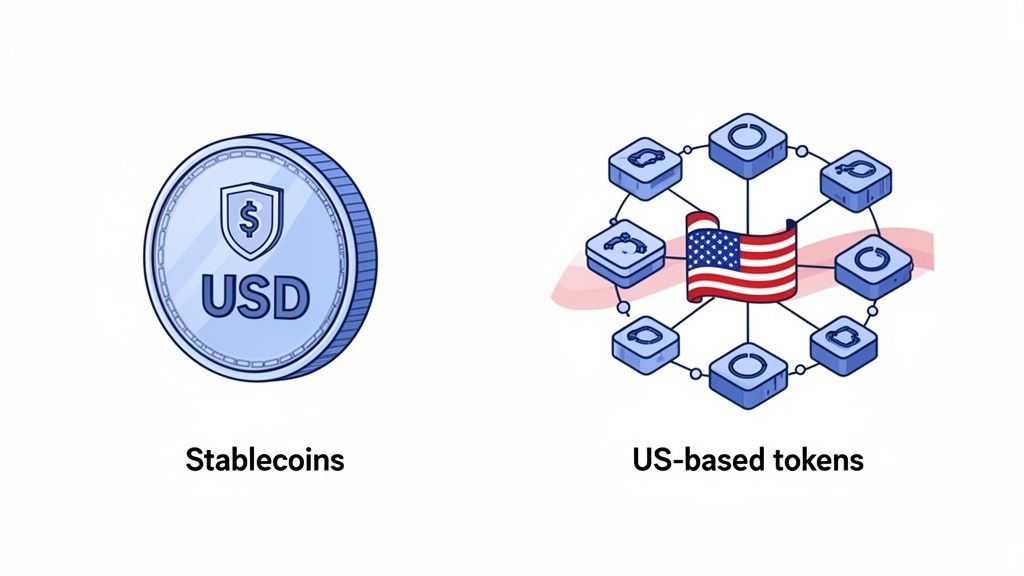
Below is a concise breakdown to help you see the difference at a glance. Each category serves its own purpose—one keeps your funds steady, the other fuels the future of decentralized apps and governance.
By separating these two definitions, you’ll avoid mixing up stability tools with innovation engines.
This distinction also highlights how deeply the U.S. influences crypto adoption. In fact, American adults holding crypto climbed from 15% in 2021 to an expected 30% by 2026—translating into over 70 million people joining the digital-asset world.

When we talk about the American crypto coin scene, we're really looking at a mix of homegrown, high-speed blockchains and the dollar-pegged stablecoins that fuel the entire DeFi economy.
For developers and investors alike, these U.S.-based projects often come with a perception of clearer regulatory footing and more familiar market infrastructure, which can be a huge advantage.
Take Solana, for example. It was launched back in 2020 by a California-based team led by Anatoly Yakovenko. Its claim to fame is a unique consensus mechanism called Proof of History, which essentially timestamps transactions before they're bundled into a block. This simple-sounding innovation is what allows the network to process an insane number of transactions.
Then you have Base, which is Coinbase’s layer-2 network built on top of Ethereum. Launched with a clear mission to make smart contracts fast and affordable, it’s a great example of an established US player building out the next generation of crypto infrastructure.
Base uses Optimism’s rollup technology, which means it processes big batches of transactions off-chain and then settles them on the Ethereum mainnet. You get the battle-tested security of Ethereum, but the costs drop to just pennies.
As a practical example, creating a brand new ERC-20 token on Base might cost you just $0.05, while doing the same thing on Ethereum’s mainnet could run you several dollars. It’s a game-changer for builders.
Both Solana and Base show how an "American crypto coin" project can start with U.S. roots and achieve global reach. Their designs strike a different balance between speed, cost, and security, giving developers real choice.
“Building on U.S. soil gives projects clarity around regulation and access to top-tier talent,” says one seasoned blockchain developer. “It’s a huge competitive edge.”
If blockchains are the highways, stablecoins are the fuel. They form the bedrock of DeFi by holding a steady 1-to-1 peg with the U.S. dollar, letting traders move in and out of volatile assets without cashing out to fiat.
USDC, issued by Circle, is a crowd favorite, especially with institutions. With over $57 billion in circulation, it undergoes monthly audits, and its governance and reserves are based in the U.S., giving it a strong stamp of regulatory compliance.
USDT from Tether is still the undisputed king, with a whopping $83 billion in circulation. While its collateral structure has historically been less transparent, it remains the most liquid and widely used stablecoin for trading on nearly every exchange in the world.
For traders, stablecoins are indispensable for a few key reasons:
U.S.-based projects tend to have deep ties to local tech and academic ecosystems, which translates into more support for builders. Think specialized grants, high-profile hackathons, and university partnerships.
For investors, this all translates into more robust tooling and clearer legal ground to stand on. Keeping a close eye on these American crypto coin projects can give you an early signal of where the market is headed next.
A well-timed bet on Solana or Base in mid-2021 would have returned over 300% by 2023, proving that tracking these ecosystems pays off.
Wallet Finder.ai is built to bring all these on-chain signals together, so you can spot the opportunities as they happen.
Investing in any "American crypto coin" means you’re stepping into the U.S. regulatory world. It can feel like a complex puzzle, but you don't need a law degree to get the lay of the land—just a clear picture of who does what.
The big players you’ll hear about most are the Securities and Exchange Commission (SEC), the Commodity Futures Trading Commission (CFTC), and the Department of the Treasury. Each one looks at crypto through a different lens, and their views directly impact which tokens you can buy and how they're treated.
For years, the biggest fight has been over a single question: is a token a security or a commodity? The answer changes everything.
This ongoing turf war is exactly why some tokens are available on US-based exchanges like Coinbase while others are nowhere to be found. A project with a big U.S. presence has likely gone to great lengths to avoid the "security" label. To get a better sense of this, you can learn more about how market reactions are shaped by these regulatory events in our detailed guide on crypto regulation impacts.
Once you know what each agency cares about, their actions and announcements start to make a lot more sense. Each plays a distinct role in shaping the market.
Beyond the big regulatory battles, the most direct impact on you as an investor comes from the IRS. In the U.S., cryptocurrencies are officially treated as property for tax purposes.
This means almost every time you do something with your crypto—selling it, trading it for another token, or even using it to buy a coffee—it’s a taxable event. You are on the hook for capital gains tax on any profit you make.
Because of this, keeping meticulous records is completely non-negotiable. You have to track the date, cost basis (what you paid), sale price, and the resulting gain or loss for every single trade. If you don't, you could face some serious penalties.
This level of financial oversight, paired with growing institutional interest, is actually a sign of the market maturing. The U.S. cryptocurrency market is projected to grow from $1.5 billion in 2025 to over $4.1 billion by 2033, and it's these regulatory and institutional shifts that are fueling that growth. While dealing with regulations takes some work, the massive growth shows just how much opportunity there is in the American crypto ecosystem.
Good investments are born from good research, not from chasing hype on social media. When you're looking at an American crypto coin, your process needs to be methodical. It should break down into two distinct parts: fundamental analysis and on-chain analysis. This two-pronged approach gives you a complete picture, covering both the project's vision and its actual performance in the market.
Think of fundamental analysis as doing your homework on the business itself. It’s where you figure out if the project has long-term potential before you even glance at a price chart. This is all about answering the big-picture questions about the team, their idea, and their game plan.
Your first step is to dive deep into the project's core building blocks. A brilliant idea is completely worthless if it doesn't have a skilled team and a clear roadmap to bring it to life. Use this checklist to stay on track:
A project with a public team, a detailed whitepaper, and a fair token distribution has already cleared several major hurdles. These elements build trust and show a commitment to long-term growth over a quick cash grab.
Once you've vetted the fundamentals, it's time to see if the project's story holds up in the real world. This is where on-chain analysis comes in. It's like checking the company's live bank statements to see where the money is actually going, giving you raw, unfiltered data on market activity.
If you want to go deeper, you can explore our complete guide on how to analyze crypto projects.
This is the point where you stop listening to what the project says and start watching what the market does.
Key on-chain metrics to watch:
By combining both fundamental and on-chain research, you get the full story. The fundamentals tell you if an American crypto coin is a good idea on paper, but the on-chain data shows you if smart investors actually agree.
Solid fundamental and on-chain research is your starting point, but the real magic happens when you turn that knowledge into actionable trading ideas. This is where a tool like Wallet Finder.ai comes in, cutting through the noise to help you follow the "smart money" that almost always moves before the crowd.
Instead of just guessing which US-based crypto project might take off, you can see exactly where the most profitable traders are parking their cash.
Think of it like this: your research process should be a funnel. You start wide with the big picture and gradually narrow down to the specifics before you pull the trigger.

This chart just visualizes common sense—a good investment thesis needs to be backed by both a solid idea and real, verifiable on-chain activity.
First things first, you need to find tokens that are actually gaining traction. The ‘Discover Tokens’ feature inside Wallet Finder.ai is like your personal market scanner. It lets you filter assets on chains like Solana and Base to spot which ones are attracting serious smart money interest right now.
You can sort by metrics like the number of unique new buyers or total smart money inflow over the last 24 hours or 7 days. This instantly gives you a shortlist of tokens that savvy traders are piling into, so you know where to start digging deeper.
Once a token grabs your attention, the next logical step is to find the elite traders who are actually making money on it. The ‘Discover Wallets’ view is built for precisely this. It shows you the top-performing wallets tied to a specific token or even just the market in general.
This dashboard is your at-a-glance view of a trader's skill, showing you the stats that matter:
The final piece of the puzzle is clicking into a top wallet to see their entire trading history. This is where you get to play detective and reverse-engineer their strategy. You can see which tokens they bought, the exact moment they entered a position, how much they deployed, and when they decided to cash out.
By studying these patterns, you can uncover powerful insights. Did they buy right after a specific news catalyst? Do they systematically take profits at a 2x or 3x? This on-chain blueprint is your window into how the pros play the game.
This kind of practical, data-driven research is becoming non-negotiable. With cryptocurrency ownership among American adults hitting 30% by 2026—that's roughly 70.4 million people—the market is only getting more competitive. The ability to cut through the hype and analyze raw on-chain data is what will separate the winners from the losers.
To finish things off, let's go through some of the most common questions people ask when they start digging into American crypto coins. These quick answers should help clear up any lingering confusion and solidify what we've covered.
In short, no. The U.S. government has not rolled out a national cryptocurrency, what you might hear called a Central Bank Digital Currency (CBDC). While they're definitely looking into the idea, there's no official "digital dollar" available to the public today.
When you hear someone say "American crypto coin," they're almost always talking about one of two things:
So, while these tokens operate under U.S. laws, they are purely private-sector creations. They aren't government-backed assets.
Figuring out if a project is genuinely based in the U.S. takes a little bit of detective work, but thankfully, most of the key clues are out in the open. You're looking for real-world evidence of a legal and operational presence in the States.
Here is a quick checklist to verify a project's US roots:
A project with a public team, a clear legal structure, and funding from reputable U.S. investors is far more likely to be a legitimate, long-term venture. Anonymous founders and vague offshore registrations are major red flags.
Even for projects on home soil, the two biggest risks are regulatory uncertainty and market volatility. A project can be doing everything right, but a sudden shift in policy from an agency like the SEC can change the game overnight.
Here is a breakdown of the primary risks:
This is exactly why tracking smart money with a tool like Wallet Finder.ai is so powerful; it can give you a heads-up on shifting sentiment before it makes the news.
"Smart money" is just a term for the capital controlled by the pros—full-time traders, crypto funds, and other seasoned players. These groups usually have better data, deeper research, and more connections than the average investor. Because of this, their moves often signal where the market is headed next.
By watching where these influential wallets are putting their money on blockchains like Base, Solana, and Ethereum, you get an early look at what's really happening. It helps you see which projects have genuine conviction behind them, cutting through the social media hype. You're essentially looking over the shoulder of the best traders to inform your own strategy and get in before the crowd catches on.
Ready to stop guessing and start tracking the smart money? Wallet Finder.ai gives you the on-chain intelligence to see what top traders are buying and selling in real time. Discover your next winning trade and get ahead of the market. Start your 7-day free trial at Wallet Finder.ai today.