Bot Crypto Price: Verify Market Bots & Oracle Feeds

Wallet Finder

Blank calendar icon with grid of squares representing days.

June 13, 2026

You open a chart, see a low-cap token jump hard, and your first reaction isn't excitement. It's suspicion. Was that real buying, a bot-driven breakout, a wash-traded spike, or just one wallet shoving price around in a thin pool?

That's the problem with bot crypto price. Most traders can get the number fast. Fewer can explain what produced it, whether it's trustworthy, and whether it's still tradable by the time they react. In DeFi, that gap matters more than speed alone.

The Real Question Behind Bot Crypto Price

When traders search for bot crypto price, they usually mean one of three very different things. If you don't separate them, you end up using the wrong tool for the job.
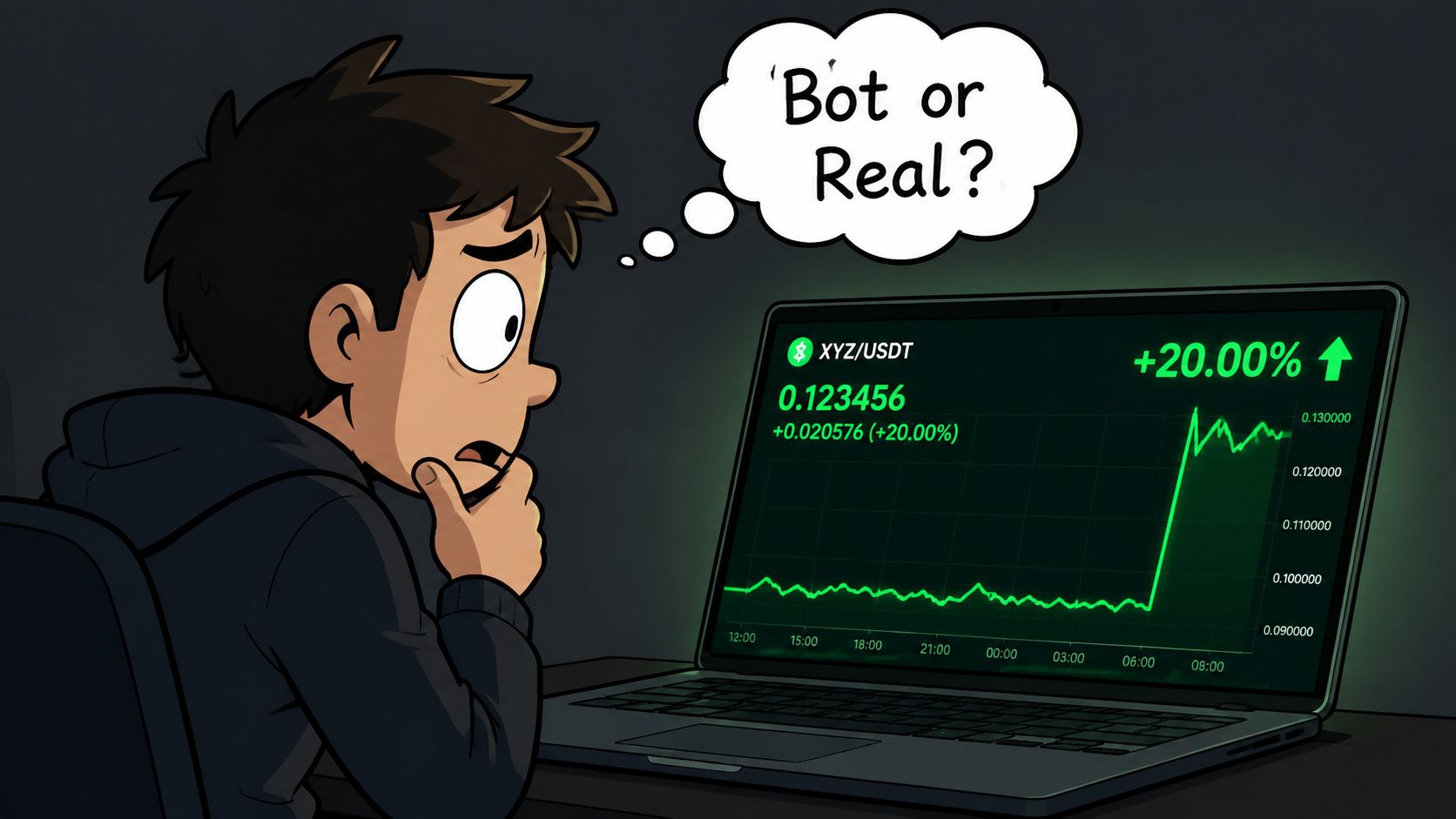
A worried young person stares at a laptop screen showing a sharp crypto price surge on a chart.

The token price itself

Sometimes the phrase refers to the market price of a bot-related token. A current example is MasterBOT. As of early June 2026, MasterBOT ($BOT) was trading at approximately $0.0002034, down 7.65% over 24 hours, with a market capitalization of $203,364.00 and $16,615.84 in 24-hour trading volume, based on live MasterBOT market data from Phemex.

That tells you what the market is printing. It doesn't tell you whether the move is healthy.

The price feed used by a trading bot

Other times, bot crypto price means the price an automated system consumes to trigger entries, exits, and rebalancing. In that case, the key question isn't “what's the coin worth?” It's “what data is this bot trusting?”

A bot can only act on the inputs it receives. If the feed is delayed, noisy, manipulated, or too narrow, the strategy may still execute perfectly and lose anyway.

The alert bot sending notifications

The third meaning is the simplest. This is the Telegram, Discord, exchange, or custom alert bot that pings you when a token crosses a threshold. Useful, yes. Sufficient, no.

Practical rule: A price alert answers what moved. A trading decision requires who moved it, where, and with what conviction.

That's why traders who want the true market story need more than a ticker or push notification. They need context around liquidity, wallet behavior, and source quality. If you want a deeper framework for that distinction, this guide on true market price in crypto is worth reviewing.

Decoding Crypto Price Bots and Data Feeds

The automated side of crypto pricing has several moving parts, but traders usually blur them together. That creates bad assumptions. A trading bot isn't an alert bot, and neither is an oracle feed.
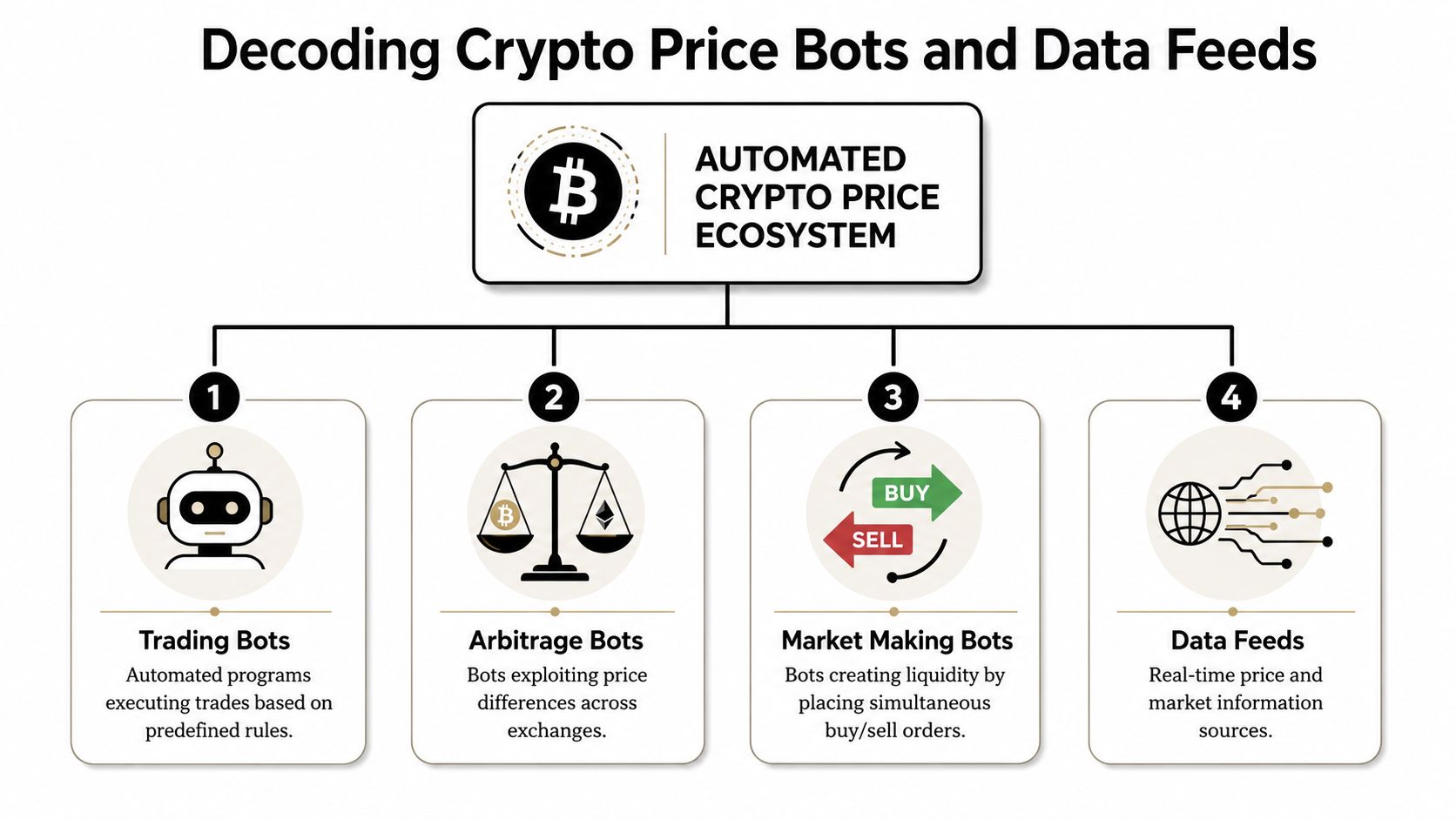
An infographic titled Decoding Crypto Price Bots and Data Feeds displaying four types of automated trading tools.

What each tool actually does

A trading bot watches market inputs and places orders according to rules. Those rules can be simple, like buying after a moving-average crossover, or more involved, like coordinating exits across several venues.

An alert bot doesn't trade. It watches conditions and reports them to a human. That can still be useful if you want manual control, but the bot stops at notification.

An oracle feed serves a different layer entirely. It moves price information into on-chain environments so smart contracts can reference external markets. Traders often ignore oracles until a feed goes stale, gets exploited, or diverges from spot conditions.

Trading bots vs alert bots vs oracle feeds

Tool TypePrimary FunctionTypical UserData Interaction
Trading BotsExecute trades from predefined logicActive traders, quant desks, strategy buildersConsume market data and act on it
Alert BotsNotify users about price or market conditionsManual traders, community members, researchersConsume market data and send alerts
Oracle FeedsDeliver price data to smart contractsDeFi protocols, on-chain developers, advanced tradersAggregate or relay data for on-chain use

A quick walkthrough helps clarify the stack:

  • Trading bot: Best when you already trust the strategy and feed, and you want execution without hesitation.
  • Alert bot: Better when you want awareness without giving a system permission to trade on your behalf.
  • Oracle feed: Critical when a protocol itself depends on price truth for lending, liquidation, settlement, or collateral logic.

Here's a short explainer that visualizes the ecosystem in a simpler way:

Where traders get confused

The confusion usually starts when someone says, “I use a price bot,” without specifying whether the bot is executing, alerting, or sourcing price into a contract. Those are different risks.

A good setup starts with one simple question. Is this system informing me, executing for me, or defining price for a protocol?

That distinction matters because each tool fails differently. An alert bot can be late. A trading bot can overtrade. An oracle problem can break an entire on-chain workflow.

How Bots Source and Verify Price Information

Most bots don't “know” price in any abstract sense. They query sources. In practice, that usually means some combination of off-chain exchange APIs and on-chain liquidity pool data.

Off-chain feeds and on-chain reads

Off-chain pricing often comes from centralized exchange APIs. These feeds are easy to integrate, fast enough for many use cases, and often cleaner to work with than raw chain data. The trade-off is dependence on a third party's reporting, uptime, and market structure.

On-chain pricing comes from decentralized exchange pools and swap activity. This route gives you direct market evidence, but it also forces you to deal with pool depth, route complexity, recent swaps, and temporary distortions in thin liquidity.

Many serious systems mix both. They compare venues, reject outliers, and avoid trusting a single source. If you're evaluating feeds for your own stack, this overview of an API for crypto prices is a practical starting point.

Why a printed price can still be misleading

A token can show a clean chart and still have weak price integrity. That happens most often in small caps, illiquid pairs, and venues where one actor can dominate the tape.

The hardest part isn't getting a quote. It's figuring out whether the quote reflects broad participation or a synthetic burst of activity.

Independent on-chain data from 2024 to 2025 found that 5% of wallets exhibiting bot-like behavior on prediction markets drove 75% of platform volume, highlighting how concentrated automated activity can distort what traders interpret as demand, according to IOSGVC's on-chain analysis note.

A practical verification checklist

Before treating any bot-reported move as actionable, check the structure around it:

  • Look for venue concentration: If most activity appears to come from one place, treat the signal carefully.
  • Compare price with liquidity context: A move in a thin market can look stronger than it is.
  • Watch wallet repetition: Repeated interaction from the same cluster often matters more than headline candles.
  • Separate volume from conviction: High reported turnover doesn't automatically mean broad buying interest.

Many traders often lose money. They trust the printed number but skip the forensic work on how that number formed.

Common Strategies Inside Crypto Trading Bots

If you want to read bot-driven price action correctly, you need to understand the logic many systems are following. Most bots aren't “thinking.” They're reacting to predefined conditions with zero hesitation.

A diagram illustrating five common strategies used by crypto trading bots, including trend following and arbitrage.

Trend and mean reversion

Two of the most common frameworks sit on opposite assumptions.

Trend-following bots assume strength tends to continue. They often rely on moving-average structure and momentum confirmation. Mean-reversion bots assume price tends to snap back toward an average after a stretch.

For crypto price automation, trend-following bots are usually built on moving-average and momentum rules, while mean-reversion bots assume price will revert toward a historical average. The same reference also notes that RSI is commonly read as overbought above 70 and oversold below 20, while MACD is used to detect momentum shifts through moving-average spread and signal-line crosses, as explained in Bitsgap's technical analysis guide for crypto trading.

The fingerprints these bots leave on charts

You can often spot the style of automation behind a move:

  • Trend systems: They tend to add into continuation and can intensify breakouts when volume confirms.
  • Mean-reversion systems: They often fade extremes and can create sharp snapbacks after emotional moves.
  • Momentum logic: This usually amplifies assets already moving fast, especially when traders chase the same trigger.
  • Grid and range logic: These systems often create repetitive buy and sell behavior inside a well-defined zone.
  • Arbitrage logic: This shows up less as trend and more as fast convergence between mismatched venues.

Why volume confirmation matters

A lot of weak bot setups fail because they trade price in isolation. That's a mistake. In practice, stronger systems use price trend plus volume confirmation because that filters out many fake breakouts and dead-cat bounces.

Desk note: When a supposed breakout appears without convincing participation, the strategy may still trigger. That doesn't mean the signal is good.

The key takeaway isn't that indicators are magic. It's that bots reduce messy chart action into hard rules. Once you know the rules, you can anticipate how groups of bots are likely to behave near the same trigger zones.

Risks and Limitations of Relying on Price Bots

Automation helps with discipline, reaction time, and repeatability. It doesn't remove market risk. In some cases, it makes bad assumptions execute faster.

What goes wrong in live trading

The first problem is execution. A bot can receive a valid signal and still fill badly because the market moves before the order lands. In volatile pairs, especially low-liquidity tokens, slippage can turn a decent setup into a bad trade.

The second problem is infrastructure. APIs stall. Exchanges lag. Websocket connections drop. On-chain transactions get reordered or priced out. If your strategy only works under ideal plumbing, it won't survive live conditions.

Backtests and alerts both have blind spots

Backtests help, but they only test the model against old market behavior. They don't capture every live detail that matters, especially around routing, latency, or sudden liquidity loss.

Alert bots have a different weakness. They tell you that price moved, but they don't tell you whether the move came from steady accumulation, one aggressive wallet, or a pattern that resembles manipulation. That context gap is exactly why many traders now focus on execution risk and MEV protection in crypto trading, not just signal generation.

The biggest limitation is missing intent

A plain price bot is blind to trader identity. It doesn't know if the wallets behind a move have a history of strong entries, fast flips, bait liquidity, or repeated pump-and-exit behavior.

That's the core trade-off:

  • Bots are good at speed
  • Bots are decent at rule execution
  • Bots are weak at interpreting intent
  • Bots can't explain who's really behind the move

If you trade liquid majors with broad participation, that blind spot is manageable. If you trade DeFi rotations, low caps, or narrative-driven tokens, it becomes a serious liability.

Beyond Bots Actionable Insights with Wallet Finder

A simple bot gives you a signal. Serious trading requires an intelligence layer on top of that signal.

Screenshot from https://www.walletfinder.ai

A better workflow for bot crypto price

Start with the move. A token spikes, breaks a range, or shows unusual turnover. That's where most bots stop. A stronger process starts there and asks harder questions.

Instead of reacting immediately, check the wallets behind the move. Are you seeing repeat buyers with a track record of clean entries? Are the buys clustered across related wallets? Did the same addresses rotate out of similar tokens recently?

That's where a wallet intelligence platform becomes useful. Wallet Finder.ai tracks on-chain wallets across ecosystems, surfaces trade history, and lets traders review things like prior entries, exits, and PnL patterns before deciding whether a price move is worth following.

What that changes in practice

A few practical improvements stand out:

  • You stop treating all volume equally: Some flows matter more because some wallets consistently act early and well.
  • You can separate accumulation from noise: Repeated buying from proven traders reads very differently from random churn.
  • You get timing context: Seeing where skilled wallets entered earlier can keep you from buying the obvious late candle.
  • You build watchlists around actors, not just assets: That's often more durable than watching tokens in isolation.

Don't just ask whether a token is moving. Ask whether the right wallets are moving into it.

The difference between reaction and validation

This is the jump most traders need to make. A price bot tells you something happened. Wallet analysis helps you judge whether that event deserves capital.

For DeFi copy traders, that's especially important. You're not trying to be first to every candle. You're trying to align with wallets that repeatedly make better decisions than the average market participant.

That shift changes your role. You stop being a follower of numbers on a screen and become an analyst of behavior.

Conclusion From Price Follower to Market Leader

Bot crypto price sounds simple, but it hides three separate realities. It can mean the market price of a bot-related token. It can mean the feed a trading bot uses for execution. It can mean the alert system that notifies you when something moves.

The problem is that none of those, by themselves, explain the story behind the price. A number on a chart is only the visible output. A key advantage comes from understanding how that number formed, what data source produced it, how much of the move is trustworthy, and which wallets are driving it.

That matters even more in DeFi and small-cap trading. Thin liquidity, synthetic activity, and clustered wallet behavior can make a chart look much stronger or cleaner than the underlying market really is. Traders who only follow price often end up reacting to noise. Traders who study participation can filter better.

The practical takeaway is straightforward:

  • Use bots for speed and structure
  • Use alerts for awareness
  • Verify price integrity before acting
  • Track wallet behavior when the move matters

If you do that consistently, you won't eliminate risk. You will make fewer lazy decisions based on surface-level prints. That's a real upgrade.


If you want to move beyond simple price alerts and study the wallets behind a move, Wallet Finder.ai gives you a way to inspect on-chain traders, review their histories, and decide whether a price spike looks like informed buying or just automated noise.