The Basics of Technical Analysis: Crypto Guide 2026
Master the basics of technical analysis for crypto. This 2026 guide covers trends, indicators, chart patterns, and combining TA with on-chain data.

June 19, 2026
Wallet Finder


You're scanning wallets after a volatile session. One address shows massive profit. Another has smaller headline gains, but the entries are cleaner, the exits are faster, and the position sizing looks disciplined. Most traders still chase the first wallet because raw PnL is easy to spot.
That's usually a mistake.
A wallet can post huge gains from one oversized punt, one illiquid launch, or one lucky hold through chaos. That doesn't tell you whether the trader allocates capital well. It tells you they made money. Those are not the same thing.
The edge comes from asking a harder question: which trader converts deployed capital into returns with the least waste, least drag, and most repeatability? That's the lens behind the capital efficiency ratio. In traditional markets, operators use it to judge how well a business turns capital into output. On-chain, traders can adapt the same logic to separate real process from lucky screenshots.
If you already review wallet histories and analyze profit and loss across trades, capital efficiency gives you the missing layer. It helps you judge whether gains came from disciplined deployment or from brute-force risk. For DeFi traders, that difference matters more than the PnL number itself.
A familiar trap in DeFi is confusing a spectacular outcome with a strong process.
Take two wallet profiles. Wallet A turns one aggressive bet into eye-catching profit. Wallet B grinds out gains across many trades, rarely overcommits, and keeps capital moving into setups with clear asymmetry. If you only sort by total return, Wallet A wins. If you care about survival and repeatability, the answer is less obvious.
That's why raw PnL is a vanity metric. It collapses several distinct behaviors into one number. It doesn't tell you how much capital the trader had to tie up, how often they recycled it, or whether the result depended on one outlier trade.
A profit figure can hide at least four things:
A trader who makes less money with tighter deployment often has the better system.
That's the practical value of the capital efficiency ratio. It shifts the frame from “who won” to “who used capital best.” For on-chain analysis, that's the difference between following a tourist and studying a professional.
When I review a wallet, I don't start with the biggest gain. I start with the relationship between output and capital consumed. If a trader repeatedly produces strong outcomes without parking oversized capital in weak setups, that's a real signal. It suggests selection skill, timing discipline, and a better understanding of liquidity and risk.
For DeFi traders, this is especially useful in noisy environments. Token launches, volatile rotations, and fragmented liquidity can make random winners look like masters. Capital efficiency helps filter that noise. It rewards traders who deploy with intent, not traders who merely survive long enough to post one giant screenshot.
At its core, the capital efficiency ratio answers a blunt question: how much output did you get for the capital you put to work?
Think of two farmers with the same harvest. One needed far more land, seed, and equipment to produce it. The other got the same result with fewer inputs. The second farmer is more capital efficient. Same output. Less capital tied up. Better use of resources.
That logic travels cleanly into finance.
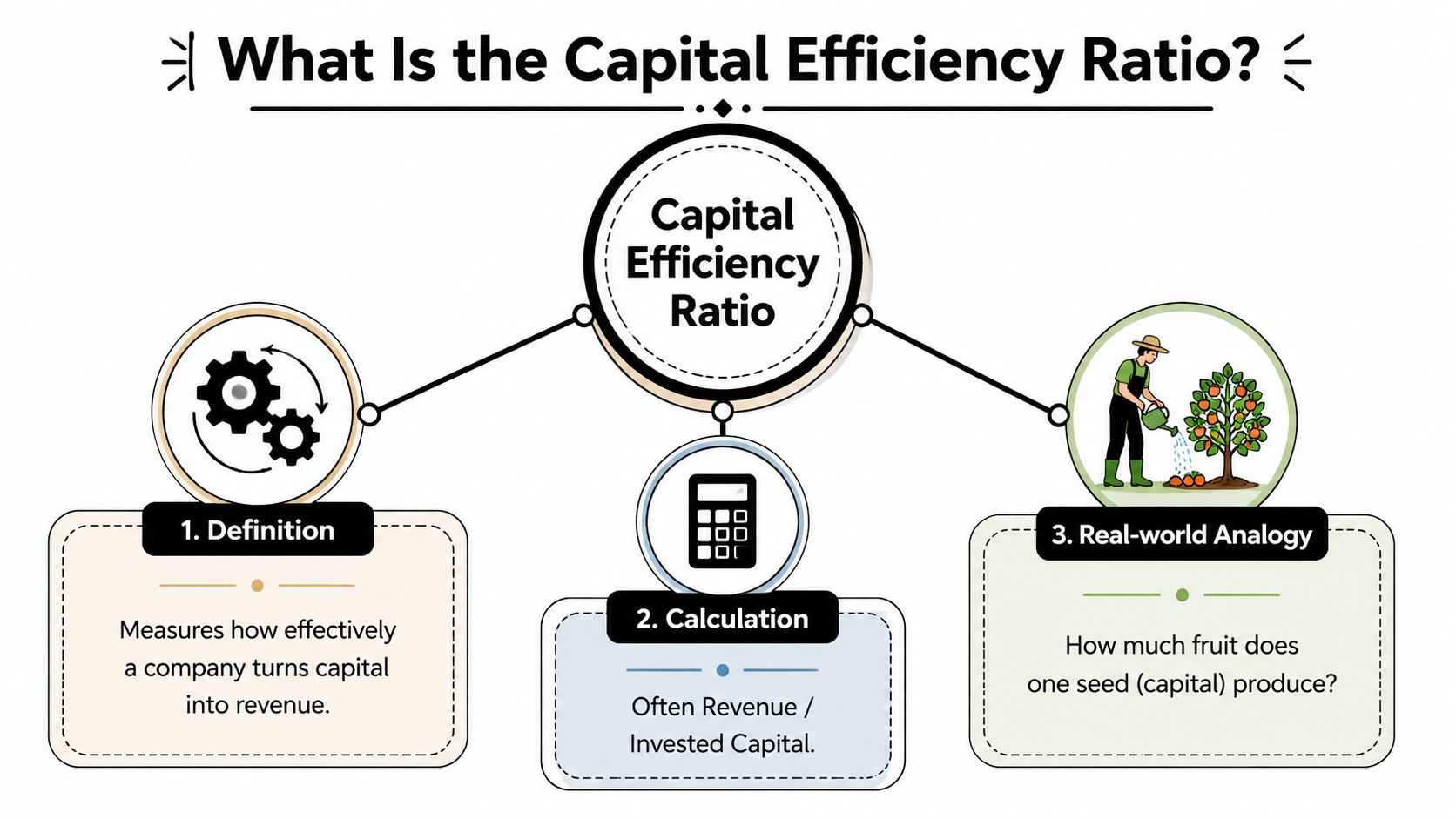
In broad finance usage, capital efficiency is often measured as revenue divided by total capital employed. A ratio of 2.0x means a business generates $2 of revenue for every $1 of capital employed, and higher generally means capital is being used more effectively, as outlined in this capital efficiency ratio reference from Monitask.
That matters because capital employed usually refers to the long-term funding base behind the business, not just whatever cash happened to move through the account. In practice, analysts often frame it around shareholders' equity plus long-term debt. The point is simple: how much productive output came from the capital base supporting the operation?
The concept isn't limited to public companies or CFO dashboards. It's a universal performance question. Any time you can define capital input and useful output, you can evaluate efficiency.
For DeFi traders, that's immediately relevant. You deploy stablecoins, ETH, SOL, or other inventory into trades. You absorb gas, slippage, and opportunity cost. Some traders need lots of capital to produce modest gains. Others rotate quickly, size well, and extract more output from less committed capital.
Practical rule: Capital efficiency is “bang for your buck” with stricter accounting.
Used properly, the metric reveals things that PnL alone won't:
A lot of confusion starts when people treat capital efficiency as one fixed formula. It isn't. The principle stays the same, but the exact formula changes with context. That's where most DeFi traders need to get sharper.
The phrase capital efficiency ratio sounds singular, but in practice it isn't. Different markets use different formulas because they're trying to answer slightly different questions. That mismatch is one reason many explainers feel incomplete.
As noted in this overview of efficiency ratio differences across finance contexts, some definitions use net sales divided by total capital employed, while startup and SaaS operators often use ARR or gross profit against capital raised or burned. Same idea. Different measurement frame.
| Context | Formula | What It Measures |
|---|---|---|
| Traditional finance | Revenue or net sales / total capital employed | How effectively a business turns its long-term capital base into revenue |
| SaaS and startups | (Total Equity + Total Debt - Cash) / ARR | How much capital was consumed to build recurring revenue |
| DeFi trading | Net PnL / total capital deployed | How much trading output a wallet generated from capital actually put at risk |
For on-chain trading, using a company-style revenue formula doesn't make sense. Wallets don't have revenue in the same way an operating business does. What you do have is deployed capital and realized trading output.
A practical DeFi version is:
Capital efficiency ratio = Net PnL / Total Capital Deployed
That won't solve every edge case, but it gives you a useful starting frame. “Net PnL” should reflect trading output after obvious trading frictions where your dataset captures them. “Total capital deployed” should mean the capital committed into trades, not the maximum wallet balance on one random day.
Here's how the logic changes by context.
Traditional finance
SaaS
DeFi
When you adapt this metric to wallet analysis, keep the process clean:
The biggest mistake is pretending one formula covers every market equally. It doesn't. What matters is whether the formula matches the economic reality of the thing you're measuring.
A ratio by itself doesn't help much until you know what “good” looks like. The problem is that benchmarks don't travel neatly from one market to another.
In startup and SaaS markets, a closely related measure is often written as (Total Equity + Total Debt - Cash) / ARR, where lower is better because less capital was consumed to build recurring revenue. Industry guidance commonly treats 1:1 as solid and 3:1 as excellent, according to this capital efficiency benchmark discussion from Kruze Consulting.

Those SaaS benchmarks matter because they teach the right habit. You don't judge the number in a vacuum. You judge it against business model, capital intensity, and growth stage.
For traders, the equivalent mistake is copying a wallet because one month looked explosive. A capital-efficient wallet in DeFi usually shows a pattern: capital doesn't stay trapped in weak positions, entries aren't bloated, and output doesn't depend on one miracle rotation.
There isn't a universal on-chain benchmark that works across memecoins, perps, spot rotation, and cross-chain farming. Crypto is too regime-dependent for that. What you can use are relative benchmarks inside a strategy class.
A practical framework:
If you want a stronger comparison base, benchmark a wallet against peers running a similar style. That's a better use of analysis than importing venture metrics directly. A useful companion is benchmarking wallet performance against relevant cohorts, not against random wallets with different mandates.
In DeFi, the trend of capital efficiency often tells you more than the static number.
A rising efficiency profile can signal improving trade selection and tighter execution. A falling profile may show style drift, bloated sizing, or declining edge. The directional change matters because markets mutate fast.
A common misconception regarding the capital efficiency ratio is the assumption that higher automatically means better.
It doesn't.
Finance guidance has become more explicit on this point. Companies can improve apparent capital efficiency by underinvesting, and that can create a misleadingly efficient profile in the short term. The key is to read the metric alongside growth rate and margin, as discussed in J.P. Morgan's capital efficiency and growth trade-off analysis.
For traders, the on-chain version is obvious once you see it. A wallet can look highly efficient because it hardly deploys until one huge winner lands. Another can look inefficient because it's building inventory carefully, probing liquidity, or scaling into a thesis before the move pays.

A high ratio is useful when it shows up with supporting evidence.
Look for combinations like these:
That's where the ratio starts to point to actual skill. It suggests the trader isn't just profitable. They're productive with capital.
A flashy number often breaks under inspection.
Common red flags include:
A high ratio without context is often just compressed risk wearing a clean suit.
Attribution aids in this scenario. If you break wallet performance into trade clusters, holding periods, and position sizing behavior, you can separate repeatable edge from accidental gains. That's the practical reason to use performance attribution for wallet analysis rather than relying on one top-line figure.
Sometimes a lower ratio is bullish.
A disciplined operator may look less efficient while accumulating into a position, testing liquidity, or keeping dry powder available for better entries. In those cases, the ratio can temporarily understate skill because the capital plan includes optionality, not just immediate output.
That's why the metric works best as part of a stack:
| Pair it with | Why it matters |
|---|---|
| Growth in output | Helps distinguish improving process from stagnation |
| Margin of safety in entries | Reduces the chance that “efficiency” came from reckless timing |
| Runway of deployable capital | Shows whether the trader can keep operating without forced behavior |
| Market share of attention or flow | Helps judge whether edge comes from crowding or genuine selection |
The ratio is useful. It just isn't sovereign. Treat it as one high-value lens, not as the whole camera.
Theory matters only if it changes what you do on the screen. For DeFi traders, the practical goal is simple: find wallets that don't just make money, but make money with disciplined capital deployment.
The workflow below is built for that.

Begin in the platform's Discover Wallets view. Don't sort for the most sensational result and stop there. Use filters to narrow toward traders with a credible operating pattern.
A practical first pass should favor wallets with:
The point of the first screen isn't to choose a wallet. It's to build a shortlist worth auditing.
Open a candidate wallet and inspect the full history. You're not hunting for a heroic narrative. You're testing whether the capital deployment process looks efficient.
Focus on these questions:
How often does the wallet commit capital?
Frequent deployment isn't automatically good, but repeated, selective entries often reveal process.
How large are positions relative to prior behavior?
If sizing is stable except when conviction rises, that's informative. If sizing is random, the ratio will be noisy.
How quickly does the wallet recycle capital?
Capital trapped in bad positions lowers practical efficiency even if top-line PnL survives.
What percentage of the output came from a handful of trades?
If the wallet depends on one monster outlier, treat the ratio with skepticism.
Export the wallet data and run a simple offline check.
A usable process looks like this:
The best wallets often don't have the flashiest public reputation. They have cleaner denominator management. They don't spray capital across noise. They press when conditions justify it and stand down when they don't.
The traders worth tracking usually look boring before they look brilliant.
Once you've identified a wallet with believable capital efficiency, move from analysis to surveillance.
A solid process includes:
Most copy traders improve by stopping their reaction to old screenshots and starting to follow current behavior. Capital efficiency is especially useful here because it helps you avoid wallets that attract attention for the wrong reasons.
Some habits improve this process quickly.
| Good practice | Weak practice |
|---|---|
| Comparing wallets within the same strategy style | Comparing a memecoin sniper to a swing wallet as if they're equivalent |
| Recalculating after removing outlier trades | Trusting the headline result blindly |
| Reviewing position sizing behavior | Focusing only on final PnL |
| Using alerts to monitor current actions | Copying stale trades after the move is crowded |
The edge isn't in finding any profitable wallet. Plenty of wallets can look profitable in the right window. The edge is finding traders whose output is supported by efficient capital use, then tracking whether that behavior persists.
That's a much harder filter. It's also the one that tends to hold up when market conditions get ugly.
The capital efficiency ratio is useful because it forces honesty. It asks whether your gains came from skillful deployment or from blunt risk. That's a professional question.
On-chain, the traders who last usually think this way. They don't just chase upside. They protect denominator quality. They treat every unit of deployed capital as inventory that must earn its place.
If you trade DeFi seriously, start grading wallets and your own book on capital efficiency, not just PnL. The shift sounds small. It changes everything.
If you want to put this framework into practice, Wallet Finder.ai gives you the tools to do it fast: discover active wallets, inspect full trade histories, export data for your own capital efficiency calculations, build watchlists, and get real-time alerts when high-signal wallets move. That's the practical path from passive wallet browsing to a repeatable on-chain research process.