Master Cost Benefit Analysis for DeFi Decisions

Wallet Finder

Blank calendar icon with grid of squares representing days.

May 21, 2026

Most DeFi mistakes don't come from bad token picks. They come from bad decision framing.

A trader sees a wallet ape into a new pair, rushes in, and only later realizes the trade needed more than price appreciation to work. Gas ate part of the upside. Slippage moved the entry. The capital sat idle while a better setup passed by. Then the trader calls the result “bad luck” when it was really a missing cost benefit analysis.

That sounds corporate, but the tool fits DeFi better than generally understood. In a market built on speed, fees, volatility, and uneven information, you need a way to turn impulse into a decision process. Not a prediction engine. A filter.

What Is Cost Benefit Analysis for Traders

For traders, cost benefit analysis is a disciplined way to ask one question before committing capital or time: is this decision worth it once every meaningful cost and benefit is on the table?

That applies to more than investing in a protocol. It applies to a single swap, joining a vault, paying for a wallet tracking tool, copying a smart wallet, or deciding whether to wait for a cleaner entry. In all of those cases, the obvious number, like token upside, is only one part of the picture.

The trader version of CBA

Traditional cost benefit analysis converts both costs and benefits into the same monetary frame so they can be compared directly. In fast-moving digital sectors like DeFi, the challenge is that many important drivers are opportunity costs, delayed outcomes, and hard-to-monetize benefits as noted in this discussion of CBA in changing digital settings.

That matters because DeFi decisions often look simple when they're not.

A memecoin trade might have:

  • Direct costs like gas, bridge fees, slippage, and taxes
  • Indirect costs like time spent monitoring the position
  • Opportunity costs like missing another setup while capital is tied up
  • Hard-to-price benefits like faster execution from having alerts in place

If you already use a basic trade calculator, this pairs well with a more focused break-even analysis for crypto trades. Break-even tells you the minimum move you need. Cost benefit analysis tells you whether the whole idea deserves your capital in the first place.

Practical rule: If your thesis only works when you ignore two or three messy costs, it probably isn't a strong trade.

Why traders need structure

DeFi punishes vague thinking. A setup can be directionally right and still be a bad decision because the friction was too high. That's why cost benefit analysis is useful. It forces you to write down the ugly parts before the market does it for you.

For a trader, CBA isn't about making every move slow. It's about making your fast moves cleaner.

A Repeatable Cost Benefit Analysis Framework

The formal workflow for cost benefit analysis typically follows five steps: define scope, identify outcomes, quantify costs and benefits, choose a discount rate to calculate present values, and compute a decision metric like the benefit-cost ratio, as summarized in this UPenn overview of formal CBA workflow.
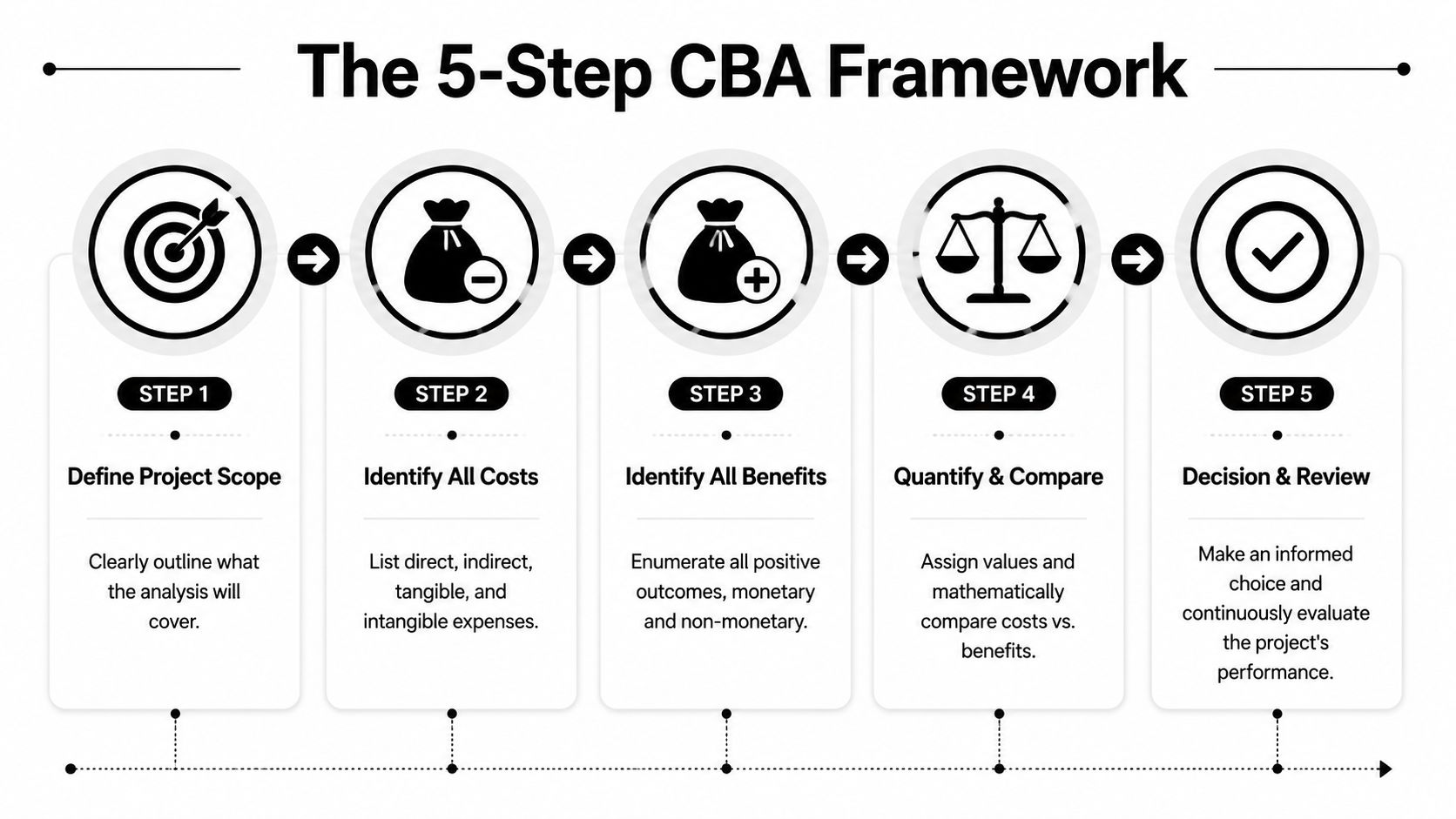
A five-step framework diagram illustrating the structured process of conducting a formal cost benefit analysis for projects.

Start with a simple non-crypto example

Say you're deciding whether to buy a better laptop for research and execution.

You don't start with “is the laptop good?” You start with scope. Are you evaluating trading performance, research speed, portability, or all three? If the scope is sloppy, the analysis turns into rationalization.

Then list costs and benefits.

Decision itemExamples
CostsPurchase price, setup time, migration hassle, learning curve
BenefitsFaster charting, fewer crashes, quicker execution, less downtime

Now turn that into a process.

The five steps in practice

  1. Define the scope
    Decide what exact choice you're evaluating. One trade? One month of using a tool? A mirror-trading strategy over a quarter? Pick one.

  2. Identify outcomes
    List what can happen if you proceed and if you don't. Good CBA compares the decision against an alternative, not against fantasy.

  3. Quantify costs and benefits
    Put dollar values where you can. For harder items, use a consistent proxy. Time saved can be valued by what that time is normally used for. Lower stress can be proxied by fewer monitoring hours or fewer emergency exits.

  4. Choose your time treatment
    If benefits and costs arrive at different times, bring them into the same frame. Discounting is a critical consideration. A gain today and a gain much later should not be treated as equal by default.

  5. Compute a decision metric
    Use a simple comparison method such as net present value, benefit-cost ratio, payback period, or all three.

The framework matters because the same idea can look profitable or unprofitable depending on timeframe, assumptions, and when the benefits actually arrive.

Translating the same process into DeFi

Take the laptop example and swap in a copy trade.

  • Scope becomes one wallet-following strategy over a defined period
  • Outcomes become the likely gains, churn risk, and missed alternatives
  • Costs include gas, slippage, fees, taxes, and monitoring time
  • Timing matters because costs hit now while many benefits may arrive later
  • The decision metric tells you whether to proceed, size down, or pass

The process doesn't change. Only the inputs do.

Key CBA Metrics and Calculations Explained

Two trades can show the same headline upside and still have very different decision quality. One pays back fast with low friction. The other ties up capital, bleeds through fees, and needs perfect timing to work. These metrics help separate those cases.

A professional man with a calculator explaining the concept of Net Present Value with a balance scale.

Net present value

Net present value, or NPV, = present value of benefits minus present value of costs.

In standard finance practice, a positive NPV means the choice creates value after adjusting both sides into present dollars, as outlined in this cost benefit analysis guide on NPV and BCR.

For DeFi decisions, NPV works best when cash flows arrive at different times. A bridge cost hits now. A farming reward arrives over weeks. A research subscription may save time every day but only if you use it. NPV forces those items into one frame so you can judge the economic result instead of the headline return.

A practical rule helps here. If a setup only looks good before gas, slippage, monitoring time, and delayed payoff are included, the trade is weaker than it first appears.

Benefit-cost ratio

Benefit-cost ratio, or BCR, = present value of benefits divided by present value of costs.

A BCR above 1.0 means expected benefits exceed expected costs after you apply the same present-value logic. I use BCR when comparing choices that solve the same problem but use different amounts of capital, time, or operational effort.

That comes up often in DeFi:

  • One analytics subscription costs more but saves more research time
  • One copy-trading wallet has higher upside but more churn and higher gas
  • One chain offers more raw opportunity but worse execution quality

BCR is a sizing and efficiency tool. It does not tell you how much absolute value you get. A trade with a 1.4 BCR on a tiny base may matter less than a trade with a 1.2 BCR on a much larger expected profit pool.

Payback period

Payback period measures how long it takes to recover the upfront cost.

This metric matters more in DeFi than many traders admit. Conditions change fast, token incentives get cut, and liquidity moves. If a strategy needs months to recover its initial drag, there is more time for the thesis to break.

Its limitation is simple. Payback period ignores much of what happens after breakeven, and it handles timing less precisely than NPV. A strategy can recover costs quickly and still be a poor decision if the upside after that point is weak or the tail risk is ugly.

For a fast trade-level check, use a crypto profit calculator framework before layering in the broader CBA assumptions.

When to use which metric

MetricBest useWeakness
NPVDecide whether a trade, tool, or strategy creates net value after timing adjustmentsDepends on your timing and discount assumptions
BCRCompare efficiency across options with different cost structuresCan hide the difference between small and large outcomes
Payback periodTest how quickly you recover upfront drag in a fast-moving marketIgnores much of the value or risk after breakeven

Use more than one metric when the decision matters. A subscription with a good BCR but long payback may still be wrong for an active trader. A trade with positive NPV but poor payback may still be too slow if you need capital free for better setups.

A short explainer can help if you want the finance intuition in video form.

Treat the metric as a filter for judgment. The output is only as good as the costs, timing, and alternatives you put into it.

Applying CBA to Your DeFi Strategy

The core value of cost benefit analysis shows up in small, repeatable decisions. Traders usually save it for “big investments,” but the edge comes from using it on routine choices before capital leaves the wallet.

A single trade is more than token upside

A trade-level CBA should start with the all-in cost stack.

Write down:

  • Execution costs like gas, bridge fees, slippage, and platform fees
  • Position risks like smart contract exposure, liquidity deterioration, and tax consequences
  • Alternative use of capital like the next-best setup you would skip
  • Expected benefits like target profit, possible partial exits, and information value from taking the trade

Many traders often stop too early. They see “token can run” and count only the upside. A better approach is to ask whether the trade still looks attractive after assuming imperfect execution.

If you're entering LP positions or rotating through pools, pair this with an impermanent loss calculator so your downside estimate isn't anchored only to price direction.

A subscription can be judged like a trade

A paid tool is just another investment decision. The mistake is evaluating it only on sticker price.

A technically sound CBA should compare alternatives, such as Telegram-only alerts versus full watchlists and exports, and should include direct and non-cash effects like faster decision-making or reduced churn in usage, which can be benchmarked with KPI proxies, following the logic in the U.S. Army guide to comparing CBA alternatives.

That means a trader shouldn't ask, “Is this subscription cheap?” The better question is, “Compared with my current setup, what does this change in speed, research load, and execution quality?”

One option in this category is Wallet Finder.ai, which lets users track wallets, build watchlists, review trading histories, and receive alerts across multiple chains. In a CBA, the relevant benefits aren't hype. They're things like time saved on wallet discovery, faster signal detection, and whether those improvements produce better decisions often enough to justify the cost.

If a tool helps you act earlier, the benefit isn't abstract. Earlier action can change entry quality, position sizing, and whether the setup is still there at all.

Mirror trading needs an alternative comparison

Copy trading feels simple because the wallet has already “proven” something. But a smart CBA compares at least two alternatives:

  • follow the wallet directly
  • use the wallet only as research input and execute selectively

The first may offer speed. The second may reduce blind-following risk.

Build the analysis around:

  • direct copy costs
  • lag between wallet action and your execution
  • differences in size tolerance
  • whether the tracked wallet's style fits your risk profile
  • downside if the wallet changes behavior

In this context, non-cash effects matter. Faster decision latency can be valuable. So can lower mental load. But both need a proxy, not hand-waving.

What usually works

Traders get the most out of CBA when they use it to reject weak setups early, not when they use it to justify trades they already want. The process works best when the alternative is explicit and the costs include friction, delay, and capital lockup.

What doesn't work is pretending every input is precise. In DeFi, some of your biggest variables are uncertain by nature. That's normal. The answer is to test ranges, not to skip the analysis.

DeFi CBA in Action A Practical Template

Below is a working template for evaluating a DeFi tool subscription. Because no verified dollar figures were provided for a live example, treat the values as your own fill-in fields, not prefilled benchmarks. The point is the structure.

CBA template for a DeFi tool subscription

CBA Template: Evaluating a DeFi Tool Subscription (e.g., Wallet Finder.ai)

ItemTypeEstimated Value ($)Notes
Subscription feeCost[enter value]Monthly, quarterly, or annual plan cost
Setup and learning timeCost[enter value]Value the hours spent onboarding
Workflow switching costCost[enter value]Friction from replacing current tools or habits
Alert fatigue riskCost[enter value]Proxy using wasted review time or distraction cost
Time saved on wallet discoveryBenefit[enter value]Estimate the value of reduced manual research
Time saved on trade monitoringBenefit[enter value]Use your own hourly value or opportunity value
Faster signal detectionBenefit[enter value]Proxy by comparing earlier versus delayed entries
Better trade filteringBenefit[enter value]Value from avoiding low-quality setups
Export and offline analysis utilityBenefit[enter value]Useful if you maintain your own research pipeline
Reduced missed opportunitiesBenefit[enter value]Estimate from setups you usually catch too late

How to fill it in without fooling yourself

Use one review period only. A month is usually enough for a trader tool. Longer periods make it too easy to stuff in speculative benefits.

Then apply three rules:

  • Use observed behavior instead of fantasy behavior. If you only review alerts twice a day, don't price the tool as if you'll act instantly every time.
  • Separate saved time from monetized edge. Time savings are one category. Better trade outcomes are another. Don't count the same benefit twice.
  • Compare against your current stack. The right comparison isn't “tool versus nothing” if you're already using DEX screener tabs, Telegram channels, spreadsheets, or manual wallet lists.

A quick scoring routine

After listing values, sum total benefits and total costs. Then ask:

QuestionYesNo
Does the tool reduce a real bottleneck in your process?Proceed to deeper reviewPass
Are the benefits still credible under slower execution?ContinueSize down expectations
Would you still want it if trade frequency drops?More robust decisionYou may be overfitting to a hot market

A good template doesn't force a buy. It helps you say no with confidence.

Common Pitfalls in Cost Benefit Analysis

Most bad cost benefit analysis isn't bad math. It's bad honesty.

Traders usually know to include gas and fees. They miss the softer variables, inflate benefits, or choose assumptions that make the answer prettier than reality. A sound CBA needs a defined framework and sensitivity analysis because costs, benefits, and risks are rarely certain, and changing key assumptions can materially alter the result, as emphasized in this practical guide to robust cost benefit analysis.

An infographic titled Avoiding CBA Pitfalls: Crypto and Beyond illustrating five common errors in cost benefit analysis.

The mistakes that break the analysis

  • Ignoring opportunity cost
    Capital committed here can't be committed elsewhere. If you don't compare the trade against the next-best use of funds, your CBA is incomplete.

  • Using one perfect-execution scenario
    Crypto execution isn't clean. Slippage changes. fills worsen. alerts arrive when you're away. Test a favorable case, a base case, and a rough case.

  • Counting vague benefits twice
    “Better decisions,” “less stress,” and “more confidence” might all describe the same improvement. Give each benefit one place in the model.

  • Choosing a lazy time horizon
    If you evaluate a volatile strategy over too long a period, you can hide near-term fragility. If you evaluate a research tool over too short a period, you can miss the actual value.

  • Letting bias pick the inputs
    Traders often run CBA after they've already decided. Then every estimate leans bullish.

Run the analysis once as an advocate and once as a skeptic. If the trade only survives the advocate version, pass.

A simple sensitivity check

Use a short table before making the decision.

VariableBase assumptionStress test
Entry qualityPlanned executionWorse fill
CostsNormal feesHigher total friction
Benefit timingImmediate effectDelayed effect
Trade frequencyNormal activityLower activity

You don't need a full model. You need enough pressure to see whether the idea still stands after reality pushes back.

Conclusion From Analysis to Action

Cost benefit analysis won't tell you which token pumps next. That's not its job.

What it does give you is a cleaner decision process. It forces you to price the things traders usually leave out, like friction, time, delay, alternative use of capital, and tool switching cost. That alone improves decision quality because many weak trades only look attractive before the full bill arrives.

For DeFi traders, this framework is most useful at the micro level. One trade. One wallet to follow. One subscription. One strategy change. Those small decisions stack, and so do their errors.

Before your next move, take a few minutes and write the trade like an operator, not a spectator. List the costs. List the benefits. Compare them objectively. If the idea still clears the bar, size it with more conviction. If it doesn't, passing is a win too.


If you want a faster way to evaluate wallet-following decisions, Wallet Finder.ai gives you structured wallet histories, alerts, watchlists, and trade discovery tools that can plug directly into your own cost benefit analysis process.