Crypto Trading Bot Comparison

Wallet Finder

Blank calendar icon with grid of squares representing days.

January 27, 2026

Let's be honest: picking the right crypto trading bot isn't about finding some mythical "best" platform that works for everyone. It's about finding the right tool for your specific strategy, your goals, and your stomach for risk. A successful crypto trading bot comparison is less about features and more about alignment—making sure the bot is a genuine extension of how you want to trade.

How to Choose the Right Automated Trading Bot

Before you even look at a single bot, you need a clear framework for evaluation that cuts through the marketing fluff. Forget chasing the highest advertised returns for a second. The real starting point is a bit of introspection about your own trading style and what you actually want to achieve.

The bot market is exploding. Once valued at USD 47.43 billion in 2025, it’s projected to hit a staggering USD 200.1 billion by 2035, growing at a 14% CAGR. This isn't just hype; it's driven by traders who are tired of making emotional mistakes. In fact, 42% of crypto enthusiasts now use bots to execute their strategies with mechanical precision in these chaotic markets. You can dig into the full market analysis on businessresearchinsights.com.

Define Your Trading Persona

So, where do you start? Before you get lost comparing features, figure out who you are as a trader. Are you a DeFi copy trader who needs to act on signals instantly? A hands-on retail investor looking for something reliable? Or a data-obsessed quant building your own models? Each profile needs something different.

  • DeFi Copy Traders: Your number one priority is speed. You need a bot that can execute trades instantly via webhooks or an API the moment a signal from a platform like Wallet Finder.ai comes in.
  • Quant Researchers: You're all about the data and the engine. Look for powerful backtesting capabilities, fully customizable strategy builders, and flexible API access to plug in your own proprietary models.
  • Retail Investors: You probably want something that just works. The focus here is on user-friendly interfaces, proven pre-built strategies, and "set-and-forget" bots with crystal-clear risk controls.

This decision tree helps visualize the first few questions you should be asking yourself. It all comes back to your goals, the strategies you want to run, and the exchanges you use.
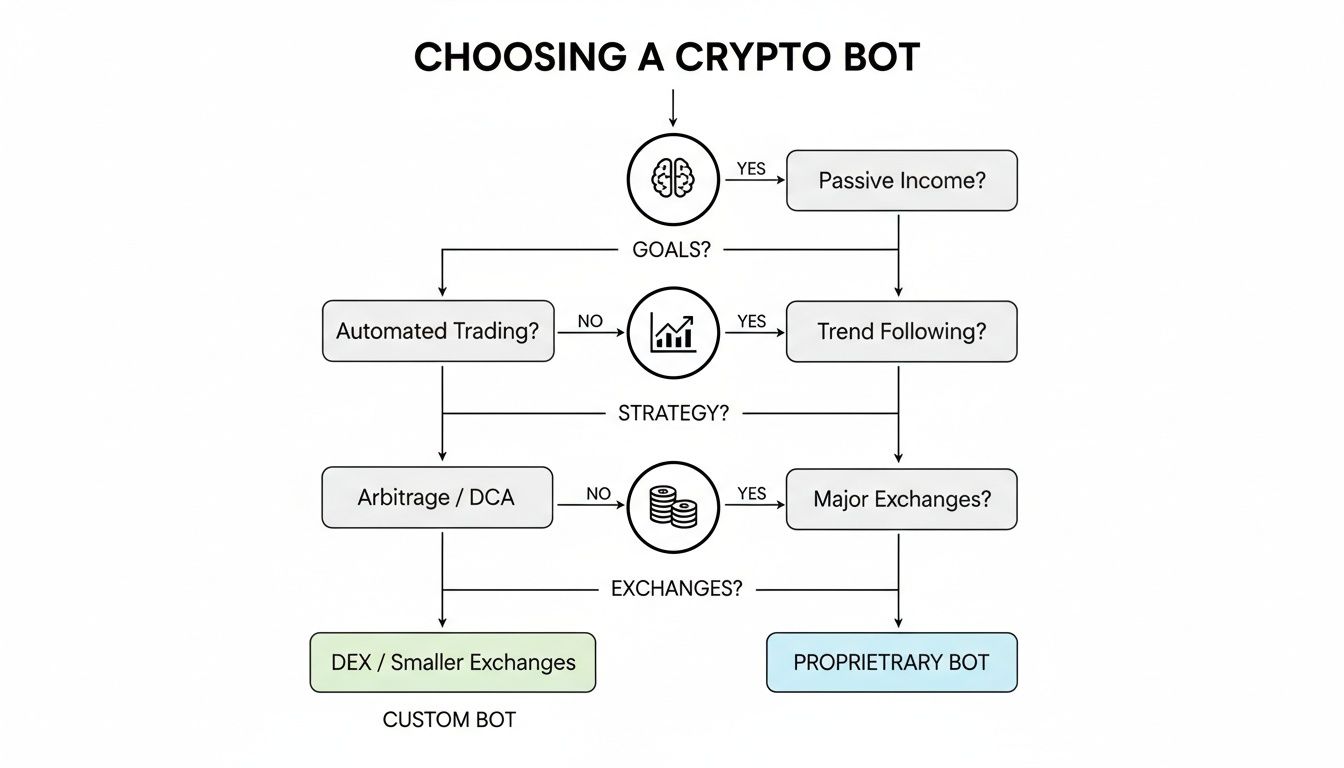
Flowchart illustrating the decision process for choosing a crypto trading bot based on goals, strategies, and exchanges.

As the flowchart shows, figuring out your primary objective—be it passive income, aggressive growth, or just preserving your capital—is the essential first step. Get that right, and your options will narrow down dramatically.

Key Evaluation Criteria

Once you know your persona, you can start comparing bots intelligently. A simple checklist of features won't cut it; context is everything.

The single biggest mistake new users make is choosing a bot based on hype or one killer feature. A smart choice is a careful balance of strategy support, security, transparent pricing, and seamless integration with your exchanges.

As we dive into the specific bot comparisons, keep these core factors in mind:

CriteriaWhy It MattersActionable Questions to Ask
Strategy SupportThe bot must run your game plan (Grid, DCA, etc.).Does it offer the specific strategies I need? How deeply can I customize the parameters?
Exchange CompatibilityIt has to work flawlessly with your exchanges.Is my main exchange supported? Are there any feature limitations for that exchange?
Security ProtocolsYour funds must be safe above all else.Does it support 2FA and API key IP whitelisting? Does it require withdrawal permissions? (Hint: It shouldn't)
Pricing ModelHidden fees can destroy your profits.Is it a flat subscription, profit-sharing, or a per-trade fee? What's the real cost for my trading volume?

Core Features and Usability Compared

Diagram illustrating DeFi copy trader, quant researcher, and retail investor roles in crypto trading.

When you're comparing crypto trading bots, a flashy feature list is just the starting point. The real test is how those features actually perform in a live market and whether they're even accessible for someone with your level of experience. A platform boasting a dozen strategies is completely useless if the interface is a nightmare to navigate or its backtesting engine spits out misleading results.

Let's cut through the marketing fluff and get into a real side-by-side analysis of how the top bots handle the essentials. We'll dig into how effective their core strategies are, what the user experience is actually like, and other critical functions that make or break your day-to-day performance.

Strategy Types and Their Real-World Effectiveness

The heart of any bot is its collection of strategies. While many platforms throw around the same terms like Grid, DCA, and Arbitrage, how they're built and how well they execute can be wildly different. Here's a quick rundown of the most common types:

  • Platforms like: Bitsgap, Pionex

The nuances are everything. One platform might offer a basic "Grid" bot, but another gives you the tools to fine-tune the grid density, set a specific trading range, and even add a trailing-up function. That's the difference between a toy and a professional trading tool.

User Interface and Overall Usability

A powerful bot with a clunky, confusing interface is a recipe for disaster. Good usability isn't a perk; it's a core feature that directly affects your ability to deploy, monitor, and tweak your strategies without making costly mistakes.

An intuitive user interface is your first line of defense against configuration errors. The best platforms walk you through the setup process with clear explanations and visual feedback, making sure you know exactly what your bot is going to do before it ever touches your capital.

We rate usability based on a few key things: how clear the dashboard is, how easy it is to launch a bot, how accessible performance reports are, and the quality of the mobile app. A platform like Pionex scores high for newcomers because it has a built-in exchange and a simple "pick-a-bot-and-go" model. On the flip side, a tool like 3Commas is incredibly powerful but has a much steeper learning curve, making it a better fit for traders who already know what they're doing.

Backtesting Engines: The Key to Strategy Validation

Before you risk a single dollar, a backtesting engine lets you test your strategy against historical market data. The quality of this feature is non-negotiable in any serious crypto trading bot comparison. A reliable backtester can save you from a flawed strategy, while a bad one gives you a false sense of confidence that can be very expensive.

Here's an actionable checklist for evaluating a backtesting engine:

  1. Data Granularity: Does it use daily, hourly, or minute-by-minute data? The more granular the data, the more accurate your simulation will be.
  2. Inclusion of Fees: Does the test account for trading fees and potential slippage? If not, the projected profits are pure fantasy.
  3. Customization: Can you test your strategy across different time frames and market conditions, like a bull run, a bear market, or a sideways chop?

Platforms like Cryptohopper and Bitsgap provide solid backtesting tools that let traders fine-tune their parameters with confidence. For anyone who's serious about automated trading, this is a must-have. If you're curious about the technical side of how bots get this data, our guide on using an API for crypto prices breaks it down further.

Core Feature Matrix of Leading Crypto Trading Bots

To pull all this together, the table below gives a quick, high-level look at how some of the most popular bots measure up against these core features. Think of this as your starting point for digging deeper.

Bot NamePrimary Strategy TypesExchange SupportBacktesting QualityUI/UX RatingMobile App
3CommasDCA, Grid, OptionsBinance, KuCoin, CoinbaseExcellent3.5/5 (Powerful but complex)Yes (Full-featured)
PionexGrid, DCA, ArbitrageIntegrated (Pionex)Good4.5/5 (Beginner-friendly)Yes (Streamlined)
BitsgapGrid, DCA, FuturesBinance, Kraken, BybitVery Good4.0/5 (Clean and data-rich)Yes (Full-featured)
CryptohopperMarket Making, DCABinance, Coinbase, OKXExcellent4.0/5 (Balanced)Yes (Full-featured)
CornixSignal/Copy TradingBinance, Bybit, KuCoinN/A (Signal-focused)4.0/5 (Simple for copy trading)Yes (Telegram-integrated)

This comparison makes one thing clear: there's no single "best" platform for everyone. The right choice really comes down to what you value most, whether it's the dead-simple approach of Pionex or the professional-grade customization offered by 3Commas.

Comparing Advanced AI and On-Chain Capabilities

Let's be honest, standard grid or DCA bots are a dime a dozen. The real magic—and the real edge—in today's crypto bot landscape comes from advanced features that go beyond simple price action. We're talking about bots that don't just react to the market; they try to get ahead of it using AI and on-chain data.

This is where serious traders find their alpha. Instead of just relying on lagging technical indicators, the top-tier platforms are pulling in machine learning, sentiment analysis, and raw blockchain intelligence to make smarter, more predictive trades. For anyone using a tool like Wallet Finder.ai, this isn't a "nice-to-have" feature. It's the essential bridge that turns on-chain signals into automated profit.

The Rise of AI-Driven Predictive Trading

Artificial intelligence is completely rewriting the rulebook for trading bots. Forget rigid, pre-programmed instructions. AI-powered bots can actually learn and adapt on the fly. They sift through massive datasets—historical prices, volume, social media chatter, even news headlines—to spot complex patterns that are completely invisible to the human eye.

The growth in this space is staggering. The AI crypto trading bot market is expected to rocket from USD 40.8 billion in 2024 to an insane USD 985.2 billion by 2034. That's a 37.2% CAGR. This explosion is being driven by machine learning's ability to process a firehose of information and find an edge, letting bots anticipate market moves instead of just chasing them. You can dig into the full report from Research and Markets if you want to see the numbers.

The true power of an AI bot isn't just its speed, but its ability to evolve. It can adjust its own parameters in response to changing market volatility or shifts in sentiment, making it far more resilient than a static, rule-based system.

For example, a smart AI bot might pick up on a wave of negative sentiment for a token across Twitter and Telegram. It could then automatically tighten its stop-loss or even exit the position entirely before the price tanks. This predictive thinking is what separates a premium tool from a basic one.

AI-driven crypto trading bot interface showing predictive analytics and on-chain data integration.

On-Chain Integration and Wallet Copy-Trading

For DeFi degens and smart money followers, the holy grail is automating trades based on what the whales are doing. This is where on-chain integration becomes non-negotiable. The best bots have features that let them watch the blockchain directly and fire off trades based on specific on-chain events. This capability is a total game-changer for anyone using a wallet tracker. Instead of scrambling to manually copy a trade after you get an alert, a well-configured bot can execute it instantly.

Here's a look at how different platforms pull this off:

  • Webhook Integration: Powerhouse bots like 3Commas let you plug in external signals using webhooks. When Wallet Finder.ai spots a trade and sends an alert, it can hit a webhook that tells your bot to execute a pre-set order immediately.
  • Telegram Signal Bots: Platforms like Cornix were born for this. They're built around automating signals from Telegram channels. You can route alerts from a wallet tracker into a private channel your bot is listening to, creating a seamless copy-trading pipeline.
  • Custom API Scripts: For the quants and developers out there, a bot with a flexible API is a blank canvas. You can write your own scripts to pull on-chain data, analyze it, and execute incredibly complex strategies based on wallet behavior, token contract interactions, or DEX liquidity shifts.

Of course, not all integrations are created equal. A bot with native, low-latency webhook support will always be faster and more reliable than one relying on clunky third-party connections. If you're serious about automating your on-chain strategies, you have to look under the hood at how a bot handles its signal inputs. To see what's possible, check out our guide on how to leverage AI agents for crypto trading.

Comparing On-Chain Capabilities in Top Bots

When it comes to using on-chain data, the difference between bots can be night and day. The table below breaks down how the leading platforms stack up in their ability to connect with external signals and run advanced, data-driven strategies.

PlatformOn-Chain Signal IntegrationAI-Driven FeaturesBest For
3CommasTop-notch webhook & API support, perfect for custom signals.AI is limited; it shines when you bring your own strategy.Traders who want to fully automate signals from tools like Wallet Finder.ai.
CryptohopperStrong signal marketplace and templates for third-party AI strategies.An AI strategy designer lets you visually build complex logic without code.Traders who want a mix of pre-built AI solutions and deep customization.
CornixBuilt from the ground up for Telegram signal automation and copy-trading.Its focus is entirely on executing signals, not predictive AI.DeFi traders living in Telegram who need fast signal-to-trade execution.

At the end of the day, picking a bot for its advanced capabilities means you have to look past the marketing fluff. You need to scrutinize its AI models, the flexibility of its API, and the raw speed of its signal integration. This is the new frontier of automated trading, where your success is defined not just by your strategy, but by the quality and speed of the data that fuels it.

Evaluating Security and Pricing Models

Crypto trading bot dashboard showing security settings and pricing plans.

Let's talk about the two pillars of any automated trading setup: security and cost. A bot with a killer strategy is completely useless if your API keys get snatched. Likewise, a "cheap" bot can bleed you dry with hidden fees and shoddy performance. This is where our crypto trading bot comparison gets real, moving past shiny features to the practicalities of keeping your capital safe and understanding what you're actually paying for.

We’re about to pull back the curtain on the security measures and often confusing pricing models of the top platforms. Think of this less as a price list and more as a cost-benefit analysis to find the true total cost of ownership, so you can trade with peace of mind.

Deconstructing Bot Security Protocols

When you link a bot to your exchange, you’re giving it the keys to the kingdom—or at least, the keys to your trading account. Trust is everything, and it has to be earned with rock-solid security. This connection happens through API keys, and how a platform treats them tells you everything you need to know about its security.

Here's an actionable security checklist to follow:

  • Restrict API Key Permissions: A bot should never need withdrawal permissions. Limit its access strictly to reading market data and executing trades.
  • Enable Two-Factor Authentication (2FA): This is non-negotiable for protecting your account on the bot platform itself.
  • Use IP Whitelisting: If available, lock down API key access to only the bot's specific server IPs. This makes a leaked key useless to an attacker.

A bot's security is only as strong as its weakest link. Any platform that skips features like IP whitelisting or nudges you toward overly permissive API keys is creating a risk you shouldn't have to take.

Solid security is the foundation. If you want to go deeper into protecting your assets, check out our guide on finding a reputable crypto security audit service to learn more about protocol safety.

Understanding the True Cost of Ownership

Bot pricing models can feel intentionally confusing, making a straight comparison a real headache. The advertised monthly fee is almost never the full story. To make a smart decision, you have to break down the different structures and see how they fit your trading volume and style.

There are three main models out there, and each has its own pros and cons depending on how active and profitable you are.

Pricing ModelHow It WorksBest ForPotential Downside
Flat SubscriptionA fixed monthly or annual fee for a specific tier of features.High-volume traders who can easily absorb the fixed cost.You pay the fee whether your bots are profitable or just sitting idle.
Performance FeesThe platform takes a percentage of the profits your bots generate.Traders who want costs tied directly to success; you only pay when you win.Can get expensive during a hot streak, taking a bigger bite out of your returns.
Credit SystemYou buy credits that get used up as your bots execute trades or run over time.Part-time traders who don’t want a recurring subscription for inactive periods.Costs can be unpredictable and might spike quickly when the market gets busy.

Practical Cost Scenarios

Let's put this into a real-world context. A bot with a "cheap" $20/month subscription looks like a steal at first glance. But if that plan caps you at one exchange and three active bots, it can end up being far more expensive than a $100/month premium plan if you need more room to operate. That premium plan might offer unlimited bots, priority support, and advanced features that actually prevent losses, giving you a much better return on your investment.

On the flip side, a performance-based model that takes 10% of profits might sound steep. But for a trader just starting out with a small bankroll, it's a zero-risk way to get in the game. You pay nothing until you're actually in the green, which perfectly aligns the platform's interests with your own. The trick is to calculate the total cost based on your expected activity and profit, not just the sticker price.

Bot Recommendations for Different Trader Profiles

After breaking down all the features, security protocols, and pricing models, we get to the most important part: matching the right tool to the right person. A bot that’s perfect for a high-frequency quant researcher is probably a terrible fit for a beginner just trying to automate their portfolio. The best choice is always personal and needs to line up with your goals, technical skill, and how you plan to find your trading edge.

This section gives you clear, actionable recommendations for three distinct types of traders. I’ll connect the dots from our earlier analysis to show you exactly why a specific bot is the ideal choice for each persona, making sure the guidance fits your unique situation.

For the DeFi Copy Trader: Instant Execution on Wallet Signals

The DeFi Copy Trader lives and dies by speed. Your main goal is to act on intelligence from platforms like Wallet Finder.ai the second it hits your screen. Any delay between getting a signal—like a top wallet scooping up a new gem—and placing the trade is lost alpha. For this, you absolutely need a bot built for seamless, low-latency signal automation.

Top Recommendation: Cornix

Cornix was practically made for this exact scenario. Its deep integration with Telegram, which is the native communication layer for most crypto communities and signal providers, makes it the undisputed champ for instant copy trading.

  • Direct Signal Integration: You can set up Cornix to watch a Telegram channel where Wallet Finder.ai alerts are posted. When a signal pops up, the bot can instantly parse it and execute a pre-defined trade on your linked exchange in milliseconds.
  • Ease of Use: There’s no need to mess around with complicated webhooks or API scripts. The setup is incredibly straightforward, designed for traders who care more about execution speed than building complex strategies from the ground up.
  • Focus on Copying: The entire platform is built around following and automating trades. It excels at mirroring strategies, whether they come from a marketplace provider or your own private signals.

For this profile, platforms like 3Commas are a solid alternative if you want more customization through webhooks. But if you're looking for the most direct path from signal to execution, Cornix’s native Telegram functionality is tough to beat.

For the Quant Researcher: Robust Backtesting and Customization

The Quant Researcher doesn't see a trading bot as a pre-built solution; they see it as an engine to power their own proprietary models. Your priorities are data integrity, a powerful backtesting environment, and a flexible API that lets you bring your own logic to the market. You need a sandbox for rigorous testing and the tools to deploy complex, data-driven strategies.

Top Recommendation: Cryptohopper

Cryptohopper really stands out with its mix of accessibility and deep customization, making it a fantastic environment for quants. It gives you the tools to design, test, and deploy unique strategies without forcing you into a rigid, pre-defined box.

The quality of a backtesting engine is non-negotiable for quants. Cryptohopper’s ability to test strategies against detailed historical data, including fees, gives researchers the confidence that their models have been properly validated before risking capital.

  • Advanced Backtesting: Its engine lets you test against all sorts of market conditions, ensuring your strategy is robust and not just curve-fitted to a recent bull run.
  • Strategy Designer: You can build complex strategies using a mix of technical indicators and even incorporate external signals, all without writing a single line of code.
  • Marketplace for Ideas: While you’ll be building your own models, its marketplace of signals and templates can be a valuable source of inspiration and components for new strategies.

While 3Commas also offers powerful tools, Cryptohopper’s more visual and accessible strategy designer gives it an edge for researchers who want to iterate on ideas quickly.

For the Retail Investor: User-Friendly and Set-and-Forget

The Retail Investor wants to get the benefits of automated trading without becoming a full-time strategist. You’re looking for a reliable, easy-to-use platform with proven, pre-configured bots that you can launch with confidence. The ideal solution here has a gentle learning curve, clear risk controls, and a "set-and-monitor" philosophy.

Top Recommendation: Pionex

Pionex is the clear winner for this profile, mostly because of its unique integrated exchange model. By combining the exchange and the bots into one platform, it completely removes the biggest technical hurdle for newcomers—fiddling with API keys.

  • Unmatched Simplicity: You just deposit funds and pick from a menu of 16+ pre-built bots, like the super popular Grid Trading Bot or DCA Bot. The whole setup process takes just a few clicks.
  • Low Barrier to Entry: Most bots are free to use. Pionex makes its money from trading fees, which are very low (around 0.05%). This model aligns their success with your trading activity.
  • Proven Strategies: The bots on Pionex are widely used and have been tested by a massive user base, giving you confidence that you’re deploying a battle-tested strategy that works.

For retail investors, the choice is pretty clear. While platforms like Bitsgap offer a clean interface, the all-in-one nature of Pionex provides a level of simplicity and security that is perfect for anyone just getting started with automated crypto trading.


Best Crypto Trading Bot by User Persona

Choosing the right bot ultimately comes down to who you are as a trader. The table below simplifies our recommendations, matching the best bot to each specific persona and highlighting why it’s the top choice for their needs.

Trader PersonaRecommended BotKey Strengths for This PersonaIdeal For
DeFi Copy TraderCornixNative Telegram integration for instant signal execution, simple setup.Traders acting on real-time alerts from signal providers like Wallet Finder.ai.
Quant ResearcherCryptohopperAdvanced backtesting, visual strategy designer, high customizability.Researchers who need to design, validate, and deploy their own proprietary models.
Retail InvestorPionexIntegrated exchange (no API keys), 16+ free pre-built bots, low fees.Beginners looking for a simple, secure, "set-and-forget" automation experience.

This breakdown should help you pinpoint the tool that not only has the right features but also aligns perfectly with your trading style and technical comfort level.

Common Questions About Crypto Trading Bots

Jumping into automated trading always brings up a few big questions. Is it really profitable? How do I keep my funds safe? Let's clear up some of the most common queries traders have before they commit to a bot.

Are Crypto Trading Bots Profitable?

Yes, they can be—but they're not a set-it-and-forget-it money printer. A bot's profitability comes down to three things: the quality of your strategy, the state of the market, and how you've configured it. A well-tuned bot is a machine that executes a winning strategy 24/7, catching opportunities you'd miss while sleeping or second-guessing yourself.

The flip side is that a bad strategy or a sudden market crash can rack up losses just as quickly. The golden rule is to thoroughly backtest every strategy before it goes live. And even then, always start with a small amount of capital to see how it performs in the real world before scaling up.

How Do I Securely Connect a Bot to an Exchange?

This is done with an API (Application Programming Interface) key, which is basically a secure messenger between your bot and your exchange account. Setting this up correctly is the most important security step you'll take.

Here is an actionable, 3-step security process:

  1. Limit Permissions: When creating your API key on the exchange, only enable permissions for trading and reading data.
  2. NEVER Enable Withdrawals: This is the most critical rule. A bot never needs this permission. Enabling it creates a massive security risk.
  3. Use IP Whitelisting: If your bot and exchange support it, lock the API key to only work from the bot's specific server IP addresses.

A pro tip: if your exchange and bot support it, always use IP whitelisting. This tells the exchange to only accept commands from your bot's specific server IP address. Even if someone stole your API key, it would be useless to them.

Can I Use a Trading Bot with External Signals?

Absolutely. In fact, pairing a bot with signals from a platform like Wallet Finder.ai is one of the most powerful ways to automate your edge. Most sophisticated bots are built to receive external alerts through tools like webhooks or Telegram.

You could, for example, set up a rule where your bot instantly executes a trade the second Wallet Finder.ai alerts you that a wallet you're tracking just made a move. This turns manual copy-trading—which is often a frantic race against the clock—into a fully automated system that acts on smart money movements instantly.

What Is the Biggest Risk of Using a Crypto Bot?

It really boils down to two things: security breaches and strategy failure. A security risk means someone gets ahold of your exchange API keys. If that happens, they could place unwanted trades. But if you followed the advice above and disabled withdrawals, they can't steal your funds.

Strategy failure is when the market does something your bot wasn't programmed for, like a "black swan" flash crash. A simple grid bot, for instance, would just keep buying on the way down, digging a deeper and deeper hole. You guard against this by building stop-losses into your strategy and keeping an eye on your bot's performance, especially when the market gets wild.


Ready to turn on-chain signals into automated trades? Wallet Finder.ai gives you the real-time alerts you need to program your bot for success. Discover top wallets, get instant notifications on their trades, and start making smarter, data-driven decisions today. Begin your 7-day trial and see what the smart money is doing at https://www.walletfinder.ai.