A Trader's Guide to Crypto Funding Rates

Wallet Finder

Blank calendar icon with grid of squares representing days.

February 15, 2026

Heard of crypto funding rates? They're the invisible hand keeping crypto derivatives in check. These are small payments between traders in perpetual futures markets, ensuring a contract's price stays close to the asset's actual spot price.

When the market is optimistic and traders go long (betting on a price increase), the funding rate turns positive. Longs pay shorts. If fear takes over and traders short (betting on a price drop), the rate flips negative. Shorts pay longs.

What Are Crypto Funding Rates
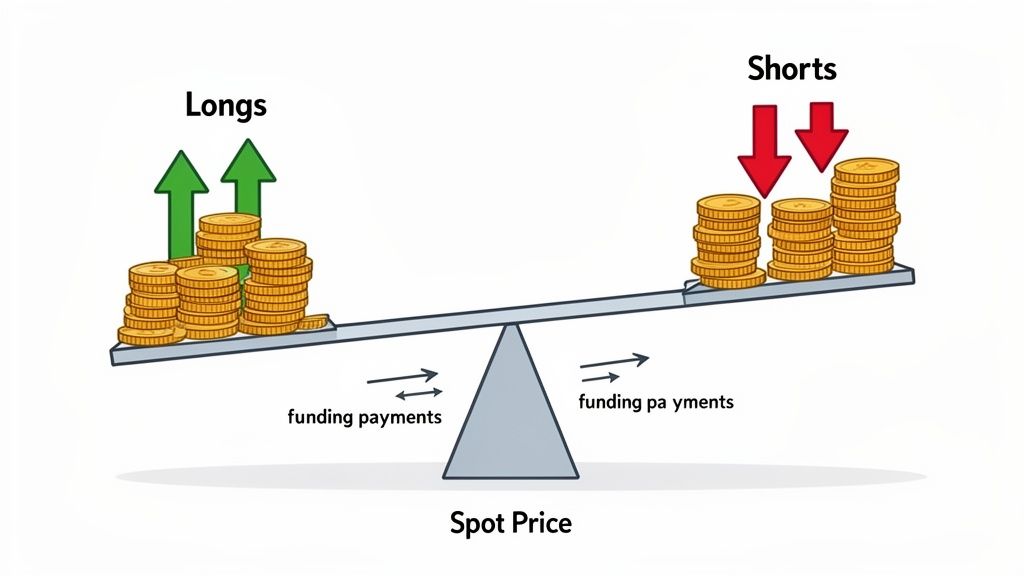
An illustration of a balance scale showing 'Longs' and 'Shorts' with coins, representing crypto funding rates.

Imagine the perpetual futures market as a tug-of-war. Bulls (longs) pull for higher prices, and bears (shorts) pull for lower prices. The rope's center must stay aligned with the asset's real-time spot price. Crypto funding rates are the rules that prevent either side from pulling too far.

It's crucial to know these aren't fees paid to the exchange. They are direct payments between traders, designed to balance market sentiment. This system is what makes perpetual futures—the most popular crypto derivative—work without an expiration date.

The Balancing Act in Action

So, how does this work in real-time? The payment direction reflects what most traders are thinking. The system cleverly makes it more expensive to follow the herd and financially rewards those who take the opposite side, naturally pulling the market back to equilibrium.

  • Bullish Market (Positive Funding): When everyone is bullish, a flood of long positions can push the perpetual contract price above the spot price. To rebalance, the funding rate becomes positive. Longs must now pay a small fee to shorts, making it less attractive to stay long and more appealing to go short.

  • Bearish Market (Negative Funding): Conversely, if negative sentiment dominates, short positions pile up, dragging the contract price below the spot price. To correct this, the funding rate turns negative. Now, shorts pay longs, rewarding traders for buying into the fear and helping to prop up the price.

This constant push-and-pull makes the funding rate an incredible, real-time barometer for market psychology.

At its core, the funding rate is the cost of disagreeing with the market's consensus. If you're long when everyone else is, you pay for that popular position. If you're short, you get paid to provide the other side of the trade.

Why Funding Rates Matter to You

For any serious trader, understanding funding rates in crypto is non-negotiable. They are more than just a trading cost; they offer a window into market dynamics and form the bedrock of several advanced trading strategies.

By keeping a close eye on these rates, you can:

  • Get a real-time read on market sentiment (is it greed or fear driving the price?).
  • Spot potentially over-leveraged trades that could lead to sharp reversals.
  • Discover opportunities for market-neutral arbitrage strategies.

To make it even clearer, here’s a quick breakdown of what funding rates signal.

Decoding Funding Rates at a Glance

This table sums up what positive and negative funding rates tell you about market sentiment and who pays whom.

Funding RateDominant Market SentimentPayment DirectionTypical Market Condition
PositiveBullish / OptimisticLongs Pay ShortsPerpetual contract price is higher than the spot price.
NegativeBearish / PessimisticShorts Pay LongsPerpetual contract price is lower than the spot price.

Simply put, the funding rate is a powerful piece of the crypto trading puzzle. Mastering it gives you a clear edge in reading the market's next move.

How Funding Rates Are Calculated

To truly use funding rates to your advantage, you must understand what happens under the hood. The calculation isn't as intimidating as it sounds—it boils down to two key ingredients: a stable interest rate and a more dynamic premium.

The Interest Rate is the baseline. It’s a small, fixed percentage set by the exchange, typically 0.01% for an 8-hour period on platforms like Binance or Bybit. This component creates a slight positive tilt, accounting for the borrowing cost differences between the two currencies in a pair (like BTC and USDT).

Then comes the exciting part: the Premium. This is where you see market sentiment in real-time. It’s the gap, or spread, between the perpetual futures contract price and the asset's actual spot price.

The Two Core Components

How these two pieces—the steady Interest Rate and the wild Premium—interact determines if the final funding rate is positive or negative. The market's mood swings the premium, and the premium swings the entire calculation.

  • The Interest Rate Component: This is the constant set by the exchange. It acts as a baseline, often giving the funding rate a slightly positive "floor."
  • The Premium Component: This is the reactive part that shows where the trading pressure is. If the perpetual contract price is higher than the spot price, the premium is positive. If it's lower, the premium turns negative.

The formula itself is straightforward: Funding Rate = Premium Index + Clamp (Interest Rate - Premium Index). The "Clamp" function is a safety mechanism to prevent the rate from getting too wild, which helps stabilize the market.

Because of this structure, even when the market is perfectly balanced (premium is zero), the funding rate will typically default to the interest rate. That’s why you often see small, default positive rates like 0.01%.

A Practical Calculation Example

Let's make this real. Assume Bitcoin’s spot price is $60,000, but bullish traders have pushed the BTC perpetual futures contract to $60,050. The exchange's Interest Rate is 0.01%.

  1. Calculate the Premium: The futures price is $50 higher than spot. This positive gap creates a positive Premium Index—let's call it +0.025%.
  2. Combine the Components: The formula then takes this premium and factors it in with the base interest rate.
  3. Determine the Final Rate: In this scenario, the bulls are in charge. The positive premium pushes the funding rate up, creating a positive rate where long positions pay short positions.

Now, flip it. What if the futures contract traded at $59,950 (a -$50 difference)? The premium would be negative. This would counteract the fixed interest rate and could easily drag the final funding rate into negative territory. When that happens, shorts must pay longs.

The entire system is designed to self-correct by making the more crowded side of the trade more expensive to hold.

The screenshot below from Binance's official documentation shows how they define these components.

This visually confirms it: funding is a mix of a fixed rate and a variable premium that ebbs and flows with the market.

The total amount you pay or receive is then calculated using this rate and your position size. This payment occurs directly between traders, usually every eight hours, which keeps the perpetual market tethered to the spot price.

Using Funding Rates as a Market Sentiment Indicator

Funding rates are far more than a fee mechanism—they are a real-time, unfiltered gauge of the market's mood. By learning to read these rates, you can gain a powerful sense of whether greed or fear is in control, often revealing clues about where the market might be headed next.

Consistently positive funding rates point to bullish conviction. It’s a clear sign that traders are confident prices will rise, so much so that they're willing to pay a premium to keep their long positions open. This optimism can fuel a strong uptrend.

But here’s where it gets interesting. Extremely high positive funding rates are not always a green light to go long. In fact, they can be a massive warning sign.

Decoding Extreme Positive Funding

When rates skyrocket, it usually signals excessive greed and a market flooded with over-leveraged long positions. This creates a fragile situation, like a house of cards ready to collapse. Even a small price dip can trigger a domino effect of liquidations, forcing leveraged longs to sell.

This chain reaction is known as a "long squeeze." Forced selling pushes prices down further, liquidating more positions, and the cycle continues. Sharp traders watch for periods of extreme positive funding as a potential signal to prepare for a steep price correction.

Interpreting Negative Funding Rates

On the other hand, negative funding rates are a clear giveaway for bearish sentiment. When shorts are paying longs, it means the market overwhelmingly expects prices to fall. You'll often see this during a downtrend or periods of intense fear.

But just like with positive rates, the real insight comes from the extremes. When funding rates turn deeply negative, it can signal peak fear and capitulation. This is the point where even dedicated bulls have thrown in the towel and the market is drowning in short positions.

For a contrarian trader, extremely negative funding rates can be a classic buy signal. It often indicates that selling pressure is exhausted and the market may be close to carving out a bottom before a potential reversal.

Historical data on funding rates crypto shows this dynamic playing out time and again. Since perpetual futures were introduced around 2016, these rates have been a reliable barometer. During the crypto winter of 2022, average BTC funding rates across major exchanges cratered, hitting lows of -0.05% every 8 hours as bearish pressure peaked.

Visualizing Market Sentiment with Funding Rates

Dashboards that track funding rates across different exchanges provide a powerful, at-a-glance view of market sentiment.

The screenshot below from Coinglass shows a funding rate heatmap for various crypto assets.

Here, bright green indicates high positive funding (bullish greed), while red signals negative funding (bearish fear). This visual tool makes it easy to spot which assets have overheated sentiment and might be due for a correction or reversal. For a deeper dive, check out our guide to crypto market sentiment analysis.

This isn't just theory. In the bull run of late 2023, funding rates flipped dramatically positive. In early 2024, as BTC surpassed $70,000, average rates spiked to +0.10% and higher, with some peaks hitting +0.375%. This was a clear sign of overcrowded longs and foreshadowed major corrections, like the 15% pullback seen in April of that year.

Actionable Strategies for Trading Funding Rates

Knowing the theory is a good start, but turning that knowledge into a profitable trading plan is the real challenge. Pro traders don't just watch funding rates—they use them to build repeatable, edge-driven strategies.

Here are two of the most effective ways to trade funding rates: the consistent Funding Rate Arbitrage and the contrarian Mean Reversion play.

Strategy One: Funding Rate Arbitrage (The "Cash and Carry" Trade)

This classic strategy, often called a "cash and carry" trade, is designed to be market-neutral. You aren’t betting on whether an asset's price goes up or down. Instead, your goal is to simply collect the funding payments. It's favored by quant funds for generating a steady income stream.

The concept is simple: find a perpetual contract with a high positive funding rate and set up a position to collect those payments.

Here is a step-by-step guide to executing this trade:

  1. Find the Opportunity: Hunt for an asset with a consistently high, positive funding rate. Anything above +0.05% per 8-hour cycle is usually worth investigating.
  2. Set Up the Trade: This part is critical. Execute two trades simultaneously: short the perpetual futures contract while buying the exact same dollar amount of the underlying asset on the spot market.
  3. Collect the Payouts: Since you're short the perpetual contract, you receive payments as long as the funding rate stays positive. Your spot holding acts as a perfect hedge, neutralizing your exposure to price swings.

If you short $10,000 worth of ETH perpetuals and buy $10,000 of spot ETH, you're covered. If ETH's price soars, your short loses money, but your spot holdings gain the same amount. If it crashes, your short profits, canceling out the loss on your spot holdings. Price movement becomes irrelevant. Your profit is the stream of funding payments you collect.

Strategy Two: Mean Reversion Trading

Mean reversion is a contrarian strategy built on one powerful idea: moments of extreme greed or fear don't last. When funding rates get pushed to extreme highs or lows, they almost always snap back toward their historical average (the "mean"). This strategy is about betting against the overheated crowd right before they lose steam.

The pattern for a mean reversion opportunity, especially one driven by extreme positive funding, is often predictable.

Market sentiment process flow showing three stages: rapid growth, warning, and downturn.

As the chart shows, an extremely high funding rate is often the final warning sign before a market top. The cost of maintaining leveraged long positions becomes too much to bear.

You can think of funding rates as an elastic band. The market can stretch it far in one direction, but eventually, the tension—the cost of funding—pulls everything back toward the center.

Timing is everything with this strategy:

  • Extreme Positive Funding: When rates are through the roof, it’s a sign of irrational exuberance. Contrarians might open a short position, anticipating a long squeeze and a sharp price drop.
  • Extreme Negative Funding: When rates are deeply negative, it signals maximum fear and capitulation. This can be a prime moment to open a long position, catching the bounce as selling pressure burns out.

This approach works especially well in volatile altcoin markets. During the ETH ETF hype in late 2023, Ethereum's funding rates blew past +0.15% as late longs FOMO'd in. This extreme greed directly contributed to the 20% flash crash that followed. Traders who spotted this had a golden opportunity to position for the reversal.

Before jumping in, it's essential to have a solid grasp of the fundamentals. If you're new, check out our guide on crypto trading strategies for beginners.

Comparing Funding Rate Trading Strategies

So, you have two powerful strategies that use funding rates crypto, but they are very different. Arbitrage is about slow, consistent accumulation, while mean reversion is about timing sharp, explosive moves.

Here’s a side-by-side comparison:

StrategyObjectivePrimary RiskBest Condition
Funding Rate ArbitrageEarn consistent yield from funding payments.Basis Risk (perp-spot spread changes).Stable market with high positive funding.
Mean ReversionProfit from price reversals at sentiment extremes.Timing Risk (entering too early or too late).Volatile market with extreme funding rates.

Ultimately, both methods show that funding rates are more than just a fee. They're a powerful data source that can become the bedrock of a sophisticated and profitable trading plan.

Combining Funding Data with On-Chain Analysis

A magnifying glass analyzes funding trends and a data network, revealing top crypto wallets full of coins.

Arbitrage and mean reversion are great, but relying on funding rates alone is like trading with one eye closed. You get a solid read on macro sentiment in the derivatives market, but you’re blind to what "smart money" is actually doing on-chain.

To get a true edge, you must pair market-wide sentiment with granular on-chain intelligence. This combo helps you answer the most important question: when funding rates are screaming fear, are the best traders panicking or accumulating?

A Practical Workflow for Smart Money Signals

By integrating tools that track both derivatives data and blockchain activity, you can build a system for high-conviction trades. A platform like Wallet Finder.ai becomes indispensable here, letting you connect the dots between a market signal and the wallets acting on it.

This workflow bridges macro signals with micro actions:

  1. Spot the Macro Opportunity: Scan for assets with extreme funding rates on a screener like Coinglass. Maybe you find an altcoin with a deeply negative rate of -0.10%, a clear sign of widespread panic.
  2. Find the On-Chain Confirmation: Now, validate that contrarian idea. Use an on-chain intelligence tool like Wallet Finder.ai to see if top-performing wallets are accumulating that exact asset. Look for wallets with high PnL, a strong win rate, and recent buy activity.
  3. Validate and Execute: If you discover that multiple profitable wallets are buying the asset on-chain while the derivatives market is overwhelmingly bearish, that’s your green light. This confirms that smart money shares your contrarian view, giving you the confidence to pull the trigger.

This method transforms a simple funding rate signal into a validated trade idea. You’re no longer just betting against the crowd; you're aligning your capital with traders who have a proven history of being right.

Using Wallet Finder.ai to Track Top Traders

Modern on-chain analysis tools make this process incredibly efficient. Instead of digging through thousands of transactions, you can use powerful filters to surface the signals you need in seconds.

By setting filters for high returns and recent activity on a specific token, the platform instantly highlights the wallets that are actively and profitably trading it.

Once you’ve identified these key players, you can create custom watchlists and set up real-time alerts. That way, you get an instant notification the moment a wallet on your list makes a move, letting you mirror their strategies right away.

To go deeper, check out our complete guide on crypto on-chain analysis to see how these tools really work.

This strategic blend of funding data and on-chain intelligence is a cornerstone of modern crypto trading. It provides a robust, data-driven approach that helps you catch major market moves before they become obvious.

Common Risks and How to Manage Them

Funding rate strategies are powerful, but the crypto markets are unforgiving. Without a solid grasp of the risks, even the sharpest strategies can fail. Protecting your capital is the only way to stay in the game.

The biggest danger is liquidation risk. It can strike even when a trade feels like a sure thing.

Take a "market-neutral" arbitrage trade. On paper, it looks bulletproof. But if you use too much leverage, one savage price wick can liquidate one side of your position instantly, collapsing your entire setup.

Understanding Key Trading Dangers

Beyond liquidation, several other risks can slowly drain your account. Know them before putting a single dollar to work.

  • Liquidation Risk: This occurs when a sudden price move against your futures position eats through your margin, forcing the exchange to close your trade at a loss. High leverage is like adding fuel to a fire.
  • Basis Risk: This is the silent killer in arbitrage plays. The "basis" is the gap between the perpetual contract and spot prices. A rapid change in this basis can completely wipe out your funding gains.
  • Timing Risk: This is the main headache for mean-reversion traders. Enter too early, and you fight the market trend. Enter too late, and you miss the move.

The takeaway is that no strategy is a magic bullet. Winning is about managing probabilities and protecting your capital when you're wrong.

A Checklist for Effective Risk Management

To combat these threats, you need a disciplined, non-negotiable risk management plan. A clear set of rules separates pros from the crowd, keeping emotions out of your decisions.

The goal of a successful trader is to make the best trades. Money is secondary. By focusing on a sound process and diligent risk management, profits often follow.

Use this checklist to keep your capital safe:

  1. Use Conservative Leverage: Start with 2-3x leverage at most, especially for arbitrage. This buffer helps your positions survive volatility.
  2. Implement Strict Stop-Losses: Always know your exit before you enter. A hard stop-loss is your emergency eject button.
  3. Right-Size Your Positions: Never bet the farm. Risk no more than 1-2% of your total trading capital on any single idea.
  4. Time Your Entry and Exit: For mean-reversion, wait for signs of a reversal instead of trying to catch the absolute peak or trough.

Funding Rate FAQs

Even after you get the hang of funding rate strategies, a few practical questions always pop up. Let's clear up some of the most common ones.

How Often Do Funding Payments Happen?

Funding payments occur at specific times set by the exchange. The most common schedule is every 8 hours, usually at 00:00, 08:00, and 16:00 UTC.

However, this can vary. For highly volatile coins or on certain platforms like Hyperliquid, funding might be paid every 4 hours or even hourly. Always double-check the contract details on the exchange you're using to avoid surprises.

Are Funding Rates the Same Everywhere?

Absolutely not. Funding rates are unique to each exchange and can differ significantly from one platform to another. You might see a +0.05% rate on Binance for a contract, while Bybit shows +0.08% for the same asset at the same time.

This isn't a bug. Each exchange has its own ecosystem of traders, and the rate reflects their unique supply and demand. These differences are what create opportunities for funding rate arbitrage.

A high funding rate on one exchange is a single piece of the puzzle. The real magic happens when you compare rates across multiple exchanges to find the biggest imbalance.

Can Funding Payments Make My Account Go Negative?

No, funding payments can't directly push your account balance into the red. These payments are taken from your available margin, not your total account equity.

The real danger is indirect. Consistently paying funding is like a slow leak. Each payment chips away at your margin, leaving you with less of a cushion against price swings and making you more vulnerable to liquidation. So while a single payment won't kill your account, the cumulative effect can be lethal if you're not managing your margin carefully.


Ready to stop guessing and start tracking the smart money? Wallet Finder.ai gives you the on-chain intelligence to see which wallets are winning the funding rate game. Find top traders, analyze their strategies, and set real-time alerts to mirror their moves. Start your free trial at Wallet Finder.ai.