Leopard Gecko Crypto: A Trader's Guide to Vetting Tokens

Wallet Finder

Blank calendar icon with grid of squares representing days.

April 17, 2026

You searched leopard gecko crypto and got two completely different worlds. One is a micro-cap token on BNB Chain. The other is a reptile disease that breeders and vets take seriously.

That mix-up is useful. It forces the right first habit for any trader in low-cap markets. Clarify the asset before you analyze it. If you can't separate noise, naming confusion, and bad assumptions at the search stage, you'll make worse decisions once money is involved.

Most traders lose on obscure tokens for boring reasons. They buy the ticker before checking the contract. They react to a candle before checking who caused it. They treat a temporary volume spike like proof of quality. A professional workflow does the opposite. It starts with identity, then legitimacy, then behavior, then execution.

Unmasking Leopard Gecko Crypto Coin or Contagion

The phrase leopard gecko crypto is ambiguous for a real reason. In reptile medicine, “crypto” often means Cryptosporidium, a parasitic infection. In token markets, it can refer to LEOPARD, a cryptocurrency token in the BNB Chain ecosystem.

That veterinary result isn't random search clutter. A 2023 Thailand study found Cryptosporidium in 51.43% of captive leopard geckos, and infection was significantly linked to wasting syndrome. The same research noted that reptile strains such as C. varanii are considered non-zoonotic, meaning they don't infect humans, according to the Thailand leopard gecko Cryptosporidium study.
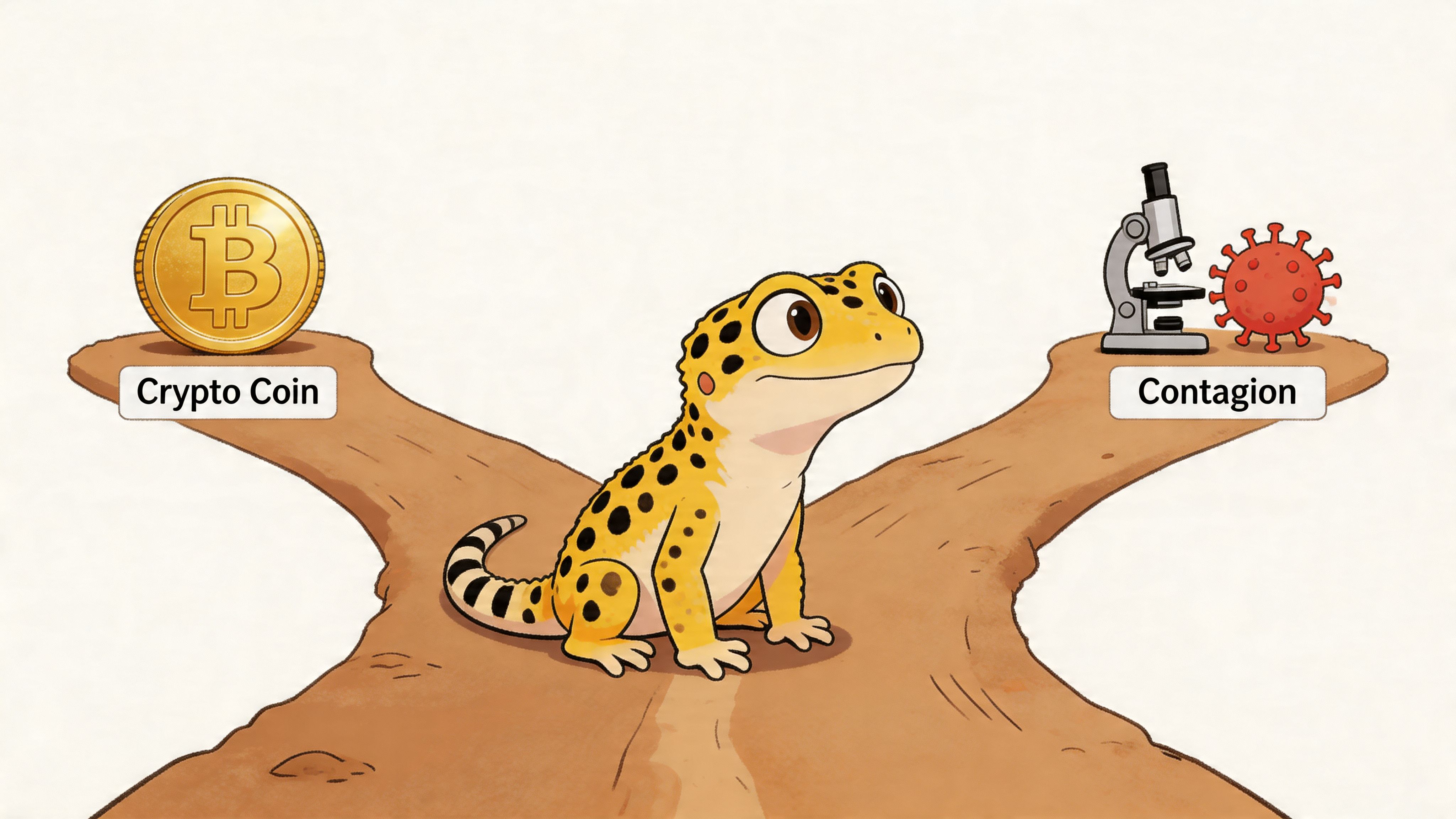
A cute leopard gecko sitting at a fork in the road between a bitcoin and a microscope.

Why this confusion matters to traders

Naming confusion is common in crypto. A token can share a word with a meme, animal, game, company, or medical term. Search results then blend unrelated content, and weak traders make fast assumptions from the wrong dataset.

That matters most in the exact part of the market where people search terms like leopard gecko crypto: low-liquidity, high-volatility tokens where information quality is already poor.

Practical rule: If a token name creates search ambiguity, rely less on generic web search and more on contract-level verification, holder behavior, and transaction history.

The useful lesson hidden in the keyword

The veterinary side also teaches a trading lesson. A parasite case isn't judged from one glance. Vets look for patterns, repeated evidence, and transmission risk. Memecoin vetting works the same way.

When I evaluate an obscure token, I don't ask, “Is this chart exciting?” I ask four harder questions:

  • What exactly is the asset? Token name, contract, chain, trading venue.
  • Can it be traded safely? Sell function, liquidity structure, contract risk.
  • Who is active in it? Wallet concentration, repeat buyers, likely insiders.
  • Is the move durable or just noisy? Volume quality, wallet quality, timing.

That's the frame for the rest of this guide. LEOPARD is the case study. The workflow applies to any risky token that shows up on your screen with a sudden burst of attention.

What Is the LEOPARD Token A Project Deep Dive

LEOPARD is a cryptocurrency token listed on CoinGecko and categorized within the BNB Chain Ecosystem, based on CoinGecko market data for Leopard. That tells you two things immediately. First, this is a live tradable asset, not just a vague meme reference. Second, you're dealing with a token in a chain environment where low-cap launches, thin liquidity, and fast rotations are common.

The current market profile is the kind of profile that attracts speculators and punishes lazy analysis.

What the market data says

CoinGecko shows LEOPARD with a 2.68% price increase over the last 24 hours, trading inside a 24-hour range of $0.000124470 to $0.000124525, using a global volume-weighted average across 1 exchange and 1 market. It also shows $136.78 in trading volume over the past 24 hours, a 728.30% increase from the previous day.

Those numbers matter less as an investment thesis and more as a warning label. A surge in activity on a token with such limited market structure can signal fresh attention, but it can also signal fragility. One venue. One market. Tiny absolute volume. That combination can move sharply on very little real participation.

What traders usually misread

A junior trader sees the volume percentage and thinks momentum. A better trader notices the base is small, the venue count is narrow, and the market can become distorted quickly.

Use this framing:

SignalWhat it tells youHow to interpret it
Single exchange exposureTrading access is limitedExecution risk is higher
Single market structurePrice discovery is thinA few actors can shape the tape
Recent volume spikeAttention has increasedAttention is not the same as durability
Tiny price denominationThe token looks “cheap”Unit bias traps inexperienced buyers

A low nominal token price doesn't make a token early, undervalued, or safer. It only makes the quote look small.

Volatility is the main feature

LEOPARD reached an all-time high of BTC 0.000015399 and now trades 97.60% below that peak, according to CoinGecko. It also stands 5,201,264.60% above its all-time low of BTC 0.000000212138. That's not a stable profile. It's the definition of an asset that can produce dramatic narrative swings depending on which time window a promoter chooses.

The recent week adds more context. Over the last 7 days, LEOPARD declined 2.40%, while the global crypto market gained 6.70% and the BNB Chain Ecosystem posted 0.00% change on the same CoinGecko page. That tells you the token recently underperformed both broad market conditions and its immediate ecosystem benchmark.

What this means in practice

Before you think about a trade, classify LEOPARD correctly:

  • It is not a quality asset by default. It is a high-risk speculative token.
  • It is not validated by activity alone. A volume spike can be mechanical, coordinated, or temporary.
  • It is worth studying precisely because it is messy. Messy assets teach discipline.

A lot of traders skip this first classification step. They move from ticker to trade. The right move is to treat LEOPARD like a lab sample. Define the market structure first. Then verify whether the thing is even safe enough to analyze further.

Verifying Legitimacy Smart Contract and Rug Risk Audit

A token can have a real chart and still be untradeable in practice. That's why contract review comes before setup hunting.

If you're vetting leopard gecko crypto as a live trading candidate, your first job isn't to predict upside. It's to decide whether the token belongs in the trash before you spend another minute on it.

A six-step guide infographic for verifying the legitimacy of a crypto token to avoid rug pulls.

The first-pass audit

Open the token on the relevant block explorer for BNB Chain. Then run a basic sequence.

  1. Match the contract address
    Search by ticker only if you want to get tricked. Pull the contract from the market listing, then verify it on the explorer.

  2. Check whether the contract code is verified
    Unverified code doesn't automatically prove a scam, but it removes your ability to inspect what matters. For low-cap tokens, that alone is often enough to move on.

  3. Read the holder list
    You don't need to be a smart contract engineer to spot concentration risk. If one wallet or a tiny cluster controls an outsized share of supply, your chart is secondary. That wallet is the chart.

  4. Inspect transfers around launch and recent activity
    Look for repeated self-routing, wallet splitting, and suspicious internal shuffling. If volume appears active but the same few wallets keep recycling flow, that's not organic participation.

  5. Review liquidity conditions
    Ask simple questions. Is there enough liquidity to enter and exit? Is the pool structure stable? Can a single actor drain confidence fast?

  6. Search for common warnings
    Honeypot reports, blocked sells, fee manipulation, blacklist behavior, owner privileges, and stealth mint concerns all belong on your list.

Token Contract Due Diligence Checklist

CheckRed Flag IndicatorWhat It Means
Contract verificationCode isn't publicly verifiedYou can't inspect core behavior reliably
Owner permissionsExcessive admin controlThe team may retain dangerous powers
Holder concentrationA few wallets dominate supplyPrice can be controlled or dumped
Liquidity structureFragile or unclear pool conditionsExit risk rises sharply
Transfer behaviorCircular or recycled flowsActivity may be manufactured
SellabilityReports of blocked exitsIt may function like a honeypot
Project identityNo clear public footprintAccountability is weak
Community qualityBots, spam, fake enthusiasmNarrative may be synthetic

What works and what doesn't

What works is a disqualification mindset. You are trying to remove bad trades fast.

What doesn't work is “falling in love” with a chart and then searching for reasons to justify it.

If a token fails basic contract hygiene, don't downgrade your standards just because the candle looks strong.

For a structured list of common red flags, I recommend reviewing a dedicated crypto rug checker guide. Use it as a pre-trade filter, not a post-loss autopsy.

The human checks traders forget

Contract review isn't enough by itself. A token can be technically tradable and still be a bad vehicle.

Run these softer checks too:

  • Developer trail: Has the team been linked to prior abandoned launches?
  • Community quality: Are real users discussing execution and risk, or are bots spamming price targets?
  • Narrative coherence: Does the project describe what it is, or only repeat slogans?
  • Market honesty: Are promoters talking about mechanics or just promising “next pump”?

A professional rug audit is boring on purpose. It should feel procedural. If the token survives that process, then you've earned the right to look for actual opportunity.

Advanced On-Chain Signal Analysis

A contract can be clean enough to trade and still be a terrible setup. The edge comes from behavior. That means wallets, sequencing, and timing.

In this context, most traders stay shallow. They look at a holder count snapshot, maybe a green candle, then convince themselves that “smart money is in.” Usually they mean they saw one wallet buy once.

That isn't enough.

Why single snapshots fail

In veterinary medicine, Cryptosporidium can be hard to detect because shedding is intermittent, which means repeated testing is needed to catch what a single sample may miss, as noted by Parasitevet's guidance on cryptosporidiosis. On-chain analysis works the same way. A wallet can accumulate unobtrusively, pause, split across addresses, then press size later.

A one-time glance misses that sequence. Repeated observation catches it.

The best signals often look unimpressive in isolation. Their value appears when you line them up over time.

The wallet behaviors worth tracking

I care less about one dramatic buy and more about a pattern that keeps repeating. In risky tokens, the strongest clues usually come from consistency.

Watch for:

  • Quiet accumulation: Multiple smaller buys over time, especially before broader attention arrives.
  • Selective participation: A wallet trades only a few names, not every trending meme.
  • Disciplined exits: Partial sells into strength instead of full panic dumps.
  • Re-entry behavior: The same wallet returns after pullbacks instead of disappearing after one trade.

Those patterns matter because they hint at process. Processed buying is different from random punting.

Reading the holder map correctly

Holder distribution is useful, but only when combined with flow. A concentrated holder base can be fatal. It can also mean the token is early. The difference shows up in behavior.

Use a practical comparison:

PatternBetter interpretationRisk implication
One large wallet holds and never interactsPossible dormant concentrationUnpredictable overhang
Large wallets add graduallyPotential informed accumulationWatch closely, don't chase
Large wallets rotate quicklyOpportunistic trading flowExpect volatility and shallow conviction
Retail wallets flood in after a spikeNarrative expansion phaseOften late for clean entries

Signal stacking beats signal hunting

Most bad decisions come from overvaluing one signal. A smart buy is not enough. A volume spike is not enough. A nice chart is not enough.

I want at least a stack like this:

  • Contract appears tradable
  • Holder map is not obviously toxic
  • A few competent wallets are active
  • Buying happens across time, not one burst
  • Flow and price action support each other

If one part breaks, I downgrade the setup.

For a broader framework on how traders interpret wallet flow, transaction timing, and token behavior, this on-chain analysis guide for crypto traders is a useful companion.

What junior traders should stop doing

Don't label every profitable wallet a whale. Don't assume every early buyer is smart money. And don't confuse visibility with quality. The loudest wallet on social media is rarely the one doing the best work.

Good on-chain analysis is repetitive. You check who bought, when they bought, how they sized, whether they held, and whether they came back. Then you compare that behavior against other tokens they touched.

That is how you turn leopard gecko crypto from a weird search term into a repeatable signal exercise.

A Practical Playbook for Trading Risky Tokens

Once a token passes identity checks, contract checks, and behavior checks, you still need a trading plan. Without one, you aren't running analysis. You're improvising with nicer language.

Risky tokens demand a tighter playbook because many of them can't be fixed. In reptile medicine, sources note that no single consistently effective treatment exists for gecko cryptosporidiosis, so supportive care becomes the practical response, according to Azeah's overview of leopard gecko cryptosporidiosis. Trading has an equivalent class of problem. Some tokens are structurally weak. No clever entry rescues broken tokenomics.

Separate live setups from zombie setups

A live setup has behavior you can work with. A zombie setup still trades, still prints candles, and still attracts hopeful buyers, but the internals are rotten.

Use this filter.

Signs of a live setup

  • Buyers return after dips: The same competent wallets don't vanish after the first impulse.
  • Flow matches price: On-chain participation supports the move instead of contradicting it.
  • Seller pressure is manageable: Exits happen, but they don't instantly crush the tape.
  • Narrative and activity line up: Attention follows behavior, not the other way around.

Signs of a zombie setup

  • Only the chart looks good: Wallet quality is weak, but the candle is dramatic.
  • Volume appears low quality: Activity feels recycled, frantic, or inconsistent.
  • Large holders loom over the market: One release of tokens, transfer, or dump can kill the move.
  • There is no second act: Once the first push fades, nobody serious adds.

Key takeaway: Avoidance is a position. In low-cap tokens, skipping bad structures preserves more capital than forcing extra trades.

The trade plan I trust most

I prefer a simple framework over a complicated one.

  1. Build the candidate list
    Only include tokens that survive the legitimacy audit.

  2. Wait for evidence of repeat participation
    I want to see more than one meaningful interaction from wallets worth following.

  3. Enter on confirmation, not on excitement
    If volume expands and better wallets continue to participate, the trade earns attention. If it only trends on social chatter, I pass.

  4. Scale with restraint
    Size small at first. Let the market prove the thesis before adding.

  5. Reduce into strength
    Risky tokens can reverse fast. Taking partial profit is not weakness. It's basic survival.

  6. Exit on behavioral deterioration
    I care more about changing wallet behavior than about my original opinion.

What doesn't work

Some habits fail over and over:

  • Buying because the token is “cheap”
  • Averaging down on a structurally weak chart
  • Ignoring wallet exits because the community stays loud
  • Treating every pullback as an opportunity
  • Holding after the reason for the trade is gone

This part is simple. Your edge in leopard gecko crypto isn't prediction. It's filtration, timing, and discipline.

Finding Top Traders with Wallet Finder ai

Manually tracing profitable wallets is possible. It's also slow, fragmented, and easy to mess up when markets are moving. If you want to operationalize this workflow, a wallet intelligence platform does the heavy lifting.

For this job, use Wallet Finder.ai's wallet tracker workflow to move from token curiosity to trader identification.

A digital diagram showing a connected network of crypto wallets with a magnifying glass over one highlighted wallet.

Start from the token, not the personality

The cleanest workflow is to begin with the asset you're researching.

Open the platform and use the Discover Tokens view to locate the token or the relevant market segment. For a name like LEOPARD, that matters because niche tokens often attract a mix of serious opportunists, random speculators, and wallets tied to the project itself.

You want the subset that trades well, not the subset that talks loudly.

Move from token page to wallet page

Once you're on the token, inspect the wallets that interacted with it successfully. Through this, the workflow becomes practical.

Focus on traders whose histories answer these questions:

  • Do they have a repeatable record across more than one token?
  • Do they enter early or only chase visible momentum?
  • How do they exit?
  • Do they size consistently or swing wildly?

A wallet with one lucky hit is noise. A wallet with coherent entries and exits across multiple trades deserves attention.

Filter for quality, not just profit

Raw profit can mislead. A wallet can score one huge win and still be a poor model to copy.

Use filtering to prioritize:

FilterWhy it mattersWhat to avoid
PnL consistencyShows repeatabilityOne-hit wonders
Win behaviorReveals execution qualityLucky spikes with poor follow-through
Trade timingHelps identify whether the wallet leads or chasesLate entrants
Position sizingShows risk disciplineWild sizing with unstable outcomes

At this stage, most traders upgrade fast. They stop asking, “Which token is hot?” and start asking, “Which wallets handled this token well?”

A good wallet history is a better teacher than a loud Telegram call.

Build a shortlist, then study behavior

Don't copy every profitable wallet you see. Build a shortlist. Compare how each wallet behaved in LEOPARD-like names. Note who buys before the crowd, who trims properly, and who exits when the thesis weakens.

The goal isn't blind imitation. It's pattern recognition. Once you identify traders with repeatable behavior in risky names, your research quality improves immediately.

That's the practical use of Wallet Finder.ai here. It shortens the path from scattered on-chain noise to a focused list of traders worth tracking.

Setting Up Real-Time Alerts for Copy Trading

Research is only valuable if you can act while the signal is fresh. In fast memecoin markets, delayed awareness usually means worse entries and weaker asymmetry.

A smartphone display showing financial trading notifications and a positive growth chart for copy trading analysis.

Turn your shortlist into a watchlist

After you've identified the wallets worth following, add them to a dedicated watchlist. Keep it selective. A bloated alert feed trains you to ignore good signals.

Set notifications for the events that matter:

  • New token buys if you want early discovery
  • Sells and trims if you care about risk-off behavior
  • Fresh entries into names you've already vetted if you're waiting for confirmation

A focused alert setup works better than a noisy one.

Use alerts to improve timing, not replace judgment

When an alert hits, don't auto-buy. Pull up the token, confirm the wallet action, and check whether the broader setup still matches your rules. Alerts compress reaction time. They don't remove the need for validation.

For a visual walkthrough of real-time trade monitoring, this video is worth watching:

The best use of alerts is simple. They let you catch a strong wallet's move while the trade is still actionable, instead of discovering it later through a screenshot thread or a delayed call channel.

Frequently Asked Questions on Leopard Gecko Crypto

Is leopard gecko crypto a real token?

Yes. In crypto markets, the term can refer to LEOPARD, a token in the BNB Chain ecosystem. The phrase is confusing because “crypto” also appears in reptile medicine as shorthand for Cryptosporidium.

Is LEOPARD a safe investment?

I wouldn't describe a token like LEOPARD as safe. It fits the profile of a high-risk, high-volatility micro-cap asset. That doesn't make it untradeable. It means you should treat it like a speculative instrument, not a long-term conviction hold by default.

Does a sudden volume spike mean the token is about to run?

Not by itself. A spike in activity can be useful, but it needs context. Check contract risk, wallet quality, holder behavior, and whether buying persists over time.

What's the biggest mistake traders make with obscure tokens?

They skip verification. They buy the ticker, the meme, or the candle before confirming the contract and studying wallet behavior.

Why bring up the gecko disease at all?

Because the search term includes both meanings, and the comparison is useful. On-chain analysis benefits from repeated observation in the same way difficult veterinary detection does. One snapshot often misses the important pattern.

What's the right takeaway from this guide?

Treat leopard gecko crypto as a workflow test. Clarify the asset. Audit the contract. Track wallet behavior over time. Build a trade plan. Then use real-time alerts to execute faster and more cleanly.


Wallet Finder.ai helps you do the hard part of memecoin trading with less guesswork. You can use Wallet Finder.ai to discover active tokens, identify the wallets trading them well, study full trade histories, and set alerts so smart money activity reaches you while it's still actionable. If you're serious about trading high-risk names with a repeatable process, it's the tool that turns on-chain noise into something useful.