Data Driven Trading: A Practical Guide for DeFi

Wallet Finder

Blank calendar icon with grid of squares representing days.

June 1, 2026

You open your terminal, wallet dashboard, and Telegram alerts at the same time. BTC moves, a whale rotates, a memecoin starts trending, and your first instinct is to chase the candle that already ran. That's how most traders leak edge in DeFi. They react to noise, then tell themselves a story about why the trade was “obvious.”

A better process starts with evidence before action. In DeFi, that means treating wallets, token flows, transaction timing, and liquidity behavior as data inputs, not background chatter. The point of data driven trading isn't to sound quantitative. It's to make decisions you can test, repeat, and improve.

Most new traders think the hard part is finding signals. It isn't. The hard part is building a workflow that filters weak signals, defines entry conditions, and keeps you from improvising every time the market gets loud.

What Is Data Driven Trading and Why It Matters

Data driven trading is a rules-based way of making trading decisions from observable evidence instead of mood, bias, or social pressure. In practice, that means you define what matters, measure it, and act only when your conditions are met.

In crypto, the alternative is familiar. You see a token moving, read five bullish posts, notice one wallet bought size, and jump in without context. Then the same wallet distributes into strength, liquidity thins, and you're left managing a trade you never really planned.

That approach feels active, but it isn't systematic. It also tends to punish traders over time. An industry analysis cited by LuxAlgo's overview of quantitative trading says emotional investors can lag by about 4.4% annually, while data-driven platforms can potentially increase returns by as much as 20%.

What changes when you trade from data

A data driven trader doesn't ask, “Do I like this token?” The better question is, “What conditions exist, and have these conditions led to acceptable outcomes before?”

That shift changes everything:

  • Entries become conditional: You stop buying because a chart looks exciting and start buying when wallet behavior, liquidity, and timing line up.
  • Risk gets defined early: Position size, invalidation, and exit logic are set before the trade, not after stress kicks in.
  • Review becomes possible: If a strategy underperforms, you can inspect the rules. If you trade on instinct, there's nothing clean to review.

Practical rule: If you can't describe your setup in a few objective conditions, you don't have a strategy yet. You have a hunch.

Why this matters more in DeFi

DeFi is unusually noisy. Narratives move fast, token lifecycles compress, and wallet-level behavior often matters more than polished public messaging. That makes systematic observation valuable.

The edge usually doesn't come from predicting everything. It comes from narrowing your field of play. You decide which wallets matter, which chains matter, what “accumulation” means, what distribution looks like, and when you'll ignore a signal. That's the difference between participating in the market and studying it closely enough to trade it with discipline.

Understanding Your Data Sources and Signals

If strategy is the engine, data is the fuel. Bad fuel gives you noisy signals and false confidence. Good fuel gives you a cleaner read on who is doing what, where, and with what conviction.

In DeFi, I treat data in four buckets. Each bucket tells you something different, and none should be used in isolation.
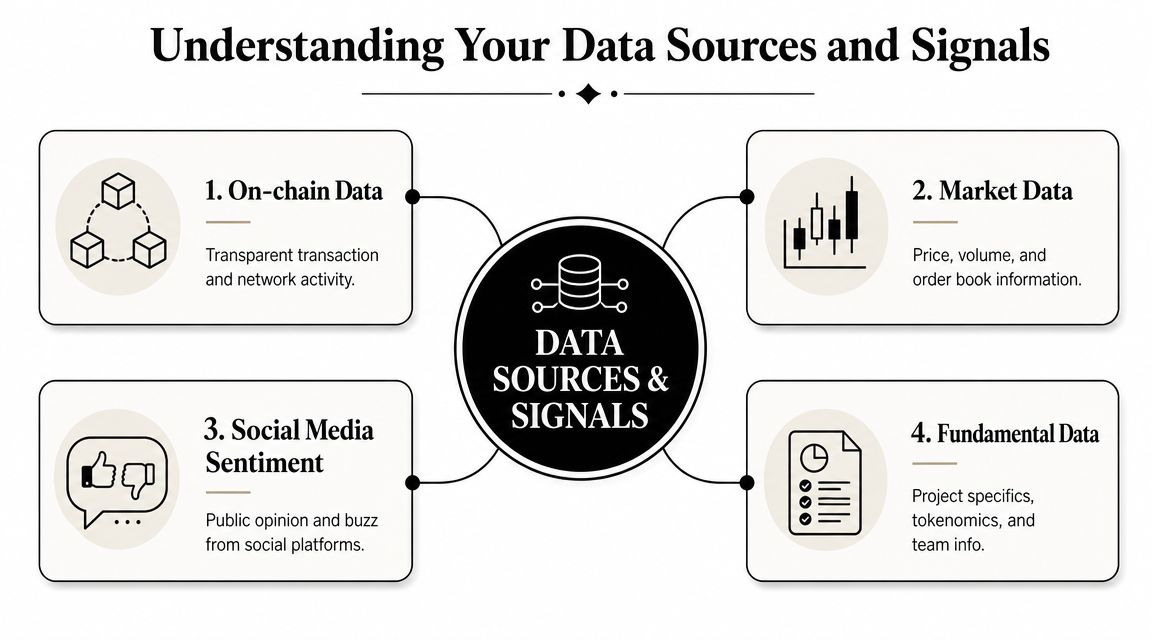
An infographic displaying four categories of crypto trading data: On-chain, Market, Social Media Sentiment, and Fundamental Data.

On-chain data

This is the native language of DeFi. Transactions, wallet balances, token transfers, swap behavior, holding periods, and realized outcomes all live here.

For most traders, on-chain data is the highest-value category because it shows actual behavior, not opinions about behavior. A wallet that buys early, sizes consistently, and exits with discipline tells you more than a hundred posts on X.

Useful on-chain signals include:

  • Accumulation patterns: Repeated buys into a token over time instead of one impulsive entry.
  • Wallet clustering: Multiple profitable wallets entering the same asset around a similar window.
  • Position management: Whether a wallet scales in, trims into strength, or panic sells.
  • Cross-chain movement: Capital rotation from one ecosystem into another.

If you're new to structuring these inputs, blockchain data analytics methods are worth studying because raw transaction data only becomes useful after you map it to trading behavior.

Market data

This includes price, volume, liquidity, spreads, order-book behavior where available, and trade flow. It answers a different question from on-chain data. Not “who is buying?” but “how tradeable is this setup right now?”

A key technical edge in data driven trading is using statistical models on historical, market, and alternative data, especially with market microstructure data like order-book depth that can reveal short-term imbalances not visible in standard price charts, as described by Quantified Strategies on data-driven trading methods.

That matters in DeFi because a strong wallet signal can still be untradeable if liquidity is thin or if execution conditions are poor.

Sentiment and social data

Sentiment data is noisy, but ignoring it is a mistake. Social velocity can change timing even when your on-chain thesis is correct. A token can stay quiet while smart wallets accumulate, then reprice once attention arrives.

Use sentiment carefully:

Data typeBest useMain weakness
On-chainConfirming real wallet behaviorCan be hard to interpret without context
MarketJudging execution quality and timingFast changes can invalidate signals quickly
Social sentimentTiming attention waves and crowd behaviorHighly manipulable
FundamentalFiltering for project quality and structureOften slower-moving than price

Fundamental data

This covers tokenomics, release structure, protocol design, team credibility, treasury behavior, and incentive design. It won't time your entries well, but it can keep you out of weak setups.

Strong signals come from agreement across categories. One wallet buy isn't enough. One bullish thread isn't enough. A better trade appears when wallet behavior, market conditions, and token structure point in the same direction.

The End-to-End Data Driven Trading Workflow

Most traders fail because they treat strategy like a single insight. It isn't. It's a pipeline. Raw observations go in, tradable rules come out, and then live monitoring tells you whether the edge still exists.

A clean workflow also matters because machine-led decision systems now sit at the center of market structure. A 2024 paper discussed by the University of Edinburgh research publication notes that high-frequency trading accounts for almost half of equity trading volume. Different market, same lesson. Rules, data, and execution discipline aren't optional anymore.

A seven-step flowchart illustrating the end-to-end process of developing a data-driven trading system workflow.

Stage one through three

I like to break the first half into input, cleanup, and idea formation.

  1. Data ingestion
    Pull the raw material first. In DeFi, that usually means wallet histories, token trades, balances, transaction timestamps, liquidity context, and chain-specific routing behavior.

  2. Data preprocessing
    Raw on-chain data is messy. You need to normalize token symbols, remove obvious one-off distortions, separate buys from transfers, and identify whether a wallet's behavior is intentional or incidental.

  3. Feature engineering
    Signals become testable variables. Examples include time between entry and exit, average size relative to prior wallet trades, repeated buying across blocks, or whether multiple profitable wallets entered within the same window.

A lot of DeFi traders skip this stage and go straight from wallet observation to live copying. That's usually where the slippage between “interesting” and “tradeable” starts.

Stage four through seven

The back half of the workflow decides whether a signal deserves capital.

  • Strategy design
    Write rules with enough precision that another trader could apply them the same way. “Follow smart money” is not a rule. “Track wallets with repeatable realized gains, wait for clustered entries into liquid pairs, enter only after confirmation of sustained buying” is closer.

  • Backtesting and validation
    Test the logic on historical examples. Then split what worked from what only looked good in hindsight. For DeFi-specific process design, a backtesting framework for crypto strategies is a practical reference point.

  • Risk controls
    Add position sizing, max exposure per narrative, and exit logic. In live DeFi markets, a mediocre entry with disciplined risk can survive. A strong signal with sloppy sizing can still damage the book.

  • Deployment and monitoring
    Once live, monitor drift. Wallets change behavior. Token conditions change. What worked during one regime can gradually decay.

Where tools help and where they don't

A tool can speed up discovery, filtering, and export. It can't think for you. Wallet Finder.ai fits the workflow where on-chain traders need structured wallet discovery, trade history, token discovery, alerts, and data export for deeper analysis.

Use tools to reduce manual searching. Don't use them as a substitute for hypothesis testing.

The strongest workflow is boring to watch. It ingests data, applies filters, rejects most setups, and acts only when the setup fits the model.

Essential Metrics for Strategy Evaluation

A profitable month doesn't prove a strategy works. It may only prove that market conditions were friendly. Evaluation starts when you ask whether the returns came from a repeatable process or a lucky stretch.

Most traders look at PnL first because it's easy to understand. PnL matters, but on its own it hides too much. You need a small set of metrics that explain quality, not just outcome.

The metrics that actually matter

Here are the core measures I use when reviewing a strategy:

MetricWhat it tells youWhat to watch for
PnLTotal profit or lossUseful, but incomplete without risk context
Win rateHow often trades close positiveCan mislead if losers are much larger than winners
Sharpe ratioReturn relative to variabilityHelps compare smoothness of returns
Maximum drawdownLargest peak-to-trough declineShows pain tolerance required to stay with the strategy
Profit factorGross profits relative to gross lossesGood for seeing whether winners meaningfully outweigh losers

A strategy with a high win rate can still be poor if one bad trade erases many small gains. A lower win rate can be acceptable if losses stay controlled and winners are allowed to run.

How I read these numbers together

I don't evaluate any metric in isolation.

  • Win rate without drawdown context tells you very little.
  • PnL without Sharpe-like risk context can flatter unstable strategies.
  • Profit factor without sample quality can overstate weak systems.
  • Low drawdown with weak upside may be too conservative to justify deployment.

This is why review needs a bundle of metrics instead of a single vanity number. A strategy earns trust when the metrics agree with each other.

If a strategy looks amazing on one metric and mediocre on the rest, assume the weak metrics are telling the truth.

Good evaluation habits

Use process discipline when reading results:

  • Segment by regime: Review how the strategy behaved during trend, chop, and panic conditions.
  • Separate live from backtest thinking: Historical fit matters less than how the logic translates into real execution.
  • Track position sizing impact: The same signal can look stable or reckless depending on allocation rules.
  • Review by setup type: A strategy often contains one strong sub-pattern and several weak ones.

For a practical checklist of what to inspect, metrics for analyzing trading profitability can help organize your review process.

What beginners usually miss

They confuse frequency with reliability. More trades don't always mean better evidence. In DeFi, repeated low-quality entries can create the illusion of activity while hiding poor selectivity.

The fix is simple. Measure what the strategy does when conditions are worst, not only when everything lines up. That's where durability shows up.

DeFi Examples Using Wallet Finder.ai

Theory gets useful when you can turn it into a daily operating routine. In DeFi, that usually means starting with wallet behavior, then deciding whether the observed pattern is strong enough to trade.

Here are three practical setups that on-chain traders use often.

A young man holding a tablet showcasing the Wallet Finder AI platform with various financial investment strategies.

Smart money copy trading

This setup starts with wallet selection, not token selection. The goal is to find wallets that show repeatable behavior, then study how they enter, add, and exit.

A clean workflow looks like this:

  1. Open Discover Wallets and filter for wallets with stable realized outcomes rather than one lucky outlier.
  2. Review trade history to see whether the wallet wins through timing, conviction sizing, fast rotation, or patient holds.
  3. Check recency because stale performance is less useful than recent behavior in the current market regime.
  4. Build a watchlist of wallets whose style matches your own execution tolerance.
  5. Set alerts so you see fresh activity when it happens instead of reviewing it too late.

What works here is selective copying. What doesn't work is mirroring every trade from every profitable wallet. Even strong wallets can have different liquidity access, speed, and risk tolerance than you do.

Whale movement detection

Large wallet activity can be informative, but only if you interpret it correctly. A big buy may signal accumulation. It may also be a rebalance, treasury movement, or setup for distribution into attention.

The process I prefer:

  • Start with transaction size in context: Large relative to the wallet's history matters more than large in absolute terms.
  • Check whether buys cluster: One move is noise. Repeated adds are more meaningful.
  • Review what happened after prior similar moves: Did the wallet tend to scale in before price expansion, or did it fade quickly?
  • Inspect liquidity conditions: If the token can't absorb size cleanly, the signal may be hard to execute.

Traders' overreaction is a frequent occurrence. They see “whale bought” and enter instantly. Better traders ask whether the wallet has a reliable pattern and whether the market structure supports the trade.

A useful walkthrough sits well in video because you can see the filtering and review flow in sequence:

Early token discovery

This is one of the more attractive use cases in DeFi because information diffuses unevenly. Some tokens show up in wallet behavior before they dominate social feeds.

The routine is straightforward:

StepWhat to inspectWhy it matters
Find new activityLook at recent token buying across tracked walletsSurfaces fresh attention early
Cross-check wallet qualitySee who is buying, not just what is being boughtFilters low-signal noise
Study trade timingCompare first entries, adds, and trimsShows whether conviction is building
Review token contextLiquidity, route quality, and holder behaviorAvoids untradeable setups

A few practical notes matter here. Early doesn't automatically mean good. Many “early” tokens never mature into quality trades. The edge comes from finding early accumulation by wallets that have shown repeatable judgment, then waiting for enough confirmation that you're not just funding someone else's experiment.

Common Pitfalls and Best Practices

Most weak data driven trading systems don't fail because the trader lacked data. They fail because the trader trusted the wrong version of the data, tested it poorly, or assumed live execution would look like the backtest.

That's fixable, but only if you know the traps.

An illustrated character walking towards a sign labeled Best Practices while avoiding traps labeled with trading pitfalls.

Overfitting

Overfitting happens when you tailor a strategy so tightly to the past that it stops generalizing. The backtest looks clean. Live trading looks confused.

Common signs include:

  • Too many filters: Every extra condition may improve historical appearance while weakening real-world effectiveness.
  • Perfect-looking equity curves: Markets rarely reward spotless historical optimization.
  • Constant parameter tweaking: If you keep adjusting thresholds after every review, you may be fitting noise.

Best practice is to keep the logic simple enough that the economic intuition still makes sense. If you can't explain why the pattern should persist, don't trust the historical fit.

Lookahead bias

This is one of the most damaging mistakes because it can hide inside a strategy without obvious warning. You accidentally use information that wouldn't have been available at the time of the trade.

In DeFi, this often appears when traders analyze wallet profitability with knowledge of full future outcomes, then assume they could have selected those wallets in real time.

Treat every backtest like a live environment with limited information. If the model uses future knowledge, the result is fiction.

Ignoring costs and execution friction

A strategy can be directionally correct and still lose money after slippage, routing issues, gas, and adverse fills. This is especially true in smaller-cap DeFi setups.

Use conservative assumptions:

  • Assume worse fills than the chart suggests
  • Avoid building systems that require perfect speed
  • Size smaller in thin liquidity
  • Skip trades where exits are less reliable than entries

Best practices that hold up

I keep returning to the same discipline list because it works:

  1. Use out-of-sample validation: Don't judge the model only on the data used to shape it.
  2. Write explicit execution rules: Ambiguity always grows during stress.
  3. Review failures manually: A losing cluster often exposes hidden assumptions.
  4. Prefer durable signals over clever signals: The market usually punishes fragile elegance.

The traders who last aren't the ones with the most complex dashboards. They're the ones who distrust easy backtests and respect execution reality.

Your Next Steps in Data Driven Trading

A trader finishes this article, opens five dashboards, watches twenty wallets, and learns almost nothing by Friday. The better start is smaller and stricter.

Pick one repeatable workflow and run it end to end. In DeFi, wallet behavior is usually the cleanest place to begin because the actions are visible and the review loop is fast. Wallet Finder.ai is useful here because it lets you monitor wallets, group activity into patterns, and review whether your idea held up in live conditions instead of staying at the theory stage.

A practical first-week checklist

  • Choose one signal family: Start with wallet accumulation in liquid pairs.
  • Write one testable hypothesis: For example, coordinated buying from wallets with a history of disciplined entries may lead to stronger follow-through than scattered one-off buying.
  • Build one review routine: Check historical examples, then monitor current setups using the same rules.
  • Trade small or paper trade: The goal is to see whether the process survives real timing and execution decisions.
  • Log every decision: Record the setup, the trigger, the reason to pass or enter, and what happened after.

Keep the scope tight.

The first milestone is not a profitable model. It is a process you can repeat without changing the rules every two days. Once that process is stable, you can widen the universe, add filters, and compare signal quality across different wallet clusters or token types.

If you want a practical starting point, set up one watchlist, define one alert condition, and review the results every day for a week. That is enough to learn whether your idea has shape, whether your rules are clear, and whether the signal is worth another round of testing.

Frequently Asked Questions

Do I need to be a coder or math expert to start

No. Coding helps if you're building custom models or running deeper analysis, but it isn't a requirement for learning the process. A beginner can start by tracking wallet behavior, building simple filters, and reviewing repeated patterns manually.

The main skill is not programming. It's forming clear hypotheses and checking whether the evidence supports them.

Is data driven trading only for day traders

No. The same principles work across timeframes. A short-term trader may focus on flow, timing, and execution quality. A swing trader may care more about wallet accumulation over days. A longer-term investor may use data to study conviction, rotation, and distribution behavior.

What changes is the holding period and signal design. The discipline stays the same.

How much capital do I need to begin

You don't need large capital to begin learning the method. Start with paper trading or with small size that lets you observe your own execution without emotional pressure.

That approach teaches more than jumping in too large. You get to test whether your signal survives real conditions, whether you follow your own rules, and whether the setup still makes sense after friction.

What's the biggest mindset shift

Stop trying to predict every move. Start trying to build a process that produces acceptable decisions repeatedly.

That sounds simple, but it's the hardest adjustment for most traders. Once you stop needing certainty, you can focus on signal quality, risk control, and review. That's where real progress starts.


Wallet Finder.ai helps DeFi traders turn on-chain activity into a usable research workflow. You can track profitable wallets across major ecosystems, inspect trade histories, review PnL and win streak behavior, build watchlists, and get alerts when tracked wallets buy or sell. If you want to apply data driven trading principles with live wallet intelligence, start with the Wallet Finder.ai platform.