
The Ultimate Living Dex Tracker for 2026
Optimize your Pokémon collection with the ultimate living dex tracker. Easily organize forms, shinies, and plan your 100% completion path for 2026.
Your boxes are full. Pokémon HOME has a few mystery trade leftovers, a stack of legendaries you forgot to sort, and at least one duplicate line of Eevee evolutions because you couldn't remember which one came from which save file. You know you've caught a lot. You also know you're still missing things, but the missing pieces are buried under chaos.
That's where a Living Dex changes the goal.
A normal completed Pokédex means you registered each species at some point. A Living Dex means you keep one live specimen of each Pokémon in storage, organized and ready to view. For a lot of longtime players, that's the ultimate collector's challenge. It's not just “seen” or “caught.” It's ownership, order, and permanence.
The hard part isn't only catching Pokémon. It's remembering what you already have, what counts toward your personal rules, and where each missing entry can be obtained. Once you add forms, regional variants, and cross-game transfers, the project stops feeling like a checklist and starts feeling like inventory management.
That's why a Living Dex tracker matters. It turns scattered boxes into a working plan. It helps you stop guessing, stop double-catching by accident, and start building toward a collection you can maintain. If you've ever stared at your storage and thought, “I know I'm close, but I have no idea how close,” you're exactly the kind of player who benefits from one.
Introduction From Pokémon Chaos to Collection Order
Most Living Dex journeys start the same way. You open a box expecting a quick cleanup, then find three Garchomp, two random event Pikachu, an Alpha from Hisui, and a half-finished regional set that made sense when you caught it months ago.
That mess doesn't mean you're bad at organizing. It means modern Pokémon collecting got bigger than the in-game tools were built to handle. The games tell you whether you've registered something. They don't help much when you want to keep a full collection alive, visible, and sorted across titles.
What players usually confuse
A lot of players mix up three different goals:
- Dex completion: Register every species once.
- Living Dex: Keep one stored specimen of every species.
- Expanded Living Dex: Keep species, forms, variants, and possibly shinies depending on your rules.
Those are very different projects. If you don't define your goal early, your boxes become a graveyard of “maybe this counts.”
Practical rule: Decide your finish line before you sort your first box.
That's the first job of a Living Dex tracker. It gives your collecting a rulebook. Instead of vaguely trying to “get everything,” you start tracking exactly what counts, what's missing, and what still needs a home in your storage.
Why order matters more than hype
The fun of a Living Dex isn't only the final screenshot. It's the feeling that your collection has structure. Kanto sits where it should. Hisui isn't mixed into breeding rejects. Version exclusives don't vanish into random boxes labeled “temp.”
Good organization also saves you from classic mistakes:
- Accidental duplicates: You catch or breed something you already had.
- Transfer confusion: You move a Pokémon into HOME and forget which slot it was meant to fill.
- Form mistakes: You count a species as done, then later realize you wanted the regional form too.
- Trade regret: You give away something that was inadvertently covering an important gap.
A Living Dex tracker acts like your project notebook, storage map, and shopping list at the same time. Once you start using one properly, the whole challenge feels less like clutter and more like a long-term collection you're proud of.
What Is a Living Dex Tracker?
You open Pokémon HOME to move a few catches over, then stop. One box has Paldea species in the middle of Johto. A regional form is sitting where the standard form was supposed to go. You are fairly sure you already bred that starter line, but you cannot remember which save file holds it. That is the moment a Living Dex tracker starts to matter.
A Living Dex tracker is the record that keeps your project consistent across boxes, games, and generations. Your in-game Pokédex only tells you whether something has been registered before. A tracker answers the questions that matter during an actual build. Do you still own it right now? Which form counts for your rules? Where is it stored? Which game should you use to fill the missing slot?
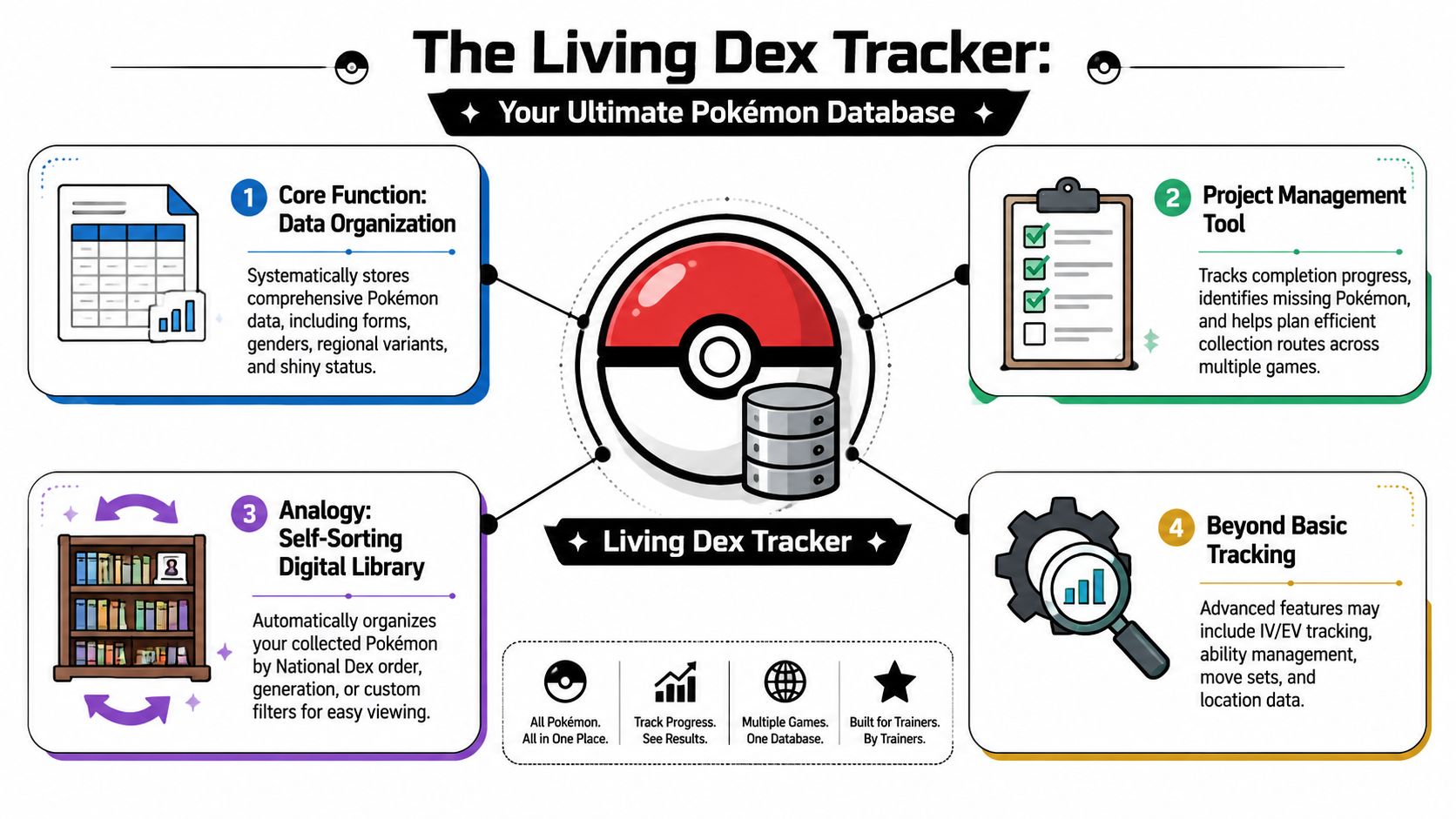
A physical binder is a useful comparison here. The cards are the collection. The binder pages give every card a planned home, so you can spot gaps immediately and keep the whole thing in order. A Living Dex tracker does that job for Pokémon, except the project is harder because your collection is spread across cartridges, save files, HOME boxes, forms, and transfer rules.
Some trackers are simple checklists. Others behave more like planning tools with filters, tags, form handling, and location notes. That difference matters. Once your Living Dex grows beyond one game, you need more than a progress bar. You need a system that helps you decide what to catch next, what to transfer later, and what already has a slot reserved.
A useful comparison outside Pokémon is the jump from rough notes to a dedicated wallet tracker app for organized asset monitoring. The collection gets large enough that memory stops being reliable. Good tools reduce repeat work and make decisions faster.
What a tracker should actually record
A tracker should record more than species names because modern Living Dex goals are rarely species-only for long. Many players also track regional forms, alternate forms, shinies, and other variants depending on their rules. If the tool cannot separate those clearly, it becomes hard to tell whether a slot is finished or only half-finished.
Useful tracker data usually includes:
- Species and order: National Dex placement and the exact slot the Pokémon is meant to fill.
- Completion status: Owned, missing, reserved, transferred, or still needed.
- Form details: Regional variants, alternate forms, and other distinct versions you chose to count.
- Variant rules: Whether shinies or gender differences matter for your project.
- Storage location: The game, box, or HOME position where that Pokémon currently lives.
- Acquisition notes: Which title, route, trade, breed chain, or event path can supply the missing entry.
That last point is easy to underestimate. A good tracker is not only a record of what you have. It is a map for what to do next.
Why this matters more than box labels
Box names can carry a small project. They struggle once your Living Dex spans several generations. You catch a Pokémon in one title, evolve it in another, store it in HOME, then realize the form you wanted is only available elsewhere. Without a tracker, you start solving the same problem twice.
That is why the best way to use a Living Dex tracker is as project management for a long collection challenge. It keeps your rules visible, your missing slots clear, and your route efficient. Instead of asking, “What am I missing?” every time you log in, you can ask the better question. “What is the smartest next step?”
Key Features of a Great Living Dex Tracker
A good Living Dex tracker should answer two questions fast. What do I still need, and what is the smartest way to get it?
That second question is what separates a simple checklist from a tool you will still trust months into the project. Once your dex spans multiple games, forms, transfers, and personal rules, the tracker stops being a trophy shelf and starts acting more like a project board.
Required features
Start with clear counting rules. Your tracker should let you define what “complete” means for your run. Some players only count one of each species. Others count forms, regional variants, gender differences, or shinies. If the tracker cannot reflect your rules, it will create arguments with yourself later. You will keep asking whether a slot is truly done or only looks done.
Next is form-aware organization. This matters more than new collectors expect. A standard Raichu and an Alolan Raichu may share a family line, but they do not fill the same goal if your Living Dex includes regional forms. The same problem shows up with Rotom forms, Deerling seasons, and Pokémon with visible gender differences. A tracker should let you separate those cleanly instead of stuffing them into one vague checkbox.
You also want:
- Flexible completion views: species-only, forms included, or custom rules for your own project
- Strong filtering: by game, form, region, missing status, and transfer status
- Quick updating: fast enough that you will record catches after a long session
- Notes or tags: for placeholders, trade targets, breed chains, or event reminders
- Export or backup options: because a long-term collection needs a safety net
The feature that saves the most time
If I had to pick one feature that improves planning the most, it would be game-based availability filtering.
Here is the practical reason. A missing list by itself can be overwhelming. A filtered list that shows “everything you can finish in Legends: Arceus tonight” is useful. It turns a giant goal into a manageable session plan. That is how you avoid bouncing between games, reopening HOME every ten minutes, and repeating work you already did.
This is the same trade-off you see in any tracking tool. Convenience helps you keep momentum, while customization helps you match the system to your rules. That balance feels a lot like choosing an app that tracks portfolio performance with the right mix of simplicity and control.
Field note: The best tracker reduces decision fatigue before you even power on a game.
Comparison table
| Feature | Web App (e.g., Pokédex Tracker) | Mobile App (e.g., Rotom Dex) | Spreadsheet (DIY Google Sheets) |
|---|---|---|---|
| Ease of setup | Usually fast | Usually fast | Slowest to build |
| Form support | Varies by tool | Varies by app | Fully customizable, but manual |
| Filters and search | Often strong | Good for quick checks | Depends on your skill |
| Offline access | Sometimes limited | Often convenient | Strong once built |
| Game availability planning | Often built in on better tools | Mixed | Manual unless you add it |
| Visual progress | Clean dashboards | Easy to glance at | Customizable but less polished |
| Long-term flexibility | Good if actively maintained | Good for casual updates | Best for personal rules |
Start tracking smart money today
Join thousands of traders using WalletFinder.ai to find profitable wallets and copy their trades.
Start Free Trial →

