OBO to USD Conversion: A Trader's 2026 Guide

Wallet Finder

Blank calendar icon with grid of squares representing days.

June 12, 2026

You buy a small-cap token, watch the chart go vertical, and your wallet suddenly shows a gain that feels life-changing. Then an important question arises: can you successfully turn that OBO position into dollars without getting clipped by slippage, bad routing, stale pricing, or a dead market?

That's the gap between paper gains and real dollars.

With lesser-known tokens, the hard part usually isn't finding a quoted price. It's finding the executable price. A screen can show green while the pool is thin, the spread is ugly, and the route to cashing out takes three separate steps. If you rush the exit, you can give back a large part of the move.

Introduction From Paper Gains to Real Dollars

Most crypto traders already think in USD, even when they trade entirely on-chain. That's not arbitrary. The U.S. dollar remains the global benchmark for pricing and settlement, and the IMF reports it accounted for about 58% of global allocated foreign exchange reserves in 2024, according to the Federal Reserve H.10 reference page. That's why most crypto PnL gets measured in dollars, even when the trade path runs through tokens, stables, and multiple chains.

For OBO, that matters even more because smaller assets don't always have clean direct exits. You may see a token quote in a wallet or on an explorer, but that doesn't mean a real buyer is there at size. A practical OBO to USD process starts with identity, then liquidity, then execution.

Practical rule: Don't ask “What is OBO worth?” Ask “What can I sell right now, on this route, after fees?”

The cash-out process is usually one of two things. Either you have a direct exchange listing with enough depth, or you need to unwind in stages, usually from OBO into a stablecoin and then from the stablecoin into bank-withdrawable USD.

That sounds simple. In practice, it's where most mistakes happen:

  • Wrong asset: Same ticker, different token.
  • Wrong quote: Display price instead of executable price.
  • Wrong timing: Selling into weak liquidity.
  • Wrong path: Paying unnecessary fees across swaps, bridges, and withdrawals.

If you handle those four problems well, OBO to USD becomes manageable. If you ignore them, the chart can be right and the trade can still go wrong.

What Is the OBO Token and How Is Its Price Set

The first job is basic, but traders skip it all the time. You need to confirm which OBO you own or plan to trade. With obscure tickers, symbol matching is not enough. Contract address is what matters.

CoinBrain lists one OBO at $0.0051, while LiveCoinWatch lists Obolo at $0.000189 and notes the market data was last traded in 2023-02-17, which is why the CoinBrain OBO converter page is useful as a warning, not just a quote source. The same ticker can point to different assets or stale markets.
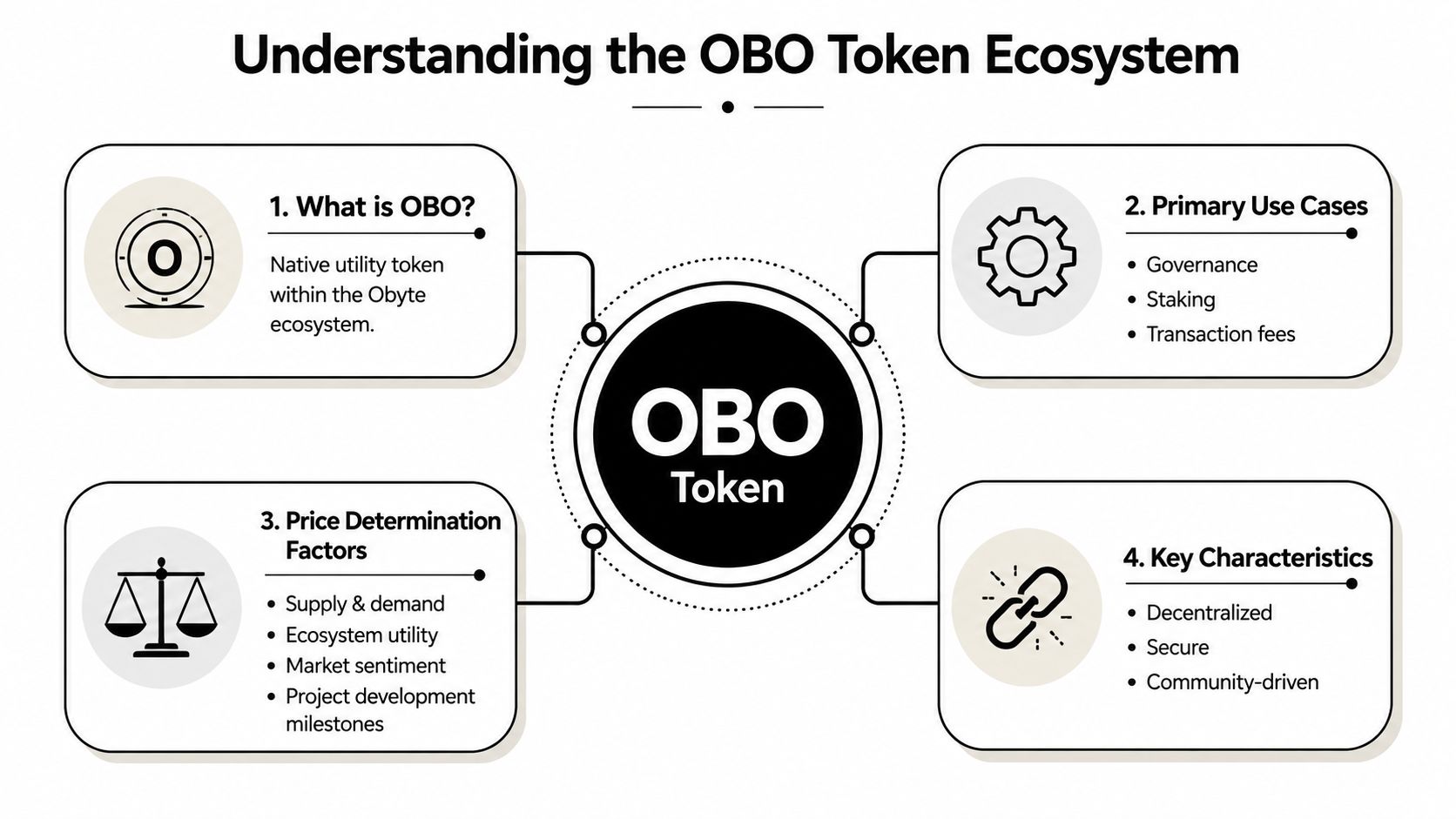
A diagram explaining the OBO token ecosystem, highlighting its utility, use cases, price factors, and key characteristics.

Verify the token before you touch the swap button

Before checking any OBO to USD quote, confirm these items:

  • Contract address: Match the token in your wallet to the official address used by the pool or exchange.
  • Chain: A token on one network is not the same asset as a lookalike on another.
  • Recent trading activity: If the market is stale, the listed price may be misleading.
  • Pool pair: See what OBO is paired against. A weak pair often leads to worse execution.

A lot of losses happen before the trade even starts. Traders search a ticker, click the first result, and route into the wrong asset. That's not market risk. That's process failure.

How the price actually gets formed

For smaller tokens, price depends less on “fair value” and more on where liquidity sits.

On a DEX, OBO is usually priced through an automated market maker pool. The quote changes as users buy or sell against the pool. If liquidity is shallow, your own sell order can push the price down while the trade is filling.

On a CEX, price comes from an order book. Buyers and sellers place bids and asks. If there's enough depth, you get cleaner execution. If depth is weak, the book can look tradable until your order starts eating through levels.

Thin markets punish certainty. The quote looks precise, but the execution often isn't.

What works and what doesn't

What works:

  • Checking the contract first.
  • Looking at the actual pool or market where you'll sell.
  • Estimating whether your trade size is small relative to available liquidity.

What doesn't:

  • Trusting a wallet's display value.
  • Assuming every OBO ticker is the same asset.
  • Using a stale market to estimate your cash-out amount.

If you only remember one thing here, remember this: for OBO to USD, token identity comes before token price.

How to Find the Real-Time OBO to USD Value

A useful OBO to USD quote has two layers. First, the reference price. Second, the executable price. Most traders look at the first and ignore the second.

Reference price is fine for orientation. Executable price is what matters when you're about to sell.

Start with a reference quote, then move to routing

A practical workflow looks like this:

  1. Check an aggregator or token page for a general spot quote.
  2. Open a DEX aggregator and simulate the actual swap size.
  3. Compare the output across routes.
  4. Review the impact of fees, slippage, and route complexity.
  5. Decide whether the quote is good enough to execute now.

If the token is thinly traded, the quote you want is the one tied to your intended size, not the smallest visible trade.

A clean way to think about it is this:

Check TypeWhat It Tells YouWhat It Misses
Listed token priceGeneral market referenceSlippage, route quality, stale liquidity
Wallet portfolio valueRough mark-to-market valueReal exit amount
DEX aggregator quoteEstimated executable outputFinal result can still change before confirmation
CEX order bookImmediate tradable levelsTransfer delays and withdrawal frictions

Use historical context, not just the current tick

Spot pricing can fool you because it compresses the whole market into one number. Historical context helps you see whether current price action is stable, stretched, or just erratic.

Reliable USD valuation is built on deeper time series. The OFX overview of historical exchange-rate data notes that OANDA offers up to 31 years of historical rates across 200+ currencies, and OFX publishes more than 20 years of historical exchange-rate data. For crypto traders, the point isn't to compare OBO to fiat pairs directly. The point is that serious valuation always uses range, history, and context, not a single print.

That same mindset helps with tokens. Look at the recent trading pattern, not just the last trade.

  • Recent candles: Are moves orderly or jagged?
  • Volume behavior: Does buying and selling appear continuous?
  • Spread and route quality: Does the output deteriorate sharply as size increases?

For traders building dashboards or monitoring multiple positions, Wallet Finder.ai's article on a crypto price API is a useful reference for structuring price workflows around live data instead of manual tab-hopping.

The price you can realize is always more important than the price you can screenshot.

Step-by-Step Methods to Convert OBO to USD

There are two main paths. One is direct and simple if the market exists. The other is more common for small tokens and requires an intermediate stablecoin.

A clear infographic flowchart explaining two methods to convert OBO cryptocurrency to USD fiat currency.

OBO to USD Conversion Method Comparison

MethodSpeedTypical FeesControl/PrivacyBest For
Direct sale on a CEXFast if listed and fundedTrading fee plus withdrawal-related costsLower privacy, more platform dependenceTraders who already use a compliant exchange
DEX to stablecoin to CEXSlower because it has more stepsNetwork fees, swap fees, then exchange-related costsHigher wallet control until the fiat off-ramp stepSmaller tokens without a direct USD market
DEX plus bridge plus CEXSlowest and most operationally complexAdds bridge-related costs and more execution riskGood wallet control, but more moving partsTokens on less-connected chains

Method one with a centralized exchange

If a real OBO market exists on a centralized exchange, this is usually the least operationally messy route.

  1. Confirm the listing is for your exact asset. Match chain support, deposit format, and token contract where relevant.
  2. Generate the deposit address on the exchange. Copy it carefully.
  3. Send a small test amount first. This catches address and network mistakes before the full transfer.
  4. Wait for funds to clear. Exchanges may hold deposits until confirmations finish.
  5. Sell OBO for USD or for a stablecoin that has a direct USD market.
  6. Withdraw USD to your linked bank account.

This route works well when the exchange has real depth and your account is already verified. It works badly when the exchange supports the ticker but not the exact network you're using.

Method two with a DEX and stablecoin exit

This is the route most DeFi traders use.

Swap OBO into a major stablecoin

Open a DEX or DEX aggregator on the correct network and simulate the trade. Don't just check the top-line price. Review route details, expected output, and slippage tolerance.

Then:

  • Approve the token if it's your first time trading that asset.
  • Set a realistic slippage limit based on market conditions.
  • Execute the swap from OBO into a stablecoin.
  • Verify the received amount before moving on.

Move the stablecoin to your off-ramp

Once you hold a major stablecoin, transfer it to a centralized exchange that supports fiat withdrawal for that asset and network.

A few practical habits help here:

  • Use the right network: Stablecoins can exist on many chains.
  • Check deposit status before sending: Exchanges sometimes suspend specific networks.
  • Keep records: Save transaction hashes and fill details.

Sell the stablecoin and withdraw USD

After the stablecoin arrives:

  1. Sell the stablecoin for USD.
  2. Review the final cash balance.
  3. Withdraw to your bank using the method available in your region.

If the direct OBO market is weak, break the trade into the most liquid path available instead of insisting on a one-click exit.

When bridging enters the picture

Some OBO positions live on networks that don't connect cleanly to your preferred off-ramp. In that case, you may need to bridge either OBO or the stablecoin after the initial swap.

That route can work, but every extra step adds a failure point:

  • wrong bridge destination
  • unsupported asset wrapper
  • delayed settlement
  • exchange deposit incompatibility

If a token is already difficult to price, simplicity beats creativity. The cleanest cash-out path is usually the best one.

Calculating Your Realized Profit and Loss

A trade isn't finished when the token leaves your wallet. It's finished when you know what you realized in USD after fees.

The distinction is simple:

  • Unrealized PnL is what your open position appears to be worth.
  • Realized PnL is what you locked in after selling.

The formula that matters

Use this:

Realized PnL = Total USD received from sale - Total USD cost basis - Total fees paid

That last part matters. Gas, swap costs, bridge costs, and exchange fees all reduce real profit. Ignoring them is how traders overstate wins.

A simple example

Suppose you bought 10,000 OBO for $100. Later, you sell the full position and receive $500. Across the round trip, you paid $20 in gas and related transaction costs.

The math is:

  • USD received: $500
  • Original cost: $100
  • Fees: $20

So your realized PnL is:

$500 - $100 - $20 = $380

That's your net realized profit.

This sounds obvious, but many traders still log the gain as $400 because they subtract entry cost and ignore execution costs. In DeFi, that mistake adds up fast.

Keep records while the trade is fresh

After an OBO to USD exit, save:

  • Wallet transaction hashes
  • Swap confirmations
  • Exchange fills
  • Fiat withdrawal records

If you want a deeper framework for tracking closed trades, Wallet Finder.ai has a concise guide to realized profit and loss explaining the accounting side in more detail.

A good journal doesn't just help at tax time. It helps you see whether your exits are efficient, or whether fees keep eating more of the move than you think.

Common Pitfalls When Cashing Out and How to Avoid Them

Small-cap exits fail in predictable ways. The mechanics are straightforward. The execution discipline is where traders slip.

A checklist infographic illustrating six common pitfalls to avoid when cashing out cryptocurrency assets like OBO.

Slippage and price impact

A quoted price is not a promise. If OBO liquidity is thin, your own sell order can move the market against you while it executes.

You avoid this by:

  • Testing smaller order sizes: See how output changes with size.
  • Using a DEX aggregator: Better routing can reduce damage.
  • Splitting exits: Several smaller sells can be cleaner than one large hit.

Gas and timing friction

Network fees can turn a good exit into a mediocre one. This is especially true when you're making several transactions in sequence.

Use a checklist before you act:

  • Check congestion first: Don't force a multi-step exit during expensive conditions.
  • Batch your actions intelligently: If you need approval, swap, transfer, and withdrawal, know the full path before starting.
  • Leave room for fees: Don't commit every token or stablecoin unit and then get stuck.

Technical indicators as filters, not predictions

For thin markets, technical indicators can help you decide whether a market is orderly enough to trade. They are not crystal balls.

Kraken explains that RSI is commonly calculated over 14 bars, with values below 30 often treated as oversold and above 70 as overbought on its guide to crypto technical indicators. For small tokens, the more useful point is practical: erratic RSI or indicator behavior that doesn't line up with volume can signal weak liquidity.

Watch for disagreement between price and participation. If the chart moves but volume doesn't confirm, execution risk usually rises.

A confirmed move with stable participation is more actionable than a random spike.

Operational errors that hurt more than market volatility

The most expensive mistakes are often boring:

  • Wrong token contract: You swap or deposit the wrong asset.
  • Wrong network on transfer: The exchange doesn't credit the deposit.
  • Incomplete KYC or withdrawal setup: Funds arrive, but you can't off-ramp promptly.
  • Tax neglect: You realize gains and have no proper records.

One practical defense is to treat the exit like a checklist, not a click. Verify address, network, market, and destination before every transfer. Send a test amount when the route is unfamiliar.

Emotional selling is another common problem. If you only decide to sell after the chart starts rolling over, you're reacting, not managing risk. Smaller assets usually punish late decisions more harshly than majors.

Optimize Your Exit Strategy with Wallet Finder.ai

You are up on OBO, the chart still looks fine, and then one cluster of early wallets starts selling into strength. By the time that shift is obvious on price alone, your exit is usually worse.

That is a primary use case for Wallet Finder.ai trading signals for smart-money wallet tracking. For low-liquidity tokens like OBO, wallet behavior often changes before retail sentiment does. If the wallets that built the move begin trimming size, rotating out, or sending tokens toward likely exit routes, that can matter more than one more green candle.

Screenshot from https://www.walletfinder.ai

A useful exit process starts with context, not hope. Track which wallets entered early, how they normally take profit, and whether selling is isolated or happening across a group with similar timing. One wallet selling can be noise. Several profitable wallets cutting exposure in the same window usually deserves attention.

I watch for behavior, not headlines.

That means checking whether strong wallets are scaling out slowly, fully closing, or only trimming after a sharp move. It also means comparing that activity to current liquidity. If smart wallets are selling and the pool is thin, waiting for confirmation can cost more than acting a bit early. You may leave some upside on the table, but you keep control over execution.

Reactive exits tend to be expensive. A trader who waits for a visible breakdown usually sells after conditions have already worsened. A prepared trader has alerts set, knows the route to stablecoins or exchange deposit, and can act while slippage is still acceptable.

The goal is not to call the exact top. The goal is to sell into order, not into panic.

If you trade names like OBO regularly, your edge is not only finding the token before everyone else. It is recognizing when the wallets that mattered on the way up stop behaving like holders and start behaving like sellers.

If you want a cleaner way to time exits, monitor profitable wallets, and get alerts when tracked traders start selling, try Wallet Finder.ai. It gives you a practical way to turn on-chain behavior into an exit workflow instead of waiting for your OBO position to become a scramble.