Realized Profit and Loss a DeFi Trader's Guide

Wallet Finder

Blank calendar icon with grid of squares representing days.

June 10, 2026

Your wallet says you're up. Your brain says you're winning. Then you try to answer a basic question, how much profit have you locked in, and things get fuzzy fast.

That confusion gets worse in DeFi. You buy on one chain, swap on another, bridge assets, provide liquidity, unwrap tokens, and check a dashboard that shows a nice green number. But green on a screen isn't the same as money you've captured. If you can't tell the difference, it's hard to judge your trading, manage risk, or prepare clean records later.

The Difference Between Paper Wealth and Real Profit

A lot of new traders treat portfolio value as if it were banked profit. That works right up until price reverses.

If a token you hold rises, your wallet balance may look stronger. But until you sell, swap, or otherwise dispose of that asset, that gain is still only a paper gain. It can expand, shrink, or disappear while you're still holding the position. What matters for your money is whether you've completed a transaction that locks in the result.

Why traders mix these up

Crypto interfaces often put everything in one place:

  • Current wallet value shows what your holdings are worth at recent market prices.
  • Position gain often looks like profit, even when nothing has been sold.
  • Historical charts can make temporary gains feel permanent.

That presentation is useful for monitoring exposure, but it can blur a critical line. A wallet can look successful while the trader hasn't secured much profit.

Practical rule: If you still hold the asset, your result is exposed to the next price move.

This distinction matters beyond theory.

What this means for your money

Realized profit and loss helps you answer questions that portfolio value can't:

  • Did this trade make money? A closed trade gives you a finished answer.
  • Are you taking profits with discipline? Locked-in gains show execution, not just optimism.
  • Can you compare one strategy to another? Closed results let you evaluate decisions on equal footing.
  • What may need to be reported later? Completed transactions create records that matter operationally.

Picture yourself standing on a mountain of chips at a poker table. Until you cash out some of them, your session result is still in play. Crypto works the same way. Unrealized gains tell you what could be yours. Realized profit and loss tells you what became yours because you acted.

What Is Realized Profit and Loss

A simple analogy helps. Say your home's estimated market value goes up. You feel richer, and maybe you are on paper. But you don't know your actual profit until you sell and see what cash remains after the transaction is done.

That's the core idea behind realized profit and loss. It refers to the gain or loss that becomes real once a trade is completed. Unrealized profit and loss is the value change on an asset you still own.
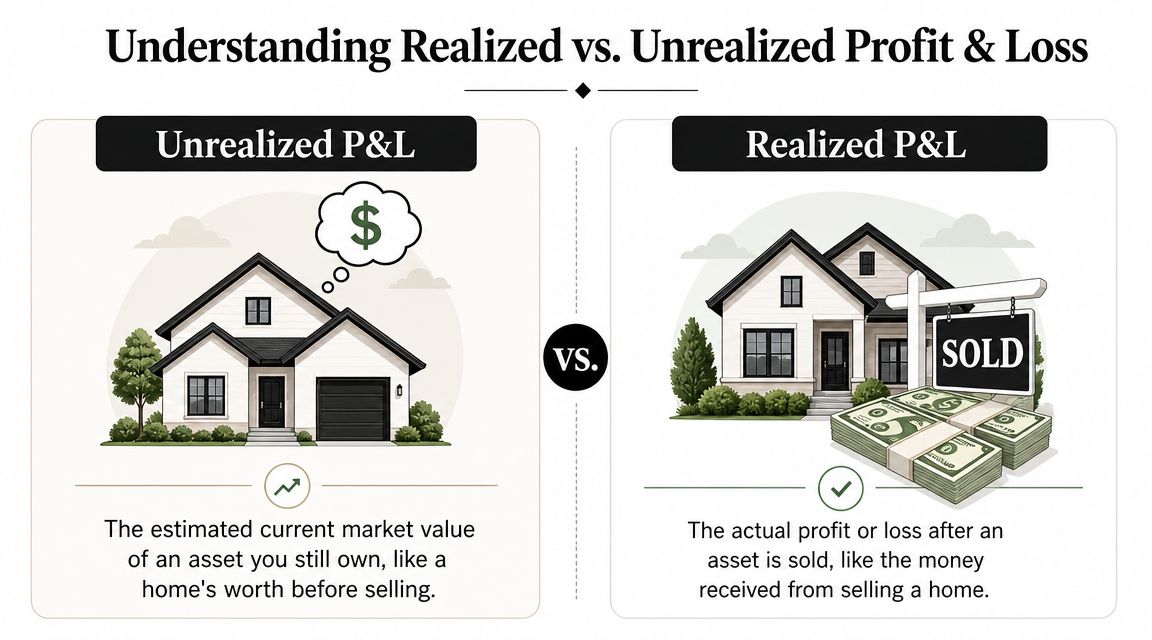
An infographic showing the difference between unrealized profit and loss versus realized profit and loss.

The plain-English definition

When you buy a token and keep holding it, your gain or loss is still floating with the market. Once you sell that token, swap it away, or otherwise dispose of it, the trade is closed and the result becomes realized.

In on-chain analytics, realized profit is defined as the USD value of profits captured when coins are spent. Glassnode explains that the metric sums the USD difference between the spent-price and the created-price for all profitable spends, which turns blockchain activity into a measurable flow of seller conviction in its realized profit metric guide.

That on-chain definition sounds technical, but the intuition is simple. Blockchain data can tell when an asset moved and compare the value at entry and exit. If the later spend happened at a higher value than the earlier acquisition, profit was realized at that moment.

Realized versus unrealized at a glance

AttributeRealized P&LUnrealized P&L
When it existsAfter a completed sale, swap, or disposalWhile you still hold the asset
CertaintyLocked in at the time of exitChanges with market price
UsefulnessEvaluates finished trading decisionsTracks current exposure
Emotional trapCan show whether you actually took profitCan tempt you to count gains too early
Recordkeeping burdenNeeds clear entry, exit, and basis recordsNeeds current valuation, but no closed result yet

Your wallet can show gains without proving you've actually made money on closed trades.

Where new traders get tripped up

The most common mistake is thinking “my token doubled” means “I made money.” You only made money in the realized sense if you sold enough of that position to capture the gain.

Another common mistake is assuming a swap doesn't count because you never touched cash. In DeFi, swapping one token for another still closes one asset position and opens a new one. That's why realized profit and loss matters so much on-chain. The blockchain records actions, not just intentions.

How to Calculate Realized P&L Step by Step

The basic formula is straightforward. Realized profit and loss is a closed-trade metric, calculated when an asset is sold, and the standard formula is sale price minus purchase price, with transaction costs deducted for true net performance, as explained in this realized profit and loss glossary.

A four-step infographic illustrating the process for calculating realized profit and loss on sold financial assets.

The core formula

Use this:

Realized P&L = sale price − purchase price − transaction costs

Transaction costs matter more than many traders expect. On-chain, that can include trading fees, gas, spreads, and other execution costs. If you ignore them, your gross result may look cleaner than your real one.

Example one: a simple buy and sell

Let's say you buy a token.

  1. You record the purchase price.
  2. You later sell it and record the sale price.
  3. You subtract the original cost.
  4. You subtract transaction costs.

If the final number is positive, you realized a profit. If it's negative, you realized a loss.

That sounds basic, but many traders skip one of those records, usually fees or exact entry cost. Once that happens across many trades, the running P&L becomes unreliable.

A dedicated crypto P&L calculator guide can help if you want a workflow for keeping those records consistent.

Example two: a partial sale

Partial exits create the first real headache.

Suppose you bought the same token in multiple batches, then sold only part of your holdings. Now you need to know which purchased units were sold. That's a cost basis problem, not just a math problem.

Many traders use a method like FIFO, which stands for first in, first out. Under FIFO, the earliest acquired units are treated as the ones sold first.

Why partial sales confuse people

A trader sees one wallet balance, but under the hood the position may be made of many separate entries:

  • First buy at one price
  • Second buy at another price
  • Third buy after a dip
  • Partial sale that closes only some units

Your realized profit depends on which units you match to that sale. If your records don't track lots clearly, you can't calculate realized P&L accurately.

Check the lot, not just the token: The same token can carry different cost bases depending on when and how you acquired each unit.

Here's a simple way to understand the concept:

StepWhat you trackWhy it matters
Entry lotsEach acquisition separatelyDifferent buys may have different costs
Disposal amountHow much of the asset you soldYou may not have exited the full position
Matching methodFIFO or another accepted methodDetermines which cost basis applies
FeesEntry and exit costsConverts gross gain into net gain

Later in the process, a video walkthrough can help if you prefer to see the logic visually:

Example three: a DeFi swap

Here, many crypto traders misread what happened.

If you swap Token A for Token B on a DEX, you didn't just “change tokens.” Economically, you likely did two things:

  1. Disposed of Token A
  2. Acquired Token B

The disposal of Token A is where realized profit and loss can occur. The acquisition of Token B creates a new cost basis for that new position.

That means a swap can trigger realized P&L even if no fiat ever entered your wallet.

A clean process for swaps

  • Start with Token A basis. What did those units cost when you acquired them?
  • Record the value received. What was the value of Token B received at the time of the swap?
  • Subtract fees and gas where appropriate. Execution costs affect net outcome.
  • Create a new basis for Token B. That becomes the starting point for the next trade.

This is why DeFi traders get overwhelmed. A single click on a swap interface can both close one trade and open another. If you miss that, your realized P&L will drift away from reality.

Why Realized P&L Is a Deeper Metric of Success

A trader can look brilliant during a rally without having proved much. Rising prices can make almost any open position look smart for a while.

Realized profit and loss is harder to fake because it measures outcomes after decisions are finished. You entered, you managed the risk, you exited, and the market no longer gets to revise that result every second.

Closed results show behavior

Traditional finance treats this distinction seriously. Profit and loss statements summarize net income over a period, and investment reporting systems separate realized and unrealized performance so completed results can be evaluated cleanly, as described in the Oregon SBDC overview of how to read a profit and loss statement.

That matters for traders because realized P&L captures behaviors that unrealized gains can hide:

  • Exit discipline when a position moves in your favor
  • Loss containment when a thesis fails
  • Consistency across multiple closed trades
  • Net execution quality once costs are counted

Unrealized gains can flatter weak habits

A wallet full of open winners can conceal bad process. Maybe the trader never takes profit. Maybe they average into volatility without a plan. Maybe they confuse conviction with refusal to exit.

Realized P&L forces a more honest review. Did you convert good entries into closed gains, or did you just sit through a favorable market phase?

The strongest-looking wallet on paper isn't always the trader with the strongest completed decisions.

It changes how you trade

When traders start reviewing realized results instead of only checking wallet value, their focus shifts:

  • They think more carefully about exits.
  • They notice which setups produce closed gains versus temporary spikes.
  • They become more aware of fees and slippage.
  • They stop giving full credit to positions that are still exposed.

That doesn't make unrealized P&L useless. Unrealized P&L still helps you understand current exposure and mark-to-market conditions. But if you want a scorecard for actual trading skill, closed outcomes tell the cleaner story.

Navigating DeFi and Tax Complications

The abstract definition of realized profit and loss is easy. The operational reality in DeFi is not.

A generic finance explainer usually assumes one brokerage account, one asset, and one sale. DeFi traders operate across wallets, chains, bridges, DEXs, LP positions, wrappers, and smart contracts that change the visible shape of a position without making the bookkeeping easier.

A confused person staring at a complex diagram illustrating the tangled world of cryptocurrency tax reporting.

Common DeFi actions that create confusion

Traders often underestimate how many actions can affect realized P&L tracking:

  • Token swaps can close one asset and open another in the same transaction.
  • Bridging can make asset history harder to follow across chains, even when the intention was simple transfer.
  • Wrapped assets can create recordkeeping questions about what was disposed of and what was received.
  • Liquidity positions can fragment exposure into deposits, withdrawals, rewards, and rebalanced token amounts.
  • Multi-wallet activity can spread cost basis records across addresses you control.

None of this means every action is treated the same way in every jurisdiction. It means your records need to be precise enough to reconstruct what happened.

The dashboard problem

A wallet dashboard may show attractive realized P&L while still leaving you with weak documentation.

That gap matters because recognizing a gain is only part of the job. The harder part is often proving the chain of events behind it. Strategic CFO notes that a realized gain is recognized when a transaction is completed, but that alone doesn't solve the practical challenge of proving cost basis and disposition history when activity is fragmented, as explained in its discussion of realized and unrealized gains and losses.

Why spreadsheets break down

Manual tracking can work for a small number of trades. It starts failing when activity becomes fragmented.

Problems usually show up in clusters:

ProblemWhat goes wrong
Missing timestampsYou can't reliably order acquisitions and disposals
Broken cost basis trailsTransfers between wallets interrupt your records
DEX fragmentationSimilar trades appear in different formats across protocols
Cross-chain activityThe same position history gets split across ecosystems

If you're already dealing with fragmented lots and transfers, a focused guide to cost basis tracking for crypto is a useful next step.

A clean realized P&L number is helpful. A clean audit trail behind that number is what makes it usable.

Tracking P&L Automatically with Wallet Finder.ai

Once your trading moves beyond a handful of simple spot buys, calculation becomes a data problem. You need transaction history, lot matching, timestamps, disposal logic, and a way to view closed outcomes without rebuilding everything by hand.

That's where Wallet Finder.ai fits. It's a DeFi wallet tracker that aggregates on-chain activity across major ecosystems and presents trading history with P&L, entry and exit timing, position sizing, and wallet-level performance views. For realized profit and loss, the practical value is that it helps users inspect closed trades in context instead of relying on scattered explorer tabs and spreadsheets.

Screenshot from https://www.walletfinder.ai

What automated tracking changes

A dedicated on-chain tracking workflow helps with several tasks at once:

  • Trade reconstruction so you can review what was bought, swapped, and sold
  • Wallet comparison so closed performance isn't confused with current balance
  • Timing analysis so you can see when profits were taken
  • Exportable history for deeper offline analysis when needed

This is useful for your own wallet, but it's also useful when researching other traders. A wallet with strong closed-trade history often tells you more than a wallet with a temporarily inflated balance.

What to look for on a dashboard

When reviewing realized P&L in any tool, don't stop at the headline number. Check:

  1. Whether trades are closed
  2. How entries and exits are paired
  3. Whether fees and execution context are visible
  4. How activity is grouped across chains and wallets

A good dashboard reduces guesswork. It doesn't remove the need for judgment, but it gives you a clearer base for that judgment.

Using Realized P&L to Copy Trade Smarter

Copy trading gets much more interesting once you stop chasing wallets that merely look rich.

A high wallet balance can come from open positions, old inflows, or tokens that haven't been sold. Realized profit and loss gives you a different lens. It highlights traders who have closed profitable trades and shows how they behaved when exits mattered.

A better workflow for wallet research

Instead of copying every fresh buy from a flashy address, start with a tighter filter:

  • Review wallets that show a history of closed profitable trades
  • Study what they sold, not just what they bought
  • Look at when they took profit during strength or weakness
  • Notice whether they scale out gradually or exit fast
  • Compare their realized results with the style of assets they trade

That approach gives you a read on process, not just outcome. You're not only asking who caught a move. You're asking who repeatedly turned opportunities into completed gains.

A practical starting point is this beginner guide to copy trading in crypto, then layer realized P&L on top of that workflow.

The wallet worth copying isn't always the one holding the biggest winners. It's often the one with evidence of knowing when to exit.

When you evaluate traders through realized profit and loss, you move from imitation to analysis. That's a much better place to trade from.


If you want to turn on-chain activity into something you can evaluate, Wallet Finder.ai gives you a way to inspect wallet histories, review P&L context, and study how profitable traders enter and exit positions across DeFi.