Crypto Cost Basis Tracking a Definitive Guide

Wallet Finder

Blank calendar icon with grid of squares representing days.

June 7, 2026

You open your wallet history to prepare taxes and instantly hit a wall. One wallet traded on Ethereum, another on Solana, a third only touched Base, and somewhere in that mess you bridged assets, farmed yields, claimed rewards, and swapped tokens that no exchange report fully understands.

That's why cost basis tracking feels so brutal in crypto. It isn't just arithmetic. For active DeFi traders, it's closer to reconstruction work. You're rebuilding what happened, when it happened, what each asset originally cost, and which lot got disposed of when you sold, swapped, staked, or removed liquidity.

If you've been leaning on exchange exports and hoping they tell the full story, they probably don't. A cleaner approach starts with understanding the mechanics, then building a workflow that can survive real on-chain activity.

Why Crypto Cost Basis Is a Tax Nightmare

For a simple stock trade, most investors think in one line: buy, hold, sell. Crypto rarely behaves that way. A DeFi trader might buy ETH on a centralized exchange, move it to a wallet, bridge it to another chain, swap part of it for a token, pair that token in a liquidity pool, receive LP tokens, unstake later, and then sell the proceeds in pieces across multiple wallets.

Every one of those actions can affect cost basis tracking.

At the simplest level, cost basis is the amount tied to an asset for tax purposes. When you dispose of that asset, your gain or loss depends on the difference between what you received and what your basis was. The hard part in crypto isn't understanding that sentence. The hard part is proving the right basis after months of fragmented wallet activity.

Why DeFi traders get stuck

Traditional finance has spent years standardizing broker reporting. In U.S. securities, broker cost-basis reporting rules were phased in by asset type starting with equities acquired on or after January 1, 2011, then mutual funds, ETFs, and dividend-reinvestment plans acquired on or after January 1, 2012, and most fixed-income securities and options acquired on or after January 1, 2014, according to Schwab's explanation of broker cost-basis rules. Crypto, especially self-custodied crypto, doesn't give you that same safety net.

That difference matters. In DeFi, the burden usually stays with you.

Crypto taxes usually break down at the point where wallet history and tax-lot history stop matching.

If you're trying to calculate gains manually, a good primer on realized gains can help frame the job. This guide on how to calculate capital gains for crypto transactions is useful for understanding the tax result you're ultimately trying to produce.

The real problem isn't one trade

Most traders don't fail because they forgot one purchase price. They fail because history becomes fragmented.

  • Wallet sprawl: Assets move across multiple addresses.
  • Chain sprawl: The same position may touch several networks.
  • Protocol complexity: LP deposits, reward claims, and token wrappers muddy the audit trail.
  • Missing context: Transfers can look like sales if your records don't tie them together.

That's why crypto cost basis tracking is a tax nightmare. You're not just logging trades. You're rebuilding the story of each token lot from first acquisition to final disposition.

The Building Blocks of Cost Basis Calculation

Start with the core rule. Cost basis is not just what you paid to buy the token. For securities, Fidelity notes that basis also includes transaction costs such as brokerage commissions, reinvested dividends or capital-gains distributions, and other IRS-recognized adjustments. In crypto, that same principle extends to gas fees and other on-chain transaction costs, as explained in Fidelity's guide to capital gains and cost basis.

That one point clears up a lot of confusion. If you bought a token for one amount but paid meaningful gas to acquire it, the tax record may need to reflect more than the sticker price.
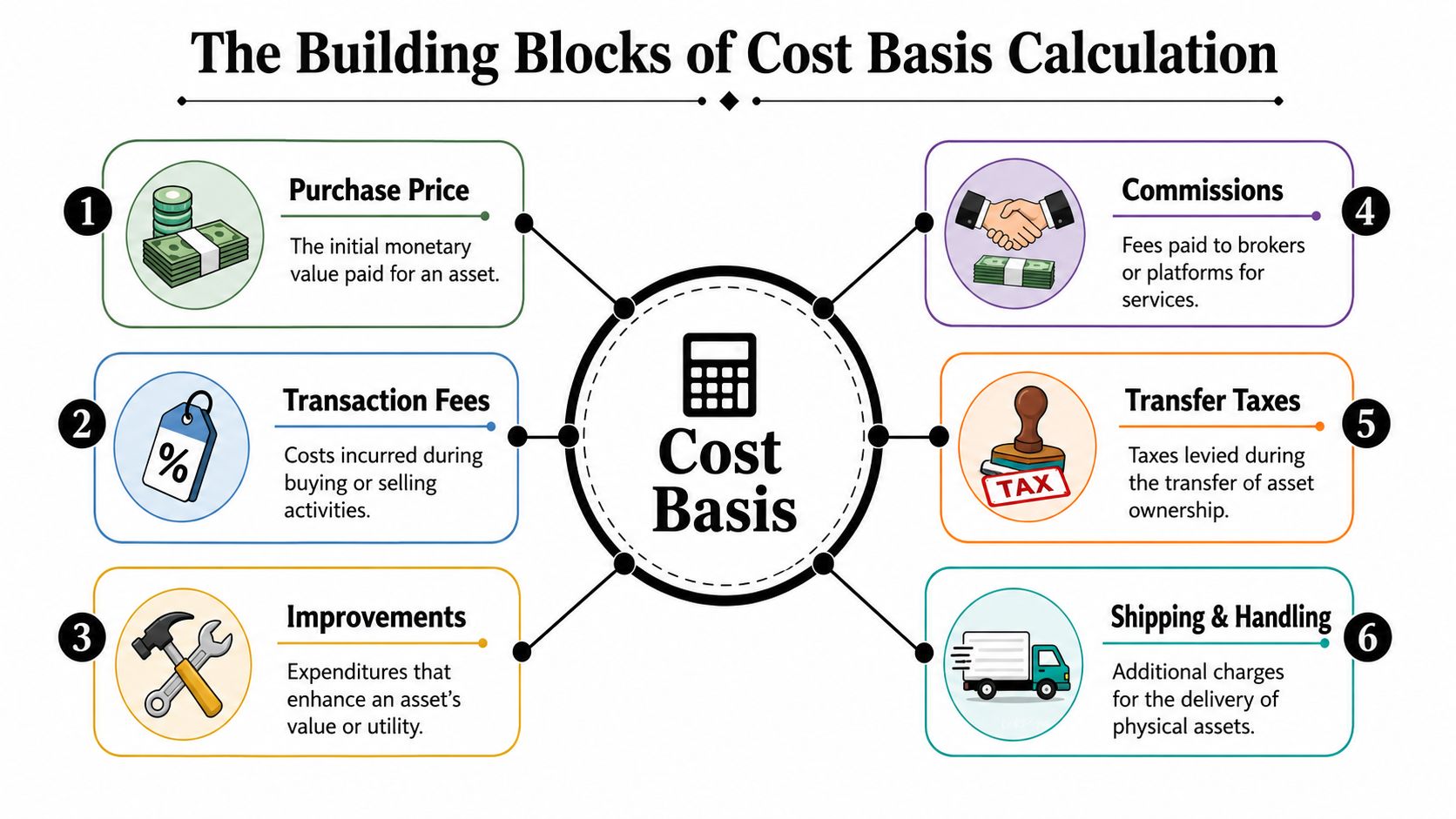
An infographic titled The Building Blocks of Cost Basis Calculation, illustrating six key components of financial assessment.

Think of basis like total landing cost

A simple analogy helps. Suppose you buy a rare collectible online. The item price is only part of your actual cost. You might also pay shipping, insurance, marketplace fees, and payment processing charges. If you later resell it, your true economic investment wasn't just the headline price.

Crypto works the same way.

For many traders, basis includes items like:

  • Purchase value: What you gave up to acquire the asset.
  • Gas and network fees: Costs paid on-chain to complete the transaction.
  • Trading fees: Exchange or protocol fees tied to the acquisition.
  • Adjustments from later events: In some cases, later activity changes the tax story tied to the lot.

What counts as a disposal

A lot of confusion comes from thinking only fiat sales matter. In crypto, a taxable disposal often happens when you part with one asset, even if no cash hits your bank account.

Common examples include:

  1. Selling crypto for fiat
  2. Swapping one token for another
  3. Using crypto to buy goods or services
  4. In some cases, converting or unwinding positions that effectively dispose of one asset and replace it with another

If you swap ETH for USDC on a DEX, that's usually not just a “trade” in casual language. For tax lot purposes, it often means you disposed of ETH and acquired USDC.

Practical rule: If an asset leaves your wallet in exchange for something else of value, stop and ask whether you just created a taxable disposition.

Calculators can help with the mechanics. If you want a quick sense of average acquisition cost before you tackle lot-level detail, try this crypto average calculator for position tracking.

The data you need every time

For reliable cost basis tracking, capture these details for every transaction:

Record itemWhy it matters
Date and timeHelps order lots correctly
Wallet and chainTies the movement to the right ledger
Asset sent and receivedDefines the disposal and acquisition
QuantityDetermines lot matching
Fees paidMay affect basis or proceeds
Transaction hashGives you audit support

If you store only token amounts and ignore fees, transfers, and chain context, your tax output can drift fast.

Choosing Your Crypto Accounting Method

Once you know what basis is, the next question is harder. Which units did you sell? That's what the accounting method answers.

Method selection can materially change tax outcomes. H&R Block notes that FIFO is the default at many brokerages, while specific-share identification gives the most control, and average cost is primarily used for mutual funds rather than individual stocks, as described in H&R Block's cost basis overview. That same logic matters in crypto because choosing a lot can change whether a sale produces a larger gain or a smaller one.

A simple ETH example

Use one consistent scenario:

  • You buy 1 ETH at $2,000
  • Later you buy 1 ETH at $3,000
  • Then you sell 1 ETH at $2,500

Your gain or loss depends on which lot is treated as sold.

Comparison of Cost Basis Accounting Methods

MethodCost Basis of ETH SoldCapital Gain/(Loss)Best For
FIFO$2,000$500 gainDefault-style tracking when oldest lots are sold first
LIFO$3,000$500 lossTraders using a latest-lot approach where allowed
HIFO$3,000$500 lossReducing gains by selecting the highest-cost lot
Specific identificationDepends on chosen lotDepends on chosen lotTraders who maintain detailed lot records
Average cost$2,500 average in this exampleNo gain or loss in this exampleConceptual comparison, though this method is primarily associated with mutual funds

What each method means in practice

FIFO means first in, first out. Your earliest acquisition gets sold first. If your oldest coins were cheap, FIFO can create larger gains in a rising market.

LIFO means last in, first out. Your newest acquisition gets sold first. If you bought recently at higher prices, that can reduce gains or create losses.

HIFO means highest in, first out. You match the sale to the highest-cost lot available. Traders often like this because it can produce a more favorable tax result when prices have moved up and down.

Specific identification gives you the most control. Instead of relying on a default queue, you identify the exact lot being sold. That only works if your records can support it.

Average cost blends purchases into one average per unit. In traditional finance, this is primarily used for mutual funds, not individual stocks. American Century gives a concrete mutual-fund example where $12,740 invested across 1,020 shares produced an average cost of $12.49 per share, so selling 20 shares created a cost basis of $249.80, as shown in American Century's average-cost example.

The method isn't just bookkeeping. It changes the gain or loss you report from the exact same market sale.

If you want to pressure-test a sale before tax season, this walkthrough on how to calculate crypto profit helps connect lot selection to realized PnL.

A practical decision rule

Pick a method you can defend. If your records are thin, claiming precise lot selection may be hard to support. If your records are strong, specific identification usually gives the most flexibility because it ties the outcome to a documented lot instead of a blunt default rule.

Unique On-Chain Tracking Challenges in DeFi

DeFi breaks neat accounting assumptions. The problem usually isn't the formula. The problem is mapping messy blockchain behavior into a tax-lot record that still makes sense months later.

T. Rowe Price notes that crypto tax reporting is becoming more standardized, including IRS Form 1099-DA reporting rules for digital asset brokers starting with 2025 transactions, and highlights a key challenge for DeFi traders as matching the right wallet, chain, and lot to each disposition in T. Rowe Price's discussion of cost basis accounting.

An infographic illustrating six complex on-chain tracking challenges faced within decentralized finance and blockchain activities.

Swaps, bridges, and wallet-to-wallet transfers

A DEX swap looks simple on the front end. Under the hood, it usually creates two tax-relevant events at once. You disposed of one asset and acquired another.

Bridges are different but just as dangerous for recordkeeping. Economically, you may think, “I still own the same asset.” Operationally, the move can generate a new transaction hash on a new network, and your records can lose continuity if the bridge in and bridge out don't get tied together.

Problems tend to show up in three places:

  • Unmatched transfers: A tool may read a bridge-out as a sale if the bridge-in isn't connected.
  • Wrapped assets: The asset changes form, even if your economic exposure feels the same.
  • Multi-wallet routing: Funds leave one address and reappear in another you forgot to track.

LP tokens are where spreadsheets start to fail

Liquidity provision confuses even experienced traders because an LP position acts less like a simple coin and more like a claim ticket to a moving inventory pool.

A useful analogy is a coat check. You hand over two separate items at the desk and receive one ticket. That ticket isn't the coat or the bag. It's evidence of your pooled claim. Later, when you redeem it, you may not get back the same mix in the same proportions.

That's why LP accounting gets messy. You often need to answer questions like:

DeFi eventWhy basis gets tricky
Add liquidityTwo assets go in, one LP token position comes out
Remove liquidityLP token leaves, underlying assets return in changed amounts
Harvest rewardsNew assets arrive with their own tax treatment
Reinvest rewardsA fresh lot may be created before the next deposit

LP tokens often turn one clean purchase history into several overlapping basis histories.

Airdrops, staking, and protocol noise

Airdrops and staking rewards create a different type of headache. They introduce assets that weren't bought in the usual way. Then traders compound the problem by swapping or redeploying them quickly, before recording how those assets entered the wallet in the first place.

Other events also clutter the ledger:

  • Staking rewards: New units arrive over time and may create fresh lots.
  • Rebases or wrappers: Token balances change without a normal buy order.
  • Dust and protocol leftovers: Tiny balances can still affect reconciliation.
  • NFT-related flows: Royalties, mint costs, and marketplace fees can complicate basis trails.

The result is why DeFi cost basis tracking feels less like accounting software input and more like evidence assembly.

A Modern Workflow for Accurate Records

Manual tracking usually starts with confidence and ends with tabs everywhere. You export CSVs from exchanges, copy wallet transactions from explorers, patch missing transfers by hand, and build a giant spreadsheet that tries to force multi-chain behavior into a single flat table.

That approach can work for light activity. It usually breaks for DeFi.

What the manual method gets wrong

The issue isn't effort. It's fragility. One missing transfer can make the next swap look like a sale from nowhere. One wrong timestamp can alter lot ordering. One ignored gas fee can distort basis.

FINRA notes that investors are ultimately responsible for maintaining their own records and that broker-reported basis can differ from their own records, which is why record cleanup often becomes a forensic exercise, as discussed in FINRA's guide to cost basis basics. In self-custodied crypto, that burden gets even heavier because there often isn't a broker maintaining the complete history for you.

A better workflow for active traders

The modern workflow is less about entering numbers and more about building a reliable ledger.

A practical process looks like this:

  1. Collect all wallets first: Don't start by calculating gains. Start by identifying every wallet and exchange account involved.
  2. Ingest full transaction history: Pull in swaps, transfers, rewards, bridges, and contract interactions.
  3. Reconcile internal movements: Match wallet-to-wallet transfers before labeling anything a sale.
  4. Classify odd events: Tag LP actions, staking rewards, airdrops, and wrappers correctly.
  5. Apply a lot method consistently: Use a defensible accounting method across the dataset.
  6. Review exceptions: Investigate negatives, duplicates, and assets with missing acquisition history.
  7. Export an audit trail: Keep transaction-level support, not just summary totals.

If your records can't explain where a token came from, your gain calculation is built on a guess.

The mindset shift

Good cost basis tracking in crypto is really automated reconciliation plus human review. Software should do the heavy lifting on aggregation and pattern recognition. You still need judgment for edge cases, but you shouldn't be hand-matching every bridge transaction at tax time.

That shift saves more than time. It makes your records easier to defend if you ever need to explain them.

Streamline Reporting with Wallet Finder ai

The hardest part of crypto taxes is usually assembling the history, not reading the final number. A tool that can surface complete wallet activity, trace trading behavior, and organize positions into a usable ledger solves a real reporting problem long before forms get involved.

Screenshot from https://www.walletfinder.ai

Wallet Finder.ai is built around that kind of on-chain visibility. It aggregates wallet activity across major ecosystems such as Ethereum, Solana, and Base, then presents trading history, PnL views, entry and exit timing, and exportable datasets in one place. For DeFi traders, that matters because the raw blockchain record is often too fragmented to work with directly.

Why this helps with tax reporting

Tax reporting gets easier when your research tool already captures the same ingredients you need for reconstruction.

Useful capabilities include:

  • Cross-wallet visibility: You can review activity from multiple addresses instead of treating each wallet as an isolated universe.
  • Trade history context: Swaps, buys, and sells appear as part of a larger sequence.
  • PnL views: Realized trading outcomes become easier to audit against tax-lot calculations.
  • Exportable datasets: You can move the data into a dedicated tax workflow or share it with an accountant.

That's especially helpful if you trade like an on-chain analyst. Many DeFi users don't just hold tokens. They track smart money wallets, mirror trades, and rotate across ecosystems quickly. Those habits create exactly the kind of fragmented history that makes manual cost basis tracking painful.

From discovery tool to record cleanup support

A platform like Wallet Finder.ai won't replace tax judgment. It does reduce the search problem.

For example, if you're trying to determine whether a token disposal came from an original purchase, a bridged transfer, or a mirrored trade copied from another wallet, having a unified view of timing, wallet flow, and position history can narrow the answer fast.

Here's a quick look at the platform in action:

That's the value. Better cost basis tracking starts with better transaction visibility. If the underlying history is disorganized, tax software downstream can only do so much.

Cost Basis Best Practices and Mistakes to Avoid

A common tax-season failure looks like this. You sold a token from Wallet B, but the original buy happened months earlier on an exchange, then moved through a bridge into Wallet A, then into a liquidity pool, then back out as a different asset mix. By the time you export everything, the sale is easy to see and the acquisition history is buried.

That is why cost basis tracking in crypto feels less like bookkeeping and more like digital forensics. The problem usually is not the tax rule itself. The problem is reconstructing a believable chain of custody for each lot across wallets, chains, protocols, fees, and token wrappers.

In traditional brokerage accounts, much of that recordkeeping is handled for the investor. In self-custodied crypto, that burden still sits largely with the investor.

An infographic showing best practices and common mistakes to avoid regarding cost basis for tax reporting.

Best practices worth following

Good records come from routine, not heroics in March or April.

  • Track from day one: The easiest transaction to support is the one you label while the context is still fresh.
  • Choose a method and apply it consistently: FIFO, LIFO, HIFO, and specific identification only work if your records can support the method you claim to use.
  • Capture fees every time: Gas and trading fees often change basis, proceeds, or both. If you skip them, your numbers drift.
  • Reconcile on a schedule: Monthly review is much easier than trying to reconstruct a year of wallet activity all at once.
  • Keep raw evidence: Save transaction hashes, CSV exports, screenshots for odd protocol events, and notes on anything a tax tool may misread.

One practical rule helps a lot. Treat every transfer as unproven until you verify both sides. If you assume a token "moved" without matching the sending and receiving transaction, you can accidentally create a fake sale in one wallet and a fake purchase in another.

Mistakes that keep causing trouble

Some errors start small and then spread across the rest of the return.

MistakeWhy it causes problems
Ignoring gas feesBasis or proceeds may be incomplete
Treating swaps like non-eventsA disposal can be missed
Assuming transfers are obviousWallet-to-wallet moves can be mislabeled
Relying only on CEX reportsOn-chain history often isn't included
Forgetting reward lotsLater sales lack acquisition records

LP positions create another frequent problem. An LP token works like a claim check for assets you deposited into a pool. If your records only show the LP token and not the assets that went in, later removal of liquidity can look confusing or incomplete. The same issue shows up with staking receipts, wrapped tokens, and bridged assets. The label changed, but the tax history still has to be traced.

Clean reporting starts long before tax season. It starts when you stop treating wallet activity like temporary noise.

A simple checklist for active DeFi traders

Use this as an operating routine:

  1. List every wallet and exchange account you use
  2. Match transfers before calculating gains
  3. Separate DeFi events from simple spot buys and sells
  4. Confirm that rewards, airdrops, rebases, and LP exits were captured
  5. Export records while the activity is still easy to recognize

The main lesson is straightforward. Accurate cost basis usually comes from reconstructing a complete history that another person could follow, wallet by wallet and lot by lot.

If you want a faster way to organize fragmented on-chain activity before it turns into a tax-season cleanup project, Wallet Finder.ai gives you a unified view of wallet histories, trades, PnL, and exports that make reconstruction far more manageable. For active DeFi traders, that means less guesswork, cleaner records, and a much easier path to tax-ready reporting.