
Safemoon Price V2: An Actionable Trader's Guide
A trader's guide to the Safemoon Price V2. Learn to analyze on-chain data, interpret tokenomics, and use advanced tools to anticipate market moves.
The SafeMoon V2 (SFM) price chart isn't for the faint of heart. It’s notoriously volatile, driven by a complex set of internal rules rather than the usual market pressures. In fact, its history includes a jaw-dropping price collapse of over 99.95% from its peak, a clear signal that your standard trading playbook won’t cut it here.
Quick Start: Your SafeMoon V2 Reality Check
Before you buy a single SFM token, here's what you absolutely need to know. SafeMoon V2 isn't like Bitcoin or Ethereum—it operates under completely different rules that can either help you or destroy you.
First, understand the 10% transaction tax. Every time you buy, sell, or even transfer SFM between your own wallets, you lose 10% immediately. This means your investment needs to gain at least 11% just to break even after one buy. If you're planning to sell later, you'll pay another 10% on the way out. That's a 20% round-trip cost before you've made a single penny in profit.
Second, check the liquidity before you trade. SafeMoon's trading volume has collapsed from millions per day to often under $100K. This means even a $5,000 trade can move the price 5-10%. When you try to sell, you might face slippage of 15-30%, meaning you get far less than the "price" you see listed.
Third, verify you're buying the correct contract. Scammers have created dozens of fake SafeMoon tokens with nearly identical names and logos. The official SafeMoon V2 contract address on BSC is crucial to verify on BSCScan before any purchase. One wrong character and your money goes straight to scammers.
Fourth, set your slippage correctly or your transaction will fail. You need at least 12% slippage on PancakeSwap to account for the 10% tax plus normal price movement. Anything less and you'll waste gas fees on failed transactions.
Fifth, never invest more than 1-2% of your portfolio. SafeMoon V2 is down 99.95% from its all-time high of $0.007232. That's not a typo—it lost 99.95% of its value. If you bought at the peak with $10,000, you'd have $5 worth today. This is an extremely high-risk speculation, not an investment.
Sixth, understand that reflections (passive rewards) are virtually worthless at current volumes. During the 2021 peak, holders earning $50-100 daily from reflections. Today, you might earn $0.10 per month on a $1,000 position. The math doesn't work anymore.
Finally, have an exit plan before you enter. Set stop-losses at 25-30% maximum loss. Take profits at 50%, 100%, and 200% gains if you're lucky enough to catch a pump. Don't marry your bags hoping for a return to all-time highs—it won't happen.
What Drives The SafeMoon V2 Price
If you want to understand the SafeMoon V2 price, you have to look beyond the typical charts. SFM was never meant to be a conventional cryptocurrency. It was built with unique tokenomics that directly shape its value with every single transaction. Because of this, on-chain data tells a much richer story than a simple price graph ever could.
Traditional market analysis just doesn't work here. It completely misses the core mechanics hard-coded into the SFM smart contract. To make any sense of the price swings, you have to get your hands dirty and look at the data generated by the blockchain itself.
The Role of Unique Tokenomics
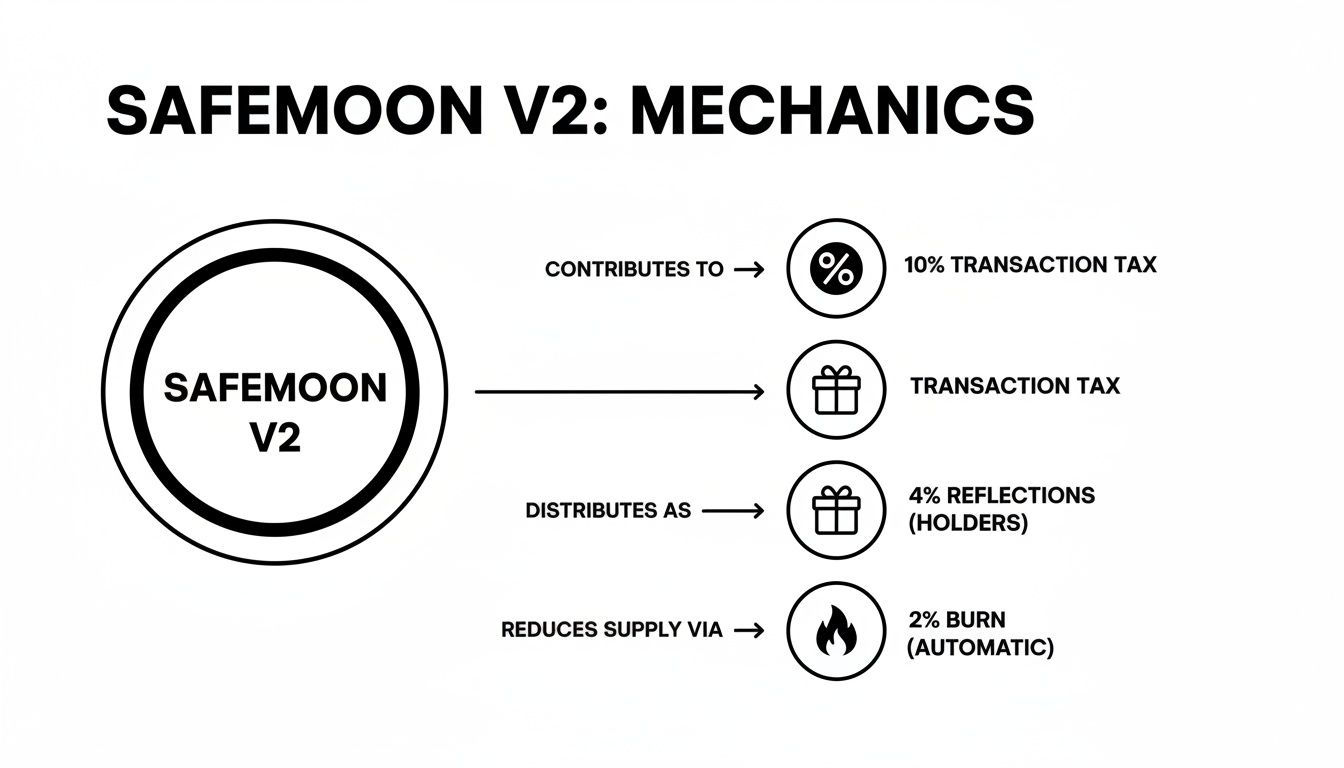
At its core, SafeMoon V2 runs on three key mechanisms that create its own little economic ecosystem:
- Transaction Taxes: A 10% fee hits every SFM transaction, whether you’re buying, selling, or just moving tokens around. This tax is what fuels everything else.
- Reflections: A portion of that tax (4%) is automatically sent back to everyone holding SFM, creating a passive reward for long-term holders.
- Burn Mechanism: Another slice of the tax (2%) is permanently destroyed—removed from circulation forever. In theory, this makes the remaining tokens more scarce over time.
These features mean the real drivers of the safemoon price v2 are trading volume, how long people hold, and how quickly the supply is shrinking.
For traders, this is a game-changer. Watching metrics like the burn rate and the growth in new wallets gives you a much clearer picture of market sentiment than just looking at the price. A rising burn rate means more activity, while reflections show you how rewards are being distributed across the network.
Think of this guide as your practical playbook for moving beyond pure speculation. Instead of just guessing, you'll learn how to use on-chain data to make decisions with confidence. We’ll dig into how tools like Wallet Finder.ai uncover these hidden signals, helping you spot market shifts before they happen.
The token's wild history makes it a fascinating case study. After hitting an all-time high of $0.007232 on January 4, 2022, the price cratered, wiping out fortunes and highlighting the extreme risks in the altcoin space. You can explore the full history of SafeMoon V2 price movements on CoinMarketCap.
The Real History of SafeMoon: From Hype to Collapse
Understanding SafeMoon's past is essential to evaluating its present. This isn't ancient history—it's a roadmap of what can happen to your money.
The 2021 Launch: Peak Memecoin Mania
SafeMoon V1 launched in March 2021 during the absolute peak of memecoin hysteria. Dogecoin was pumping. Everyone wanted the "next big thing." SafeMoon's pitch was genius: hold the token and earn passive income from other people's trades through the reflection mechanism.
The marketing blitz was everywhere. YouTube influencers (many paid) were screaming about 1000x gains. Twitter was flooded with #SafeMoonArmy posts. The community called themselves the "SafeMoon Army" and genuinely believed they'd all get rich together. The tokenomics seemed revolutionary—why wouldn't you hold a token that pays you just for holding?
The numbers during the peak were insane:
- All-time high: $0.00001399 (V1 price, equivalent to roughly $0.014 in V2 terms)
- Market cap: Over $6 billion at peak
- Holder count: Over 2.5 million wallets
- Daily volume: $500 million+ during peak trading days
- Social media: Trending #1 on crypto Twitter multiple times
Early buyers made life-changing money. If you bought $1,000 in the first week and sold at the peak, you walked away with $50,000-$100,000. Stories like this fueled even more FOMO buying.
The Cracks Start Showing
But by May 2021, just two months after launch, problems emerged. The promised "SafeMoon Wallet" was delayed. The "SafeMoon Exchange" that was supposed to revolutionize crypto trading never materialized. Leadership drama exploded on social media with team members leaving and accusing each other of mismanagement.
Most damaging was the realization that the tokenomics favored early adopters at the expense of late buyers. The 10% tax meant that pumping the price required constant new money flowing in. Once the new buyer flow slowed, the price had nowhere to go but down.
The descent timeline:
- May 2021: First major crash, down 70% from peak
- June-August 2021: Slow bleed, losing another 50%
- September-November 2021: Failed recovery attempts, each pump weaker than the last
- December 2021: V1 to V2 migration announced
The V2 Migration: Band-Aid on a Bullet Wound
In December 2021, the team announced SafeMoon V2 with a 1000:1 consolidation. Every 1,000 V1 tokens became 1 V2 token, and the price was adjusted 1000x higher to match. Your total dollar value stayed the same, but the optics improved.
Why the migration? The official reasons were to improve exchange listings (many require minimum price per token), reduce the massive supply numbers, and implement "improvements" to the smart contract. The real reason was likely to reset the narrative and try to attract fresh capital with a "new" token.
The migration itself was messy. Thousands of holders didn't migrate in time or didn't understand how. Some lost access to their tokens entirely. Others got caught in between chains with tokens stuck. The community fractured between those who successfully migrated and those who felt abandoned.
Post-V2: The Slow Death
After V2 launched, there was a brief 2-3 month pump as the migration brought renewed attention. But by mid-2022, the downward trend resumed with a vengeance. Key milestones in the collapse:
January 2022: V2 hits all-time high of $0.007232 (up from migration price of ~$0.002). This is the last major peak.
March-June 2022: Entire crypto market crashes. Bitcoin drops 70%. SafeMoon drops 90%. The excuse was "market conditions."
July-December 2022: Failed promises pile up. The exchange never launches. The wallet has bugs. Volume dries up to under $1 million daily.
2023: The forgotten year. Price languishes under $0.0001. No development updates. Community shrinks from millions to thousands of active members.
2024: Occasional 20-50% pumps on random news, immediately sold back down. Classic dead-cat bounces.
2025-2026: Current state. Price under $0.000005. Down 99.95% from ATH. Volume under $100K most days. The "SafeMoon Army" is now mostly bagholders waiting for a miracle.
What Actually Killed SafeMoon
Let's be clear about the causes of death:
Cause #1: Unsustainable TokenomicsThe 10% tax requires exponential growth to maintain price. When new buyers stop coming, the math breaks. Early holders cash out their reflections, creating constant sell pressure. Late buyers can never catch up.
Cause #2: Failed PromisesThe exchange was supposed to launch in 2021. It's 2026 and it doesn't exist. The wallet has bugs years later. The NFT marketplace never happened. Each broken promise killed credibility.
Cause #3: Leadership FailuresTeam members left amid accusations of incompetence and worse. The original CEO stepped down. Legal issues emerged. Nobody trusted the team to execute.
Cause #4: Market ConditionsThe 2022 crypto crash killed momentum. But good projects recovered. SafeMoon didn't because it had no fundamental value to support recovery.
Cause #5: Whale ManipulationTop wallets held 30-40% of supply. They could (and did) manipulate price at will. When they sold, retail got destroyed. Trust evaporated.
The Lessons
SafeMoon's story teaches everything you need to know about memecoin speculation:
Lesson #1: Tokenomics That Sound Good Aren't Always GoodReflections seemed amazing until you realized they require constant new buying to have value.
Lesson #2: Community Hype Doesn't Equal FundamentalsMillions of holders and trending hashtags couldn't overcome the lack of real utility.
Lesson #3: Early Wins Create Late LosersFor every person who made 100x, there were 10 who lost 90% buying the top.
Lesson #4: Exit Strategy Beats Entry StrategyKnowing when to sell matters more than knowing when to buy. The holders who made money sold. The "diamond hands" lost everything.
Lesson #5: Promises Are WorthlessJudge projects on what they've delivered, not what they say they'll deliver.
Reading The On-Chain Signals That Drive The SFM Price
If you want to get a real handle on the SafeMoon price v2, you can't just stare at the price chart all day. You have to go deeper—into the on-chain data. The token’s value is directly wired into its unique mechanics, which act like a built-in economic engine humming away on the blockchain.
Every single transaction leaves a footprint. Learning how to read these signals gives you a massive advantage over traders who only react to price wiggles.
Unlike your typical crypto asset, SFM's price is heavily shaped by three core functions: a transaction tax, automatic rewards for holders (known as reflections), and a continuous token burn. Together, these create a transparent ecosystem where you can see exactly what's happening. A sudden spike in the daily burn rate isn't just a random number; it's a flashing sign of rising trading volume, which often comes right before a big price move.
This diagram breaks down exactly how each transaction fuels the SafeMoon V2 ecosystem.
Start tracking smart money today
Join thousands of traders using WalletFinder.ai to find profitable wallets and copy their trades.
Start Free Trial →

