Security Edge Coin: Find Legitimacy in Crypto

Wallet Finder

Blank calendar icon with grid of squares representing days.

June 11, 2026

A coin dealer turns a silver piece sideways before saying a word. He isn't admiring the artwork. He's checking the edge, because the rim often tells the truth faster than the face.

Crypto works the same way. The loudest claims usually sit on the surface, while legitimacy hides in the hard-to-fake details.

The Collector's Dilemma and the Crypto Parallel

Collectors learn early that a convincing fake can look perfect from the front. The portrait is crisp. The date looks right. The metal even feels close enough in the hand. Then the coin gets rotated, and the edge gives it away.

That instinct matters because a security edge on coins exists for a reason. One concrete example is the American Silver Eagle's interrupted reeded edge introduced in 2021, where subtle variations or missing reeds in specific areas make tampering or counterfeiting harder by adding a discontinuity that's difficult to replicate, as explained in GovMint's overview of American Silver Eagle security features.

The lesson is simple. Real authentication rarely depends on one obvious feature. It depends on details that are costly to fake and easy to inspect if you know where to look.

Crypto has its own version of the same problem. A token can have a polished website, an active social feed, and a flood of hype posts. None of that proves the contract is safe, the liquidity is stable, or the holders behind the first wave of buying are trustworthy.

Why surface-level checks fail

A beginner often asks, “Is this a good coin?” That question is too broad to help. A better question is, “What hidden signals would be hard for a weak project to fake?”

For a coin collector, that includes the rim. For a crypto trader, it includes on-chain behavior.

Consider the parallel:

  • Coin face vs token branding: Both are easy to polish.
  • Coin edge vs on-chain records: Both expose structure you can verify.
  • Collector expertise vs trader discipline: Both come from repeatable checks, not gut feel.

A fake usually wins at first glance and loses under inspection.

That's the useful way to think about the phrase security edge coin in crypto. It isn't a ticker. It's a method. You're looking for the digital equivalent of a coin edge, meaning evidence that survives scrutiny from multiple angles.

The real problem in crypto

Most crypto losses don't come from missing a trend. They come from trusting appearance over verification.

Anonymous teams aren't automatically bad. Aggressive marketing isn't automatically fraudulent. But neither should count as proof. If you can't inspect a project's “edge,” you're trading on narrative alone.

That's where on-chain analysis becomes powerful. It gives you something collectors have always valued: a way to inspect authenticity without relying on the seller's story.

Defining a Crypto Security Edge

A practical crypto security edge is a stack of checks, not a single signal. Traders get in trouble when they chase one shortcut. They want one metric, one influencer mention, or one chart pattern that answers everything. That shortcut doesn't exist.

A stronger framework looks at several layers together. If multiple layers line up, the asset has a better claim to legitimacy. If they conflict, slow down.
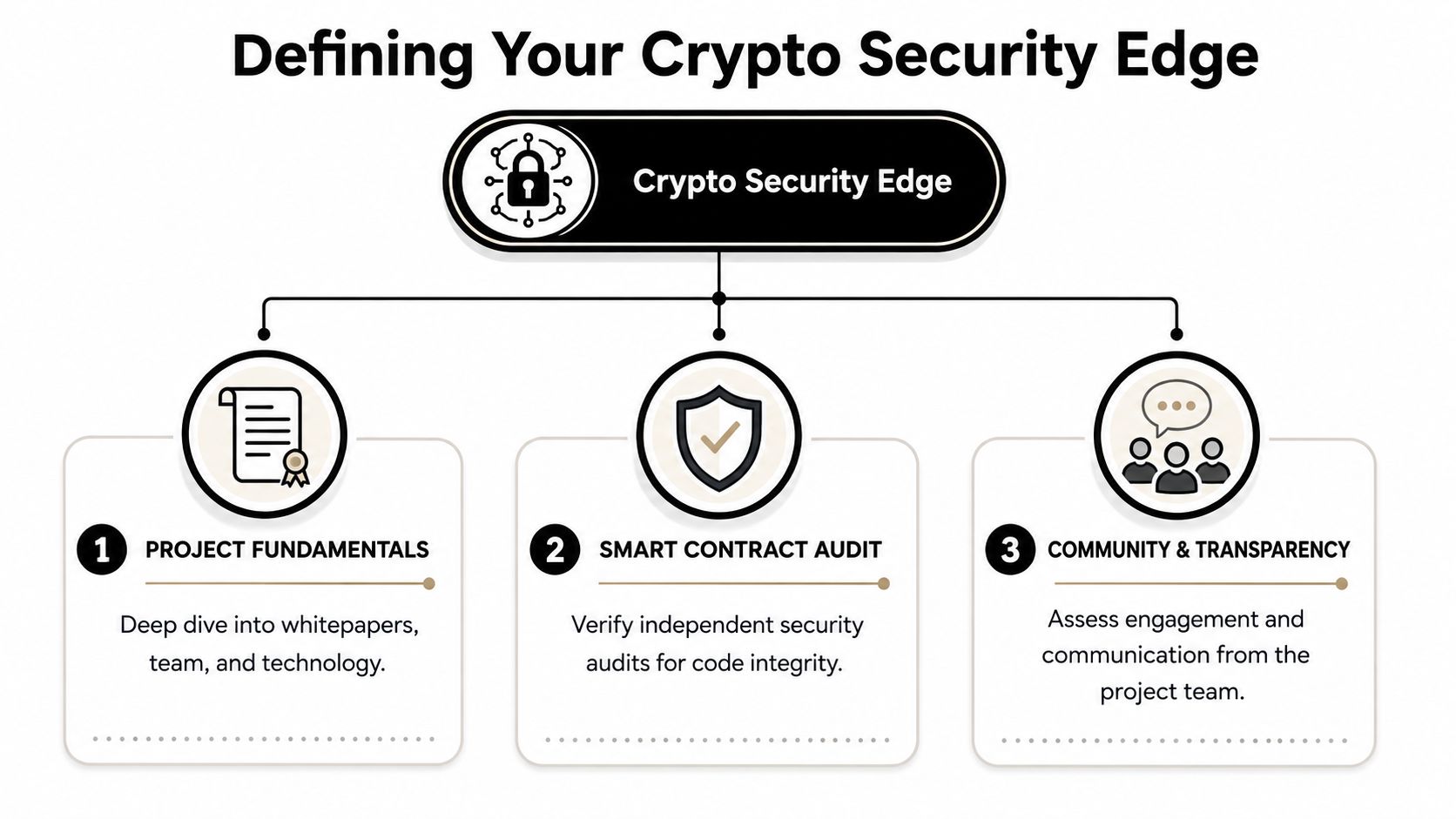
A diagram outlining three essential steps to define your crypto security edge: fundamentals, audits, and community transparency.

Four pillars that matter

I'd define a Security Edge Coin framework around four pillars.

Technical soundness

Start with the contract itself. Is the code verified on the relevant block explorer? Is ownership structure clear? Are permissions narrow or broad? Can someone still change core behavior after launch?

This is the “metal and minting” layer. If it's weak, the rest doesn't matter much.

Financial stability

A token also needs structural support. That means asking where liquidity sits, whether it appears dependable, and whether the token design creates obvious pressure points.

You don't need a perfect model of tokenomics to spot danger. If the setup makes exit risk or manipulation easy, the project has no real edge.

Holder health

Next, inspect distribution. A token can look active while a small cluster of wallets controls too much of the supply or too much of the tradable float.

Healthy distribution doesn't guarantee success. Unhealthy concentration can make failure sudden.

Smart money endorsement

The last pillar is behavioral. After a project passes foundational checks, ask who is buying. Not random wallets. Not headline-chasing tourists. Wallets with a visible history of disciplined entries and exits.

Practical rule: Don't treat any single green flag as proof. Treat alignment across pillars as evidence.

What this framework changes

This approach changes how you read crypto opportunities.

Instead of asking, “Is this token hot?” ask:

  1. Can I verify the contract?
  2. Can I inspect the market structure?
  3. Can I see who holds it?
  4. Can I identify credible wallets entering early?

That's the digital equivalent of turning a coin sideways.

People get confused here because they think due diligence should produce certainty. It won't. The point is narrower. You're reducing the chance of buying something that only looks authentic from the front.

A true security edge coin, in this sense, is any crypto asset that holds up when you inspect its hidden structure.

Analyzing a Token's Technical Foundation

Before you study narratives, momentum, or wallet flows, inspect the base layer. Coins use physical properties to make forgery harder. Crypto projects need their own equivalent set of checks.

For circulating coins, the edge profile is a meaningful anti-counterfeiting control. The European Central Bank notes that euro coins use standardized physical and electromagnetic properties for machine identification that are “extraordinarily difficult to counterfeit,” which matters because a forgery must match multiple independent verification channels, not just visual appearance, as described in the ECB's euro coin leaflet.

That's a strong analogy for token analysis. Don't rely on one visible cue when you can inspect several independent signals.

What to verify first

A token's technical foundation should answer one question fast: can this project be altered, drained, or trapped in ways casual buyers won't notice?

Use this checklist before you spend serious time on a chart.

SignalGreen Flag (Legitimacy Indicator)Red Flag (Warning Sign)
Contract verificationSource code is publicly verified on the chain explorerContract isn't verified, so buyers must trust claims blindly
Audit qualityAudit is easy to locate, readable, and tied to the exact deployed contract“Audited” appears in marketing, but no clear report or matching deployment is available
Ownership controlsAdmin permissions are limited, transparent, and clearly explainedA single owner can change fees, blacklist wallets, pause trading, or alter core behavior without warning
Liquidity structureLiquidity status is clear and the project explains how trading infrastructure is protectedLiquidity details are vague, missing, or easy for insiders to withdraw
UpgradeabilityAny upgrade path is documented and justifiedUpgradeability exists but nobody explains who controls it or how changes are governed
Transaction mechanicsBuy, sell, and transfer behavior is consistent with what the project states publiclyHidden taxes, transfer failures, or unusual restrictions appear only after users interact
Documentation consistencyWhitepaper, explorer data, and token behavior alignPublic materials contradict what the contract actually allows

Fake comfort signals to ignore

A lot of traders stop at “there's an audit” or “ownership is renounced.” That's not enough.

An audit only matters if it's specific, current, and relevant to the deployed contract. Renounced ownership can reduce certain risks, but it doesn't magically fix a bad design. A flawed contract with no owner is still a flawed contract.

If you want a grounded walkthrough of what these checks involve, this guide to smart contract security fundamentals is a useful companion.

A fast red-flag routine

When time is limited, use a triage pass:

  • Check explorer visibility: If the contract details are hidden or incomplete, treat that as a serious concern.
  • Read permissions: Focus on what privileged wallets can still do.
  • Inspect liquidity claims: Don't accept marketing language without on-chain evidence.
  • Compare story to code behavior: If the project says one thing and the contract allows another, trust the contract.

If several small technical concerns appear at once, treat them as a pattern, not as isolated quirks.

A project doesn't need to be perfect to be tradable. It does need to be understandable. If basic mechanics remain unclear after a careful pass, that lack of clarity is itself a risk signal.

Tracking Smart Money The Ultimate Edge

Technical checks help you avoid obvious traps. They don't tell you whether a token has serious upside. For that, behavior matters more than brochure language.

The most useful behavioral signal in DeFi is where skilled wallets move before the crowd notices. That's why tracking smart money often becomes the ultimate edge after baseline due diligence is done.

Why wallet behavior matters

A strong wallet trail can reveal intent in a way public chatter can't. Experienced traders usually don't buy because a meme is trending. They buy because they've seen something in the contract, liquidity profile, timing, or order flow that retail hasn't processed yet.

That doesn't mean every profitable wallet is “right.” It means a repeat pattern of disciplined entries is more informative than broad social excitement.

There's also a practical reason to watch wallets instead of headlines. On-chain actions are recorded. A wallet either entered or it didn't. A post can be deleted, edited, or reframed after the fact.

What separates signal from noise

Not every large buyer counts as smart money. Some wallets are early and reckless. Some are large but inconsistent. Some chase every launch and survive only because they size aggressively.

A better filter looks for wallets that show:

  • Consistent decision-making: Entries don't look random across different trades.
  • Good timing: They tend to appear before wide retail attention.
  • Position discipline: They don't spray capital into every passing narrative.
  • Repeatable outcomes: Their history shows a coherent process, not one lucky hit.

For readers who want a deeper look at this concept, this article on smart money in crypto gives useful context.

Follow wallets that behave like professionals, not wallets that simply got loud after one good trade.

How smart money fits the framework

A security edge coin, in the framework used here, needs more than clean technicals. It needs informed participation.

That matters because many tokens are technically passable. They aren't scams, but they still go nowhere. Smart money helps you separate “safe enough to exist” from “interesting enough to monitor.”

A useful mental model is this:

  • Technical checks answer, “Can this break?”
  • Holder analysis answers, “Who controls this?”
  • Smart money analysis answers, “Who believes this is worth entering now?”

Those are different questions. Traders often collapse them into one and miss the nuance.

A common mistake

Retail traders often buy when a token looks socially validated. Skilled wallets often buy when the token still looks ignored but the structure is improving.

That gap is where edge lives.

If several credible wallets enter around the same window, and the token already passed technical review, you're no longer reacting to hype alone. You're observing a cluster of informed decisions. That's much closer to evidence than hope.

How to Find Your Edge with Wallet Finder.ai

A coin collector does not authenticate a rare piece by glancing at the face alone. They rotate it, inspect the edge, compare the strike, and check whether all the small details agree. Crypto research benefits from the same discipline. A token can look attractive on a chart and still fail under closer inspection.

A good research process pulls those checks into one place. In coin collecting, structured references matter because authenticity often depends on small physical markers. In modern U.S. coin collecting, edge design is part of authentication, and PCGS CoinFacts provides values and reference data for over 39,000 U.S. coins, showing how detailed edge and variety knowledge sits inside mainstream research workflows, as noted in this Coin Community discussion citing PCGS CoinFacts.

On-chain, your version of the coin's edge is the pattern around the asset. Who bought early. How concentrated the holders are. Whether liquidity looks stable. Whether the same credible wallets keep appearing. A smart money tracking platform for crypto wallets and tokens helps you inspect those details without jumping between disconnected tabs.

Screenshot from https://www.walletfinder.ai

Start with discovery, then verify

The practical mistake is starting with social buzz. That puts attention ahead of evidence.

Start from a token discovery view and treat it like a tray of raw coins waiting for inspection. You are not looking for the loudest candidate. You are looking for early signs that informed participants are paying attention before the broader crowd notices.

A simple workflow helps:

  1. Filter for newer tokens: Early-stage assets often reveal the clearest gap between informed buying and public attention.
  2. Sort by smart money activity: Put tokens with credible wallet participation near the top.
  3. Check the first wave of buyers: See whether early entries came from wallets with repeatable behavior or scattered speculation.
  4. Open the token page: Review trade history, wallet overlap, holder concentration, and liquidity setup together.

That sequence matters because each step narrows the field before emotion gets involved.

Reverse the usual search order

Many retail traders begin with a token name and only later ask who is buying it. A stronger habit starts with the buyer.

If a collector trusts a specific dealer or grading source, the object gets a closer look. The same logic applies here. Build a shortlist of wallets that show disciplined timing, coherent trade history, and recent activity in sectors you care about. Then inspect the tokens those wallets are entering.

The goal is not to copy every trade. The goal is to borrow a better filter.

When you review a wallet, focus on a combination of traits:

  • Consistent trade quality: A pattern of solid decisions matters more than one outlier win.
  • Repeated participation: The wallet keeps appearing in setups that deserve attention.
  • Recent activity: Current behavior matters more than old screenshots of past gains.
  • Early positioning: Entries arrive before the token becomes a social media story.

Use a two-screen routine

One view should answer, “Is this wallet a credible source of signal?” The other should answer, “Does this token hold up under inspection?”

That small habit changes the quality of your research. You stop reading a token as a story and start reading it as evidence connected to a specific actor.

A short walkthrough helps make the workflow concrete:

Turn scattered checks into a repeatable filter

Beginners often treat each token as a completely new mystery. Analysts with better discipline use the same review path again and again, just as a collector applies the same authentication routine to each coin.

Use a compact decision path:

  • First pass: Is credible wallet interest present?
  • Second pass: Do holder patterns and trade timing look reasonable?
  • Third pass: Do contract structure and liquidity meet your minimum standard?
  • Fourth pass: Has broad retail attention already arrived, or is the opportunity still early?

A good tool does not replace judgment. It gives judgment a cleaner process.

That is the practical value of the security edge idea in crypto. You are not treating “security edge coin” as a token name. You are using the collector's method. Check the edge, confirm the details, and only then decide whether the asset deserves your attention.

Building Your Smart Money Watchlist and Alerts

Discovery is only half the job. Once you've identified wallets worth monitoring, the next step is staying close to their behavior without staring at dashboards all day.

A watchlist gives structure to that process. Instead of tracking the whole market, you track a curated group of wallets whose activity has already earned your attention.

Screenshot from https://cdn.prod.website-files.com/672a899237f5df0bf0c92eeb/6a2a867e09d93b11a4540c38_security-edge-coin-defi-trading.jpeg

Build a focused list

The best watchlists are selective. If you add every wallet that ever had a good trade, alerts become noise.

A cleaner approach is to separate wallets into small groups:

  • Core wallets: Traders with repeatable behavior you trust most
  • Exploratory wallets: Newer additions you're still evaluating
  • Theme wallets: Wallets that specialize in one ecosystem or one style of trade

That structure helps because a buy from a core wallet should carry more weight than a buy from an exploratory one.

Set alerts around actions, not emotions

Alerts work best when they report objective behavior. You want notifications for buys, swaps, and sells because those are recorded actions, not opinions.

The mistake is treating every ping as a trade signal. A single buy can mean many things. It might be conviction, testing, hedging, or even a small probe.

What matters more is pattern.

Several watched wallets entering the same token within a short window is far more meaningful than one isolated alert.

How to read alert clusters

A cluster doesn't mean “buy immediately.” It means “investigate now.”

When multiple watched wallets move into the same token, ask:

  1. Did these wallets enter at similar timing or very different times?
  2. Are position sizes consistent with conviction or just experimentation?
  3. Did the token already pass your baseline technical review?
  4. Is this the first coordinated interest, or are you late to an existing move?

Keep the watchlist alive

Watchlists decay if you never prune them. Wallet quality changes. Trading styles drift. Some wallets stop producing useful signals.

Review your list regularly and remove wallets that no longer fit your standards. The goal isn't to collect addresses. It's to maintain a live set of decision-makers whose on-chain footprints still deserve attention.

A disciplined watchlist turns on-chain analysis from occasional research into an operating system.

Trade with an Edge Not with Hope

The phrase security edge coin sounds like it should name a token. It doesn't. It names a habit.

A collector checks the edge of a coin because appearances can mislead. A careful crypto trader does the same thing in digital form. They verify contracts, inspect structure, study holder behavior, and watch what skilled wallets do before the crowd arrives.

That shift matters because crypto punishes shallow confidence. Hope won't tell you whether a contract hides dangerous permissions. Excitement won't reveal whether informed traders are entering or avoiding a token. Only verification will.

The practical takeaway is straightforward. Don't buy because a project looks polished. Don't buy because a feed says it's early. Buy only after the asset shows the kind of hidden, hard-to-fake signals that legitimate opportunities tend to share.

An edge doesn't remove risk. It gives you a better process for choosing which risks are worth taking.


If you want a faster way to apply this framework in live markets, Wallet Finder.ai helps you track profitable wallets, inspect token activity, and monitor smart money moves in real time so your decisions come from on-chain evidence instead of guesswork.