Unlock Stable Coin Yield: 2026 Opportunities

Wallet Finder

Blank calendar icon with grid of squares representing days.

May 25, 2026

You're probably looking for the same thing others seek after a few cycles in crypto. A way to keep dollars onchain without accepting the full volatility of BTC, ETH, or the latest rotating narrative. You want something that feels closer to cash management than directional betting.

That's where stable coin yield gets interesting. But the first filter matters: the stablecoin itself doesn't pay you. The yield only appears when someone deploys that stablecoin into a lending market, a liquidity pool, a settlement flow, or a yield-bearing wrapper. If you miss that, you'll read APYs as product features instead of what they really are, compensation for a specific bundle of risks.

Most beginner guides stop at “park USDC and earn.” That's not enough. A smart operator asks different questions. Who is paying? Why are they paying? What breaks first if market conditions change? Can I verify that from onchain behavior instead of marketing copy?

Stablecoin yield also isn't some tiny corner of crypto anymore. A 2026 White House-related policy analysis discussed yield-bearing stablecoins as a macro-financial issue, and industry analysis cited that work to show the category is large enough to model against bank lending effects in major markets, even if the projected effect of a prohibition on traditional bank lending was relatively minor (Bank Policy Institute analysis on yield-bearing stablecoins). That tells you two things. First, the market is real. Second, policymakers are paying attention.

Navigating the New Frontier of Stablecoin Yield

The clean way to think about stable coin yield is this: you're renting out stable liquidity.

Sometimes you lend it to borrowers. Sometimes you place it in a pool that traders use. Sometimes you hold a wrapper that routes the underlying assets into short-duration, lending, or settlement strategies. In every case, the return comes from activity around the stablecoin, not from the token sitting still in your wallet.

Why this category keeps pulling capital

People want a middle ground between idle stablecoins and outright speculation. Stablecoin yield offers that middle ground, but only when you treat it like a market, not a savings account. Rates move. Liquidity changes. Incentives disappear. Good opportunities age badly if you stop monitoring them.

The practical appeal is obvious. You can stay in dollar terms and still seek return. The practical danger is just as obvious. “Dollar-denominated” doesn't mean “low-risk” by default.

Stablecoin yield is a tool for treasury management, not a shortcut to risk-free return.

What makes one opportunity better than another

The best setups usually share three traits:

  • Clear revenue source: Borrower interest, trading fees, or settlement revenue is easier to trust than vague “protocol rewards.”
  • Simple exit path: If you can't understand how you get out, the APY is overstated.
  • Observable behavior onchain: Strong opportunities usually leave evidence. Consistent deposits, healthy withdrawals, stable utilization, and rational wallet behavior matter more than homepage numbers.

A lot of new entrants still compare offers by APY first. Professionals usually do the reverse. They start by ranking the quality of the yield source, then check whether the quoted return is worth the operational headache.

Where Does Stablecoin Yield Actually Come From

Start with the cash flow. If a protocol is paying you 8%, someone or something is funding that 8%. Your job is to identify that source onchain, decide whether it is durable, and watch for the signals that say it is weakening before the homepage APY updates.

Yield usually comes from one of a few engines: borrowers paying interest, traders paying swap fees, basis or funding spreads, or a wrapper routing capital into those same strategies. The stablecoin is the unit you hold. The return comes from the activity around it.
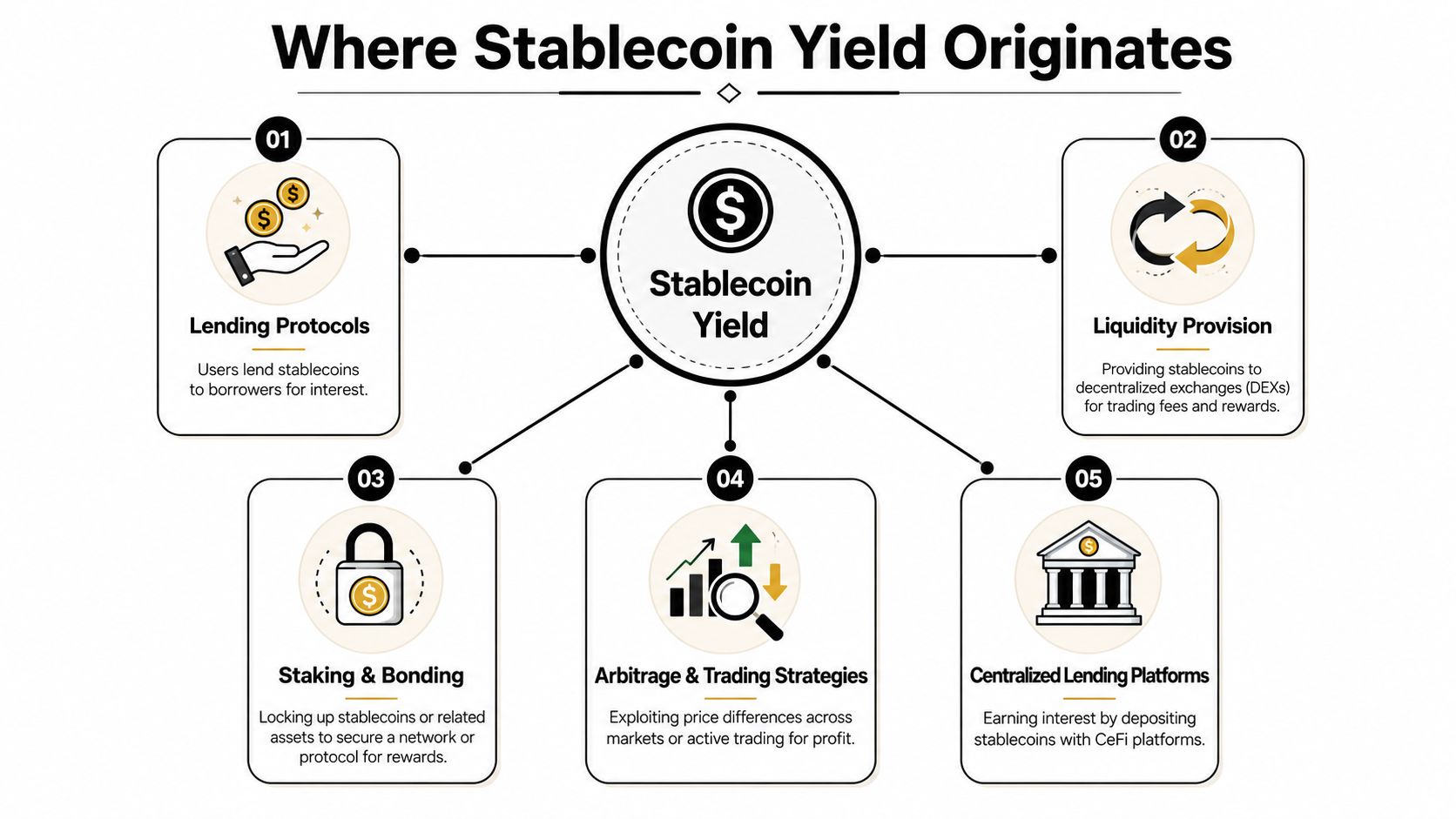
A diagram illustrating five different methods for generating yield from stablecoin assets in cryptocurrency markets.

The three buckets that matter most

Lending markets

In lending markets, lenders earn because borrowers are willing to pay for liquidity. That demand tends to be easier to verify than many new entrants expect. Check utilization, borrowing volume, reserve growth, and whether rates spike only during short bursts of demand. If the lender APY is attractive but borrowing activity looks thin, rewards are probably doing too much of the work.

This category works well when the protocol has deep deposits, predictable rate mechanics, and liquid collateral. It gets weaker fast when utilization whipsaws, collateral quality slips, or a large wallet can move the market by entering or exiting.

A practical check helps here. Pull up the top depositors and top borrowers. If a handful of wallets dominate both sides, your “market yield” may really be one trade that can disappear overnight.

Liquidity pools

Liquidity pool yield comes from swap fees first, incentives second. That order matters. Real volume can support a strategy. Emissions can decorate it for a while.

The verification step is straightforward. Compare fee generation to total liquidity. Check whether volume is organic or concentrated in a few wallets. Watch how the pool behaves during stress, especially if one asset in the pair starts trading below peg. A stablecoin pool can still punish lazy analysis if one side becomes the asset nobody wants to hold.

I also care about exit quality. A pool that looks fine in calm conditions can turn ugly if withdrawals are slow, the pool skews hard toward the weaker stablecoin, or the route out requires multiple swaps.

Yield-bearing wrappers

Wrappers save time, but they compress risk into a single token. You get cleaner operations and auto-compounding. In exchange, you have to trust the manager, the strategy routing, the redemption design, and every protocol underneath.

The right question is simple: what exact positions sit inside the wrapper today? Good products make that answer easy to verify through dashboards, attestations, or wallet-level visibility. Weak products ask you to trust branding and a marketing page.

If the wrapper claims treasury-bill exposure, lending exposure, or delta-neutral income, check whether the underlying addresses and balance changes support that story.

Revenue-backed versus incentive-driven

This distinction decides whether a yield source is investable or just promotional.

Revenue-backed yield comes from usage. Borrowers pay to borrow. Traders pay to swap. Arbitrageurs pay through spreads and execution demand. These returns move with market conditions, but they have a real economic source you can inspect.

Incentive-driven yield comes from token rewards, grants, or temporary campaigns. That can still be worth farming. It just needs a different playbook. Enter with a plan, monitor emissions schedules, and assume the rate can reset lower with little notice.

Treating both categories as equal is how teams get trapped in decaying yield. The token rewards stop, TVL leaves, and the remaining liquidity is stuck holding a strategy that never produced enough fees on its own.

Practical rule: If you cannot point to the wallet flows, borrower demand, fee generation, or reserve assets that fund the APY, you do not know where the yield comes from.

Comparison of Stablecoin Yield Sources

Yield SourceWhat actually pays youPrimary risksComplexity
Centralized lending platformsBorrower demand and platform spread managementCounterparty exposure, withdrawal limits, opaque asset deploymentLow
DeFi lending protocolsOnchain borrower interestSmart contract risk, collateral stress, utilization swingsMedium
Liquidity poolsSwap fees, plus possible token incentivesPool imbalance, depeg exposure, contract riskMedium
Yield-bearing stablecoinsIncome from underlying reserves or routed strategiesReserve quality, wrapper design, redemption constraintsMedium
Vault aggregatorsA mix of lending, LP fees, basis trades, and rewardsStrategy opacity, contract layering, reward decayHigh
Delta-neutral or basis strategiesFunding rates, basis spreads, execution edgeFunding reversals, leverage, operational mistakesHigh

The table is a starting point, not a ranking. Higher yield usually means more moving parts, more assumptions, and more ways to be wrong.

For a broader view of how products present and package returns, this guide to stablecoin interest rates gives useful context. The better move is to verify the source yourself. Follow protocol treasuries, top depositors, strategy wallets, and net flows over time. That is how you tell the difference between a durable income stream and a temporary APY headline.

Understanding the Risks Behind the APY

A good stable coin yield setup doesn't remove risk. It isolates it, prices it, and makes it observable enough to manage.

That's why the first number I care about isn't the APY. It's the gap between the quoted APY and what I can explain in plain English. If I can't explain the yield source, I'm not underwriting it. I'm renting hope.

Public guidance on strategy ranges gives a useful anchor. The most reliable stablecoin yields tend to cluster near the risk-free rate, roughly 4% to 5% APY, while yields that materially exceed that range often rely on amplified positions, liquidity risk, or subsidized incentives (Eco's guide to stablecoin yield strategies and risk).

An infographic detailing five key risks associated with stablecoin yields, including smart contract, de-peg, and regulatory risks.

Smart contract risk

If code controls your position, code can fail. The obvious version is a bug. The less obvious version is an interaction failure between multiple contracts, upgrades, or external dependencies.

What to watch for:

  • Recent contract changes: A newly modified system often carries more risk than a boring old one.
  • Dependency sprawl: The more modules and external hooks, the more places failure can enter.
  • Admin power: If a multisig can change key parameters quickly, governance quality matters.

Depeg risk

Stablecoins are only “stable” within the limits of their design, reserves, liquidity, and market confidence. A temporary deviation can still hurt you badly if you need to exit during stress.

Watch the mechanics, not the brand. What backs the peg? How transparent are reserves? How does redemption work? Is secondary market liquidity deep enough to absorb panic?

Counterparty and custody risk

Many users get lazy with centralized products and wrapped structures. If a platform controls assets, rehypothecates collateral, or imposes discretionary withdrawal controls, your risk sits with a legal and operational counterparty, not just a protocol.

The APY might look stable right up until access to your funds matters.

If the product page spends more time selling yield than explaining custody and withdrawals, that's the wrong emphasis.

Oracle and pricing risk

Some strategies depend on external price feeds to determine collateral value, liquidations, or rebalancing logic. If the oracle fails, lags, or gets manipulated, a healthy-looking position can become unhealthy fast.

This matters most in capital-amplifying or automated structures, but it can also affect wrappers and vaults that rely on external pricing assumptions.

Regulatory and access risk

Even if the trade works economically, users can still get trapped by jurisdictional changes, geofencing, product redesigns, or sudden compliance shifts. This isn't a theoretical issue. It directly affects whether a yield stream remains available and whether exits stay smooth.

If you want a quick refresher on how compounding itself is presented versus what it doesn't tell you about risk, this explainer on what APY means in crypto is worth a read.

Your Practical Due Diligence Checklist

Most losses in stable coin yield don't come from not knowing what APY means. They come from skipping verification steps because the opportunity looked familiar.

Use a checklist. The point isn't to find a perfect protocol. The point is to catch avoidable mistakes before capital is deployed.

A checklist for performing due diligence on stablecoin yield investments, presented in a clean, professional graphic format.

What to verify before depositing

  1. Read the yield source first
    Don't start with the homepage APY. Start with the mechanism. Is the return coming from lending spreads, trading fees, settlement revenue, short-duration government paper exposure, or incentives? If you can't map the source, stop.

  2. Check reserve quality and structure
    For stablecoins and wrappers, reserve quality matters more than branding. Look for transparency around backing, custody, and redemption. A “stable” label doesn't tell you whether the underlying structure will hold up during stress.

  3. Review withdrawal terms
    Same-day access, notice periods, queues, cooldowns, and redemption windows all change the actual value of a yield product. Yield you can't exit is not liquid yield.

A practical walkthrough helps here:

What to inspect onchain and in docs

  • Audit trail: Audits help, but read what was audited, when, and whether contracts changed after the review.
  • Admin controls: Pause functions, upgrade rights, treasury permissions, and multisig composition all matter.
  • Liquidity profile: Check whether exits depend on deep pool liquidity or orderly redemptions from the issuer.
  • Token incentive dependence: If rewards were removed, would any meaningful yield remain?
  • Community and governance behavior: Dead forums, unclear announcements, and reactive messaging usually show up before bigger failures.

A simple pass or fail filter

I use a brutal first-pass screen:

CheckPass signalFail signal
Yield sourceEasy to explain in one sentenceVague or marketing-heavy
Exit pathClear withdrawal and redemption processLockups or unclear delays
Contract postureMature, understandable setupFrequent changes or complexity creep
Reserve clarityTransparent backing and mechanicsOpaque structure
IncentivesBonus on top of core revenueEntire APY depends on rewards

If two opportunities offer similar returns, choose the one with the cleaner structure every time.

Example Strategies and On-Chain Signals to Watch

There isn't one best stable coin yield strategy. There are only strategies that match your constraints, your monitoring ability, and your tolerance for ugly exits.

The edge comes from treating onchain activity as verification, not entertainment. Wallet flows can confirm whether experienced participants are entering thoughtfully, rotating out discreetly, or farming incentives with no intention of staying.

Strategy one: conservative lending

This is the baseline play. Deposit a major stablecoin into a mature lending market and earn from borrower demand.

The appeal is simplicity. You can usually understand the mechanism, the collateral framework, and the withdrawal process without peeling through five nested contracts.

What to watch onchain:

  • Consistent net deposits from known active DeFi wallets: One-off spikes matter less than repeated, deliberate sizing.
  • Healthy utilization: Too low and capital is idle. Too high and withdrawals can become awkward.
  • Borrow side quality: If borrowing demand appears cyclical and organic, yields are easier to trust than if they jump only during incentive windows.

A healthy lending market often looks boring. That's a good sign.

Strategy two: stablecoin liquidity provision

Here you provide liquidity to a stablecoin pair and collect fees, sometimes with extra rewards. This can outperform plain lending when trading volume is strong and the pool stays balanced.

The trap is relying on fee assumptions that don't hold once volume drops. A lot of pools look efficient until you divide actual fee generation by capital sitting there.

What to watch onchain:

SignalWhy it mattersWhat weakens the setup
Sustained trading activitySupports fee-backed yieldActivity fades after campaign launch
Pool balance behaviorShows whether one asset is being drainedRepeated imbalance and stressed reweights
Entry and exit patterns from experienced walletsReveals whether capital is stickySmart wallets farm rewards briefly and leave
Redemption behavior of underlying stablesShows confidence under stressOne side exits at the first sign of dislocation

Strategy three: wrapper-based yield

Yield-bearing stablecoin wrappers are convenient because they abstract the strategy. You hold one token and let the product route capital into income-producing activity.

This is useful for treasury workflows and passive positioning, but it creates one big analytical burden. You need to inspect the wrapper, the underlying strategy, and the redemption mechanics separately.

The onchain tell here is behavior during mild stress. Watch whether top wallets continue holding, reduce exposure gradually, or redeem aggressively. That pattern often tells you more than the public FAQ.

Don't just track inflows. Track who stays when the APY compresses. Durable capital is more informative than excited capital.

How to use wallet behavior without copying blindly

Following strong wallets can sharpen your process, but copying entries without context is lazy. A top wallet might be hedged elsewhere, running basis exposure offchain, or using the stablecoin leg as collateral management rather than yield farming.

Use wallet tracking to answer these questions:

  • Are skilled wallets increasing exposure before the crowd notices?
  • Are they sizing gradually or aping in one transaction?
  • Do they hold through normal volatility or leave as soon as incentives decay?
  • Are multiple unrelated wallets reaching the same trade independently?

When several experienced wallets converge on the same low-complexity yield source, that's useful confirmation. When they chase a flashy campaign and rotate out quickly, that's also useful. It tells you the opportunity is tactical, not foundational.

The Modern Yield Hunter's Toolkit

Manual due diligence still matters. But today's stable coin yield market moves too fast to rely on protocol homepages, Discord chatter, and memory alone.

You need three tool layers.

Dashboard layer

Use protocol analytics dashboards for the broad picture. They help you compare lending markets, pool depth, category shifts, and general capital rotation. Good dashboards tell you what changed. They don't always tell you who caused it.

Portfolio layer

Use a portfolio tracker to keep your own positions visible across chains and products. Stablecoin yield gets messy once you mix wrappers, LP positions, vaults, and lending receipts. If you can't see your own exposure cleanly, you can't manage risk cleanly.

Wallet intelligence layer

This is the layer most traders underuse. Onchain wallet tracking shows which wallets are building positions, trimming risk, or rotating into fresh opportunities before a protocol becomes consensus.

Screenshot from https://www.walletfinder.ai/

A dashboard can show that a pool gained capital. Wallet-level tooling can show whether that capital came from disciplined operators or from tourist flow. That difference matters. One is signal. The other is exit liquidity.

For traders who want to build a process around repeatable observation, a guide to the best tools for tracking yield farming history is a solid starting point.

Frequently Asked Questions About Stablecoin Yield

What's a realistic APY to expect?

Start with the mechanism, not the headline number.

A plain lending market for major stablecoins usually pays modest yield. Once the quoted APY gets much higher, the return is often coming from one of four places: incentive tokens, thinner liquidity, basis or funding trades under the hood, or extra smart contract and custody risk. The question is not whether a double-digit APY is possible. It is whether you can verify what is paying you and how quickly that yield can disappear.

Check the pool composition, recent TVL changes, and the wallets entering size. If yield spikes but the inflow comes from short-term farmers who rotate every few days, treat that APY as promotional, not durable. If experienced wallets build and hold, and the source of return is visible onchain, the opportunity deserves a closer look.

How is stablecoin yield taxed?

Tax treatment depends on where you live and on the structure of the position.

In many jurisdictions, yield can be taxed when received, even if it arrives as a rebasing token, accrues inside a wrapper, or sits inside an LP position you have not unwound. Receipt tokens and vault shares also create recordkeeping problems because your wallet history may show deposits and redemptions clearly while the income event is harder to classify.

The practical answer is operational. Export transactions early. Label wallets by strategy. Keep snapshots of deposits, withdrawals, and token balances throughout the year. If you wait until December to reconstruct six months of bridging, wrapping, and farming activity, you are creating an accounting problem that costs real money.

Is this basically a crypto savings account?

Treat stablecoin yield like a credit and liquidity strategy with code risk attached.

The return depends on borrowers, market makers, vault managers, or protocol incentives doing what you expect. There is usually no deposit insurance, and a position that looks stable on a dashboard can still carry redemption delays, depegging exposure, governance risk, or concentrated counterparty risk. That changes how you size it.

Use the same discipline you would use for any trading book. Verify reserves or collateral structure when possible. Watch large wallet behavior after market stress. Track whether top operators are adding, sitting tight, or exiting. That process will keep you safer than any label that makes the product sound cash-like.


Wallet Finder.ai helps turn stablecoin yield research into something you can act on. You can use Wallet Finder.ai to track profitable wallets across major chains, study how skilled traders deploy stablecoins, monitor entries and exits in real time, and build a watchlist of wallets whose behavior you trust more than protocol marketing. If you want to verify opportunities by following onchain evidence instead of headlines, it's one of the most practical ways to do it.