To the Moon Meaning: A Trader's Guide

Wallet Finder

Blank calendar icon with grid of squares representing days.

January 5, 2026

If you’ve spent any time in crypto circles, you've heard it. Shouted in Telegram groups, plastered across X (formerly Twitter), and chanted like a mantra on Reddit. "To the moon!" It's the ultimate rallying cry, a pure shot of hopium that means one thing: an asset's price is about to go on a parabolic, gravity-defying tear.

It’s more than just a phrase; it's an expression of pure, unadulterated optimism and the raw hype that fuels so much of the market.

What “To the Moon” Really Means in Crypto

Think of "to the moon" as the digital equivalent of a crowd roaring at a sports game. It's all about building energy, excitement, and a powerful sense of "we're all in this together" among investors. It signals that a community is fired up and ready for a wild ride.
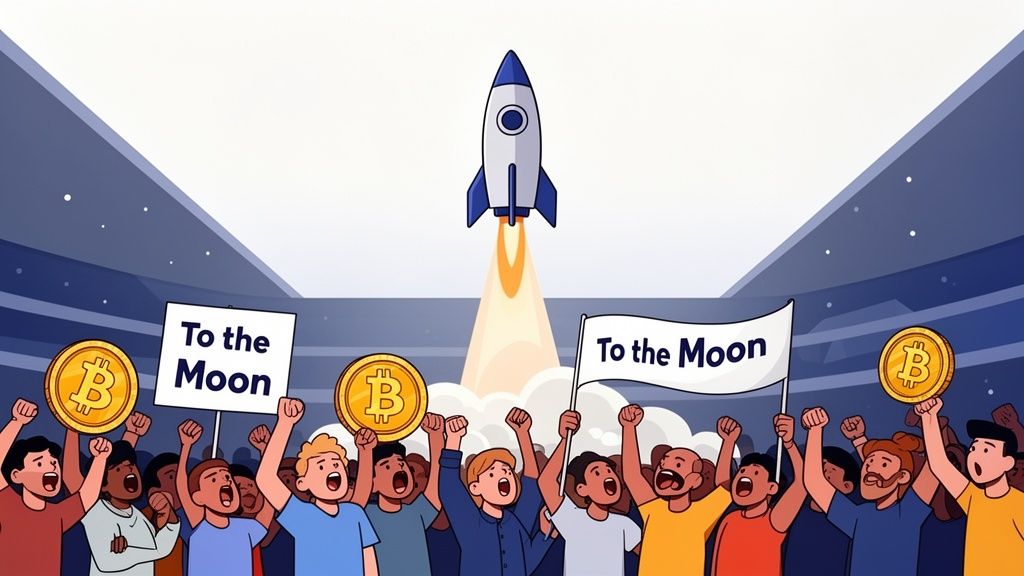
A cheering crowd with 'To the Moon' signs and Bitcoin coins watching a rocket launch.

You’ll see this phrase thrown around most often with memecoins and other super-volatile tokens where the power of the crowd can literally move markets. For a trader, hearing "to the moon" is a double-edged sword. On one hand, it’s a flashing neon sign that social momentum is building, which could ignite a massive price surge.

On the other hand? It can be a massive trap. This exact language is the calling card of coordinated "pump-and-dump" schemes. Organizers whip up a frenzy to lure in unsuspecting buyers, only to dump their own bags at the peak, leaving everyone else holding worthless tokens.

This is why you have to look past the hype. As decentralized finance keeps growing—with research pointing to its expanding dominance by 2025—telling the difference between a genuine groundswell and manufactured hype is a survival skill. You can learn more about the future of DeFi and its growth to get a sense of where things are headed.

To help you out, we’re going to break down where this phrase came from, the risks that come with it, and—most importantly—how to use on-chain data to see if a "moonshot" has real fuel in the tank or is just hot air.

Decoding the “To the Moon” Signal

When you see the rockets flying on social media, it's easy to get swept up in the excitement. But for a smart trader, it’s a signal to start digging deeper. This table breaks down what the phrase implies and when you should be skeptical.

ComponentMeaning for TradersPotential Red Flag
Community HypeA strong, engaged community is forming around the asset, which could drive demand.The hype appears out of nowhere and is driven by anonymous, bot-like accounts.
Price ExpectationTraders are anticipating a rapid, exponential price increase—not just a slow climb.The price has already pumped 100x and new buyers are being urged to "get in before it's too late."
Speculative InterestThe asset is likely highly volatile and driven by social sentiment rather than fundamentals.There's no clear use case, whitepaper, or credible team—only memes and price predictions.

Ultimately, "to the moon" is a call to pay attention, not a guaranteed ticket to riches. Use it as your cue to open up your analytics tools and verify what's really happening on-chain.

The Origin Story: From Reddit Rallies to Crypto Culture

The phrase "to the moon" wasn't cooked up in some corporate marketing meeting. It was born in the wild, chaotic forums of the internet, bubbling up from the early days of the Dogecoin community on Reddit. Back then, it was just a fun, hopeful cheer for the meme-inspired crypto's success.

But its real launch into the mainstream happened during the GameStop (GME) saga in early 2021. Retail traders, gathering on the subreddit r/wallstreetbets, made "to the moon" their battle cry. It became the anthem of a movement, a way for everyday people to push back against the big hedge funds that were betting on the company to fail.

For these traders, "to the moon" meant so much more than just a price target. It was a powerful mix of community hope, defiance against the financial establishment, and the exhilarating dream of hitting it big.

You can see the raw energy in discussions from that time. Forums like r/wallstreetbets were a perfect storm of memes, intense chatter, and shared financial goals that fueled an incredible wave of coordinated buying.

Laptop displaying a chat application with a Doge meme profile and cartoon avatars, featuring rocket ships.

This blend of humor and serious financial ambition is exactly what gives the phrase its punch.

From Stocks to Crypto

After GameStop, the phrase was permanently stamped into the internet's DNA. It was a natural fit for the crypto world, where volatility is the name of the game, and it was quickly adopted by communities rallying around new tokens and especially memecoins.

Understanding this backstory is key for any trader today. When you see "to the moon" plastered across social media, it's not just noise. It's a signal that signifies:

  • A Community Rally: A large, passionate group of people is emotionally and financially locked in.
  • Serious Volatility Ahead: All that emotion can drive prices to incredible highs or send them crashing down just as fast.
  • An Underdog Mentality: It often pits the small retail investor against the so-called "smart money," tapping into an anti-establishment vibe.

This is why the slogan can kick off such intense market momentum. It's also why you have to approach it with a clear head and solid data, not just pure emotion.

Why Chasing Moonshots Can Lead to Major Losses

That "to the moon" feeling can spark some serious FOMO (Fear Of Missing Out). It's a powerful psychological trigger, and it's responsible for a lot of impulsive, high-risk trades. But jumping on a token just because of social media hype is a dangerous game that often ends in disaster.

The raw emotion behind the phrase makes it the perfect bait for scammers. It’s almost always the battle cry for pump-and-dump schemes, where a group of insiders artificially inflates a token's price. They'll flood Twitter, Telegram, and Discord with rocket emojis and insane price predictions to lure in waves of unsuspecting buyers.

Once the price has skyrocketed, the organizers dump their huge bags on the market. The value crashes in an instant, leaving everyone who bought into the hype holding nearly worthless tokens.

The Anatomy of a Hype Trap

It's easy to mistake a coordinated social media campaign for genuine, organic momentum. An army of bots or a handful of paid influencers can suddenly start shilling a token, creating the illusion that a massive community is forming around it.

This is exactly why a smart trader hears "to the moon" and doesn't see a buy signal—they see an urgent warning to start digging deeper.

The critical takeaway is to treat the phrase as a starting pistol for your due diligence, not as a green light to invest. Genuine opportunities are backed by data, not just emotional appeals and memes.

A sudden, aggressive marketing push with zero real project development to back it up is a colossal red flag. These campaigns prey on the universal hope for quick, life-changing money, but the reality is often devastating. Many of these schemes are just slickly packaged exit scams. You can learn more about these risks in our detailed guide on the meaning of a rug pull in crypto.

Ultimately, protecting your capital comes down to one thing: learning to tell the difference between authentic community growth and manufactured hype. Before you ever put money on the line, ask yourself: Is this excitement supported by real on-chain activity, or is it just a lot of noise?

How to Verify "Moon Signals" with On-Chain Data

When a token starts trending and the "to the moon" chants echo across social media, it's easy to get swept up in the hype. But for a smart trader, that's not a buy signal—it's a trigger for due diligence. Instead of chasing hashtags and rocket emojis, you need to ground your decisions in on-chain data.

On-chain data is the blockchain's permanent, unchangeable record of every single transaction. It tells you what's really happening with a token, not just what influencers want you to believe.

Think of social hype as smoke; on-chain data is the fire. You need to see a real fire before you run towards it. This means digging for cold, hard evidence that real money—and real conviction—is behind the noise.

Moonshot Signal Decision Tree flowchart guides through evaluating ideas from signal to research frontier.

The key takeaway is simple: a moonshot signal should always kick off an investigation, not an immediate buy order. This is how you avoid getting burned by a pump-and-dump scheme.

Actionable On-Chain Verification Checklist

Use this checklist to systematically validate the hype you see online. If a token fails to meet these criteria, proceed with extreme caution.

    • What to Look For: A steady, organic increase in the number of unique wallets holding the token.
    • Why It Matters: This signals genuine, widespread adoption, not just a few insiders buying up the supply.
    • What to Look For: Check the top 10-20 wallets on a block explorer. Ideally, no single wallet (excluding exchange or contract addresses) holds a dangerously high percentage of the supply.
    • Why It Matters: High concentration (e.g., top 10 wallets hold >50%) is a major red flag for a potential dump.
    • What to Look For: Are wallets with a history of profitable trades buying in? Are they holding or selling immediately?
    • Why It Matters: Inflows from experienced traders are a high-confidence signal. You can track this with specialized tools like Wallet Finder.
    • What to Look For: Consistent, healthy trading volume that supports the price action.
    • Why It Matters: A price spike on very low volume is easily manipulated and unsustainable.

    Key On-Chain Metrics to Watch

    Signal TypeSocial Hype Indicator (Low Confidence)On-Chain Data Indicator (High Confidence)
    Community GrowthThousands of new Twitter followers overnightA steady, organic increase in unique wallet addresses holding the token.
    Trading ActivityA few influencers posting "Just aped in!" screenshotsSignificant and consistent buy orders from "smart money" wallets with a history of profitable trades.
    Token OwnershipClaims of a "strong community" and "diamond hands"A healthy holder distribution where the top 10 wallets hold less than 50% of the supply.
    Market SentimentA flood of rocket emojis and "WAGMI" postsRising net flow into the token, with more buys than sells from established wallets.

    By prioritizing the high-confidence indicators on the right, you dramatically reduce your risk and trade based on substance, not sentiment. For a more detailed breakdown of these techniques, check out our complete guide on how to use crypto on-chain data.

    The goal is to find alignment between social sentiment and on-chain reality. When a token’s story is backed by a growing holder base, smart money inflows, and healthy trading volume, the phrase "to the moon" starts to feel less like a gamble and more like a data-supported opportunity.

    Case Studies: Tokens That Actually Went to the Moon

    Talk is cheap. It’s one thing to understand the theory, but seeing how "to the moon" plays out in the wild is where the real lessons are. Some tokens have become legendary, delivering on the hype and creating fortunes along the way.

    When we look back at these explosive runs, we can often find the breadcrumbs—verifiable on-chain data that hinted at their moonshot potential long before everyone else caught on.

    Two of the best examples are Shiba Inu (SHIB) and PEPE. Both started as obscure memecoins that most people dismissed, yet they captured the market's imagination and went on incredible rallies. For traders who looked past the social media noise and dug into the data, the early signals were there.

    On-Chain Signals of a True Moonshot

    With both SHIB and PEPE, the blockchain told a story that was far more convincing than any tweet. Before the prices went vertical, specific indicators painted a picture of genuine, growing interest—a stark contrast to the usual pump-and-dump schemes.

    Here’s what the smart money was seeing:

    • Quiet Accumulation: Long before the hype cycle kicked in, a handful of wallets were steadily buying up large amounts of the token without causing massive price swings.
    • Rising Holder Count: The number of unique wallets holding the token grew day after day. This wasn’t just a few whales; it was organic, grassroots adoption.
    • Sustained Volume: Big transactions weren't just one-off events. A consistent flow of significant capital was entering the ecosystem and, more importantly, it was staying there.

    This kind of on-chain activity is what separates a project with real potential from a flash in the pan. To dive deeper into these dynamics, check out our guide on what moonshot crypto is.

    The Other Side: A Hyped Token That Crashed

    Of course, for every success story, there are countless tokens that generated massive hype only to crash to zero. In almost every one of those cases, the on-chain signals we just talked about were nowhere to be found.

    Instead, you’d see a high concentration of tokens in just a few wallets and a holder count that flatlined after the initial pump. The hype was loud, but the blockchain was silent.

    The lesson is clear: doing your own research is non-negotiable. A token’s on-chain footprint tells the real story, offering a layer of truth that social media sentiment just can’t match.

    As the global crypto wallet market is projected to grow substantially in 2025, the tools for this kind of research are becoming better and more accessible. You can read more about the expanding crypto wallet market on Fortunebusinessinsights.com.

    Got Questions About Crypto Slang?

    Let's be real, diving into crypto trading feels like learning a new language. This section will break down some of the most common questions traders have about slang like "to the moon," so you can trade with more clarity and less confusion.

    How Reliable Are "Moon Calls" Anyway?

    "To the moon" calls on social media are extremely unreliable if you take them at face value. Think of them as a flare in the dark—a signal to start digging for yourself, not a green light to throw your money in.

    The hard truth is that the vast majority of these calls are just noise, designed to whip up fake excitement for pump-and-dump schemes. Always, always verify the hype with actual on-chain data before you even think about making a move.

    What Exactly Is a Pump-and-Dump Scheme?

    A pump-and-dump is when a group manufactures a sudden, massive price spike based on nothing but social media hype. There's no real project value, no fundamentals—just hot air. This is a world away from genuine growth, which is always backed by solid on-chain metrics.

    Genuine growth looks like a steady increase in unique wallet holders, sustained trading volume, and visible development from the project's team. A pump-and-dump has none of that. It's all about creating FOMO before the insiders cash out, leaving everyone else holding the bag as the price crashes to zero.

    How Can Beginners Avoid Getting Wrecked by FOMO?

    Your best defense against FOMO is having a rock-solid trading plan before you invest a single dollar. This is what separates calculated trading from emotional gambling in a red-hot market.

    Your plan needs to clearly define three things:

    • Your Entry Price: The exact price you're willing to buy at. No exceptions.
    • Your Exit Prices: Set clear targets for taking profits and, just as importantly, for cutting your losses.
    • Your Maximum Risk: Know the absolute most you're willing to lose on this trade and stick to it.

    By following your own rules, you sidestep the emotional traps laid by all the "to the moon" hype. Never invest more than you're truly comfortable losing, especially with the highly speculative tokens where this slang is most common.


    Stop gambling on hype and start trading with data. Wallet Finder.ai surfaces the on-chain signals that matter, helping you spot real opportunities before they go mainstream. Discover the tokens and wallets smart money is buying right now at https://www.walletfinder.ai.