Guide to Trading Crypto Pairs

Wallet Finder

Blank calendar icon with grid of squares representing days.

February 6, 2026

At its core, all crypto trading comes down to one thing: pairs. When you trade a pair like BTC/USDT, you're really just speculating on the value of one asset against another. This simple concept fuels the entire market, creating liquidity and helping everyone figure out what an asset is actually worth.

Getting a Grip on Crypto Pairs and Why They're So Important
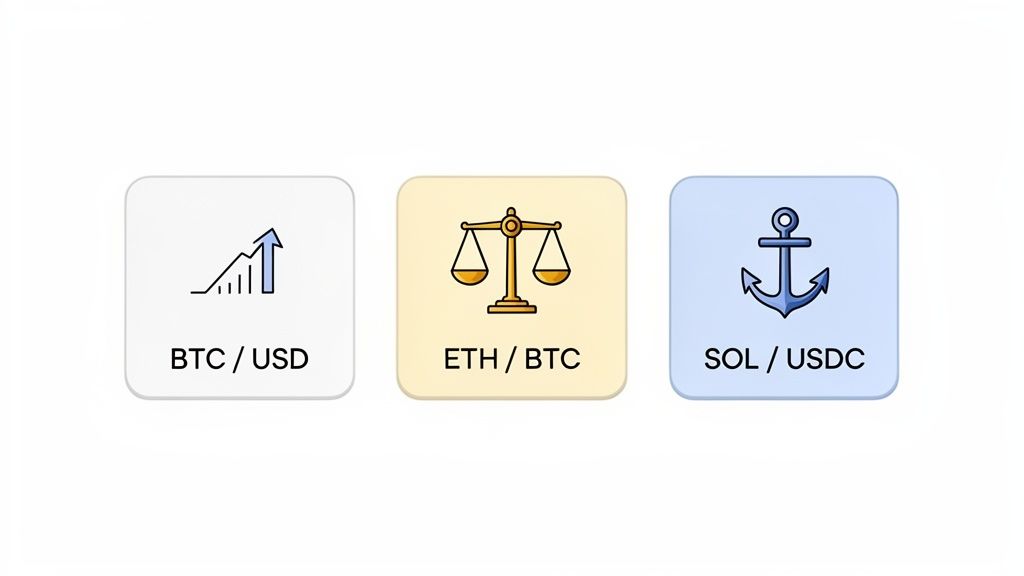
Three minimalist icons representing cryptocurrency trading pairs: BTC/USD, ETH/BTC, and SOL/USDC with corresponding symbols.

Think of a crypto pair as a seesaw. One side has the base currency—the crypto you’re buying or selling. The other side has the quote currency, which is what you're using to price it.

In the ETH/BTC pair, Ethereum is the base, and Bitcoin is the quote. The price you see is simply how much Bitcoin it costs to get one Ethereum.

Understanding this dynamic is what separates passive investors from active traders. Instead of just hoping the entire market trends upward, you can make strategic bets on the relative strength between two specific assets. This opens up a whole new playbook of trading strategies that work even when the market is flat or choppy.

The Three Flavors of Crypto Pairs

Not all trading pairs are the same. They're built for different purposes, and you can generally lump them into three main categories. Each one gives traders a unique angle on the market.

  • Crypto-to-Fiat Pairs (e.g., BTC/USD): This is your main bridge to the traditional financial world. Pairs like Bitcoin versus the US Dollar are the go-to for measuring a crypto's value in familiar, real-world terms. It's usually how new money enters the ecosystem.
  • Crypto-to-Crypto Pairs (e.g., ETH/BTC): These pairs are for pure crypto-on-crypto speculation. Trading ETH/BTC is a direct bet that you think Ethereum will outperform Bitcoin, regardless of what either is doing against the dollar. It's a true crypto-native play.
  • Crypto-to-Stablecoin Pairs (e.g., SOL/USDC): This has become the standard for most active traders today. Pairing an asset like Solana with a stablecoin like USDC lets you trade its volatility while giving you a stable asset to park your profits in. It’s the perfect way to sidestep a market crash without having to cash out to fiat completely.

At its heart, trading crypto pairs is about managing relativity. You're not just asking, "Will this asset go up?" You're asking, "Will this asset go up more or down less than the other asset in the pair?"

Why Picking the Right Pair Is Half the Battle

The pair you decide to trade fundamentally shapes your strategy and your risk. For example, if you trade an altcoin against BTC, you're exposed to the volatility of both assets. But if you trade that same altcoin against a stablecoin like USDT, your risk is isolated to just that one crypto's performance.

A Quick Guide to Crypto Trading Pairs

This table breaks down the three primary types of crypto pairs, highlighting their unique characteristics and best-use scenarios for traders.

Pair TypeExamplePrimary Use CaseKey Trader Insight
Crypto-to-FiatBTC/USDCashing out profits or buying crypto with traditional currency.Directly links crypto value to the real-world economy. Most common for new investors.
Crypto-to-CryptoETH/BTCSpeculating on the relative performance of two cryptocurrencies.Ideal for capitalizing on momentum shifts between major assets without exiting the crypto market.
Crypto-to-StablecoinSOL/USDCTrading crypto while hedging against market volatility.The standard for active traders. Allows for securing gains in a stable asset between trades.

Once you get a feel for these foundational concepts, you can start building much more deliberate and effective trading strategies. That's exactly where we're headed next.

Proven Strategies for Trading Crypto Pairs

To succeed in trading crypto pairs, you need to get your hands dirty with specific, proven strategies. This is how you actively engage with the market, finding and capitalizing on inefficiencies and momentum swings. Think of it as shifting from being a passive passenger to an active driver.

The Art of Market Making

Market making is all about providing liquidity to an exchange by setting both a buy (bid) and a sell (ask) order for the same pair simultaneously. The goal is to profit from the spread—the difference between the two prices.

Actionable Steps:

  1. Select a Pair: Choose a high-volume, low-volatility pair like ETH/USDT.
  2. Set Orders: Place a buy order at $3000.00 and a sell order at $3000.50.
  3. Capture the Spread: When both orders are filled, you earn the $0.50 spread.
  4. Automate: Use trading bots to repeat this process hundreds or thousands of times a day.

This strategy shines in stable markets but carries inventory risk. If the price makes a sudden move against you, you could be left holding a losing position.

Capitalizing on Price Gaps with Arbitrage

Arbitrage is exploiting tiny price differences for the same asset across different exchanges. The crypto market's fragmented nature makes it a perfect fit for this strategy.

Actionable Steps:

  1. Spot a Gap: Find BTC/USDT trading at $60,000 on Exchange A and $60,050 on Exchange B.
  2. Execute Simultaneously: Buy BTC on Exchange A and immediately sell it on Exchange B.
  3. Lock in Profit: You've captured a $50 profit per coin, minus fees.

Speed and capital are everything here. You'll need funded accounts on multiple exchanges and, realistically, automated bots to execute these trades before the price gaps vanish.

Arbitrage is a game of speed and efficiency. The profit windows are often incredibly small and last for mere seconds, making automation almost a necessity for anyone looking to compete seriously.

Advanced Pair Trading: The Relative Strength Play

Pair trading is a more sophisticated, market-neutral strategy where you take opposing positions in two correlated assets, betting that one will outperform the other. Your profit is tied directly to the relative performance gap between the two assets.

Actionable Steps for a SOL/ETH Trade:

  1. Form a Thesis: You believe Solana (SOL) will outperform Ethereum (ETH) due to stronger ecosystem growth.
  2. Go Long on SOL: Buy $5,000 worth of Solana.
  3. Go Short on ETH: Simultaneously, short an equal dollar amount—$5,000—of Ethereum.
  4. Profit from the Ratio: If SOL rallies 10% and ETH only rallies 5%, your long position's gains (+$500) will be greater than your short position's losses (-$250), resulting in a net profit of $250.

This approach isolates your bet and tunes out broader market noise. To get better at spotting these movements, our guide on how to read a candlestick chart for cryptocurrency is a great place to start.

Choosing Your Strategy

Which strategy is right for you? It boils down to your capital, risk tolerance, and current market conditions.

StrategyIdeal Market ConditionKey ToolsPrimary Risk Factor
Market MakingHigh liquidity, low volatility, tight rangeTrading bots, API keys, significant capitalInventory risk from sudden price moves
ArbitragePrice discrepancies across exchangesMulti-exchange accounts, high-speed botsExecution speed, transaction fees
Pair TradingDivergence in performance between correlated assetsAdvanced charting tools, fundamental analysisThe underperforming asset rallying unexpectedly

By mastering these strategies, you stop being a reactive market participant and start becoming a strategic one.

A flowchart illustrates the process of trading strategies: market-making, arbitrage, and pair trading.

Find Winning Trades with On-Chain Intelligence

The real edge in crypto pair trading comes from seeing what the smart money is doing before the market catches on. This is where on-chain intelligence becomes your secret weapon. The public blockchain is a goldmine of data you can use to find actionable trade ideas by following the digital breadcrumbs of profitable traders.

Unlocking the Power of On-Chain Data

On-chain analysis is about looking directly at blockchain transactions to see capital flows, gauge sentiment, and spot trends. Sifting through millions of transactions manually is impossible, which is where tools like Wallet Finder.ai come in.

Think of it as a search engine for smart money. It aggregates data from countless wallets, automatically flagging the ones that consistently crush the market. Your job is to find these top performers and let their insights guide your own trades.

The core idea is simple but incredibly powerful: Don't just trade the market; trade alongside the market's sharpest players. When you find wallets with a proven track record, you gain a massive advantage.

A Practical Workflow for Finding On-Chain Signals

Here's a repeatable process for sniffing out on-chain signals for crypto pair trades. The goal is to go from a huge universe of wallets to a specific, well-researched trade idea.

Actionable Checklist for Finding Top Traders:

  • Filter for High PnL: Seek wallets with a history of substantial, consistent profits.
  • Look for a Strong Win Rate: Target a win rate over 60-70% for consistency.
  • Check for Recent Activity: Focus on wallets active in the last 7-30 days to ensure relevance.
  • Verify Significant Volume: Confirm they are trading with enough capital to indicate conviction.

Once you have a handful of promising wallets, dive into their recent trade history. What pairs are they trading? Are they rotating out of ETH into a hot new Layer 1? Are they quietly accumulating a memecoin? This is how you spot opportunities before everyone else.

From Analysis to Actionable Trade Idea

After you’ve zeroed in on a target wallet and a pair they're active in, your next job is to deconstruct their strategy.

Key Data Points to Analyze:

  • Entry Points: At what price did they open their position? Did they buy all at once or average in over time?
  • Position Sizing: How much of their portfolio did they risk? A 10% allocation signals high conviction.
  • Exit Timing: If they’ve closed the trade, when did they take profit? Their exit is as revealing as their entry.

This granular analysis helps you build a strong thesis. For example, finding a top wallet buying a new TOKEN/WETH pair for three days straight, with an average entry of $0.05 and an 8% portfolio allocation, is a powerful signal. You can explore more methods in our guide on crypto on-chain analysis techniques.

The numbers back this up. The global crypto market saw spot volumes hit $1.47 trillion recently. During that turbulence, BTC-denominated pairs still held 16% dominance. This volatility highlights the edge you get from using a tool like Wallet Finder.ai, which can find top wallets pulling in 200-500% returns even when the market is bleeding. This data drives home why following the smart money is so critical.

Building a Disciplined Trade Plan

A man reviews his trading plan checklist on a clipboard, marking 'Entry' and 'Position size'.

Finding a promising crypto pair is just the starting line. A great signal is useless without a structured plan. This is where you turn a good idea into a calculated trade, shifting from "what to buy" to "how to actually trade it." A trade plan is your shield against emotion, forcing you to define your strategy before a single dollar is on the line.

Your Pre-Trade Checklist

Before entering any trade, ensure you have clear answers to these questions:

    • On-Chain Example: "I will enter after the tracked wallet makes its third accumulation buy of TOKEN/WETH."
    • Technical Example: "I will enter after a breakout above $1.50 resistance and a successful retest on the 4-hour chart."
  1. What is my profit target? (Your "Take Profit" or TP level)
  2. What is my invalidation point? (Your "Stop-Loss" or SL level)
  3. How much am I risking? (Position Size)
  4. Is the potential reward worth the risk? (Risk/Reward Ratio)
  5. Mastering Position Sizing

    This is the most important part of managing risk. A simple but powerful guideline is the 1-2% rule: never risk more than 1-2% of your total trading capital on one idea.

    Sticking to a strict position-sizing rule is what keeps you in the game. It ensures that a few bad trades in a row won't blow up your account, giving you the longevity to survive and trade another day.

    Let's break it down. With a $10,000 account and the 2% rule, your maximum loss per trade is $200. If your stop-loss is 10% below your entry, your position size is: $200 / 0.10 = $2,000. You’d enter with $2,000, leaving 80% of your capital safe.

    Calculating Your Risk/Reward Ratio

    Before entering a trade, ask: is the potential reward worth the risk? The risk/reward (R/R) ratio gives you a clear answer by comparing your potential profit to your potential loss. Aim for a minimum R/R of 2:1, but 3:1 or higher is ideal.

    ComponentExample Calculation
    Entry Price$1.00
    Stop-Loss Price$0.90 (Risk = $0.10)
    Profit Target Price$1.30 (Reward = $0.30)
    Risk/Reward Ratio3:1 ($0.30 / $0.10)

    When you only take trades with a good R/R, you don't even have to be right most of the time to be profitable. With a 3:1 ratio, you only need to win 25% of your trades just to break even. Want to dig deeper? Check out our guide on effective profit and loss analysis.

    Stablecoin pairs like USDT/BTC and USDC/ETH provide the deep liquidity needed to execute these trades. They anchor a massive $310 billion market cap and handled $1.2 trillion in January trading volumes. For more on stablecoin growth, check out the full report from Coindesk.

    Managing Live Trades and Learning from Every Outcome

    Your trade is live. Now comes the hard part: managing your psychology. The goal isn't to glue yourself to the charts. You did the work upfront for a reason. Your job now is to monitor the conditions you already defined and let your thesis play out.

    Staying Objective with Real-Time Alerts

    Automate your monitoring to quiet the emotional noise. Tools like Wallet Finder.ai let you set up instant notifications for when a wallet you’re following makes a key move. This turns random market noise into a clear signal.

    Interpreting Wallet Alerts:

    • Confirmation Signal: The wallet buys more of the token, validating your thesis.
    • Warning Sign: The wallet abruptly dumps their entire bag—a massive red flag.
    • Rotation Signal: They sell your token to buy another, indicating a potential narrative shift.

    These alerts are data-driven nudges that pull you away from emotional decision-making and back toward your strategy.

    The Power of Post-Trade Analysis

    Whether a trade ends in profit or loss, its real value is what you learn from it. A trading journal is non-negotiable for this. After closing a position, document everything—not just the entry and exit prices, but the why behind every action.

    A detailed trading journal is the feedback loop that fuels your growth. It transforms every outcome—good or bad—into actionable intelligence, ensuring you rarely make the same mistake twice.

    Actionable Journaling Prompts:

    1. Thesis Validation: Was my original reason for entering the trade correct? Why or why not?
    2. Execution Review: Did I stick to my plan (entry, stop-loss, take-profit)? If not, what emotion drove my decision?
    3. Improvement Opportunities: Could I have set a better stop-loss? Was my position size appropriate for the risk?
    4. Smart Money Comparison: How did my actions compare to the top wallet I was tracking? Did I panic-sell while they held?

    This relentless commitment to review is what separates pros from hobbyists. It's also crucial to understand the broader market context. During quiet periods, like when crypto volume crashed by 51% year-over-year to $1.2 trillion in January, a sharp trader can find wallets that perform well in downturns. This helps identify pairs ready to pop when volume returns. Learn more about how market volumes impact trading on Logos Press.

    Got Questions About Crypto Pairs? We've Got Answers.

    Jumping into crypto pair trading always stirs up a few questions. Let's tackle some of the most common ones.

    What Are the Best Crypto Pairs for Beginners?

    Stick to the high-liquidity pairs: BTC/USDT or ETH/USDT. These pairs have enormous trading volume, meaning the difference between the buy and sell price (the spread) is tiny, and their movements are generally more predictable. Starting here is like learning to drive in an empty parking lot—it allows you to get a feel for the market's rhythm without the extreme risk of volatile altcoin pairs.

    How Do I Handle Risk with the Crazier, More Volatile Pairs?

    Risk management becomes non-negotiable when dealing with volatile pairs.

    Two Unbreakable Rules for Volatility:

    1. Always Use a Stop-Loss Order: This is your eject button. It automatically closes your trade at a preset price, taking emotion out of cutting a loss.
    2. Master Your Position Sizing: Never risk more than 1-2% of your total trading account on any single trade. This discipline ensures that a bad run of trades stings, but it doesn't knock you out of the game.

    You don't survive in trading by avoiding losses—you survive by making sure your losses are small enough to fight another day. Longevity is the goal, and controlling your downside is the only way there.

    Should I Be Trading on a CEX or a DEX?

    The CEX vs. DEX debate boils down to your goals and technical comfort.

    • Centralized Exchanges (CEXs): Platforms like Binance or Coinbase are user-friendly, offer deep liquidity, and have advanced order types, making them perfect for beginners.
    • Decentralized Exchanges (DEXs): Platforms like Uniswap are your ticket to new, undiscovered tokens. The biggest draw is self-custody—you hold your own keys. The trade-off is often a steeper learning curve and higher gas fees.

    Here’s a quick breakdown to help you decide:

    FeatureCentralized Exchange (CEX)Decentralized Exchange (DEX)
    User ExperienceClean, intuitive, and built for beginners.Can be complex; requires wallet know-how.
    Asset CustodyThe exchange holds your funds for you.You are your own bank (self-custody).
    Token SelectionMostly established, well-vetted coins.A massive range, including brand new gems.
    Typical UserNew to intermediate traders.Experienced DeFi natives and alpha hunters.

    Ready to stop guessing and start tracking the smart money? Wallet Finder.ai gives you the on-chain intelligence to see what top traders are doing in real time. Find profitable wallets, discover winning trades, and get alerts the moment they make a move. Start your free 7-day trial and trade with an edge.