What Is a Limit Buy A Guide to Smarter Crypto Trading

Wallet Finder

Blank calendar icon with grid of squares representing days.

February 17, 2026

A limit buy order is an instruction you give an exchange to purchase a crypto asset, but only at a specific price you set or lower. It's like telling the market, "I'm interested in this token, but only at a price I'm comfortable with." This simple tool puts you in complete control of your entry point, protecting you from overpaying in a volatile market.

Understanding the Core Concept

Imagine you're at an auction. Instead of getting swept up in a bidding war, you decide your absolute maximum bid is $500. You won't pay a penny more. That’s a limit buy in a nutshell. You set your maximum price, and your order only executes if the asset's market price drops to meet your limit.

This is the opposite of a market order, which buys immediately at the best available price, for better or worse. A limit buy introduces patience and strategy, which is critical in the fast-paced world of crypto. We dive deeper into how these orders work on specific platforms in our guide to the Robinhood limit order.

Why Price Control Matters

Crypto is notorious for wild price swings. A limit buy acts as a safety net, preventing you from accidentally purchasing an asset during a sudden price spike. It ensures you never pay more than you intended. For any trader sticking to a strategy, this control is non-negotiable.

A limit buy order is your commitment to a price, not a commitment to a trade. It empowers you to define your own terms with the market, turning volatility from a threat into a potential opportunity.

How a Limit Buy Order Actually Works

When you place a limit buy, you add your bid to a digital marketplace called the order book. This is a live, public list of all buy and sell orders for a specific asset. Your order joins other "bids" from buyers, organized by price. On the other side are the "asks"—the prices sellers are willing to accept.

Your limit buy waits patiently in this queue. For it to execute, a seller's asking price must drop to match what you’re willing to pay. This mechanism guarantees you never overpay.

This visual breaks down the simple flow from setting your price to executing the buy.
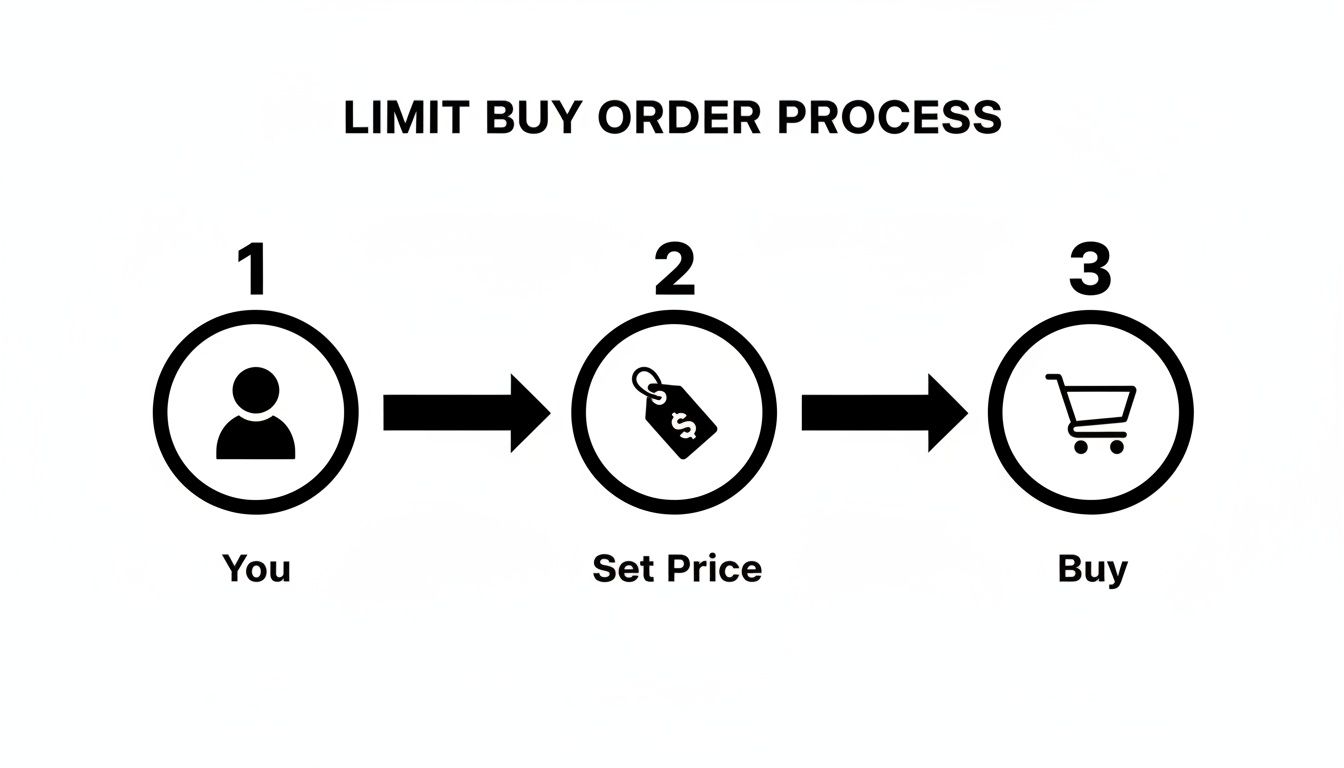
A simple black and white flowchart illustrating the three steps of a limit buy order process.

As the chart shows, the price you set is the core of the whole operation. It dictates exactly when the trade can happen.

From Submission to Execution

Once submitted, your order's lifecycle begins. It remains "open" in the order book until one of two things occurs:

  1. Full Execution: The market price hits your limit, and enough sellers are available to fill your entire order at or below your specified price.
  2. Partial Fill: The market price touches your limit, but there isn't enough of the asset being sold at that price to complete your purchase. The filled portion is secured, while the remainder of your order stays open.

The biggest takeaway here is that a limit order’s execution depends entirely on market movement. It’s a game of patience where your price has to become attractive enough for a seller to bite.

This mechanism is standard across centralized exchanges like Coinbase and decentralized platforms like Uniswap. The speed of execution often comes down to one critical factor: liquidity. For a high-liquidity asset like Bitcoin, there are thousands of buyers and sellers, so limit orders often fill almost instantly once the price is met. For a new, low-volume altcoin, your order could sit unfilled for hours or days if the price never drops to your target.

Limit Buy vs Market Order vs Stop Order

Choosing the right order type is fundamental to executing your trading strategy with precision. Think of limit buys, market orders, and stop orders as different tools in your toolbox, each designed for a specific job. Each strikes a different balance between price control, speed, and automation.

  • Market Order: Your tool for immediate action. You tell the exchange, "Buy this now at the best available price." It prioritizes speed over price certainty. You'll get your tokens instantly but may pay more than you wanted during volatile periods.
  • Limit Buy Order: Your tool for price control. It prioritizes your desired entry price above all else. The order only fills if the asset's price drops to your limit or lower, guaranteeing you never overpay.

Comparing Key Order Types

This table breaks down the strengths and weaknesses of each order type. The right choice depends entirely on your immediate goal. A stop order, for example, is a defensive tool used to manage risk, which you can read more about in our guide to setting a stop loss.

FeatureLimit Buy OrderMarket Buy OrderStop-Limit Buy OrderPrimary GoalPrice Control & PrecisionSpeed & Certainty of FillRisk Management & AutomationExecutionFills only at your set price or lower.Fills immediately at the current best market price.Becomes a market or limit order once a trigger price is hit.Best Used WhenYou have a target entry price below the current market.You need to enter a position immediately and price is secondary.You want to buy after an asset shows upward momentum.

Data consistently shows the value of a patient, strategic approach. In the high-stakes crypto arena, limit buy orders have statistically outperformed impulsive market buys time and time again.

During the 2021 bull run, historical data from Uniswap V3 showed that limit buys made up 62% of profitable ETH-USDC entries. Not only that, but their average entry prices were 12% below the spot averages, leading to a PnL that was 2.5x higher than what market orders achieved. You can find more insights on order type performance on Gemini.

The Fee Advantage Nobody Talks About: Why Limit Orders Are Cheaper by Design

Every article about limit buy orders tells you they give you price control. Almost none of them tell you that limit orders are also cheaper to execute than market orders on every major exchange — sometimes by enough to measurably affect annual returns. Understanding why this happens and how to calculate the real cost difference is one of the most immediately actionable pieces of information a crypto trader can have.

The mechanism is the maker/taker model. Every centralized exchange that uses an order book charges two different fee rates: a taker fee for orders that execute immediately against existing orders in the book (market orders), and a maker fee for orders that add liquidity to the book by sitting and waiting (limit orders). When you place a limit buy below the current market price, your order goes into the order book and sits there, adding liquidity. You're a market maker. Exchanges reward this by charging you a lower fee or, on some platforms, paying you a rebate.

On Coinbase Advanced, the taker fee ranges from 0.05% to 0.60% depending on your 30-day volume, while the maker fee ranges from 0% to 0.40%. At the retail tier (under $10,000 monthly volume), you're paying 0.60% as a taker versus 0.40% as a maker — a 33% cost reduction just from using a limit order instead of a market order. On Binance, the standard taker fee is 0.10% against a maker fee of 0.10% at the base level, but on their BNB discount tiers the gap widens, and on their VIP tiers it becomes more pronounced. Kraken runs 0.26% taker versus 0.16% maker at standard volume.

The dollar impact on a real trading portfolio becomes significant fast. Consider a trader executing $5,000 in purchases per week. At Coinbase's retail taker rate of 0.60%, that's $30 per week in fees, or $1,560 per year. The same trading activity using limit buy orders at the 0.40% maker rate costs $20 per week, or $1,040 per year. The difference — $520 annually — is money that stays in your account compounding rather than going to the exchange. For a trader managing $50,000 in annual volume, the fee differential at retail rates exceeds $1,000 per year in the exchange's pocket instead of yours.

The secondary fee advantage of limit orders appears in spread capture. When you place a market buy, you pay the ask price (the seller's asking price), which is always higher than the bid price (what buyers are offering). The difference between ask and bid is the spread, and on high-volume assets like Bitcoin on major exchanges it's typically very small — a few dollars on a $95,000 price. But on lower-liquidity altcoins, spreads of 0.5% to 2% are common. A market buy on a lower-cap token effectively costs you the spread on top of the taker fee, doubling or tripling your true execution cost versus what the exchange fee schedule shows. A limit buy avoids the spread entirely, because you're setting your price within the bid-ask range rather than crossing it.

The practical framework for deciding when the fee advantage justifies the non-execution risk is straightforward: if the fee saving equals or exceeds the maximum price movement you'd accept from missing the trade, use a limit order. For a $5,000 position where the fee saving at Coinbase is $10 (0.20% maker vs taker differential), ask yourself if you'd accept paying $10 more for the asset just to get immediate execution. If yes, use a market order. If no, use a limit order and capture the fee saving. For most planned entries based on technical analysis rather than breaking news reactions, the limit order wins that calculation every time.

Proven Strategies for Using Limit Buy Orders

Knowing how a limit buy works is one thing; using it to gain a market edge is another. For seasoned traders, limit orders are a cornerstone of a larger game plan, helping turn market volatility from a threat into an opportunity.

Here are actionable strategies you can use:

  1. Buying the Dip: Place limit buy orders at key technical support levels (e.g., moving averages, previous price floors) where a price bounce is likely. This removes emotion and allows you to methodically buy assets at a discount during a downturn.
  2. Laddering Your Buys: Instead of a single large order, set a series of smaller limit buys at incrementally lower prices. This automates a Dollar-Cost Averaging (DCA) strategy, lowering your average entry cost during a correction.
  3. Capitalizing on Flash Crashes: Set "low-ball" limit orders far below the current market price. During sudden, irrational sell-offs (flash crashes), these orders can execute, securing you an incredible entry point.

Example: Automating Entries with Laddering

Instead of placing one $300 order and hoping you've timed the bottom perfectly, you can "ladder" your buys. This strategy spreads your risk and improves your average cost.

Here's what that might look like for buying ETH:

  • Order 1: Buy $100 of ETH if the price drops to $3,000.
  • Order 2: Buy another $100 if it falls further to $2,900.
  • Order 3: Buy a final $100 if it reaches $2,800.

This disciplined approach prevents you from going all-in at a single price that might be far from the actual bottom.

Capitalizing on Market Panic

Limit buy orders are your best friend during moments of market chaos.

A flash crash is a rapid, deep, and volatile fall in security prices occurring in an extremely short period. Limit buy orders placed well below the current market price can execute during these events, turning widespread panic into a remarkable entry point.

On "Black Thursday" (March 12, 2020), Bitcoin's price collapsed. On-chain data shows that traders with pre-set limit buys for ETH around $110—a level that seemed impossible when it was trading at $230—saw their orders fill. As the market recovered, they were sitting on gains of over 110% by May 2020.

You can dig into more data on how these mechanics play out on platforms like CoinMarketCap. These events prove that a well-placed limit buy is a powerful tool for turning others' fear into your financial gain.

Iceberg Orders and Hidden Depth: Why Your Limit Order Fills at the Wrong Price

Most explanations of limit order execution describe a clean, simple mechanism: price drops to your level, sellers appear, your order fills. In liquid markets with transparent order books this is roughly accurate. In practice — especially in crypto markets where institutional players and sophisticated algorithmic traders coexist with retail — the actual execution environment is considerably more complicated, and understanding two specific phenomena will save you from the confusion of watching your limit price get hit without your order filling.

The first phenomenon is iceberg orders (also called hidden orders or reserve orders). Major exchanges including Binance, Kraken, and Coinbase Pro allow sophisticated traders to post limit orders that only display a small portion of their actual size to the order book. A whale who wants to sell 500 Bitcoin without visibly crashing the market might post an iceberg sell order that shows only 5 Bitcoin at a time in the public order book. As each 5 BTC portion fills, the next 5 BTC slice appears, making it look like consistent small sell pressure rather than a massive single sale.

For a retail limit buy trader, this creates a specific problem. You see a relatively thin order book with, say, 15 BTC for sale at your target price. You place a limit buy for $50,000 worth of Bitcoin at that level expecting easy execution. The price drops, your order enters the queue — and then it sits. The iceberg sell order hidden behind the visible 15 BTC keeps feeding new supply at your price level faster than buyers (including you) can absorb it. Your order partially fills, then hangs, then partially fills again as you wonder why the price is sitting exactly at your limit but you're only getting dribs and drabs of execution.

The tell for an iceberg order is consistently sustained selling at a single price level for far longer than the displayed order book depth would suggest. When you see 10 BTC showing for sale at $94,500 and the price stays exactly at $94,500 for twenty minutes with heavy volume trading, there's almost certainly a much larger hidden order feeding that price level. In this scenario, your limit buy will eventually fill, but much more slowly than you planned, and if the market recovers before the iceberg depletes, you'll get a partial fill at best.

The second phenomenon is order book spoofing and its impact on apparent support levels. Spoofing involves placing very large visible limit orders with no intent to let them fill, purely to create the illusion of strong buying or selling interest at certain prices that other traders will use as reference points. A $2 million visible buy order sitting at $90,000 Bitcoin makes that level look like strong institutional support, encouraging retail traders to also place limit buys around $90,000. But if the spoofer cancels their $2 million order the moment price approaches it, that manufactured support evaporates instantly, and your retail limit buy ends up sitting at what turns out to be a hollow price level.

Spoofing is technically illegal in regulated U.S. markets and Coinbase is regulated, but it's essentially unenforceable in real time. More importantly, unregulated offshore exchanges and DeFi liquidity pools have no enforcement mechanisms at all. When you're setting limit buys based on visible order book depth — especially on Binance, OKX, or any DEX — you should treat displayed large orders at round-number levels (the $90,000 or $100,000 Bitcoins) with significant skepticism because round numbers attract both legitimate interest and spoofed orders.

The operational adjustments for navigating these realities are specific. Set your limit buys at non-obvious price levels — not at the round numbers where order book depth concentrates and spoofed orders cluster. If the obvious support level is $90,000, consider setting your limit at $90,170 or $89,850. This doesn't change your economic thesis but takes you off the predictable price where competition from other buyers and manipulation effects are highest. Check volume-weighted average price (VWAP) data to identify where actual transactions — not just visible orders — have historically concentrated, since VWAP reflects real execution rather than displayed intent.

What Are the Risks of Using Limit Orders?

While a limit buy order gives you fantastic price control, it’s not without risks. Understanding the potential downsides is key to trading effectively. The biggest risk is simple: your order might never get filled. If an asset's price never drops to your target and instead rallies, you will miss out on potential gains while waiting for a discount that never arrives.

Another common frustration is the partial fill. This occurs when the market price briefly touches your limit, but there isn't enough liquidity (sellers at that price) to fill your entire order. You might end up with only a fraction of the crypto you wanted.

How to Navigate Common Limit Order Pitfalls

In decentralized finance (DeFi), you also face the risk of front-running. Sophisticated bots can spot your pending limit order and place their own trades to profit from the minor price movement your order might cause.

The core trade-off with a limit buy is simple: you sacrifice the certainty of execution for the certainty of price. You get the exact price you want, but only if the market decides to meet you there.

To protect yourself, follow these best practices:

  • Set Realistic Prices: Base your limit price on technical analysis, such as support levels, not just wishful thinking.
  • Check Liquidity: Before placing a large order on a smaller altcoin, check the order book's depth to ensure there are enough sellers to fill your trade.
  • Avoid Extreme Greed: Setting your limit price just a few cents too low can be the difference between a filled order and a missed opportunity. Sometimes "good enough" is better than "perfect."

MEV and Sandwich Attacks: The Threat to Limit Orders on DEXes

The article's existing risk section mentions front-running in DeFi as a danger. The actual threat is more specific and considerably more sophisticated than a passing mention covers. Maximal Extractable Value (MEV) is the profit that miners, validators, and specialized bots extract by reordering, inserting, or censoring transactions within a block. For traders placing limit buy orders on decentralized exchanges, MEV creates an adversarial environment where sophisticated automated actors are reading your orders before they execute and profiting at your expense.

The most directly relevant MEV attack for limit buy orders is the sandwich attack. Here's the precise sequence: you submit a limit buy order for a DeFi token on Uniswap or another AMM-based DEX at a price slightly below the current market. A bot monitoring the mempool (the public list of pending transactions) sees your order. The bot immediately submits its own buy order with a higher gas fee, ensuring its transaction gets included in the block before yours. The bot's buy drives the price up slightly. Your limit buy now executes at a price slightly above what you intended because the pool's price shifted before your order filled. Immediately after your buy, the bot sells its position into the liquidity your purchase created, pocketing the difference.

The dollar impact per attack is typically small — a few dollars on a $1,000 trade, maybe $50-$150 on a $10,000 trade. But on high-frequency trading activity, these amounts accumulate. More damagingly, sandwich attacks on limit orders at technical support levels mean you're systematically buying slightly above the support levels you identified, which erodes the edge your technical analysis was supposed to generate.

The practical defenses vary by protocol. CoW Protocol (formerly CowSwap) uses batch auction settlement, where orders are grouped and settled simultaneously at a uniform clearing price, making sandwich attacks economically unviable because the bot can't front-run a batch settlement the way it can front-run an individual transaction. 1inch Fusion uses a Dutch auction mechanism that achieves similar protection. Flashbots MEV Blocker is an RPC endpoint you can add to your wallet that routes transactions through private mempools, hiding them from public bot scanning until they're included in a block.

For limit orders specifically on Uniswap V3, the architecture matters. Uniswap V3's concentrated liquidity design means your limit order is executed as a range order within a specific price band rather than a traditional limit order. The range order mechanism does provide some inherent MEV resistance compared to standard AMM swaps because the execution is spread across a price range rather than hitting a single specific price point.

On centralized exchanges — Coinbase, Binance, Kraken — MEV in the pure DeFi sense doesn't apply because the exchange controls order matching without a public mempool. However, a related risk exists: latency arbitrage. Sophisticated co-located trading systems at major exchanges can detect the momentum created when large limit orders begin filling and execute complementary positions faster than retail traders can react. This doesn't directly harm your limit order execution but creates an environment where the price you thought was a reliable support level gets vacated rapidly once your level fills, because professional traders are positioned to capitalize on the price discovery your execution just enabled.

The actionable threshold: if you're trading amounts under $5,000, MEV costs are real but probably not worth restructuring your execution strategy around. If you're regularly placing limit buys above $10,000-$15,000 on DEXes, using CoW Protocol or another MEV-resistant routing layer for those larger transactions pays for itself almost immediately in recovered execution quality.

Putting Limit Buys to Work with Wallet Finder AI

Knowing how to set a limit buy is one thing; knowing where to set it is what separates amateurs from professionals. Instead of guessing, you can use on-chain data to gain a decisive edge.

Laptop displays Wallet Finder AI with smart wallet data, on-chain timeline, and recent limit buys.

By tracking the activity of top-performing traders ("smart money"), you can see the exact price levels they are targeting with their limit orders during market dips. These aren't random guesses; they often reveal hidden support zones the rest of the market has overlooked.

Finding Profitable Entry Points

Here's an actionable workflow using Wallet Finder AI:

  1. Discover Top Wallets: Use the Discover Wallets feature to find top-performing wallets based on their PnL and trading history.
  2. Analyze Their Strategy: Dig into their on-chain history to see where they consistently place limit buy orders to achieve better-than-average entries.
  3. Set Up Real-Time Alerts: Create a custom watchlist of these elite wallets and set up instant Telegram alerts. You'll be notified the moment a wallet you're tracking places a significant limit buy.

Watching the on-chain footprints of seasoned traders turns their strategic limit buys into your personal alpha. Their patience and precision become your opportunity.

This strategy works across major ecosystems, helping you pinpoint entries on:

  • Ethereum
  • Solana
  • Base

By mirroring the moves of top traders, you can place your limit buys with significantly more confidence. You can start exploring how the best traders are positioning themselves right now on the Wallet Finder AI platform.

Your Top Questions Answered

When you're first getting the hang of limit buys, a few practical questions always pop up. Getting these sorted out is key to trading with confidence and dodging those rookie mistakes. Let's tackle the most common ones.

Can a Limit Buy Order Expire?

Yes, they can. Most exchanges require you to select a "time-in-force" setting. The most common options include:

  • Good 'Til Canceled (GTC): The order remains active until it is filled or you manually cancel it. This is often the default setting.
  • Day Only: The order automatically expires if it is not filled by the end of the trading day.
  • Immediate Or Cancel (IOC): The order must be executed immediately, and any portion that cannot be filled is canceled.

What Happens if My Limit Order Only Partially Fills?

A partial fill occurs when the price hits your limit, but there aren't enough sellers at that moment to fill your entire order. The portion that was filled is secured in your account. The remainder of your order stays open on the order book, waiting for the price to return to your limit so it can attempt to fill the rest.

Are Limit Orders Visible to Everyone?

Absolutely. When you place a limit order, it is added to the public order book. This transparency is a core feature of financial markets, allowing all participants to see supply and demand at various price levels. While this provides valuable data for analysis, it also means your trading intentions are visible to others.

Does the Exchange Keep My Limit Order If It Goes Down or Gets Hacked?

This is a question traders rarely ask until something goes wrong, and the answer differs significantly between centralized and decentralized exchanges.

On a centralized exchange like Coinbase or Binance, your open limit orders exist as records in the exchange's internal order management system, not on the blockchain. This means two things: first, if the exchange experiences a technical outage, your orders don't execute during the downtime — they either remain open or get canceled depending on the exchange's outage policy. During Coinbase's major outages in 2021, many open orders were simply held in place and processed when systems came back online, though some users reported unexpected cancellations.

More critically, if a centralized exchange is hacked and an attacker gains access to your account, they can cancel your open limit buy orders and replace them with sell orders that drain your balance. This has happened in documented exchange hacks. The defense is enabling all available account security measures — hardware 2FA (not SMS) is the minimum viable security for any account with meaningful funds, and whitelisting withdrawal addresses adds a critical second layer.

On decentralized exchanges using smart contract-based limit orders (like Uniswap V3's range orders or Gelato Network's limit order infrastructure), the order is encoded in a smart contract on the blockchain itself. A hack of the front-end interface doesn't touch your order because it's secured by the blockchain's cryptography, not the DEX's servers. However, if there's a vulnerability in the smart contract code, your locked funds could theoretically be at risk from a protocol-level exploit. This is a different threat model — lower frequency but potentially higher severity — than the CEX account hack risk.

Can I Cancel a Limit Buy After It's Been Partially Filled?

Yes, and understanding how partial fill cancellations work saves both money and confusion. On all major centralized exchanges, you can cancel a partially-filled limit order at any time. When you do, the filled portion is retained as a completed purchase in your account, and the remaining unfilled portion of the order is canceled with no charge. The amount reserved for the unfilled portion (funds you had allocated to complete the full order) is released back to your available balance.

The nuance is with maker fees on partial fills. On exchanges that charge maker fees per execution event rather than per order, each partial fill generates a separate fee charge proportional to the amount filled. If your $5,000 limit order fills in seven partial executions across a trading day, you may have paid maker fees seven times on small amounts rather than once on the full amount. The total fee is the same either way, but it's worth knowing this in case you're reconciling your trade history and see multiple small charges from a single order.

On decentralized exchanges, canceling a partially-filled smart contract order requires an on-chain transaction to update the contract state. This means you pay gas fees to cancel, which can be meaningful on Ethereum mainnet during high-congestion periods. If your partial fill amount is small — say $150 out of a $1,000 order — the gas cost to cancel the remaining $850 worth of orders might run $10-$40 depending on network conditions. In these situations, it's worth doing the math on whether canceling is economically sensible relative to the gas cost, especially if you don't urgently need the reserved capital back.

How Far Below Market Price Should I Set a Limit Buy?

There's no universal answer, but there's a framework that outperforms the "pick a round number that feels right" approach most guides describe.

The baseline methodology is support-based placement. Identify the nearest meaningful technical support level below the current price — a previous price floor where the asset bounced, a major moving average like the 50-day or 200-day, or a high-volume consolidation zone visible on the chart. Set your limit buy at or slightly above that support level (1-2% above, not exactly at it, for the same anti-obvious-price reasons described in the MEV section). This gives you a technically justified entry rather than an arbitrary one.

The second consideration is liquidity at your target price. On any major exchange, check the order book depth at the price level you're considering. If there are significant existing buy orders clustered at your target, you're entering a competitive queue — when price reaches that level, your order fills after all the orders ahead of yours in the queue. If your intended buy is $10,000 and there's $500,000 in buy orders ahead of you at the same price, a brief dip to that level might fill others but leave you behind.

The third consideration is asset volatility. For high-volatility assets — altcoins with daily ranges of 5-10% — setting limits within 1-2% below market makes the limit order nearly equivalent to a market order in terms of fill probability. For these assets, the limit buy's value comes from targeting genuine support 5-15% below current price where the asset might pull back during a broader market correction, not from chasing tight discounts that are almost certain to fill.

A practical rule: for assets with 30-day historical volatility under 30% (major caps like Bitcoin, Ethereum), 2-5% below market is a reasonable limit placement range. For assets with 30-day volatility over 60% (most mid-cap and small-cap altcoins), the limit needs to be at least 8-15% below market to have a meaningful probability of filling during a routine dip rather than only during a major crash.

Ready to stop guessing where to set your limit buys? Use Wallet Finder.ai to see where the smartest traders are placing their orders and get real-time alerts. Start your 7-day trial today.