
What is a liquidity pool? A Guide to AMMs & LP Tokens
Discover what is a liquidity pool, how AMMs and LP tokens work, and how to avoid impermanent loss with smart pool picks.
At its heart, a liquidity pool is a collection of cryptocurrencies locked in a smart contract. These pools are the engines behind decentralized exchanges (DEXs), allowing anyone to trade digital assets instantly without needing a direct buyer or seller.
The Foundation of Decentralized Trading
In a traditional stock market like the NYSE, selling shares requires a buyer on the other side of the trade. This system relies on an order book—a list of buy and sell orders.
Decentralized finance (DeFi) flips this model on its head.
Instead of matching individual traders, DeFi uses liquidity pools. Imagine two digital jars: one with ETH and one with USDC. Together, they form a liquidity pool. This pool is always "on," ready for anyone to use without waiting for an order match.
Two Key Players in the Ecosystem
This system functions because of two essential groups. Understanding their roles is key to grasping how DeFi works.
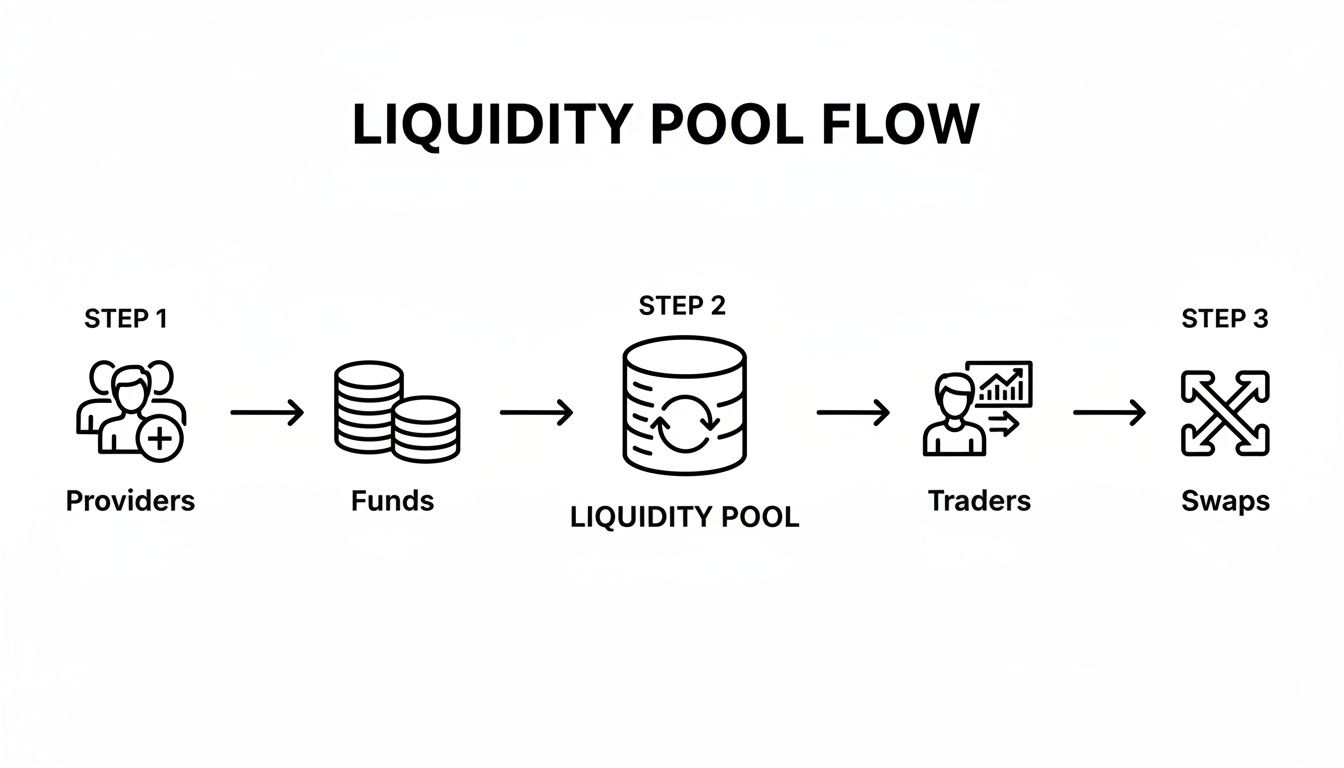
- Liquidity Providers (LPs): These are individuals who deposit their crypto into the pools. Typically, they provide an equal value of two different tokens (e.g., ETH and USDC). By "providing liquidity," they ensure there are enough assets for trades to execute smoothly. In return, LPs earn a percentage of the trading fees from every swap made in their pool.
- Traders: These are users who want to swap one token for another. They interact with the pool by depositing one token and withdrawing another. For instance, a trader can add USDC to the pool and receive the equivalent value in ETH, paying a small fee to the LPs for the service.
This dynamic creates a self-sustaining financial ecosystem where LPs are incentivized to fund pools, and traders get immediate access to the assets they need.
A liquidity pool is essentially a decentralized market maker. It performs the role of a traditional financial institution but uses automated code instead of intermediaries, opening the market for anyone to contribute capital and earn passive income.
How to Get Started as a Liquidity Provider (Actionable Steps)
Ready to become an LP? Here's a simplified, step-by-step guide to providing liquidity on a typical DEX like Uniswap or PancakeSwap.
- Choose a DEX and a Pool: Select a well-established decentralized exchange. Research different liquidity pools and evaluate their TVL, volume, and potential risks (more on this later).
- Acquire Both Tokens: You'll need an equal value of both tokens in the asset pair. For an ETH/USDC pool, if you want to deposit $1,000, you'll need $500 worth of ETH and $500 worth of USDC.
- Connect Your Wallet: Navigate to the "Pool" or "Liquidity" section of the DEX and connect your DeFi wallet (e.g., MetaMask, Trust Wallet).
- Deposit Your Tokens: Select the tokens you want to provide, enter the amounts, and approve the smart contract interaction.
- Receive LP Tokens: After you confirm the transaction, you will receive LP (Liquidity Provider) tokens in your wallet. These act as a receipt for your share of the pool.
- (Optional) Stake LP Tokens for Yield Farming: Some platforms allow you to "stake" your LP tokens in a separate contract to earn additional rewards, a process known as yield farming.
If you want to dive deeper into the mechanics, you can check out our detailed guide on crypto liquidity pools.
How Automated Market Makers Drive Trading
If there’s no order book, how does a trade actually happen? The magic is an algorithm called an Automated Market Maker (AMM).
The AMM is the rule-enforcer for the liquidity pool. It's a smart contract that uses a mathematical formula to price assets and execute trades, ensuring the pool remains balanced based on supply and demand.
This algorithmic approach powers decentralized exchanges (DEXs). Instead of a centralized company setting prices, the AMM handles everything automatically, making instant, permissionless trading possible. To get a better sense of how this fits into the bigger picture, our guide on what a DEX does connects all the dots.
The Constant Product Formula Explained
The most common AMM algorithm is the constant product formula: x * y = k. It might look like abstract algebra, but the concept is simple and powerful.
Let’s break it down with a hypothetical ETH/USDC pool:
- x = The amount of Token A (e.g., 10 ETH)
- y = The amount of Token B (e.g., 40,000 USDC)
- k = The constant product (in this case, 10 * 40,000 = 400,000)
The AMM's sole purpose is to keep k constant during trades. If someone removes some of Token A, the AMM adjusts the price of Token B to maintain the same total product. This formula is the core of a liquidity pool's pricing mechanism.
The constant product
konly changes when liquidity providers add or remove funds from the pool. For all trades happening within the pool,kremains the same, forcing the asset prices to adjust algorithmically.
A Practical Trading Example
Let's say a trader wants to buy 1 ETH from our 10 ETH / 40,000 USDC pool. They'll be putting USDC into the pool and taking ETH out. Here’s how the AMM crunches the numbers to figure out the price.
- Trader's Action: The trader wants to withdraw 1 ETH and will pay with USDC.
- Pool State (Before): The pool has 10 ETH and 40,000 USDC. This means the current price of 1 ETH is 40,000 / 10 = $4,000.
- AMM Calculation: After the trader takes 1 ETH, there will only be 9 ETH left. To keep
kat 400,000, the AMM calculates the new amount of USDC needed: 400,000 / 9 = 44,444.44 USDC. - Price Determination: The difference between the new USDC balance (44,444.44) and the original amount (40,000) is 4,444.44 USDC. This is exactly what the trader has to pay for their 1 ETH.
- Pool State (After): The pool is now rebalanced to 9 ETH and 44,444.44 USDC. The new implied price of 1 ETH is 44,444.44 / 9 = $4,938.27.
This flow is what keeps the market moving, with liquidity providers supplying the funds that traders use for swaps.
Notice how the price of ETH jumped after just one trade? That’s called slippage. By removing ETH, the trader made it scarcer relative to USDC, causing the AMM to automatically increase the price for the next buyer. Large trades can significantly shift prices, creating the arbitrage opportunities that savvy traders hunt for.
The Rewards and Risks of Providing Liquidity
Becoming a Liquidity Provider (LP) can be a great way to earn yield on your crypto, but it's an active investment, not a passive one. You're providing a crucial service to DeFi, which comes with a unique mix of rewards and risks.
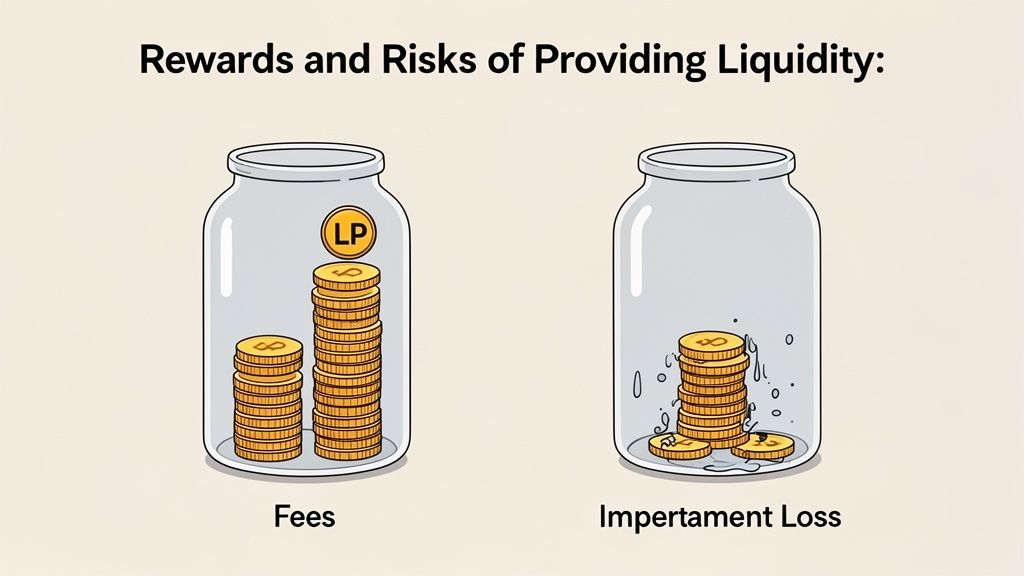
The primary incentive for LPs is earning a share of trading fees. Every swap in the pool incurs a small fee—usually between 0.05% and 0.3%—which is distributed among all LPs. If you own 1% of the pool, you receive 1% of the fees.
For popular trading pairs on major DEXs like Uniswap or PancakeSwap, these fees can generate a consistent income stream, especially during periods of high trading volume.
Beyond Fees with Yield Farming
Many DeFi protocols offer additional incentives to attract liquidity through yield farming (or liquidity mining). On top of trading fees, you may receive the protocol's native token as a bonus reward.
This creates a powerful incentive loop for LPs:
- You deposit assets into a pool (e.g., ETH and USDC).
- You get LP tokens as a receipt for your share.
- You stake those LP tokens in a separate "farm" contract.
- You earn extra rewards in the protocol's native token (like UNI or CAKE).
This is how some LPs achieve high APYs. However, it adds complexity and risk, as the value of the reward token can be highly volatile.
The Big One: Impermanent Loss
While fees are attractive, every LP must understand impermanent loss. It's a complex concept in DeFi that can turn a profitable position into a loss.
Impermanent loss is the difference in value between holding two assets in a liquidity pool versus simply holding them in your wallet. It's "impermanent" because the loss is only realized when you withdraw your funds.
Here’s the issue: the AMM constantly rebalances the pool to maintain its formula (x * y = k). If the price of one of your tokens rises significantly relative to the other, the AMM effectively sells your appreciating asset to buy more of the depreciating one. As a result, you end up with more of the less valuable asset and less of the more valuable one.
Strategies for Managing the Risk
Impermanent loss can erode your fee earnings and even your initial capital. It’s a real threat, but it can be managed. Here are some actionable strategies:
- Choose Stablecoin Pairs: Pools like USDC/DAI have minimal impermanent loss because their prices are pegged to $1 and rarely diverge. The trade-off is that fee revenue is typically lower.
- Use Correlated Assets: Pairs like WBTC/ETH tend to move in the same general direction. While some impermanent loss is still possible, the price divergence is usually less dramatic than pairing a volatile altcoin with a stablecoin.
- Utilize Modern Pools: Newer protocols like Uniswap V3 offer concentrated liquidity, allowing you to provide funds within a specific price range. This boosts capital efficiency and potential fee earnings but requires more active management.
- Monitor Your Position: Don't "set it and forget it." Regularly track your pool's performance using a DeFi portfolio tracker. If impermanent loss is outpacing your fee profits, it may be time to withdraw your liquidity and reassess.
How to Evaluate and Select Profitable Pools
Start tracking smart money today
Join thousands of traders using WalletFinder.ai to find profitable wallets and copy their trades.
Start Free Trial →Get weekly market alpha
Pre-breakout setups, whale moves, and OSINT signals. Free, every Thursday.


