A Guide to Raydium Liquidity Pool Profits
Unlock the secrets of the Raydium liquidity pool. This guide explains how to analyze pools, manage risk, and use on-chain data to mirror smart money strategies.

January 2, 2026
Wallet Finder

January 2, 2026

Dollar-Cost Averaging (DCA) is a straightforward investment strategy where you invest a fixed amount of money into a specific crypto at regular intervals, regardless of the price. Think of it as putting your crypto investing on autopilot, saving you from the nail-biting stress of trying to perfectly time the volatile market.
At its heart, DCA is all about consistency over timing. Instead of trying to pull off the near-impossible feat of buying at the absolute market bottom, you commit to a simple, repeatable plan. For instance, you could decide to buy $50 of Bitcoin every Friday, like clockwork. This disciplined approach helps smooth out your average purchase price over the long run.
Here's the simple mechanic that makes it work:
This process is a powerful shield against volatility, turning scary market downturns into genuine buying opportunities instead of moments of panic. If you're just getting started, you can see how this fits into the bigger picture by exploring other beginner-friendly crypto trading strategies in our guide.
A solid DCA plan needs three simple but essential components. Nailing these down is the first step to making the strategy work for you.
To make it crystal clear, let's break them down.
The Three Pillars Of A Crypto DCA Strategy
This strategy has become incredibly popular for good reason. A Kraken survey found that 59.13% of crypto users call DCA their go-to investment approach. This makes perfect sense in a market that saw Bitcoin plunge 75% from nearly $69,000 to under $17,000.
Imagine an investor who started a $100 weekly DCA in January 2022. They would have automatically scooped up more BTC during those lows, bringing their average cost down to around $25,000 by mid-2024. You can learn more about these kinds of investment trends over on BitPay.
Knowing the theory behind dollar-cost averaging is one thing, but seeing it work with real numbers is where the magic happens. Let's walk through a practical scenario to see how this strategy tames the market's wild swings.
Imagine you decide to invest $100 in Bitcoin every month for six months during a particularly volatile period—the perfect testing ground. This simple, consistent approach turns market chaos into a manageable process. You’re not trying to guess the tops and bottoms, which is a fool's errand for most. Instead, you're focused on disciplined accumulation, methodically building your position over time.
To really see the difference, we’ll compare your DCA journey against someone who invested their entire $600 as a lump sum right at the beginning—at the market's peak for this six-month window. This side-by-side comparison perfectly highlights the core strength of DCA in a rocky market.
Any DCA plan boils down to three simple pillars: how much you invest, how often you do it, and what you're buying.
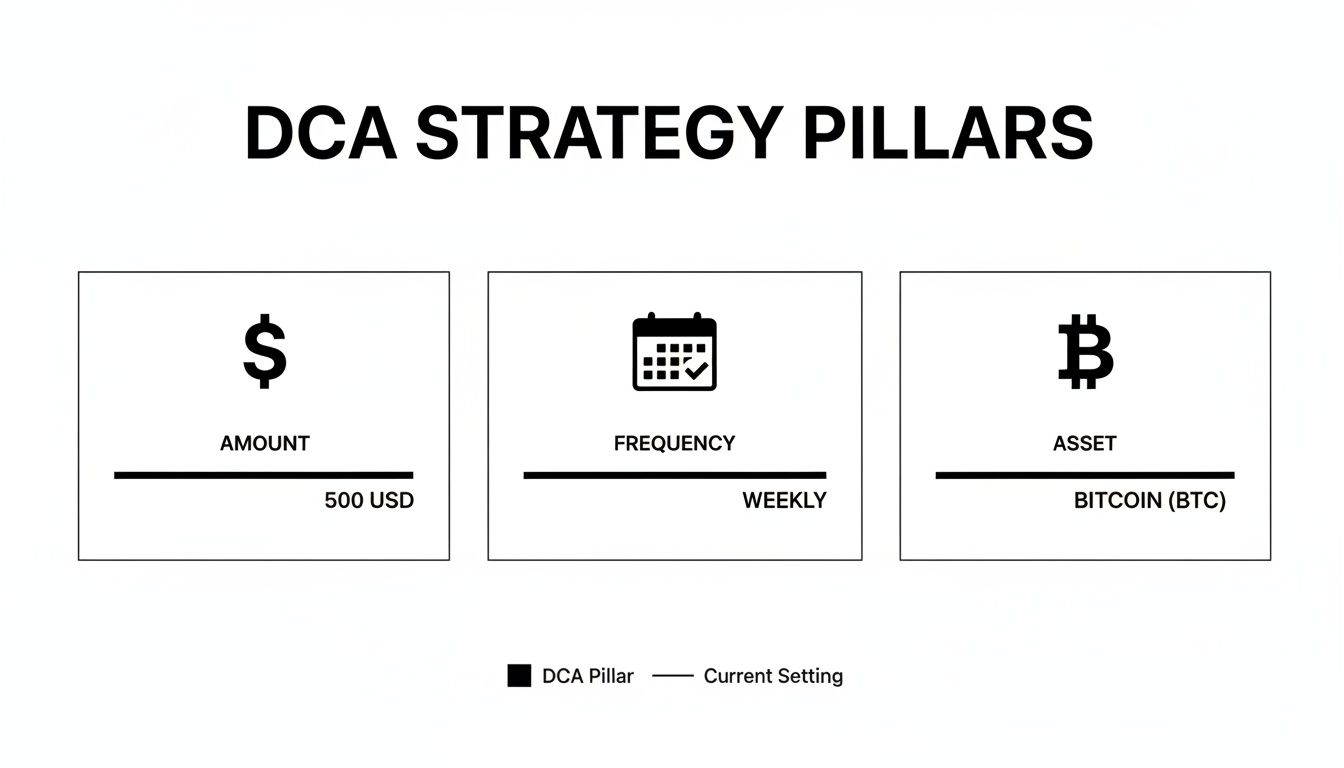
This visual breaks the strategy down to its core components. It’s this structured, repeatable process that removes emotion and guesswork from the equation.
A powerful historical example unfolded after the 2017 bull run. Bitcoin crashed from $20,000 to below $3,200—a brutal 84% drop. Someone using DCA to buy $100 of BTC monthly for the 10 months starting in January 2018 would have ended up with an average cost of about $6,500 per coin, securing over 0.15 BTC.
Fast forward to a hypothetical December 2024, with BTC trading above $95,000. That position would be worth over $14,000, a 1,300% return that crushed what a lump-sum investor would have seen buying at the start of 2018. If you want to dive deeper, Fidelity has a great analysis of how DCA performs in volatile markets.
Okay, let's get into the numbers. The table below tracks our hypothetical six-month scenario. It shows the Bitcoin price each month, how much BTC each $100 purchase gets you, and how the average cost per coin changes for the DCA investor versus our lump-sum friend.
See what happened there? By the end of six months, the DCA investor has a lower average cost per coin ($45,907 vs. $50,000) and has accumulated more Bitcoin overall (0.01307 vs. 0.01200 with the same capital).
Key Insight: Notice how the DCA investor automatically bought more Bitcoin during the price dips in months 3 and 4. This is the superpower of DCA—it forces you to buy more when prices are low, which systematically drags down your average entry price and provides a cushion against volatility that the lump-sum investor completely misses out on.
The real power of DCA isn't in some complex algorithm; it’s in its simplicity and its ability to build sustainable, long-term investing habits. It shifts your focus from chasing short-term pumps to patiently building a solid position over time.

Let's break down the core advantages that make this approach so effective.
Our psychology is often our worst enemy as an investor. The fear of missing out (FOMO) makes you want to buy at market peaks, and panic causes you to sell at the bottom. A DCA strategy acts as a circuit breaker for these gut reactions. By automating your buys, you stick to a logical plan, no matter how chaotic the market feels. Your decisions are driven by discipline, not drama.
Trying to perfectly time the crypto market is a losing game. It's stressful, and more often than not, it's a complete waste of time. DCA takes this impossible burden right off your shoulders.
You don't need a crystal ball to win with DCA. The strategy is built to embrace volatility and use it to your advantage, ensuring you are always accumulating without the pressure of guessing the market's next move.
This approach is pragmatic. It accepts that you'll probably never buy the absolute bottom, but it also protects you from going all-in right at the top.
One of the biggest myths in investing is that you need a huge pile of cash to get started. DCA completely shatters that idea. You can begin with an amount that fits your budget, whether that's $20 a week or $200 a month. This accessibility throws the doors wide open for anyone to start building a portfolio without taking on scary financial risk.
Success in crypto, like any market, is a marathon, not a sprint. When you commit to a regular buying schedule, you build the powerful habit of consistency, which is the secret sauce for long-term wealth creation. This steady, "set-it-and-forget-it" method keeps you in the game and focused on your big-picture goals, stopping you from making impulsive, short-sighted moves.
While dollar-cost averaging is a fantastic strategy for building discipline and taking emotion out of investing, it's not a magic wand. It won't guarantee the highest possible profits in every market scenario. To use DCA effectively, you have to understand its trade-offs.
The biggest drawback of DCA becomes clear during a strong, sustained bull market. If a coin is on a steady upward trajectory, a single lump-sum investment at the start will almost always outperform a DCA strategy. With DCA, each purchase is made at a slightly higher price, raising your average cost. The lump-sum investor, meanwhile, locked in their entire position at the lowest price before the rally.
Key Takeaway: DCA is built to protect you from gut-wrenching drops. In a market that only seems to go up, this protective feature becomes a drag on your potential returns compared to going all-in from day one.
Transaction fees can be a silent portfolio killer. When you're making frequent small buys, those fees can add up and eat into your capital. To mitigate this:
Opportunity cost is the potential gain you miss out on by not putting all your capital to work at once. If the market blasts off, the cash you were holding for future DCA purchases effectively missed the boat. This is the fundamental trade-off:
Knowing this helps you pick the right strategy for your market outlook.
Alright, enough theory. Let's put a real, automated crypto DCA plan into action. Here’s a blueprint to get your own "set-it-and-forget-it" strategy running today.

This automation is the secret sauce. It takes emotion out of the equation and forces discipline by doing it for you.
Let's tackle some of the most common questions people ask when they begin dollar-cost averaging in crypto.
Not always, but it's usually safer. In a market that only ever goes up, a lump-sum investment at the start would make more money. But crypto is volatile. DCA is a risk management strategy. Its real job is to protect you from the disaster scenario of investing all your cash right at a market peak.
This usually boils down to balancing a better average price against transaction fees.
For most people, a weekly or bi-weekly schedule hits the sweet spot. It does a great job of reducing volatility's impact without racking up excessive fees. A crypto average calculator can be very insightful for running your own numbers.
Absolutely. The principle works just as well for volatile assets like altcoins—in fact, it's arguably even more powerful for them. DCA allows you to gain exposure to assets with massive growth potential while dramatically reducing the risk of buying into a temporary, hype-fueled price spike. Just ensure the altcoins you pick fit your portfolio goals.
Your exit plan should be tied to your personal goals, not daily market movements. Stopping your plan because prices feel too high or too low is an emotional decision that undermines the strategy.
Key Principle: A good DCA plan needs a clear finish line. Maybe you stop once your portfolio hits a certain value, or when you need the money for a major life event like a down payment. Tying your exit to a personal goal is how you keep emotion from wrecking your long-term plan.
Ready to stop guessing and start learning from the best? Wallet Finder.ai gives you the on-chain intelligence to discover top-performing wallets and mirror their strategies in real time. Start your 7-day trial and find your edge today!