Chainlink Staking Rewards: A Trader's Guide for 2026
Explore our guide on Chainlink staking rewards. Learn how they work, the real APR to expect, risks like slashing, and how to monitor staking activity on-chain.

June 6, 2026
Wallet Finder


Those asking what is smart money think they're asking for a definition. They're usually asking for something else: who moved early, how can I see it, and what can I do before the crowd notices.
That gap matters more in crypto than anywhere else. In traditional markets, smart money is often discussed like an invisible class of better-informed participants. In on-chain markets, you can often inspect wallets, flows, timing, and behavior directly. That doesn't make tracking alpha easy. It makes it possible.
In traditional finance, smart money usually means capital controlled by institutions and other professional market participants. The idea isn't just market slang. Academic finance has treated smart money as something measurable.
A widely cited study of U.S. stocks found that stocks with the greatest increase in institutional ownership outperformed those with the greatest decline by an average of 8.1% per quarter during the 1980 to 1994 sample, which gave the concept a concrete historical basis rather than a vague reputation claim (academic paper on smart money and institutional ownership).
That matters because the original meaning of smart money is about observable positioning. It's not “these people are rich, so copy them.” It's “these participants appear to have an information edge, and their accumulation has historically aligned with stronger outcomes.”
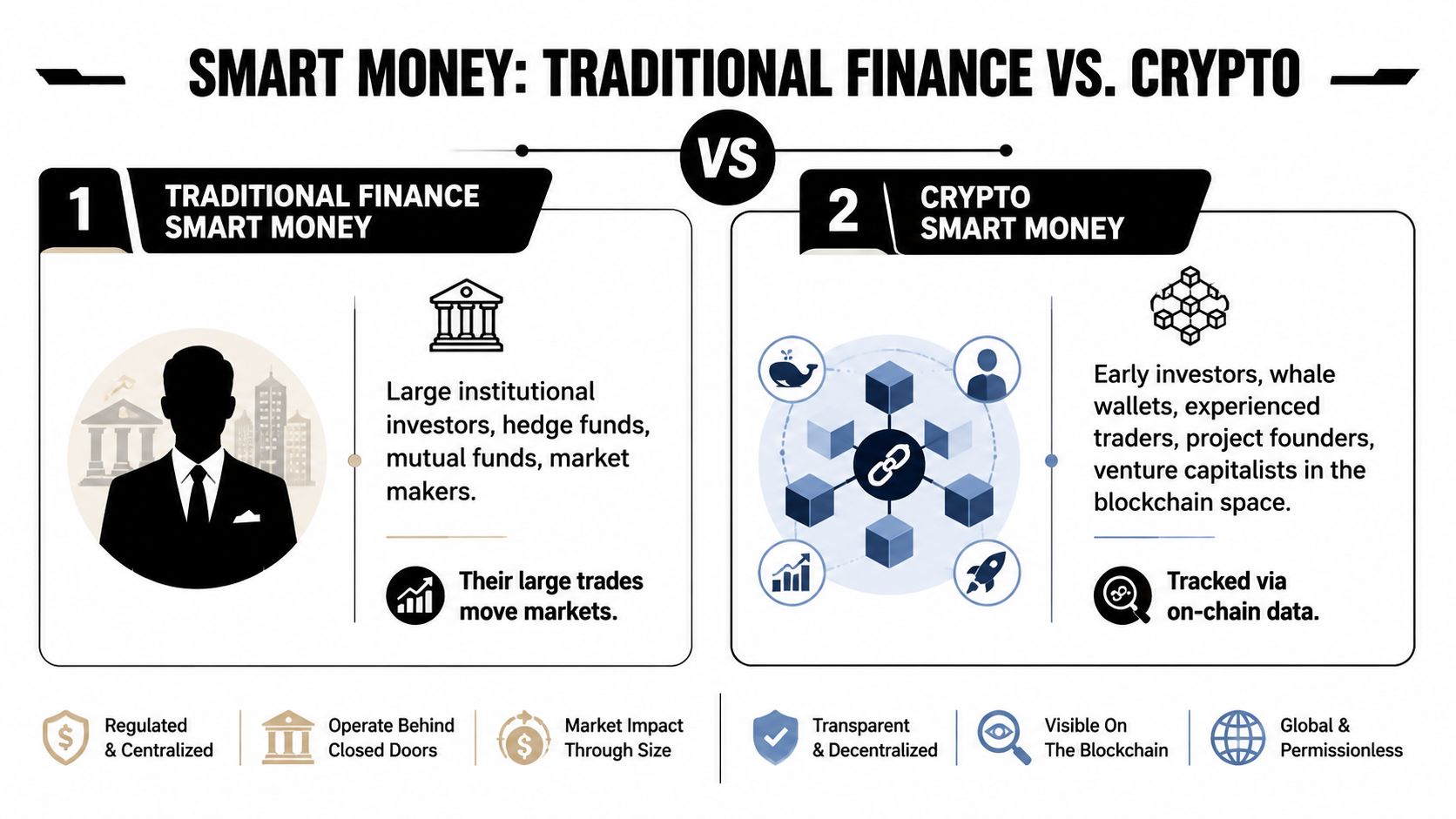
In crypto, the phrase gets used in a more practical way. Traders often mean:
That's different from the broad TradFi definition. In crypto, smart money is less about category and more about traceable behavior.
A hedge fund can be smart money in one market and late money in another. A random-looking wallet can be smart money if its history shows disciplined entries, strong exits, and informed positioning around catalysts.
Public blockchains change the game. Instead of guessing what institutions might be doing through delayed filings or market commentary, you can often inspect wallet histories in real time. You can see who bought before a narrative expanded, who rotated out before liquidity dried up, and who keeps showing up in the right places.
Smart money in crypto isn't a status label. It's a behavior pattern you can test.
That's why the crypto version is more actionable for independent traders. You're not trying to decode a quarterly filing. You're building a list of wallets, checking how they behave, and deciding whether their actions deserve your attention.
If you want the market-structure side of the idea, a trader's guide to the smart money index is useful context. But on-chain trading pushes the concept further. It turns smart money from a theory into a workflow.
Most traders start with the wrong signal. They look for a single huge buy and call it smart money. That's incomplete. A large transfer can be conviction, treasury management, exchange routing, internal wallet shuffling, or noise.
Useful tracking comes from clusters of behavior.
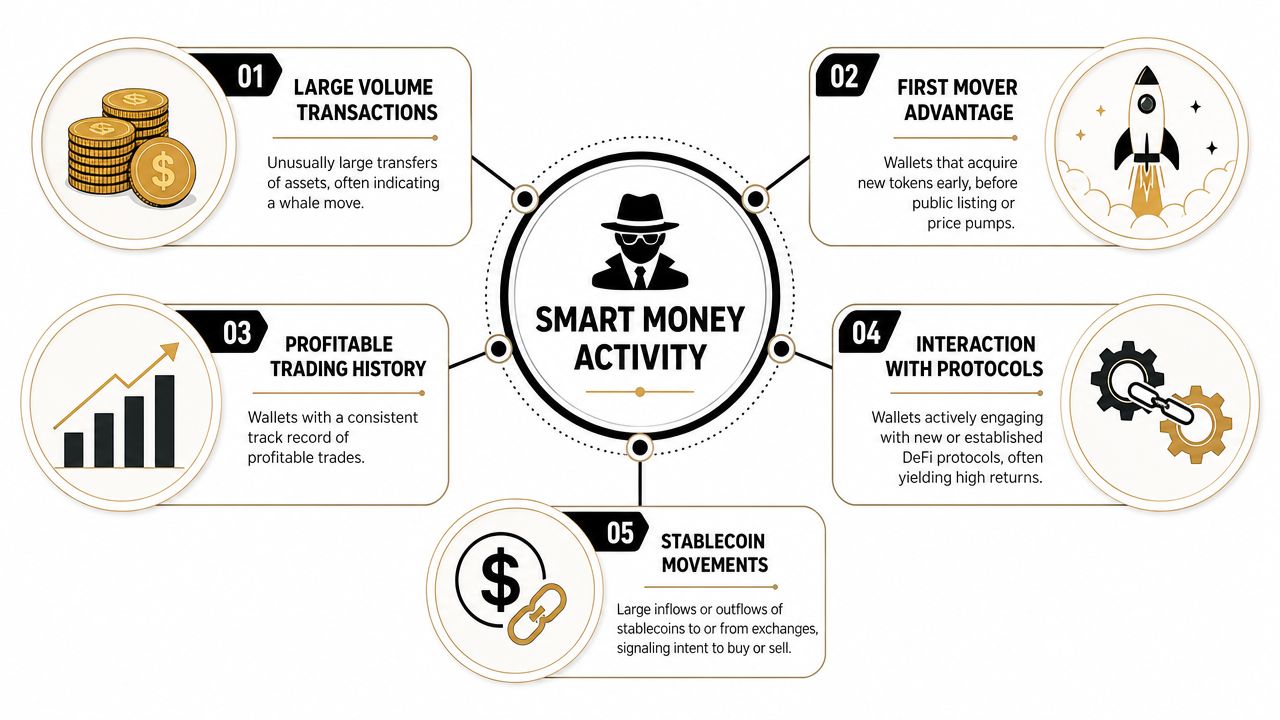
The strongest wallets tend to leave a mix of signals:
| Signal Type | Description | Potential Indication |
|---|---|---|
| Accumulation before attention | A wallet builds a position before broader social or exchange attention arrives | Early conviction or better information flow |
| Fast reaction to new protocols | A wallet interacts with a new protocol early and sizes intelligently | Strong research habits or insider-level ecosystem awareness |
| Repeated profitable rotations | A wallet shows a history of entering and exiting narratives well | Process, discipline, and timing edge |
| Stablecoin deployment | A wallet moves stablecoins into action before buying risk assets | Intent to enter positions rather than idle capital movement |
| Cross-wallet connections | A wallet repeatedly overlaps with other strong wallets in the same assets | Coordinated discovery or shared research networks |
| Sophisticated DeFi use | A wallet uses staking, LPs, bridges, perps, and spot together rather than in isolation | More advanced capital management |
No single row confirms anything on its own. The edge comes from stacking evidence.
On-chain data is strongest when it lines up with market structure. In Smart Money Concept trading, practitioners watch order blocks, fair value gaps, and other imbalances created when large orders move price quickly. Those zones are often revisited, which is why traders use them for entries and confirmation rather than chasing the initial move (SMC explanation covering order blocks and fair value gaps).
That gives you a practical framework:
A wallet buying aggressively into a token is interesting. A wallet buying aggressively while price displaces from a key zone and later pulls back into imbalance is much more useful.
The strongest process usually includes:
For traders focused on exchange behavior, bridge activity, and treasury deployment, crypto inflow and outflow analysis helps add context to wallet moves. It's often the difference between seeing a transfer and understanding what that transfer likely means.
Practical rule: Treat any wallet signal as a lead, not a command.
Manual wallet research still teaches the fastest. Even if you later automate most of it, doing the work yourself helps you stop mistaking noise for signal.
Pick a token that recently attracted real attention. Not because it already pumped, but because the move created something you can inspect: who was there early, who added on confirmation, and who exited into strength.
Open a block explorer like Etherscan or Solscan and work backward:
In trading usage, smart money is often inferred when price shows high-volume displacement at liquidity-rich levels such as swing highs, swing lows, and clustered support or resistance. The logic is simple: large participants need counterparties, so they tend to execute where pending orders are concentrated. Traders treat the resulting volume spike and break of structure as evidence of larger-player involvement (overview of high-volume displacement and liquidity-rich levels).
That matters on-chain because not every profitable wallet buys in the same way. Some scale into quiet periods. Others hit moments where liquidity is available and force repricing.
A good candidate wallet usually shows several of these traits:
If a wallet wins big once, that's interesting. If it trades well across unrelated conditions, that's useful.
Say a token breaks out after weeks of chop. Instead of buying the candle, inspect earlier transactions. You may find a cluster of wallets that accumulated during low attention, then added when the structure changed.
From there, compare those wallets:
Many traders go wrong. They anchor on the largest wallet or the wallet with the flashiest single trade. In practice, the better target is often the wallet with the most repeatable process.
Manual research gets cleaner when you eliminate the usual traps:
The point isn't to find “the smartest wallet.” It's to build a shortlist of wallets whose actions regularly matter.
How do you track smart money without spending half your day buried in explorers?
Manual wallet work is still useful. It teaches pattern recognition, helps you spot false positives, and forces you to verify what a wallet is doing. But once you cover multiple chains and rotate across sectors, manual work turns into a collection problem. The edge comes from judging behavior quickly, not from opening 30 tabs.

A wallet tracker helps by turning raw public activity into something you can sort, compare, and revisit. That matters because "smart money" means one thing in traditional finance and something tighter on-chain. In tradfi, the term usually points to informed capital with better information or better positioning. On-chain, the practical question is narrower. Which wallets enter early, size well, and repeat that behavior often enough to matter?
That is the job Wallet Finder.ai's wallet tracking platform is trying to solve.
Start with discovery. Filter by the chains and ecosystems you trade. If you only trade Solana memes and Base ecosystem plays, a huge Ethereum-only wallet list adds noise, not edge.
Then review wallet history with a trader's eye:
This is the same shift analysts made in public equities years ago. The useful signal is rarely "who has the most capital?" It is "who keeps positioning correctly before broader attention shows up?"
A quick product walkthrough helps if you want to see that process visually:
Finding wallets is the easy part. The actual value comes from what you track after they hit your list.
Focus on changes in behavior:
I treat this like building a small network of scouts. One scout can be wrong. A group of scouts spotting the same thing in different places is harder to ignore.
Good tooling speeds up the boring part so you can spend more time on the trade decision itself. The goal is not to copy every move. The goal is to catch useful behavior early enough to ask the right questions before the market fully prices it in.
Copy trading fails when traders confuse visibility with certainty. Seeing a wallet buy doesn't mean you understand the thesis, time horizon, hedge, or exit plan behind that trade.
That's why mirror trading needs rules.

Use wallet activity as a filter, then make your own decision.
A workable checklist looks like this:
Three mistakes show up over and over:
Public wallets give you evidence, not permission.
Instead of copying every trade, try this approach:
That last point matters. Some wallets are worth following for entries. Others are better for spotting sectors. A few are useful only as sentiment tells. Smart money isn't one monolithic thing, and your process shouldn't treat it that way.
Tracking public blockchain activity is generally treated as analyzing public data. The wallet is visible on-chain. The more important question isn't legality alone. It's whether you understand what you're looking at before acting on it.
A whale is usually defined by size. Smart money is defined by quality of behavior. A large wallet can be clumsy. A smaller wallet can be consistently early and disciplined.
No fixed amount is required to learn from wallet behavior. What matters more is execution quality, fees, slippage awareness, and position sizing discipline. Smaller traders often benefit most from using wallet activity as a research shortcut rather than trying to mirror every move exactly.
Yes. Strong wallets still take losses. The difference is usually in process, not perfection. They cut, rotate, and adapt.
Because many articles answering what is smart money still give generic finance definitions when traders want a crypto-specific, on-chain explanation of how to identify and act on wallet movements in DeFi, which is a real content gap noted in commentary on search intent around the topic (discussion of the gap between generic definitions and crypto-specific smart money content).
If you want to turn smart money theory into a repeatable workflow, Wallet Finder.ai gives you a practical way to discover wallets, review trading histories, build watchlists, and monitor public on-chain activity without doing every step by hand in block explorers.