Top Yield Farming Platforms to Maximize Gains
Discover the 12 best yield farming platforms of 2026. In-depth analysis of Yearn, Beefy, Pendle & more to help you find top APYs and manage risk.

January 11, 2026
Wallet Finder

January 11, 2026

Yield farming offers a powerful way to generate returns on your crypto assets, but navigating the decentralized finance (DeFi) ecosystem is a complex challenge. With hundreds of protocols launching across dozens of blockchains like Ethereum, Solana, and Base, identifying legitimate, high-performing opportunities while managing inherent risks is a full-time job. The core problem is clear: information overload and a lack of transparent, aggregated data makes it difficult to distinguish signal from noise. How do you find the best yield farming platforms without spending countless hours on research?
This guide is your solution. We provide a comprehensive, actionable breakdown of the top 12 platforms where serious farmers deploy capital. We'll move beyond surface-level descriptions to offer a detailed analysis of each platform's core mechanics, fee structures, security audits, and unique strategic advantages. You will learn not just what each platform does, but how to use it effectively.
Inside this resource, you will find:
Whether you're an experienced trader looking to optimize complex strategies or a newcomer aiming to put your assets to work safely, this curated list will equip you with the essential information needed to make informed decisions and find your edge in the competitive world of yield farming. Let's explore the protocols shaping the future of DeFi returns.
Yearn Finance is one of the most established and trusted yield farming platforms in DeFi, pioneering the concept of automated yield aggregation. It simplifies the often complex process of yield farming by pooling user deposits into "yVaults." These vaults automatically execute sophisticated strategies across the DeFi ecosystem, interacting with protocols like Curve and Balancer to maximize returns through lending, liquidity provision, and reward compounding. This "set-and-forget" model makes it an excellent choice for both beginners and seasoned investors looking to optimize their stablecoin and blue-chip crypto holdings without constant manual management.
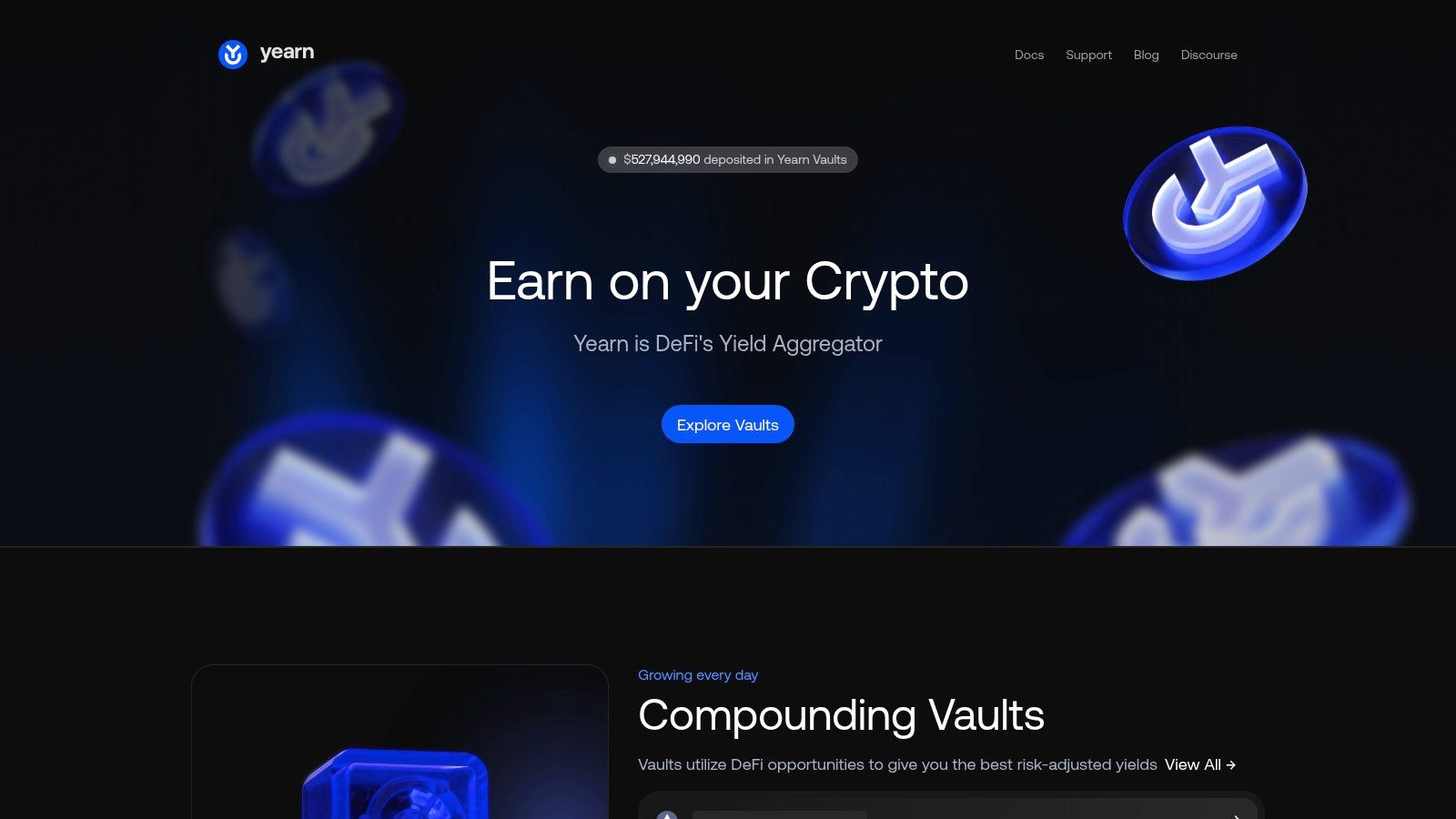
What sets Yearn apart is its relentless focus on optimizing net returns for users. The platform's user interface is transparent, clearly displaying the net APY after all fees are deducted, which helps users make informed decisions. Its introduction of v3 vaults and the permissionless Vault Factory empowers developers to deploy new, capital-efficient strategies, fostering continuous innovation. This architecture ensures that Yearn remains a dynamic and competitive force among yield farming platforms. To effectively track the performance of these complex strategies and compare them with others, using specialized yield farming monitoring tools is highly recommended.
Pros:
Cons:
Beefy Finance is a leading multi-chain yield optimizer that simplifies the process of earning compound interest on crypto assets. It operates on the principle of auto-compounding, where it automatically harvests rewards from liquidity pools and staking opportunities and reinvests them back into the original position. This frequent compounding maximizes returns over time, saving users from manually performing these transactions and incurring significant gas fees. With a vast array of vaults spanning dozens of blockchains, Beefy provides one of the most extensive selections of strategies among all yield farming platforms.

What distinguishes Beefy is its commitment to transparency and user experience. The platform clearly displays APYs with all performance fees already factored in, ensuring the rate you see is the rate you get. Each vault includes a detailed Safety Score, breaking down risks associated with the underlying assets and smart contracts, which empowers users to make more informed investment decisions. Furthermore, Beefy frequently partners with other protocols to offer "boosted" vaults, which provide additional token rewards on top of the standard compounded yield for a limited time, creating unique, high-return opportunities for its users.
Pros:
Cons:
Pendle Finance introduces a novel approach to yield farming by tokenizing future yield. The platform splits yield-bearing assets, such as staked ETH or stablecoins, into two distinct components: a Principal Token (PT) and a Yield Token (YT). This separation allows users to trade future yield on an open market, creating unique opportunities to fix yields, speculate on APY fluctuations, or provide liquidity for trading fees. This innovative model has made Pendle a go-to platform for advanced strategies involving Liquid Staking Derivatives (LSDs) and emerging points programs.

What truly distinguishes Pendle is its ability to create time-sensitive, fixed-yield markets. Users can purchase PTs at a discount to their underlying asset's value, effectively locking in a fixed return upon maturity, a strategy similar to a zero-coupon bond. Alternatively, they can buy YTs to gain leveraged exposure to an asset's future yield. This functionality transforms abstract future earnings into a tradable asset, providing sophisticated tools for hedging and speculation that are not commonly found on other yield farming platforms. Its expansion across multiple L2s like Arbitrum and Base has made these strategies highly accessible.
Pros:
Cons:
Convex Finance is a yield-boosting protocol built on top of Curve Finance and Frax Finance, designed to maximize rewards for liquidity providers and CRV/FXS token stakers. It operates by aggregating user deposits of CRV and FXS tokens into its platform, locking them to gain significant voting power (veCRV/veFXS). This collective power is then used to boost the APYs on Curve and Frax liquidity pools, allowing individual users to earn enhanced yields without having to lock up their own tokens for long periods. This innovative model has cemented Convex as a cornerstone of the DeFi yield ecosystem.

What makes Convex one of the most essential yield farming platforms is its symbiotic relationship with the Curve ecosystem. By depositing Curve LP tokens into Convex, users receive boosted CRV rewards and additional CVX tokens as incentives, effectively layering rewards. The platform's interface is straightforward, allowing users to stake their LP tokens with a single click to start earning boosted yields. This simplification of a complex boosting mechanic, combined with its deep integration into bribe markets, makes it a go-to platform for serious farmers looking to optimize returns within the stablecoin-focused Curve ecosystem.
Pros:
Cons:
Curve Finance is a cornerstone of the DeFi ecosystem, renowned for its automated market maker (AMM) protocol designed for extremely efficient, low-slippage swaps between pegged assets. It specializes in stablecoins (like DAI, USDC, and USDT) and liquid staking derivatives (like stETH and wstETH), making it an essential hub for traders seeking to exchange these assets with minimal price impact. For yield farmers, Curve offers the opportunity to provide liquidity to these deep pools and earn a combination of trading fees and token rewards, establishing it as one of the most fundamental yield farming platforms.
What truly sets Curve apart is its powerful gauge system, which directs CRV token emissions to specific liquidity pools. Liquidity providers can stake their LP tokens in these gauges to earn these CRV rewards, which can then be vote-escrowed (veCRV) to boost rewards and participate in governance. This flywheel mechanism has created the "Curve Wars," where other protocols compete to accumulate CRV to direct liquidity incentives to their own pools. Understanding the dynamics of these crypto liquidity pools is crucial for maximizing returns on the platform. This makes Curve not just a place to swap assets but a foundational layer for countless DeFi strategies.
Pros:
Cons:
Balancer elevates the concept of an automated market maker (AMM) by functioning as a programmable liquidity protocol. Instead of simple two-token pools, Balancer enables multi-asset, weighted, and fully customizable pools, making it a flexible foundation for sophisticated yield farming platforms. Its standout feature is the introduction of "Boosted Pools," which intelligently deploy a portion of idle liquidity into external yield-generating protocols like Aave. This capital-efficient design allows liquidity providers to earn both trading fees from Balancer and additional yield from integrated lending markets, creating multiple revenue streams from a single deposit.

What sets Balancer apart is its powerful incentive flywheel driven by the veBAL (vote-escrowed BAL) system. By locking BAL tokens, users can vote on which pools receive token emissions, directly influencing APYs and creating a vibrant ecosystem of partner protocols that offer "bribes" to attract liquidity. This governance layer adds a strategic dimension to yield farming, rewarding long-term participants who understand the protocol's mechanics. The composable nature of its pools also makes Balancer a crucial building block for other DeFi applications, cementing its role as a core piece of infrastructure.
Pros:
Cons:
Aura Finance is a protocol built on top of Balancer that maximizes yield for liquidity providers. It simplifies the process of earning boosted rewards by aggregating veBAL voting power from Balancer governance token holders. Users can deposit their Balancer Pool Tokens (BPTs) into Aura to receive boosted BAL emissions, platform-native AURA incentives, and a share of protocol swap fees without needing to lock up BAL tokens themselves. This mechanism makes it one of the most efficient yield farming platforms for those participating in the Balancer ecosystem.

What makes Aura stand out is its symbiotic relationship with Balancer and the creation of auraBAL. By locking BAL into veBAL through Aura, users receive auraBAL, a liquid-staked token that earns a portion of Balancer's protocol revenue and AURA rewards, providing yield without sacrificing liquidity entirely. This model creates a powerful flywheel effect: more deposits into Aura mean more veBAL power, leading to higher boosts for LPs, which in turn attracts more liquidity. The platformβs streamlined user interface makes it easy to stake, claim rewards, and participate in governance, abstracting away much of the underlying complexity.
Pros:
Cons:
PancakeSwap is a dominant force in the decentralized exchange (DEX) space, expanding from its BNB Chain origins to become a multi-chain automated market maker (AMM). It offers a straightforward entry into yield farming through its "Farms," where users can stake their liquidity provider (LP) tokens to earn CAKE token emissions on top of the trading fees their position generates. This dual-reward system makes it a popular choice for users seeking to maximize returns on a wide variety of token pairs, from major assets to newer, emerging tokens.

What sets PancakeSwap apart is its user-friendly interface that clearly breaks down the components of the annual percentage rate (APR), showing both the fee-based returns and the CAKE-based rewards. The platform integrates concentrated liquidity (V3) pools, allowing for greater capital efficiency, but this requires more active management to stay in range. To aid users, PancakeSwap provides helpful tools like ROI and impermanent loss calculators, making it one of the more transparent yield farming platforms for assessing potential risks and rewards before committing capital.
Pros:
Cons:
Uniswap is the largest decentralized exchange (DEX) by volume and a foundational pillar of DeFi, where liquidity providers (LPs) earn yield directly from trading fees. Its introduction of concentrated liquidity in v3 (and further optimized in v4) revolutionized capital efficiency. This model allows LPs to provide liquidity within specific price ranges, capturing a higher share of swap fees from active trading zones. This makes Uniswap a primary venue for earning fee-based yield, serving as a base layer for countless yield farming platforms and individual strategies.
What distinguishes Uniswap is its purely market-driven yield model. Unlike platforms that rely heavily on token emissions, returns on Uniswap are generated directly from the protocol's trading activity. This provides a more sustainable, albeit variable, source of income for LPs. The platform's flexible fee tiers (from 0.01% to 1%) allow providers to tailor their positions to the volatility of specific asset pairs. However, this model requires active management to keep liquidity in range and mitigate risk; using tools like an impermanent loss calculator is essential for effectively managing these positions.
Pros:
Cons:
Raydium is a cornerstone of the Solana DeFi ecosystem, functioning as an automated market maker (AMM) that provides liquidity to the Serum central limit order book. This unique integration allows Raydium's liquidity providers to benefit from the order flow and trading fees of the entire Serum ecosystem, creating a more capital-efficient environment. The platform offers a dual-liquidity model, featuring both traditional constant-product pools and modern concentrated liquidity market maker (CLMM) pools, which allow LPs to focus their capital within specific price ranges for potentially higher returns. This makes it one of the most versatile yield farming platforms on Solana for users of all experience levels.
What sets Raydium apart is its role as a launchpad and liquidity hub for new projects on Solana. Its "Farms" feature enables users to stake their LP tokens and earn additional token emissions on top of the trading fees they already collect, creating powerful, multi-layered yield opportunities. The platform also provides tools for projects to easily create their own incentive programs, fostering a vibrant and ever-expanding ecosystem. While Solanaβs network performance can occasionally impact the user experience, Raydiumβs combination of deep liquidity, fast settlement, and diverse farming options solidifies its position as a go-to platform.
Pros:
Cons:
GMX v2 offers a distinct approach to yield farming by allowing users to provide liquidity to a leading decentralized perpetual exchange. Instead of inflationary token rewards, liquidity providers (LPs) deposit assets into GM (GMX Markets) pools on Arbitrum and Avalanche, earning a substantial share of the protocol's real revenue. This income is generated from trading, liquidation, borrowing, and swap fees, with approximately 63% being distributed directly to LPs. The yield is accrued directly into the value of the LP token, creating a sustainable, non-emissions-based return stream tied directly to platform usage and trading volume.

What differentiates GMX v2 from many other yield farming platforms is that its LPs act as the direct counterparty to traders. This model, powered by Chainlink Data Streams for reliable pricing, introduces a unique risk-reward dynamic. While LPs earn consistent fees from trading activity, they are also exposed to the profit and loss (PnL) of traders on the platform. This means if traders are collectively profitable, the pool's value can decrease. This structure appeals to sophisticated users who want to earn real yield and are comfortable with managing the associated counterparty risk inherent in a decentralized derivatives market.
Pros:
Cons:
DeFiLlama Yields is not a platform for direct investment but rather an essential aggregator and discovery tool for anyone serious about yield farming. It functions as a comprehensive, data-rich dashboard that tracks thousands of liquidity pools and staking opportunities across hundreds of protocols and blockchains. Instead of offering its own vaults, it provides a neutral, bird's-eye view of the entire yield landscape, allowing users to find, compare, and analyze opportunities before deploying capital directly on the native protocols. This makes it an indispensable starting point for research.

What makes DeFiLlama Yields stand out among yield farming platforms is its powerful and granular filtering system. Users can sort opportunities by chain, specific tokens, APY, TVL, and even by characteristics like "single-sided staking" or "stablecoin pools." This level of detail empowers users to quickly identify pools that match their specific risk tolerance and asset preferences. Once an attractive opportunity is found, the platform provides a direct link to the official dApp, streamlining the transition from research to execution while ensuring users land on the correct, verified site.
Pros:
Cons:
Navigating the expansive universe of decentralized finance requires more than just knowing the names of the top yield farming platforms. As we've explored, protocols like Yearn, Beefy, Pendle, and Convex each offer a unique combination of risk, reward, and strategic complexity. Simply chasing the highest Annual Percentage Yield (APY) is a recipe for disaster; a sustainable approach demands a deep understanding of the underlying mechanics, from liquidity provision on Curve and Balancer to leveraged trading on GMX.
The true edge in this competitive landscape comes from moving beyond static analysis and embracing dynamic, on-chain intelligence. The most successful farmers don't just "set and forget" their capital. They are constantly monitoring market conditions, rotating between protocols, and reallocating assets to capitalize on emerging opportunities, whether on established chains like Ethereum or newer ecosystems like Base and Solana.
To distill our deep dive into actionable insights, remember these core principles. First, diversification is not just about assets, but about platforms and strategies. A balanced portfolio might combine the auto-compounding simplicity of Beefy with the sophisticated, time-based yield speculation of Pendle. Second, risk is multifaceted. It encompasses not only smart contract vulnerabilities but also impermanent loss, oracle manipulation, and underlying asset volatility. Platforms with extensive audits and long track records, like Curve and Uniswap, generally present lower technical risk, but market risk is ever-present.
Finally, the most critical takeaway is that alpha is generated by information asymmetry. The ability to see what successful, high-volume wallets are doing before their strategies become common knowledge is invaluable. This is where observation transforms into a repeatable, data-driven process.
To translate this knowledge into a profitable execution plan, you must bridge the gap between theory and real-time market activity. Here is a structured approach to help you select the right platforms and implement your strategy effectively.
Your first step is an honest self-assessment. Are you a long-term holder seeking passive, auto-compounded returns, or an active trader looking to capitalize on short-term yield fluctuations?
Once you've defined your focus, the next step is to identify and track the "smart money" operating within that niche. This is where you move from being a passive participant to an active hunter.
By systematically applying this framework, you transform a generic list of platforms into a personalized strategic map. You are no longer just a user of these protocols; you are an informed participant, leveraging on-chain data to make decisions with confidence and precision, ensuring you're always one step ahead.
Ready to stop guessing and start tracking the strategies of top-performing wallets? Wallet Finder.ai gives you the power to discover, monitor, and receive real-time alerts on the most profitable farmers across all major yield farming platforms. Build your "smart money" watchlist today and turn on-chain data into your ultimate trading advantage by visiting Wallet Finder.ai.