Best Yield Farming Platforms in 2026

Wallet Finder

Blank calendar icon with grid of squares representing days.

February 25, 2026

Yield farming remains a cornerstone of Decentralized Finance (DeFi), offering a powerful way to generate passive income on crypto assets. The ecosystem is constantly shifting, with new protocols, strategies, and risks emerging across major chains like Ethereum, Solana, and Base. Simply chasing the highest Annual Percentage Yield (APY) is no longer enough. A successful strategy requires a clear understanding of the mechanics, from impermanent loss and smart contract risk to the importance of a platform's Total Value Locked (TVL).

This guide cuts through the noise to provide an actionable roundup of the best yield farming opportunities available today. We move beyond basic advice to give you a detailed breakdown of top-tier platforms, proven strategies, and crucial risk assessments. Each entry includes screenshots and direct links to help you get started immediately.

Our goal is to equip you with the knowledge to make informed decisions. We will dissect leading protocols like Aave, Yearn Finance, and Pendle, comparing their offerings and ideal use cases. More importantly, we will show you how to find and mirror the moves of the most profitable farmers in real-time. By learning to use tools like Wallet Finder.ai, you can turn transparent on-chain data into your competitive advantage, transforming your approach from guesswork to a data-driven strategy. This article is your direct path to finding the best yield farming platforms and putting your capital to work more effectively.

1. Aave

Aave stands as a cornerstone of decentralized finance, offering one of the most established and secure platforms for lending and borrowing. Rather than chasing fleeting, high-risk opportunities, Aave provides a foundational layer for earning a reliable, variable yield. Users supply assets like ETH, WBTC, or stablecoins to the protocol and earn interest paid by borrowers, making it an essential venue for more conservative yield farming strategies.
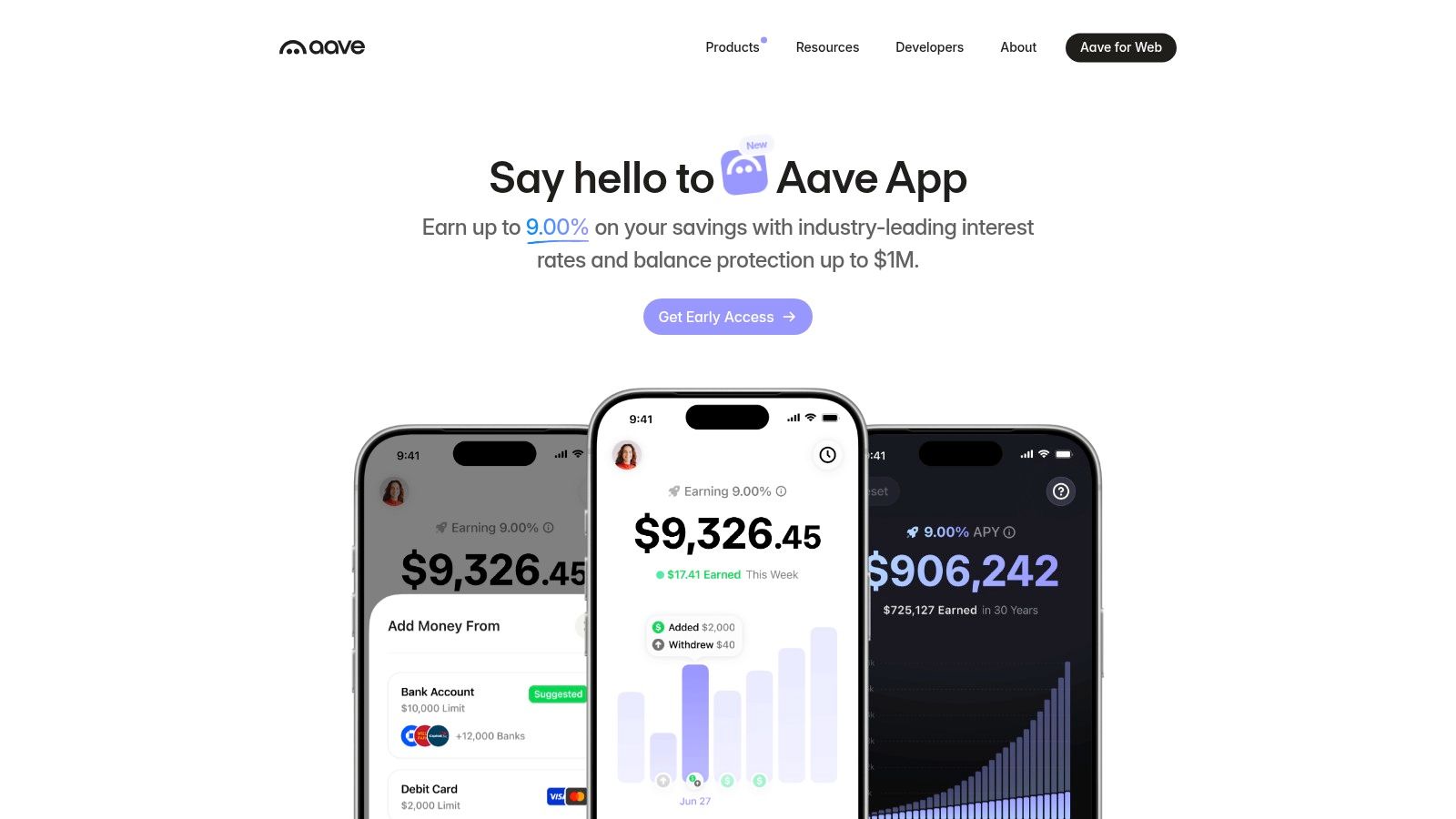
Aave

The platform’s V3 multi-chain markets are deployed across major networks like Ethereum, Arbitrum, Optimism, and Polygon, giving users flexibility. Aave’s strength lies in its transparent and battle-tested risk management. It provides granular controls, such as supply caps, borrow caps, and isolation modes, which help mitigate systemic risk. This focus on security and deep liquidity makes it a trusted choice for both individual farmers and institutional players. For those new to the space, understanding how these core lending protocols function is a critical first step; you can explore a deeper guide on DeFi yield farming to build that foundational knowledge.

Key Features and Yield Opportunities

Aave is more than just a simple lending market. Its ecosystem offers several distinct avenues for generating yield:

  • Lending Yield: The primary method is supplying assets to earn a base APY from borrowing demand. This yield fluctuates based on the utilization rate of each asset pool.
  • GHO Stablecoin: Users can mint Aave’s native, over-collateralized stablecoin, GHO, against their supplied collateral. This can be used in other DeFi protocols. Furthermore, by staking GHO, users can earn a yield through the sGHO (Staked GHO) mechanism.
  • Horizon RWA Market: Aave has expanded into Real World Assets (RWAs), allowing users to gain exposure to yields from off-chain assets like tokenized U.S. Treasuries, bridging traditional finance with DeFi.
  • Safety Module: For those with a higher risk tolerance, staking AAVE tokens in the Safety Module offers rewards in exchange for acting as a backstop against potential protocol shortfalls.
FeatureDescriptionBest For
Multi-Chain V3Markets on Ethereum, Arbitrum, Polygon, and more with high efficiency mode.Users seeking low transaction fees and flexibility.
GHO StablecoinMint a native stablecoin against supplied collateral for use across DeFi.Advanced users creating complex strategies.
RWA MarketsEarn yield from tokenized, off-chain assets like government bonds.Portfolios seeking diversification from crypto volatility.

Pros and Cons

Pros:

  • Blue-Chip Reputation: Years of operation with billions in TVL make it one of the most trusted names in DeFi.
  • Deep Liquidity: High liquidity across major assets ensures minimal slippage and reliable access to funds.
  • Transparent Risk: All risk parameters and collateral factors are public and governed by the Aave DAO.

Cons:

  • Lower Base Yields: Compared to newer, incentive-driven protocols, base APYs on major assets can be modest.
  • Liquidation Risk: Leveraged strategies (supplying and borrowing) introduce the risk of liquidation if your collateral value drops.

Visit the website: https://aave.com

2. Yearn Finance

Yearn Finance is a pioneering decentralized asset management protocol that automates yield farming. It acts as a yield aggregator, taking user deposits and routing them into the most efficient strategies across DeFi to maximize returns. Yearn's core offering, Vaults, simplifies the complex process of finding, executing, and compounding yield from protocols like Curve, Convex, and Morpho, making it a go-to platform for passive, set-and-forget strategies.
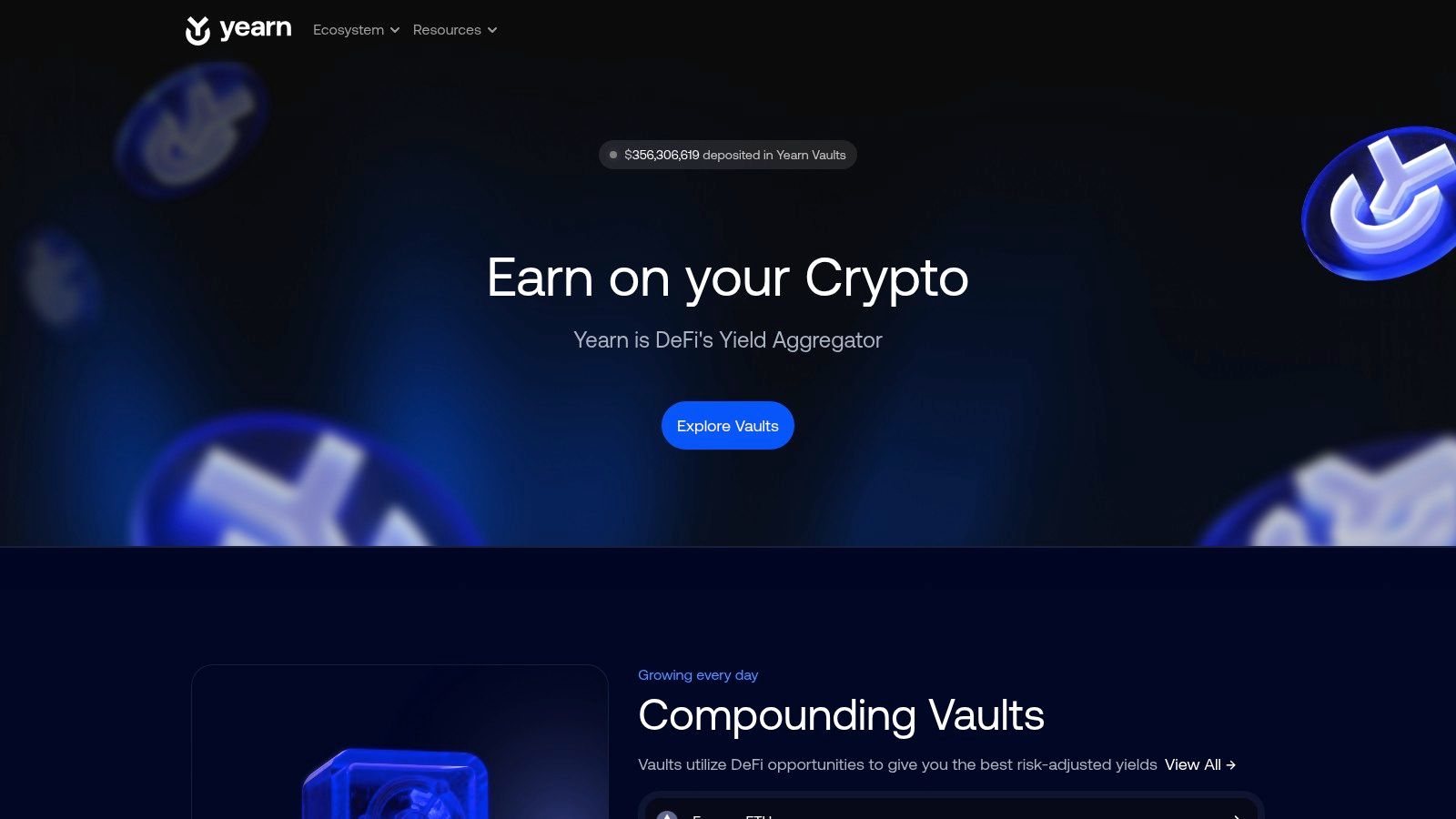
Yearn Finance

The protocol's V3 architecture introduces a higher degree of flexibility and transparency, built on the ERC-4626 tokenized vault standard. This standardization makes Yearn Vaults highly composable, allowing them to be easily integrated into other DeFi applications. For users, this means access to sophisticated, multi-step strategies without needing to manage them manually. While automation simplifies farming, some underlying strategies may involve liquidity pools, so it is wise to understand potential risks; you can use a tool like an impermanent loss calculator to model different scenarios.

Key Features and Yield Opportunities

Yearn's ecosystem is designed around automating and optimizing yield generation through its signature Vaults.

  • Strategy Vaults: The primary product where users deposit assets (like stablecoins, ETH, or WBTC) into vaults that execute specific, automated yield strategies. All returns are auto-compounded, saving users gas fees and time.
  • V3 Modular Design: The latest iteration allows for dynamic fees and strategy adjustments through a modular 'Accountant' system. This makes vaults more adaptable to changing market conditions.
  • ERC-4626 Standard: Full compliance with this standard enhances composability, meaning Yearn's yield-bearing tokens can be used as collateral or building blocks in other protocols.
  • Open-Source & Governed: All strategies and contracts are open-source and vetted. The protocol is managed by a decentralized governance structure, giving YFI token holders a say in its direction.
FeatureDescriptionBest For
Automated CompoundingVaults automatically reinvest earned yield back into the strategy.Passive investors seeking to maximize returns without manual effort.
V3 VaultsFlexible, efficient vaults built on the ERC-4626 standard.Users who value capital efficiency and composability.
Multi-StrategyRoutes capital through various protocols like Curve, Aave, and Morpho.Farmers looking for diversified yield sources managed under one roof.

Pros and Cons

Pros:

  • Simplifies Multi-Protocol Farming: "Set and forget" approach removes the need for constant monitoring and manual transactions.
  • Transparent Net Yields: APYs are displayed net of vault-level fees, giving a clear picture of expected returns.
  • Long Operating History: As one of DeFi's original yield aggregators, it has a proven track record and strong brand recognition.

Cons:

  • Variable Vault Fees: Fees differ between vaults and strategies; older V2 vaults had both management and performance fees.
  • Underlying Protocol Risk: While Yearn is secure, its strategies are exposed to the smart contract and economic risks of the protocols they interact with.

Visit the website: https://yearn.fi

3. Beefy

Beefy simplifies the often complex process of yield farming by automating it. As a multi-chain yield optimizer, its core function is to take deposits from users and auto-compound the rewards, maximizing returns over time. Instead of manually harvesting and reinvesting profits from liquidity pools, Beefy’s smart contracts handle this process efficiently, saving users significant time and gas fees. This "set and forget" approach makes it an excellent choice for both new and experienced farmers looking for some of the best yield farming opportunities without constant management.
Beefy

The platform’s expansive reach, covering dozens of blockchains from major players like Arbitrum and Base to smaller, emerging networks, gives users a single interface to manage positions across the entire DeFi ecosystem. Beefy’s vaults source their yield from underlying protocols, such as decentralized exchanges and lending markets. It standardizes the user experience, presenting APYs net of fees, which provides a transparent view of potential earnings. This combination of automation, broad chain support, and user-friendly design solidifies its position as a go-to tool for passive yield generation.

Key Features and Yield Opportunities

Beefy offers a focused yet powerful set of tools designed to streamline and amplify yield farming returns:

  • Auto-Compounding Vaults: This is the platform's primary offering. Users deposit single assets or LP tokens into a vault, and the protocol automatically sells reward tokens and reinvests them back into the principal position to generate compound interest.
  • "Zap" Tooling: To simplify entering complex liquidity positions, the Zap feature allows users to deposit a single asset (like ETH or a stablecoin) into an LP vault. The tool automatically handles the token swaps and liquidity provision in one transaction.
  • BIFI Token: The native BIFI token serves both governance and revenue-sharing functions. By staking BIFI in dedicated vaults, holders can earn a share of the platform's revenue, which is paid out in native gas tokens like ETH or BNB.
  • Transparent Yields: Beefy displays APYs with vault performance fees already deducted, offering a clear expectation of net returns. Many vaults also feature zero deposit or withdrawal fees, making entry and exit more capital-efficient.
FeatureDescriptionBest For
Multi-Chain OptimizerAuto-compounding vaults on over 40 blockchains through a unified UI.Farmers wanting to diversify assets across multiple ecosystems.
Zap In/OutEnter or exit LP positions with a single token in one transaction.Users who want to save time and gas on multi-step processes.
BIFI Revenue ShareStake BIFI to earn a share of platform fees paid in blue-chip assets.Long-term investors who believe in the platform's growth.

Pros and Cons

Pros:

  • Set-and-Forget Automation: Auto-compounding saves immense time and reduces the gas costs associated with manual harvesting.
  • Broad Ecosystem Support: Unmatched coverage of dozens of blockchains and hundreds of liquidity pools.
  • Transparent Fee Structure: Yields are shown net of fees, and the documentation clearly outlines the cost structure for each vault.

Cons:

  • Inherited Risk: Each vault’s security is dependent on the underlying protocol it farms. A hack on a partner DEX could affect a Beefy vault.
  • Impersonation Risk: The brand's popularity has led to phishing sites. Users must be diligent and only use official links.

Visit the website: https://beefy.com

4. Pendle Finance

Pendle Finance introduces a novel approach to yield farming by separating yield-bearing assets into their principal and yield components. This process, known as yield tokenization, allows users to trade future yield, fix interest rates, or provide liquidity with a high degree of control over the asset's maturity date. By splitting an asset like stETH into a Principal Token (PT) and a Yield Token (YT), Pendle creates a new market for rate trading, making it a powerful platform for advanced DeFi strategies.
Pendle Finance

The platform has established itself as a core infrastructure layer for Liquid Staking Tokens (LSTs), Liquid Restaking Tokens (LRTs), and even Real World Assets (RWAs). It operates on major networks including Ethereum, Arbitrum, and BNB Chain, attracting deep liquidity and a dedicated user base. For farmers looking beyond simple lending or liquidity provision, Pendle offers institutional-style strategies, such as going long on yield by buying YT when you expect rates to rise, or locking in a fixed rate by holding PT until maturity. This makes it one of the best yield farming venues for active traders.

Key Features and Yield Opportunities

Pendle's architecture unlocks several distinct ways to generate returns, each with a different risk and reward profile:

  • Fixed Yield: Users can purchase Principal Tokens (PT) at a discount to their face value. Holding PT until its expiry date guarantees a fixed return, similar to a zero-coupon bond, removing all volatility associated with fluctuating yields.
  • Long Yield: By purchasing Yield Tokens (YT), users gain exposure to all the future yield generated by the underlying asset until expiry. This is a leveraged bet on yields increasing over time, offering potentially high but variable returns.
  • Liquidity Provision: Users can supply liquidity to Pendle’s specialized AMM by pairing PT with its underlying asset (e.g., PT-stETH with stETH). LPs earn trading fees, PENDLE emissions, and often third-party incentives with minimized impermanent loss.
FeatureDescriptionBest For
Yield TokenizationSplits yield-bearing assets into PT (principal) and YT (yield) components.Users who want to fix, speculate on, or trade future yield.
Dedicated AMMA custom-built automated market maker designed for yield-bearing assets.Liquidity providers seeking returns from trading fees and incentives.
Tenor ControlAll PT and YT positions have fixed expiry dates for precise strategy timing.Farmers implementing time-based or maturity-matched strategies.

Pros and Cons

Pros:

  • Unique Yield Strategies: Offers powerful, otherwise unavailable tools to hedge, fix, or amplify yield exposure.
  • Granular Control: The use of expiries (tenors) allows for precise management of investment time horizons.
  • Deep Integrations: Strong support for the most popular LSTs and RWAs provides diverse yield sources.

Cons:

  • Increased Complexity: Understanding PT, YT, and the AMM mechanics requires more knowledge than standard DeFi protocols.
  • Active Management: Positions have expiry dates, requiring users to actively manage their assets to roll over or exit.
  • Basis Risk: Liquidity providers are exposed to risks related to fluctuating yield rates in addition to impermanent loss.

Visit the website: https://pendle.finance

5. Lido

Lido has become a foundational pillar of DeFi by popularizing liquid staking, primarily through its stETH (Staked Ether) token. It allows users to earn Ethereum network staking rewards without locking up their assets or running their own validator node. Instead of providing complex, multi-layered strategies, Lido offers a simple yet powerful base layer for yield. Users stake their ETH, receive stETH in return, and this liquid token can then be deployed across hundreds of other DeFi protocols to "stack" additional yields, making it a crucial component in many of the best yield farming strategies.
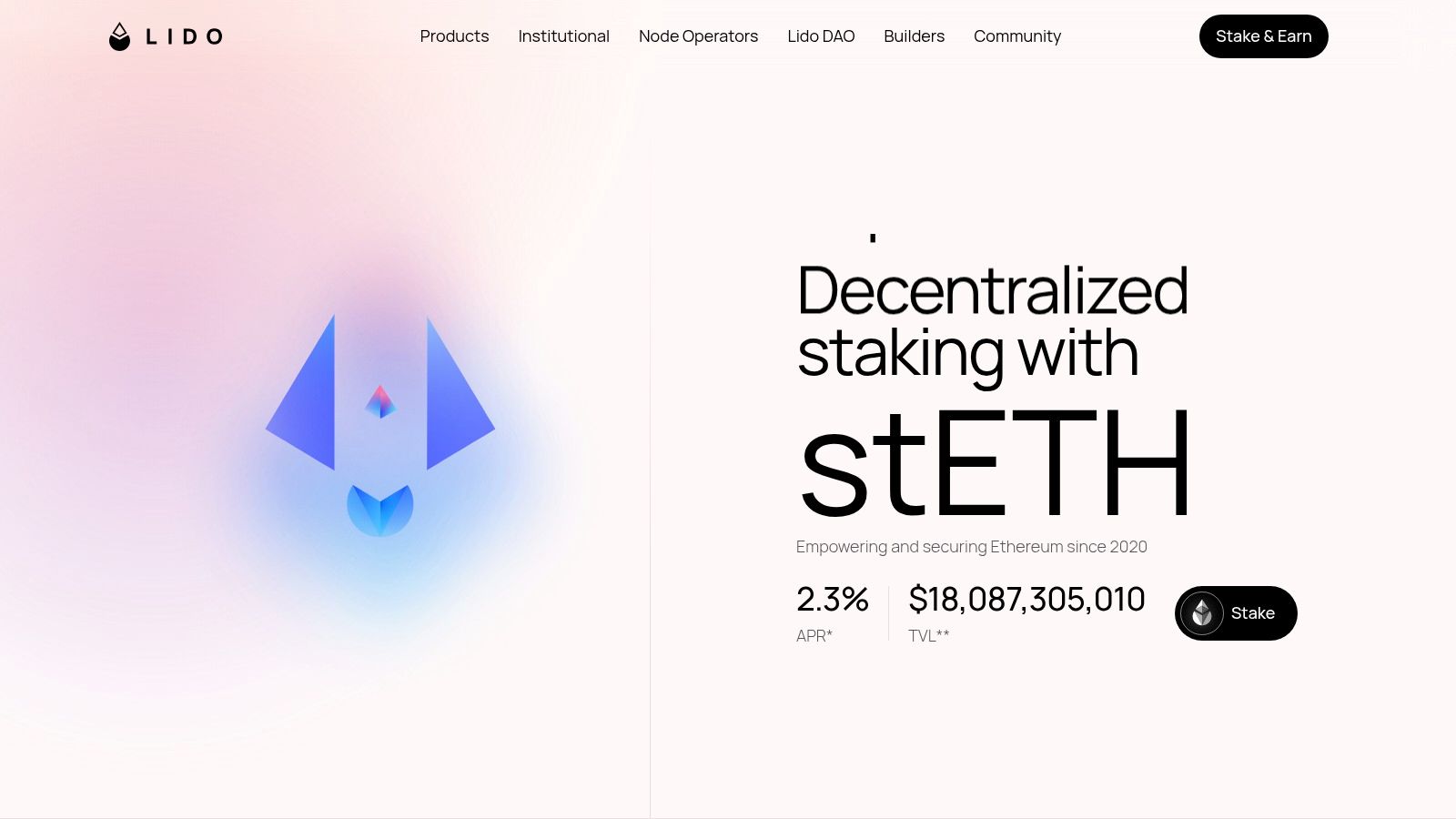
Lido

The platform's dominance stems from its non-custodial approach and the deep, network-wide liquidity of stETH. This token is integrated into lending markets like Aave, liquidity pools on Curve, and yield-trading platforms like Pendle, allowing for immense composability. Lido's commitment to security is evident through its transparent validator selection process and extensive smart contract audits. For those looking to understand the core differences between earning rewards this way and more active strategies, exploring the fundamentals of staking vs. yield farming is a great starting point.

Key Features and Yield Opportunities

Lido's core function is straightforward, but its impact on yield generation is expansive due to the utility of its liquid staking tokens (LSTs):

  • Ethereum Staking (stETH): The flagship offering allows users to stake any amount of ETH and earn a variable APR from network validation rewards. The resulting stETH token accrues these rewards automatically.
  • DeFi Composability: stETH is one of the most widely accepted collateral types in DeFi. It can be supplied to lending protocols to borrow other assets, used as liquidity in AMMs, or deployed in advanced vault strategies.
  • Multi-Chain Staking: Lido has expanded beyond Ethereum to offer liquid staking solutions for other networks like Polygon (stMATIC), giving users similar flexibility on different chains.
  • Transparent Operations: The Lido website provides real-time reporting on the current staking APR, total assets staked (TVL), and the distributed set of professional node operators securing the network.
FeatureDescriptionBest For
Liquid Staking (stETH)Stake ETH to receive a liquid token that accrues rewards and is DeFi-ready.Users seeking a base yield layer for more complex farming strategies.
Extensive IntegrationsstETH is usable on over 100 DeFi applications, including Aave, Curve, and Maker.Farmers who want maximum flexibility and composability for their assets.
Real-Time ReportingA clean dashboard showing current APR, fees, and total value locked.Investors who value transparency and up-to-date performance data.

Pros and Cons

Pros:

  • Dominant Liquidity: stETH has the deepest liquidity of any LST, ensuring minimal slippage and wide acceptance across DeFi.
  • Simplicity and Accessibility: Provides an easy on-ramp to earning staking rewards without technical overhead.
  • Clear Security Disclosures: Lido is transparent about its fees, validator set, and security audit history.

Cons:

  • Reward Commission: The protocol takes a 10% fee on staking rewards, which is split between node operators and the Lido DAO treasury.
  • Variable APR: Staking rewards are not fixed and fluctuate based on Ethereum network conditions.
  • Systemic Risk: Lido's large market share introduces a degree of centralization risk to the broader Ethereum ecosystem.

Visit the website: https://lido.fi

6. Convex Finance

Convex Finance serves as a powerful yield amplifier for liquidity providers on Curve Finance and Frax Finance. Instead of locking up CRV or FXS tokens for long periods to earn boosted rewards, users can deposit their Curve or Frax LP tokens directly into Convex. This process grants them access to the maximum possible reward boost, earning a combination of platform-native tokens and other incentives without needing to manage their own token locks.

Convex Finance

The platform effectively aggregates user-supplied CRV and FXS, locking them to gain significant governance power within those ecosystems. This collective power is then used to direct token emissions toward the pools where Convex users have provided liquidity. As a result, LPs enjoy higher APYs than they could achieve on their own. Convex’s model has made it a foundational component of DeFi, offering a simplified and efficient way to maximize returns from some of the space’s most established stablecoin and asset pools, which is a key element of many advanced best yield farming strategies.

Key Features and Yield Opportunities

Convex simplifies and enhances yield generation from Curve and Frax through several core mechanisms:

  • Boosted LP Rewards: The primary function is to deposit Curve or Frax LP tokens to earn boosted CRV, CVX, and other available reward tokens. Convex automatically claims and distributes these rewards.
  • CVX Locking: Users can lock their earned CVX tokens as vlCVX (Vote-Locked CVX) to participate in governance. This allows them to vote on which Curve pools receive boosted CRV emissions, earning bribe rewards from protocols seeking that liquidity.
  • cvxCRV Staking: When users deposit CRV, it is converted to cvxCRV. This token can be staked to earn a share of Convex's platform fees, providing another passive income stream.
  • Simplified Claiming: All rewards from various pools and staking positions are aggregated into a single, user-friendly interface, making it easy to claim multiple token types at once.
FeatureDescriptionBest For
Boosted Curve/Frax YieldDeposit LP tokens to receive maximum reward rates without locking CRV/FXS.Liquidity providers seeking to maximize stablecoin yields.
CVX GovernanceLock CVX to vote on gauge weights and earn bribes from other protocols.Active DeFi users wanting to participate in governance.
Simplified UXA single interface to manage deposits and claim all accumulated rewards.Farmers looking for efficiency and time savings.

Pros and Cons

Pros:

  • Maximized Yields: Provides access to the highest reward tiers on Curve and Frax without personal token locking.
  • Established Protocol: A battle-tested and widely integrated platform with a strong reputation in the DeFi community.
  • Simplified Experience: Removes the complexity of managing veCRV/veFXS positions and claiming multiple reward types.

Cons:

  • Inherited Risk: Your position is exposed to the underlying risks of the Curve or Frax pools you deposit into, including smart contract risk.
  • Volatile APRs: Yields can fluctuate significantly based on CRV/CVX emissions, bribe markets, and governance vote outcomes.

Visit the website: https://www.convexfinance.com

7. Aerodrome Finance (Base)

Aerodrome Finance has quickly become the central liquidity hub on Base, Coinbase's Layer 2 network. It operates on the innovative ve(3,3) automated market maker (AMM) model, which creates a dynamic marketplace for yield. Instead of just earning from trading fees, liquidity providers (LPs) receive AERO token emissions, with the rates determined by a weekly governance vote, making it a prime location for some of the best yield farming on the Base chain.

Aerodrome Finance (Base)

The platform’s core mechanism allows users who lock AERO for veAERO (vote-escrowed AERO) to direct emissions to their preferred liquidity pools. This system attracts other protocols to "bribe" veAERO holders to vote for their pools, creating an additional layer of yield for governance participants. This flywheel effect aims to concentrate liquidity where it is most needed across the Base ecosystem, offering a more capital-efficient and engaging farming experience. The rapid growth of this ecosystem is also creating new roles; for those looking to build in this space, positions like a DeFi Lend Product Manager on Base show how the demand for talent is expanding.

Key Features and Yield Opportunities

Aerodrome provides several interconnected pathways for generating yield, catering to both passive LPs and active governance participants.

  • Liquidity Provision: The most direct method is providing liquidity to either volatile (e.g., ETH-AERO) or stable (e.g., USDC-USDbC) pools to earn trading fees and AERO emissions.
  • veAERO Voting and Bribes: By locking AERO tokens for veAERO, users can vote on which pools receive emissions for the next weekly epoch. In return for their votes, they collect bribes paid out by protocols seeking to deepen their own liquidity.
  • Rebasing and Fees: veAERO holders also receive a portion of the trading fees generated by the pools they vote for, along with a "rebase" that increases their veAERO position over time, protecting them from dilution.
  • Ecosystem Integration: As the primary AMM, its liquidity pools are a foundational piece for many other Base protocols, including aggregators and lending markets, creating further utility for its LP tokens.
FeatureDescriptionBest For
ve(3,3) ModelLock AERO for veAERO to direct emissions and earn bribes and fees.Active farmers who want to participate in governance.
Bribe MarketplaceA system where protocols pay veAERO holders to vote for their liquidity pools.Advanced users seeking to maximize yield from multiple sources.
Weekly EpochsA predictable weekly cycle for emissions, votes, and bribe distribution.Strategists who can adapt to changing market dynamics weekly.

Pros and Cons

Pros:

  • Multiple Yield Levers: Users can earn from trading fees, emissions, and bribes, creating diverse income streams.
  • Deep Base Integration: As a central DEX on a rapidly growing L2, it benefits directly from ecosystem growth.
  • Predictable Emissions: The weekly epoch system provides a clear and consistent schedule for rewards.

Cons:

  • Active Management Required: Maximizing yield often requires active participation in weekly voting and bribe analysis.
  • ve-Locking Illiquidity: Locking AERO for veAERO makes the position illiquid for the chosen duration (up to 4 years).
  • APR Volatility: Yields are heavily dependent on weekly vote outcomes and bribe amounts, which can fluctuate significantly.

Visit the website: https://aerodrome.finance

Top 7 Yield Farming Platforms Comparison

Protocol🔄 Implementation complexity⚡ Resource requirements📊 Expected outcomes💡 Ideal use cases⭐ Key advantages
AaveModerate 🔄 — multi-chain V3 & risk paramsCapital + collateral management; cross-chain gasSteady variable yield; deep liquidity 📊 ⭐⭐⭐Conservative lending, transparent risk-managed yieldsBlue‑chip liquidity, GHO & RWA support; clear governance
Yearn FinanceModerate 🔄 — automated vault orchestrationDeposit-only UX; vault fees; trust in strategies ⚡Auto‑compounded net returns; simplifies multi‑protocol farming 📊 ⭐⭐Hands‑off users wanting consolidated yield strategiesERC‑4626 vaults, modular fees, strong integrator network
BeefyLow–Moderate 🔄 — multi‑chain vaults & zapsCapital across chains; gas savings via zaps ⚡Auto‑compounded yields across 40+ chains; gas‑efficient net returns 📊 ⭐⭐Cross‑chain LPs and farmers seeking convenienceWide chain coverage, unified UI, zap tooling
Pendle FinanceHigh 🔄 — yield tokenization, expiries, AMMActive position management; understand PT/YT mechanics ⚡Fix, hedge or amplify yield with tenor control; variable returns 📊 ⭐⭐Rate‑traders, fixed‑yield strategies, LST/RWA structuringUnique PT/YT model, liquid rate trading, granular tenor control
LidoLow 🔄 — liquid staking wrapper (stETH)ETH to stake; accepts protocol fee cut; minimal ops ⚡Staking rewards + liquid token usable in DeFi; variable APR 📊 ⭐⭐Users wanting liquid staking and yield stacking on DeFi railsDominant liquidity, 100+ integrations, simple UX
Convex FinanceLow–Moderate 🔄 — boost layer for Curve/FraxLP exposure; optional governance locking (CVX) ⚡Boosted CRV/CVX rewards and simplified multi‑token claims 📊 ⭐⭐Curve/Frax LPs seeking higher emissions without locking ve tokensTime‑tested booster, easy reward claiming, no deposit fees
Aerodrome (Base)Moderate–High 🔄 — ve(3,3) + bribe mechanicsActive veAERO voting/locking; Base L2 liquidity ⚡Concentrated Base liquidity with emissions + bribes; variable APR 📊 ⭐⭐Advanced farmers on Base targeting bribe/emission strategiesBase‑native integration, bribe marketplace, predictable epochs

From Theory to Action: Finding Your Edge in Yield Farming

We've explored a powerful lineup of DeFi's top platforms, from the foundational lending of Aave to the automated vaults of Yearn and Beefy, and the specialized strategies offered by Pendle, Lido, Convex, and Aerodrome. Each represents a distinct opportunity for generating yield, yet the platforms themselves are merely the arena. The secret to achieving the best yield farming results isn't just knowing where to go; it's knowing when to move and what strategies the most profitable wallets are executing in real time.

Success in this space is an active pursuit, not a passive one. It demands a disciplined approach that balances potential rewards with calculated risks like impermanent loss and smart contract vulnerabilities. The most successful farmers don't just "set and forget." They constantly monitor capital flows, rotate between narratives, and adapt to shifting market conditions. This active management is what separates average returns from exceptional ones.

Bridging the Gap Between Knowledge and Execution

This guide provides the foundational map, but a map is only useful if you know how to read the terrain as it changes. Instead of relying on static blog posts or outdated forum threads, the key is to access live, on-chain intelligence. This is where you can shift from a reactive to a proactive strategy.

Key Takeaway: The best yield farming strategy is an adaptive one. It involves observing the real-time actions of seasoned DeFi participants, understanding their position sizing, and learning from their entry and exit points.

By analyzing the on-chain footprints of top-performing wallets, you gain an invaluable edge. You can see which new pools are attracting "smart money," how experts are hedging their positions, and when they decide to take profits off the table. This is no longer about guesswork; it's about data-driven decision-making.

Actionable Steps to Elevate Your Strategy

Before deploying capital, it’s critical to establish a clear framework. This involves more than just chasing the highest APY; it means building a sustainable and resilient portfolio.

  1. Define Your Risk Tolerance: Are you comfortable with the higher risks of a new L2 farm on Base, or do you prefer the battle-tested security of Ethereum mainnet protocols like Aave and Lido?
  2. Establish Clear Exit Rules: Decide ahead of time what conditions will prompt you to exit a position. This could be a specific profit target, a drop in TVL, or a change in the underlying token's fundamentals.
  3. Factor in Operational Costs and Taxes: High gas fees on Ethereum can erode profits from smaller positions. Furthermore, remember that farming rewards are often treated as income. For those in certain jurisdictions, understanding regulations like the Australian crypto tax rules is essential for accurate reporting and avoiding future complications.
  4. Use On-Chain Data to Verify, Not Just Follow: Don't blindly copy every move. Use a tool like Wallet Finder.ai to identify promising wallets, then do your own due diligence to understand the "why" behind their trades before you commit your own funds.

Yield farming is a dynamic and competitive field, but the tools available today give you an unprecedented ability to learn from the best. By combining the foundational knowledge of top platforms with the actionable, real-time intelligence of on-chain analysis, you are equipped to build a more informed, profitable, and adaptive DeFi strategy.


Ready to stop guessing and start tracking the smart money? With Wallet Finder.ai, you can discover, analyze, and mirror the exact strategies of top-performing yield farmers in real time. Find your edge and execute with confidence by visiting Wallet Finder.ai today.