Crypto White Paper: A Guide to Finding Winners

Wallet Finder

Blank calendar icon with grid of squares representing days.

February 25, 2026

For any new crypto project, the white paper is the document. It’s a mix of a business plan, a tech manual, and a pitch to investors, all rolled into one. It breaks down the problem the project is trying to fix, the technology it’s using to do it, and the entire economic model behind its token. For you, the potential investor, it's the single best source of truth to figure out if a project is the real deal or just smoke and mirrors.

What a Crypto White Paper Actually Is

Think of a crypto white paper like the blueprint for a skyscraper. Before a single shovel hits the dirt, the architect has to deliver a massive document detailing everything—the foundation, the structural steel, the wiring, the plumbing. That blueprint proves the building is possible, safe, and has a purpose. A white paper does the exact same thing for a digital project.

You'd never sink your money into a building without seeing that blueprint first, right? The same goes for crypto. Investing without reading the white paper is like buying a house sight unseen. You’re just gambling on hype, not substance. This document is your first and most powerful due diligence tool.

Its Real Purpose

At its core, a white paper is written to be both persuasive and deeply informative. It’s meant to give you all the details needed to make a smart decision. It has to wear a few different hats, all of which are crucial for a project's launch and survival.

Its main goals are to:

  • Pinpoint the Problem: Clearly lay out a real-world issue or inefficiency that blockchain can supposedly solve.
  • Detail the Solution: Explain exactly how the tech works and what makes it better than what's already out there.
  • Break Down the Tokenomics: Lay out the entire economic engine of the token—its supply, how it gets distributed, and what you can actually do with it.
  • Introduce the Team: Put names and faces to the project, showing the experience and credibility of the founders and their advisors.
  • Map Out the Future: Provide a clear timeline with major milestones for development and growth.

A good white paper answers three simple but critical questions: What are they building? Why does it need to exist? And how is the token supposed to make and hold its value?

This document is more than just a dry technical breakdown; it’s a mission statement. It sets expectations for how the token will be used, how the project will be governed, and how committed the team is. By digging into it, you can start to tell the difference between a project with a solid foundation and one built on nothing but clever marketing. A strong white paper builds the trust and transparency needed to create a real community, making it an absolutely essential part of your research.

Anatomy Of A Winning Crypto White Paper

A truly great crypto white paper isn’t just a document; it’s a compelling argument. It has to clearly define a problem, lay out an elegant solution, and prove why it needs to exist on a blockchain. Learning to separate a well-crafted blueprint from a disorganized sales pitch is the first real step in serious project analysis.

Think of it like this: you're looking at an architect’s detailed plans versus a glossy real estate brochure. One is the foundation for something real, and the other is just for show.

Every solid white paper follows a logical flow, guiding you from the high-level vision down to the nitty-gritty technical and economic details that make it all work.
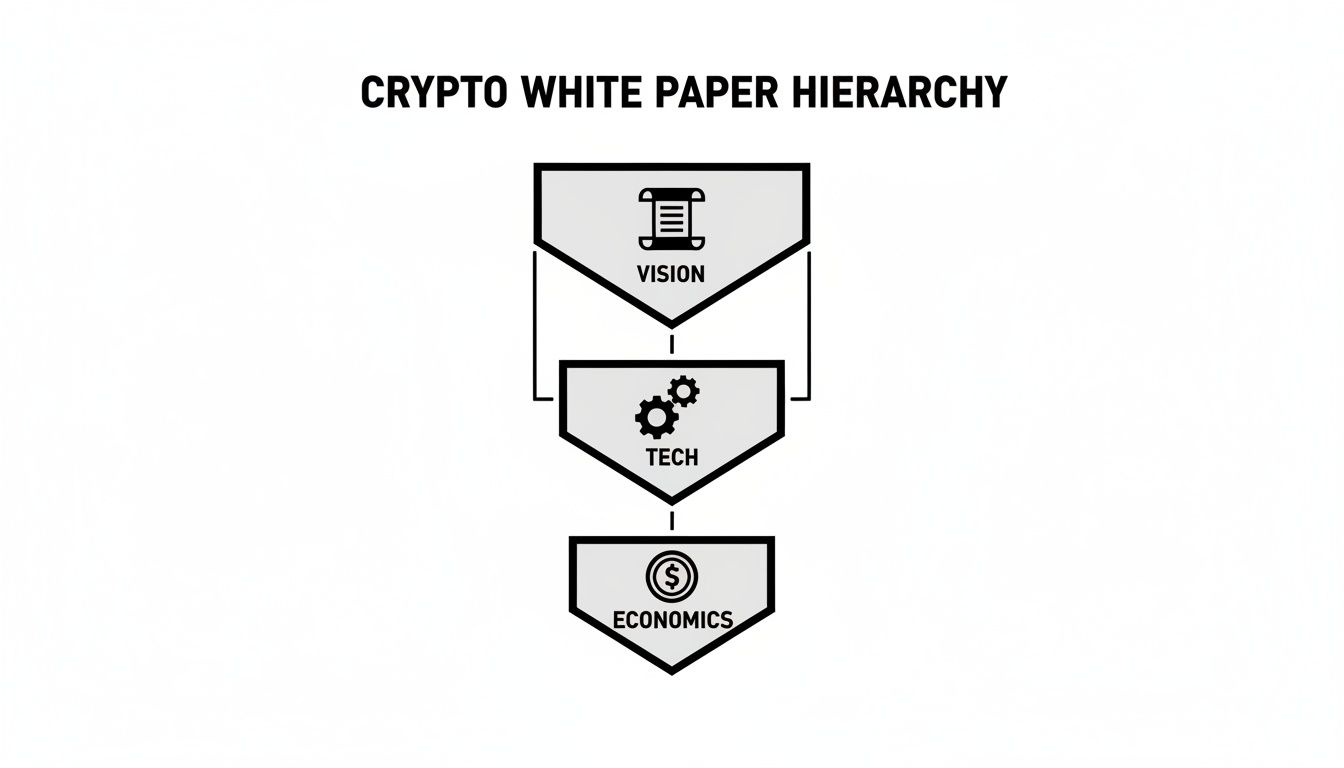
A visual hierarchy illustrating the key components of a crypto white paper: vision, technology, and economics.

This structure shows how a serious project builds its case from the top down. It starts with the big idea and then backs it up with solid technology and a sustainable economic model. A paper that nails this structure shows the team has thought through every single layer of their plan.

The Vision: Problem And Solution

The paper should kick off by pinpointing a specific, real-world problem. A winning white paper avoids vague fluff like "decentralizing finance" and instead zeroes in on a tangible pain point. For example, it might target the $1.7 trillion lost to cross-border payment inefficiencies or the lack of true digital ownership in the $150 billion gaming industry.

The solution presented has to be just as clear. It needs to explain why blockchain isn't just a trendy add-on, but the only tool for the job. If the whole thing could be built more easily on a simple database, that’s a massive red flag.

Technology And Architecture

This is where the project proves it has the technical muscle to pull off its promises. It can get dense, but this section absolutely must be coherent and detailed. It should walk you through the core design of the project.

Key things to look for:

  • Blockchain Choice: Why did they pick a specific chain like Ethereum, Solana, or build their own? The answer should tie directly to the project’s needs—things like transaction speed, security, or specific smart contract capabilities.
  • Consensus Mechanism: Are they using Proof-of-Work, Proof-of-Stake, or something else? The paper needs to justify this choice based on the trade-offs between security, scalability, and decentralization.
  • Technical Architecture: This part should map out the system’s layers, from the base protocol to the apps users will interact with. It needs to have enough detail for a competent developer to grasp the logic.

A strong technical section shows foresight. It confronts potential hurdles like scalability and security head-on instead of ignoring them or vaguely promising to figure it out later.

Tokenomics And The Team

For an investor, this is arguably the most critical part of any white paper. Tokenomics—the economics of the token—is what dictates how value is created, distributed, and sustained within the ecosystem. A project can have brilliant tech, but if its economic model is broken, it's destined to fail. This section needs to clearly define the token's utility, supply mechanics, and distribution schedule.

Finally, the paper must introduce the core team and advisors. Look for real names, relevant experience, and backgrounds you can actually verify. An anonymous team isn’t an automatic deal-breaker (after all, Bitcoin's founder is still a mystery), but it jacks up the risk profile significantly. A public team with a proven track record in tech, finance, or business is a powerful signal of credibility.

Crypto White Paper Section Breakdown

A solid white paper is your first and best tool for due diligence. This breakdown will help you dissect any project's blueprint, showing you what quality looks like and which red flags to run from.

SectionWhat To Look ForGreen Flag ExampleRed Flag Example
Problem StatementA specific, well-defined problem that blockchain can uniquely solve."High-latency, expensive remittance payments for migrant workers.""We are disrupting the entire global financial system."
TechnologyDetailed architectural diagrams and a clear rationale for technical choices."We use a sharded PoS consensus to achieve 10,000 TPS for our gaming platform.""Our revolutionary algorithm is a secret for competitive reasons."
TokenomicsClear token utility, a fixed or predictable supply, and fair distribution."The token is used for staking to secure the network and for governance votes.""90% of tokens are reserved for the team and 'marketing'."
Team & AdvisorsPublic, verifiable team members with relevant industry experience."Our CEO led a successful fintech exit; our lead dev worked on Ethereum's core.""Our team is anonymous to protect them from government oversight."
RoadmapSpecific, measurable, and realistic milestones with clear timelines."Q3 2024: Mainnet launch. Q4 2024: Onboarding first 10 enterprise partners.""Q1: Moon. Q2: Mars."

By systematically checking these boxes, you can quickly gauge whether a project is built on a solid foundation or just hot air. A well-structured paper that addresses each of these points with clarity and detail is a sign of a professional team with a viable plan.

How To Analyze Tokenomics And Project Viability

Tokenomics is the economic soul of a crypto project. A brilliant idea with a broken economic model is like a supercar with an empty gas tank—it looks impressive but is going absolutely nowhere. To really get under the hood of a crypto white paper, you have to dissect this financial heart to see if it’s built for the long haul or a spectacular crash.

An illustration of Tokenomics Analysis with a Bitcoin, gears for supply, staking, and fees, and a magnifying glass on a pie chart.

This goes way beyond just glancing at the total token supply. You need to dig into the core mechanics that actually give the token value and create demand over time. A well-designed system aligns the incentives of everyone involved—developers, investors, and users—so they’re all rowing in the same direction toward long-term network health.

Deconstructing The Token Model

First things first: what's the point of the token? You need to understand its fundamental purpose. Why does it even exist, and what can you do with it? A solid white paper will clearly lay out the specific utility that creates organic demand.

Look for these key utility drivers:

  • Staking: Can you lock up your tokens to help secure the network and earn rewards? This pulls tokens out of circulation and rewards long-term holders.
  • Gas Fees: Is the token required to pay for transactions or smart contract operations? This creates constant, natural demand as the platform is used.
  • Governance: Does holding the token give you a vote on the project’s future? This gives holders a real, tangible stake in the protocol’s success.
  • Access: Is the token required to access certain features, products, or services within the ecosystem?
  • Payments: Can the token be used as a medium of exchange for goods and services on the platform?

A token should be absolutely essential to the project's function, not just a glorified fundraising tool. If the platform could work just as well without its native token, that's a huge red flag for its long-term value.

You also need to figure out if the token is inflationary (supply grows over time) or deflationary (supply shrinks through token burns). Neither is automatically good or bad, but the white paper must have a strong reason for its choice. An inflationary model might be necessary to fund development, while a deflationary one aims to boost scarcity.

Examining Allocation And Vesting Schedules

A project’s token allocation table tells you who really matters. This part of the white paper, often a pie chart, shows you how the tokens are split between the team, advisors, private investors, and the public. Be very suspicious of projects that give a massive chunk—say, over 40%—to insiders.

But the vesting schedule is even more critical. This is the timeline that dictates when insiders are allowed to sell their tokens. A project with no vesting or a super short "cliff" (the initial lock-up period) is screaming "pump and dump." It means the team and early backers can unload their bags on the market right after launch, tanking the price for everyone else.

A healthy vesting schedule usually looks like this:

  1. A significant cliff: At least 6-12 months where insiders can't sell a single token.
  2. Linear unlocking: Tokens are released gradually over a long period, like 2-4 years, after the cliff ends.

This structure forces the team to stick around and build real, lasting value. Their payday is directly tied to the project’s long-term success, not a quick flip.

Assessing The Business Model And Market Fit

Finally, zoom out and look at the bigger picture. A project’s viability depends on whether it can actually find its place in an incredibly crowded market. The crypto market keeps growing, recently crossing the $4 trillion mark. With about 17 percent of U.S. adults having owned crypto as of late 2025, the fight for users is intense.

When you're judging a project's long-term potential, you have to understand the market it's entering. For instance, a strategic guide to crypto casino growth highlights the specific challenges and opportunities in that niche. A good white paper will show it's done its homework with a competitive analysis, explaining exactly how it’s different and better than what’s already out there. It must lay out a clear plan for attracting users and making money, proving it has a real shot at succeeding.

Spotting Red Flags And Deceptive Marketing

A slick white paper loaded with groundbreaking promises can make a weak—or even fraudulent—project look like the next big thing. Let's be real: the crypto world is powered by hype, and a lot of marketing is designed to trigger your FOMO (Fear Of Missing Out). Learning to cut through that noise is probably the most important skill you can develop to protect your capital.

Many questionable projects lean on psychological tricks instead of solid tech. Their entire game plan is to get you emotionally hooked before you’ve had a chance to think things through. Here’s an actionable checklist of the most common red flags.

Red Flag Checklist

Use this list to quickly identify potential warning signs in any crypto white paper:

  • [ ] Vague Language: Filled with buzzwords like "paradigm shift" or "synergy" but lacking technical specifics.
  • [ ] Unrealistic Roadmap: Promises world-changing results on an impossible timeline (e.g., "global adoption by next quarter").
  • [ ] Anonymous Team: Founders are anonymous or have no verifiable track record.
  • [ ] Overstated Partnerships: Claims partnerships with major companies that are unverified or just a customer relationship (e.g., "partnered with AWS").
  • [ ] Poor Tokenomics: Over 40-50% of tokens are allocated to the team and insiders with short vesting schedules.
  • [ ] No Problem-Solution Fit: The project uses blockchain for something a simple database could do better.
  • [ ] Unprofessional Document: The white paper is poorly written, full of typos, or looks like a rushed sales brochure.

A white paper should feel more like a technical manual than a sales brochure. If it reads like marketing copy and creates more questions than it answers, it's probably hiding something.

The Unrealistic Roadmap

Next up is what I call the "roadmap to Mars." This is a timeline promising to solve world hunger, disrupt ten different industries, and hit a trillion-dollar market cap by Q2. A realistic roadmap is measured, specific, and doesn't shy away from potential hurdles.

Look for a timeline with clear, believable milestones.

  • Good: "Q3 2024: Launch public testnet and initiate security audits."
  • Bad: "Q1 2025: Onboard 100 million users and achieve global adoption."

Outlandish promises are purely for generating hype to reel in investors who don't know any better. A serious team sets expectations they can actually deliver on.

Anonymous Teams And Overstated Partnerships

Sure, Bitcoin's creator is anonymous, but for 99% of new projects, a hidden or unverified team is a huge risk. If the founders aren't willing to attach their real names and reputations to their work, why should you attach your money to it? You should be able to find team members with verifiable LinkedIn profiles and relevant experience.

Be just as skeptical about exaggerated partnerships. A project might claim a "partnership with Google" when, in reality, they're just using Google Cloud. A true partnership is a formal, collaborative agreement. Always double-check these claims by looking for official announcements from the other company. This kind of deceptive marketing is a classic sign of a project that cares more about hype than honesty.

You can dive deeper into these kinds of issues in our guide on how to check for crypto rug pulls. Any project that isn't transparent about its team or its partners should immediately make you more cautious.

Verifying White Paper Claims With On-Chain Data

A crypto white paper is a document of promises. The blockchain, however, is a ledger of proof.

The smartest investors I know all agree on one thing: the real work starts where the white paper ends. Closing that gap between what a project says it will do and what it actually does is where you find your edge. It's how you go from being a passive reader to an active investigator.

On-chain data is your immutable, real-time record of everything happening inside a project’s ecosystem. Think of it as a direct feed from the company's bank accounts and operational logs. By learning to read this data, you can check the claims made in a white paper and spot signs of confidence—or distress—long before they make headlines.

An illustration of a blockchain with blocks, a magnifying glass, and green checkmarks for verification.

This is how you see what project insiders and "smart money" are actually doing, not just what they're saying.

From Words to Wallets

The first step is to treat a white paper’s tokenomics section as a list of testable hypotheses. If the document says team and investor tokens are locked for 12 months, the blockchain can prove it—or expose the lie. Wallet tracking tools are your best friend here, letting you keep an eye on the wallets belonging to project insiders.

You can verify key claims by checking:

  • Team and Investor Wallets: Are these wallets holding steady, or are tokens quietly being moved to exchanges? Any activity that breaks the stated vesting schedule is a massive red flag.
  • Treasury Wallets: How is the project actually spending its funds? On-chain data reveals if the treasury is funding legitimate development and partnerships or if it’s being mysteriously drained.

To do this right, it helps to adopt a VC due diligence framework that forces you to turn assumptions into verified facts. Cross-referencing claims with on-chain data is the core of this approach—you seek objective proof instead of just trusting the text.

Analyzing Token Distribution and Smart Money

Beyond just checking vesting schedules, on-chain analysis reveals the true power structure of a token’s economy. A white paper might talk a big game about decentralization, but the blockchain shows who really holds the cards.

A project's health is often reflected in its on-chain behavior. Smart money moves silently but leaves clear footprints on the blockchain for those who know where to look.

A critical step is checking for wallet concentration. Is a huge chunk of the supply sitting in a handful of "whale" wallets? If so, those few players could tank the price in an instant. A healthy distribution shows tokens spread across thousands of different holders, which points to genuine community adoption.

You can also track the wallets of established, successful traders and venture capital funds. When you see this "smart money" buying into a project, it's a powerful, real-time vote of confidence that's worth more than any press release. On the flip side, if they start selling, it’s a clear warning. For a deeper dive into this process, check out our guide on https://www.walletfinder.ai/blog/blockchain-data-analytics.

A Practical Checklist for On-Chain Verification

Use this simple checklist to cross-reference any crypto white paper with hard evidence from the blockchain. This process turns abstract promises into concrete data points.

  1. Identify Key Wallets: Find the wallet addresses for the project's team, treasury, and known early investors. They're often disclosed or can be tracked down with a blockchain explorer.
  2. Monitor Vesting Schedules: Tag these wallets in a tracker and set up alerts. Watch for any token movements that violate the lock-up periods described in the white paper.
  3. Check Holder Distribution: Use an analytics tool to view the token holder chart. Is the supply concentrated in the top 10 wallets, or is it widely distributed?
  4. Track Smart Money: Identify wallets of known VCs or successful traders interacting with the project. Are they buying or selling?
  5. Analyze Exchange Flows: Keep an eye on the flow of tokens to and from major exchanges. A large, sudden rush of tokens onto exchanges often means insiders are getting ready to sell.

By following the blockchain evidence, you shift from hoping the white paper is true to verifying that it is. This is how you make investment decisions based on actions, not just words.

A Simple Template For Your Crypto White Paper

Even if you’re an investor and not a founder, understanding how a great white paper is built is a killer analytical tool. It gives you a mental framework to spot when crucial pieces of the story are missing or just don't add up. For builders, it’s the logical starting point for putting a compelling vision on paper.

This template isn’t about writing code; it’s about crafting a clear, persuasive, and transparent narrative. Think of it as a checklist for both creators and evaluators, making sure every critical angle is covered with the right level of detail.

Core Structure And Key Questions

A winning white paper has a logical flow. It guides the reader from the big idea all the way down to the technical nitty-gritty. Each section should answer the specific, tough questions that any serious stakeholder would ask.

Here's a simplified outline you can follow:

  1. Abstract: This is your one-paragraph executive summary. What is the project, what problem does it solve, and what's the core solution? It needs to be crystal clear and straight to the point.
  2. Introduction (The Problem): Time to dive deep into the pain point. Why does this problem actually matter? How big is the market it affects? Use real data to show the scale of the issue and why it needs fixing.
  3. The Solution & Vision: Now, explain your approach. How does your project solve the problem you just laid out? Most importantly, why is blockchain the only or best way to do it?
  4. Technical Architecture: This is the "how." What blockchain are you building on? What's your consensus mechanism? You need enough detail here for a technical reader to grasp the system's design and see that it's feasible.
  5. Tokenomics (The Economic Engine): This section is absolutely vital. Explain the token's purpose (utility), total supply, and how it’s allocated (use charts!). Don't forget vesting schedules for insiders. How does value actually flow to the token?
  6. The Team: Show us who's behind the curtain. Introduce the core founders, developers, and key advisors. You have to include links to verifiable profiles (like LinkedIn) and highlight experience that builds credibility.
  7. Roadmap: Lay out a timeline with specific, measurable, and achievable milestones. What are you delivering next quarter, next year, and beyond?

A Quick Content Checklist

Use this table as a gut-check for your content, whether you're writing the paper or just reading one. It helps ensure all the fundamentals are covered, which is how you build trust and show you've thought the plan through.

SectionMust-Answer QuestionGood Example Prompt
IntroductionWhat specific, costly problem are you solving?"Cross-border transaction fees currently cost users $45 billion annually..."
TechnologyWhy is your technical approach the right one?"We chose a Proof-of-Stake model to ensure low fees and high throughput for..."
TokenomicsHow will this token gain and hold its value?"The token is burned with each transaction, creating a deflationary pressure that..."
RoadmapWhat are your concrete, near-term goals?"Q3 2024: Complete smart contract security audit with CertiK and launch on testnet."

A well-structured paper answers the tough questions before they're even asked. It doesn't wait for investors to poke holes; it provides the data, logic, and transparency upfront, building confidence with every page. By following this structure, both builders and investors can focus on what truly matters: the substance of the project itself.

Frequently Asked Questions

It's natural to have questions when you're digging into something as dense as a white paper. Let's clear up a few of the most common ones that pop up.

Is A Crypto White Paper Legally Binding?

Nope. In almost all cases, a crypto white paper is not a legally binding contract. The best way to think of it is as a detailed manifesto or a high-level business plan. It's the project's way of laying out its vision, tech, and financial model for everyone to see.

But that doesn't mean it’s a legal free-for-all. If a team intentionally packs its white paper with lies, makes fraudulent promises, or misleads people about how much money they could make, that paper can absolutely be used as evidence against them. In most countries, that kind of behavior falls squarely under securities fraud or consumer protection laws, which come with some very real legal teeth.

White Paper vs. Litepaper

The big difference here comes down to two things: how much detail you want and who it's for. While they both come from the same project, they serve totally different roles.

  • Crypto White Paper: This is the whole enchilada. It's the deep, technical document aimed at developers, serious investors, and anyone who wants to pick apart the project's guts. Expect exhaustive detail on the tech stack, consensus models, and the nitty-gritty of the tokenomics.
  • Litepaper: This is the highlight reel. It’s a slimmed-down, easy-to-read summary made for a wider audience that doesn't need (or want) to get lost in the technical weeds. It hits the key points—what problem it solves, the solution, the main features, and the basic tokenomics—in a way you can digest in minutes.

Most projects put out both. The litepaper gets you interested, and the white paper gives you the substance you need to do your homework properly.

Should A Project Update Its White Paper?

Yes, and you should be wary of any project that doesn't. Crypto moves incredibly fast. A project with a white paper that hasn't been touched in years is a huge red flag—it often signals the project has stalled or been abandoned altogether.

A white paper should be a living document that reflects the project's current state and future ambitions. Sticking to an outdated version from years ago shows a lack of progress and adaptability.

Think about it: projects are supposed to evolve. They might shift their strategy, hit a new technical milestone, or tweak their token model based on what they're seeing in the real world. Updating the white paper is how they keep their community and potential investors in the loop with the most current information. Before you invest any serious time or money, always hunt down the latest version.


Ready to stop guessing and start verifying? Wallet Finder.ai gives you the on-chain intelligence to confirm the promises made in any crypto white paper. Track smart money, monitor insider wallets, and get real-time alerts before the market moves.

Start your 7-day free trial and see what the blockchain is really saying at https://www.walletfinder.ai.