The Basics of Technical Analysis: Crypto Guide 2026

Wallet Finder

Blank calendar icon with grid of squares representing days.

June 19, 2026

You open a crypto chart to check one setup, then five minutes later you're staring at candles, moving averages, volume bars, RSI, trend lines, and a dozen opinions from X. The screen looks busy, but your decision still feels fuzzy. Buy now, wait, or walk away?

That confusion is normal. Most new traders don't fail because charts are impossible to read. They struggle because nobody shows them how to separate signal from decoration.

From Chaos to Clarity Your Introduction to Technical Analysis

A chart can look random until you know what you're reading. Once you do, it stops being a pile of lines and starts acting like a record of crowd behavior. Buyers push, sellers defend, momentum builds, momentum fades. Technical analysis is how traders read that behavior from market history.

The roots of technical analysis are commonly traced to Charles Dow's work between 1851 and 1902, and Dow Theory still frames markets in three trend timeframes: primary movements lasting a year to several years, secondary reactions lasting 10 days to a year, and minor movements lasting seconds to days according to IG's overview of technical analysis and Dow Theory. That matters because the same logic still shows up on a crypto chart today. A token can be bullish on a higher timeframe, choppy on the daily, and messy on the intraday all at once.

For crypto traders, this point clears up one of the first major mistakes. You can be "right" about the bigger move and still lose money on the entry because you traded the wrong timeframe. A strong long-term trend doesn't protect a bad short-term entry.

What technical analysis is really doing

At its core, the basics of technical analysis aren't about predicting the future with certainty. They're about asking better questions:

  • Where is price trending
  • Where have buyers or sellers stepped in before
  • Is this move backed by real participation
  • Where does my trade idea stop making sense

That last question matters most.

Practical rule: A chart isn't there to prove you're right. It's there to show you when you're wrong.

In crypto, that mindset helps because price can move fast, liquidity can thin out quickly, and sentiment flips without warning. If you treat technical analysis like a crystal ball, you'll overtrade. If you treat it like a framework for making cleaner decisions, you'll survive long enough to improve.

A good trader doesn't try to know everything. A good trader learns to read structure, define risk, and wait for conditions that fit the plan.

Reading the Market The Pillars of Price Action

Technical analysis has a lot of tools, but most of them sit on top of three basics. If you can read trend, support and resistance, and volume, you can make sense of most charts before adding any indicator.
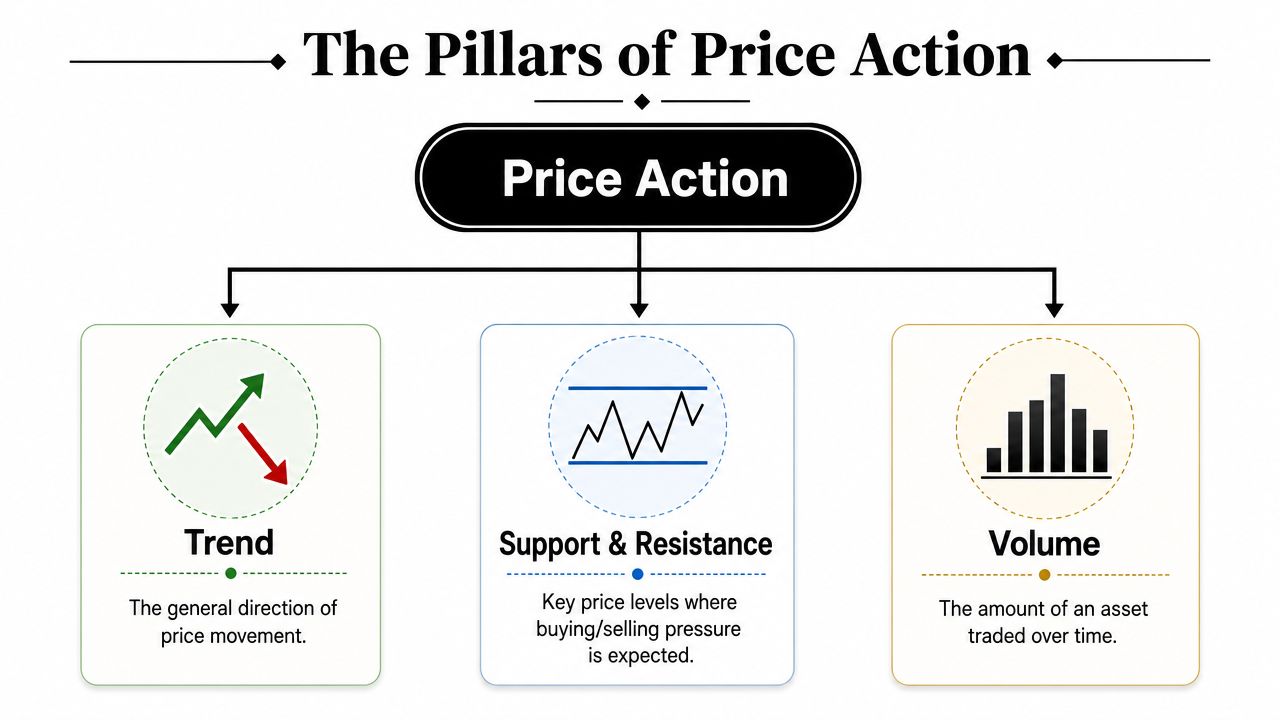
A diagram illustrating the three pillars of price action: Trend, Support and Resistance, and Volume in trading.

A technically rigorous baseline is that technical analysis treats price, volume, and open interest as the primary information set, and it assumes market prices already incorporate relevant information, as summarized in Wikipedia's technical analysis reference. In plain English, traders start with what the market is demonstrating, not what they wish it would do.

For a visual foundation, this guide on how to read crypto charts pairs well with the concepts below.

Trend is the market's path

Trend answers the simplest question first. Is price generally moving up, down, or sideways?

Think of trend like walking on a hillside. If the path keeps climbing, you're in an uptrend even if there are short slips along the way. If the path keeps dropping, sellers control the market. If the path goes nowhere, the market is ranging and often punishes impatient traders.

A quick working view:

Market conditionWhat price often looks likeWhat traders usually do
UptrendHigher highs and higher lowsLook for pullbacks or continuation entries
DowntrendLower highs and lower lowsStay defensive or look for rallies to fade
RangePrice bounces between clear levelsTrade edges carefully or wait for breakout confirmation

Crypto traders often get trapped by trying to short every sharp green candle in an uptrend or buy every red dip in a downtrend. Trend keeps you from fighting the broader move too early.

Support and resistance are the chart's floor and ceiling

Support is an area where buyers have shown interest before. Resistance is where sellers have pushed back before. These aren't magic lines. They're areas where traders remember pain, profit, or missed opportunity.

If a token keeps bouncing near the same zone, buyers are probably defending it. If price repeatedly stalls at another zone, sellers may be active there. That's why support and resistance matter so much in crypto. They help you define both opportunity and invalidation.

A few practical uses:

  • Support test: If price revisits support and holds, buyers may still be in control.
  • Resistance retest: If price breaks above resistance and then holds it, old resistance can become new support.
  • Range boundaries: Repeated reactions between the same two areas can signal a market with no clean trend.

Volume tells you how much conviction is behind the move

Price can move on thin participation. That's where beginners get fooled. A breakout looks exciting, but if very few traders are involved, the move can fail fast.

Volume gives context. Rising price with strong participation tends to carry more weight than a weak push that drifts upward. In crypto, that distinction matters a lot because false breakouts happen constantly, especially in thinner names.

A move isn't interesting just because price traveled far. It's interesting when participation supports it.

When you combine these three pillars, charts get quieter. You stop reacting to every candle and start reading structure.

Your Essential Crypto Trading Toolkit

Once you understand market structure, you need a small toolkit you can effectively use. Most beginners make this harder than it needs to be. They load the chart with indicators, then freeze when those indicators disagree.

Start with a few tools that answer different questions. One tool should help you read price behavior. Another should help you identify trend. A third should help you judge momentum.

An infographic diagram outlining the essential components of a crypto trading toolkit including candlestick charts and patterns.

A practical companion piece is this breakdown of best crypto indicators, especially if you're deciding what to keep on your chart and what to remove.

Candlesticks show the fight inside each session

A candlestick gives you four pieces of information for a chosen period: open, high, low, and close. That sounds basic, but it reveals who controlled that period and how much conflict happened along the way.

A candle with a strong body and little wick shows decisive movement. A candle with long wicks can show rejection, hesitation, or both sides fighting for control.

Here's how a beginner can read common candle behavior:

  • Strong bullish candle: Buyers controlled most of the period and closed near the high.
  • Strong bearish candle: Sellers stayed in control and closed near the low.
  • Long lower wick: Price traded down, then buyers pushed it back up.
  • Long upper wick: Price traded up, then sellers knocked it back.

Single candles matter most when they form at important levels. A rejection wick in the middle of nowhere isn't as useful as a rejection wick at resistance after an extended move.

Moving averages help you filter the trend

Moving averages smooth noise. They won't catch the exact top or bottom, but that's not their job. Their job is to keep you aligned with the market's general direction.

A common baseline is the 50-day and 200-day moving averages for trend, while RSI and MACD are often used for momentum or exhaustion, as explained in Daloopa's guide to fundamental versus technical analysis. The same source notes that traders often want both a trend condition and a momentum trigger instead of relying on one signal alone.

For beginners, that means something simple:

ToolWhat it helps withCommon beginner mistake
50-day moving averageIntermediate trend directionTreating every touch as an automatic entry
200-day moving averageBroader trend filterIgnoring it when taking countertrend trades
RSIMomentum and potential exhaustionAssuming overbought means "must fall now"
MACDMomentum shift and trend confirmationUsing crossovers without checking market structure

RSI is a momentum gauge, not a buy or sell button

The Relative Strength Index helps you see whether price has pushed hard in one direction. New traders often misuse it by treating "overbought" as an immediate short and "oversold" as an immediate long.

That shortcut causes losses. In a strong trend, RSI can stay stretched longer than you expect. It's more useful when paired with structure. If price is in an uptrend and RSI cools off during a pullback, that can be more helpful than trying to fade strength blindly.

Patterns matter because they show repeated behavior

You don't need to memorize every pattern name on the internet. Focus on a few that reflect obvious market behavior.

  • Triangle: Price compresses as buyers and sellers tighten into a smaller range. Compression often leads to expansion.
  • Head and shoulders: Buyers lose strength across repeated pushes, and the final break can signal a shift in control.
  • Range breakout: Price leaves a well-defined area. The key question isn't the breakout itself. It's whether price can hold outside the range.

Desk advice: Use each tool for one job. Candles show behavior. Moving averages filter trend. RSI tests momentum. Patterns frame the setup.

That's enough to start building repeatable decisions.

Applying Technical Analysis A Step-by-Step Example

Let's take a simple crypto workflow using SOL/USD. Not to predict the next move, but to build a trade idea you can test, reject, or refine. That's how technical analysis becomes useful.

The chart process below is worth following in order. Most traders lose discipline when they jump straight to entry before deciding whether the setup deserves attention at all.

A five-step infographic illustrating the process of applying technical analysis for trading SOL/USD cryptocurrency pairs.

Start with the higher timeframe

Open the daily chart first. You're not looking for a perfect setup yet. You're asking whether SOL is broadly trending, ranging, or weakening.

If the daily chart is making cleaner higher lows and reclaiming prior resistance, that's constructive. If it's chopping in the middle of a broad range, your expectations should shrink. If it's below major trend structure and failing to hold bounces, you stay cautious.

Mark the levels that matter

Next, draw the obvious zones. Not every tiny pivot. Just the areas where price clearly reacted before.

A practical checklist:

  1. Mark prior swing highs where sellers showed up.
  2. Mark prior swing lows where buyers defended.
  3. Note recent breakout areas that could act as retest zones.
  4. Keep the chart clean so you can still read price.

Once those zones are marked, shift to a lower timeframe to see how SOL behaves as it approaches them.

The walkthrough below can help you visualize that process in action.

Add one trend tool and one momentum tool

Now place a moving average on the chart and check RSI. You don't need a control panel full of signals. You need enough context to judge whether the setup lines up with trend and whether momentum supports the idea.

One educational source notes that setups with 3–5 confirming indicators or signals are often more successful than those with only 1–2, as described in Babson's introduction to technical analysis. The point isn't to stack random tools. The point is to look for confluence.

For example, a cleaner long setup might include:

  • Trend alignment: Higher timeframe structure still leans up.
  • Level interaction: Price pulls back into a prior support area.
  • Momentum reset: RSI cools during the pullback instead of staying overheated.
  • Candle behavior: Buyers reject lower prices near the zone.
  • Participation: Volume improves as price moves away from support.

Build the trade plan before the trade

Now define the plan in plain language.

Decision pointExample thought process
EntryI only want the trade if price reacts constructively at support
InvalidationIf support fails and price accepts below that zone, my idea is wrong
TargetFirst objective is the next resistance area, not a fantasy move
ManagementIf price stalls near resistance, I reduce risk or take partials

Notice what isn't here. No certainty. No prediction disguised as confidence. Just a structured idea with clear conditions.

If you can't point to the exact chart area that proves your setup wrong, you don't have a trade plan yet.

That habit alone separates chart reading from gambling.

Beyond Charts Combining TA with On-Chain Signals

Charts tell you what price did. In crypto, they don't always tell you who drove the move or whether that move has support beyond the chart itself. That's where on-chain context helps.

A key question for modern traders is what still adds edge once everyone watches the same indicators like RSI and moving averages. One strong answer is context, including trend alignment, liquidity, and confirmation from external data such as on-chain wallet activity, as noted in Socrates Platform's beginner guide to technical analysis.

Screenshot from https://www.walletfinder.ai

For traders who want to study that extra layer, this introduction to on-chain analysis is a useful starting point.

What on-chain confirmation can add

Say a token breaks resistance on the chart. That's your technical trigger. But before acting, you check the surrounding context:

  • Are active wallets accumulating or distributing
  • Are large holders moving tokens toward exchanges
  • Is there fresh participation, or is price moving in a thin pocket
  • Is the move happening across the broader market, or only in one isolated chart

Those questions can help you avoid a common crypto trap. A chart can look bullish while underlying wallet flows suggest distribution or exit activity. The opposite can also happen. Price may look dull right before larger participants start building positions.

How to combine the two without overcomplicating it

The goal isn't to replace chart reading. The goal is to upgrade it.

A clean process looks like this:

LayerWhat you're checkingWhy it matters
Technical structureTrend, levels, momentum, volumeTells you whether the setup is organized
On-chain contextWallet behavior, flow direction, large activityTells you whether behavior under the surface supports the chart
ExecutionEntry, invalidation, target, riskTurns the idea into a tradeable plan

One option traders use for this workflow is Wallet Finder.ai, which tracks blockchain wallets, trades, tokens, and watchlists across ecosystems such as Ethereum, Solana, and Base. Used alongside a chart, that kind of tool can help you test whether a breakout is attracting informed participation or just short-term noise.

A chart pattern is stronger when market structure and participant behavior point the same way.

That matters even more in DeFi and memecoin trading, where fast rotations and thin liquidity can make textbook setups fail quickly.

Common Pitfalls and The Golden Rule of Risk Management

New traders usually don't lose because they never learned an indicator. They lose because they use technical analysis to justify action instead of to control risk.

One practical view is that basic technical analysis is often less about prediction and more about risk calibration, using trends, volatility, and support or resistance to decide when a setup is invalidated, as explained by NYIF's fundamentals of technical analysis. That framing is especially useful in thin, volatile crypto markets.

Mistakes that show up early

Some errors repeat so often that you should expect them.

  • Indicator overload: You add too many tools, then wait for perfect agreement that never comes.
  • Forcing RSI signals: You see overbought and short into a strong trend, or see oversold and buy into weakness.
  • Ignoring invalidation: You enter because the setup looks good, but you never define where it fails.
  • Revenge trading: One stop-out turns into a string of emotional entries.
  • Trading low-quality conditions: You take setups in messy structure because you want action.

The fix isn't more complexity. It's more discipline.

The rule that keeps traders alive

A trade idea has to answer one question before anything else. Where am I wrong?

If you can't answer that from the chart, skip the trade. Maybe support isn't clear. Maybe the breakout level is messy. Maybe the market is too thin and reactive. That's fine. Cash is a position.

Use technical analysis to reduce uncertainty, not to eliminate it. That means accepting three facts:

  1. Good setups still fail
  2. Bad setups sometimes work
  3. Your job is to manage both outcomes

Your edge doesn't come from never being wrong. It comes from losing small when you're wrong and pressing only when the setup is clear.

That's the golden rule. Risk first. Everything else comes after.

Your Lifelong Journey into Market Analysis

The basics of technical analysis get simpler once you stop treating charts like a puzzle with one perfect answer. Start with structure. Read trend. Mark support and resistance. Check whether volume and momentum support the move. Then decide whether the setup gives you a clean invalidation point.

That's enough to build a serious foundation.

Over time, you'll notice that your real progress doesn't come from adding more indicators. It comes from better judgment. You get better at ignoring weak setups, waiting for confluence, and matching the timeframe to the trade. In crypto, you get even sharper when you combine chart structure with context from wallet flows and market behavior beneath the surface.

Keep it simple at first. One chart. A few levels. One trend filter. One momentum tool. One written trade plan.

Then repeat.


If you want to go beyond chart-only analysis, Wallet Finder.ai can help you track blockchain wallets, token activity, and trade flows across major ecosystems so you can compare what the chart suggests with what on-chain participants are doing.