10 Best Copy Trading Platforms of 2026

Wallet Finder

Blank calendar icon with grid of squares representing days.

May 29, 2026

Tired of copying the wrong crypto traders? That's a common starting point. They open a copy trading app, sort by recent gains, pick a leader with a sharp-looking curve, and assume the hard work is done. Then the copied account runs into a rough patch, entries come late, exits slip, and the portfolio starts bleeding.

The problem usually isn't that copy trading itself is broken. The problem is the copying of presentation before process. A leaderboard can show returns, but it often doesn't tell you enough about timing, position sizing, wallet behavior, concentration risk, or whether the trader's edge is still working.

That's why the best copy trading platform isn't always the one with the flashiest social feed or the biggest leaderboard. It's the one that matches how you want to trade, where you want to keep custody, and how much verification you can do before putting real capital at risk. In practice, that means some traders will prefer a regulated broker, others will want exchange-based API execution, and many DeFi users will get better signal quality by checking wallets on-chain first.

This guide gets straight to the tools. You'll see CEX platforms, DEX-native options, and on-chain research tools that help you decide who's worth copying before you follow a single trade.

1. Wallet Finder.ai
Wallet Finder.ai

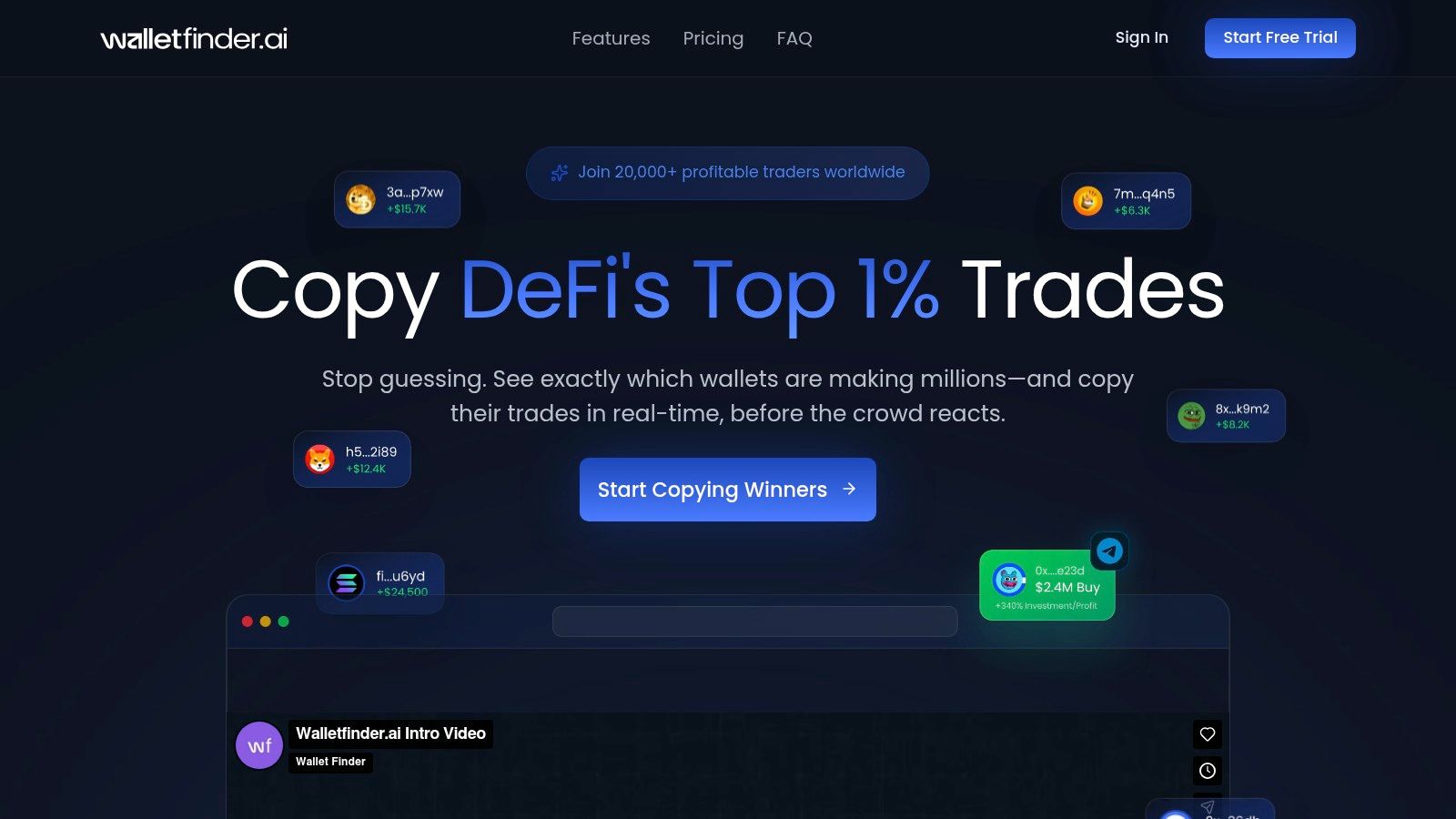
If your real problem is trader selection, Wallet Finder.ai is the strongest place to start. It isn't a broker and it doesn't pretend to be one. It helps you find wallets, trades, and tokens worth tracking so you can build your own copy workflow with actual on-chain context instead of trusting a glossy leaderboard.

That matters more in DeFi than most beginners realize. A trader can look brilliant inside a closed app and still be impossible to verify externally. On-chain intelligence flips that. You can inspect behavior, compare entries and exits, watch position sizing patterns, and decide whether a wallet is disciplined or just got lucky in one market regime.

Why it stands out

Wallet Finder.ai is built for traders who want signal discovery first. The platform surfaces profitable wallets across major ecosystems, then lets you filter for the behavior you care about, such as consistency, recent performance patterns, timing, and risk flags. The Discover Wallets, Discover Trades, and Discover Tokens views make it easier to move from research to action without stitching together five other tools.

It also fits the way active copy traders work. You build watchlists, wait for specific behavior, and react fast when a tracked wallet buys, swaps, or sells. Alerts through Telegram and mobile push make that workflow far more practical than manually refreshing block explorers all day.

Practical rule: In DeFi, don't start by asking which wallet made the most. Start by asking which wallet behaves in a way you can repeat.

For newer users, the copy trading for beginners guide from Wallet Finder.ai is a useful companion because it frames copying as a research process, not a shortcut.

Best for and trade-offs

This is best for DeFi traders, memecoin hunters, on-chain analysts, and anyone who wants to verify before copying. It's also useful for desks and serious solo traders because you can export data and do your own offline work instead of staying trapped inside one interface.

The trade-offs are straightforward:

  • Best use case: You want to find smart-money wallets and create your own copy watchlist.
  • What works well: Real-time alerts, multi-chain coverage, wallet-level research, and exportable data.
  • What doesn't: It won't execute trades for you inside a broker account. You still need your own execution stack and judgment.
  • Who should skip it: Traders who only want one-click social copying and don't care how the underlying edge is validated.

Security posture matters here too. The platform emphasizes encrypted connections, no storage of private keys, and AWS Cognito-based authentication in the U.S. That won't remove market risk, but it does remove one common reason traders avoid wallet-linked research products.

For DeFi users trying to decide on the best copy trading platform, this is the sharpest option for the research side of the equation.

2. eToro CopyTrader

eToro, CopyTrader (US)

If you want the mainstream benchmark, eToro remains the standard against which others are measured. Copy trading moved from a niche broker feature into a mainstream retail investing model after eToro introduced CopyTrader, and broker roundups still described eToro as a leading copy trading platform by 2026, which says a lot about its staying power in the category according to Goat Funded Trader's market overview.

The appeal is obvious. Discovery, execution, and portfolio management sit in one place. You choose a trader, allocate capital, and let the platform handle the mirroring.

Where eToro fits best

For U.S. users, the cleaner pitch is convenience. You can mirror eligible users across supported assets in one interface instead of juggling separate analytics, custody, and execution tools. That's attractive if you're coming from stock investing and want copy trading without moving fully into DeFi infrastructure.

ForexBrokers.com says eToro's CopyTrader lets users duplicate trades from more than 2.5 million investors, and eToro's own product supports real-time replication, proportional allocation, and relationship-level controls like pause, fund add or remove, and stop-loss management, as summarized in ForexBrokers.com's social and copy trading guide.

The strongest part of eToro isn't novelty. It's that most people can understand how to use it in one sitting.

The downside is just as important. You're still relying heavily on platform-native analytics and availability rules. U.S. users also face asset and jurisdiction constraints, and crypto copied through the product has its own handling rules. If you're a DeFi-native trader, this can feel closed compared with on-chain verification.

If you like the social discovery side but want stronger independent wallet context, pair that workflow with smart money crypto research from Wallet Finder.ai. That combination helps filter out traders who look good in-app but don't line up with the broader market behavior you're targeting.

Visit eToro CopyTrader

3. Zignaly

Zignaly, Profit Sharing Copy Trading

Zignaly takes a different angle. Instead of pushing you toward pure subscription copying, it leans into profit sharing. That structure appeals to traders who want managers to get paid when performance improves rather than charging fixed access costs up front.

The practical benefit is alignment. A high-water-mark model means the fee logic is at least pointed in the right direction. If a manager digs a hole, they need to climb out before earning again.

What works in practice

Zignaly is easier to live with than some API-heavy setups because you don't need to handle the same level of exchange integration complexity yourself. For users who don't want to manage exchange keys and bot infrastructure, that simplicity matters.

Its dashboards and manager pages are useful, but this isn't a platform where you should switch your brain off. Manager quality varies. Risk styles vary even more. Some will fit patient trend followers. Others will fit aggressive traders who can stomach larger swings.

AvaTrade notes that strong copy trading platforms should show detailed trader profiles with historical returns, risk levels, trade frequency, and risk controls like stop-loss functionality in its copy trading education overview. That's the right lens to use here. Don't focus on the headline. Focus on the repeatability of the manager's behavior.

  • Good fit: Traders who want managed crypto copy exposure with incentive alignment.
  • Less ideal: Traders who insist on keeping everything inside their own exchange account.
  • Main caution: Custody and manager selection matter more than the fee model alone.

Before allocating, I'd still sanity-check any manager's style against independent wallet behavior where possible. Tools that score and compare wallets can sharpen that filter, and Wallet Finder.ai's wallet ratings explainer is useful for thinking through what makes a wallet worth following beyond raw profit.

Visit Zignaly

4. WunderTrading

WunderTrading, Copy Trading + Automation Hub

WunderTrading is a better fit for traders who want copy trading plus an automation stack in the same place. The marketplace matters, but the exchange integrations, TradingView connectivity, and bot tooling are what make it practical for active users.

The biggest advantage is custody. Your funds remain on your connected exchange account, and API keys can be configured without withdrawal permission. For a lot of traders, that's the line between “worth testing” and “not interested.”

Where it wins and where it slips

This is a strong middle ground between consumer-friendly social copy apps and fully manual multi-exchange operations. You can copy strategies, automate parts of execution, and expand into DCA or grid workflows if that matches your style.

The catch is execution drift. When a leader enters on one venue and your copy runs through exchange APIs with their own latency and limits, fills can differ. That matters a lot for shorter timeframes and momentum-driven entries.

Fast strategies often look better on the leader account than on the follower account. API distance and exchange latency don't care how good the screenshot looked.

WunderTrading works best when you use it for strategies that can tolerate small differences in timing. It's less ideal for trying to mirror hyper-reactive traders who depend on near-perfect entry precision.

  • Best for: Multi-exchange users who want copy trading, bots, and TradingView automation together.
  • Strong point: Exchange custody stays with you.
  • Weak point: Slippage and API execution variance can become the whole game.

Visit WunderTrading

5. Cornix

Cornix, Signals‑Driven Auto Copy

Cornix isn't really about leaderboard copying. It's about turning signal channels into execution. If you already follow Telegram or TradingView signal providers and want those ideas routed into your exchange account automatically, Cornix is built for that workflow.

That makes it a niche tool, but a useful one. Some traders don't want social feeds and public rankings. They want to choose a signal source they trust and automate the repetitive part.

Who should actually use it

Cornix is good for traders who already have conviction about the source. If you've done the filtering and know which channel fits your risk appetite, the platform helps with implementation. You can control position sizing, portfolio rules, and exchange connections instead of manually entering every alert.

The weak point is obvious. Cornix doesn't improve a bad signal provider. It just executes that provider faster and more consistently than you would by hand.

That means your edge comes from source selection, not from the software itself. In volatile conditions, API lag and exchange congestion can still create worse entries than the original signal posted.

  • Best for: Traders committed to signal-based workflows.
  • Works well when: You trust the source and want cleaner execution discipline.
  • Works poorly when: You're using it to outsource judgment entirely.

Visit Cornix

6. Kryll

Kryll is better thought of as strategy copying than trader copying. That distinction matters. Instead of following a discretionary person and hoping their judgment holds up, you can rent or run structured, rule-based strategies through its marketplace and no-code builder.

For many traders, that's a cleaner model. Rules are easier to inspect than personality.

Why systematic traders like it

The visual strategy builder is the draw. It lowers the barrier for testing ideas, and the marketplace gives less technical users a way to use existing systems without coding them from scratch. If you care about repeatable logic, this feels more disciplined than most social copy feeds.

That said, systematic doesn't automatically mean safe. Marketplace quality still varies, backtests can flatter weak ideas, and API execution realities still affect live results. A strategy can look excellent in design and still underperform once it meets real spreads, real latency, and real market noise.

A practical use case is copying a rules-based strategy while you gradually learn to modify it. That's where Kryll has more staying power than simple one-click following.

  • Best for: Traders who prefer systems over personalities.
  • Strong point: Structured strategies are easier to evaluate than discretionary boasts.
  • Main caution: Backtest confidence can create false comfort.

Visit Kryll

7. dHEDGE

dHEDGE, On‑Chain Vault Copying (Non‑custodial)

dHEDGE is one of the cleaner examples of on-chain vault-based copying. Instead of copying trade by trade through a broker or exchange API, you deposit into a manager vault and let smart contracts handle the mechanics.

For DeFi-native users, that model has real appeal. Fee logic is on-chain, positions are transparent, and you aren't relying on a centralized social network to tell you what happened.

The real trade-off

Non-custodial design is the obvious upside. You keep the DeFi-native structure and can inspect vault behavior on-chain. Performance fee rules and high-water-mark logic are handled programmatically, which is exactly how many traders prefer these systems to work.

The limitation is flexibility. Strategy universes depend on supported venues and whitelisted assets. User experience is also more technical than most CEX products, so this isn't where I'd send someone who still struggles with wallet approvals and chain-specific workflows.

If you already live on-chain, dHEDGE feels logical. If you don't, it feels like homework before you've even taken the first trade.

This is best for users who value transparency and can handle DeFi operations without friction. If you want the best copy trading platform in a non-custodial format, dHEDGE belongs on the shortlist.

Visit dHEDGE docs

8. Enzyme Finance

Enzyme Finance, On‑Chain Asset Management Vaults

Enzyme sits closer to programmable asset management than casual copy trading, but that's exactly why some advanced users prefer it. Managers can build vaults with clear rules, fee schedules, and protocol integrations, then investors can subscribe to those vaults rather than mirror an individual discretionary trader manually.

This is less social and more structured. In the right context, that's a feature.

Best use case

Enzyme works well for users who want on-chain transparency with more formal vault mechanics. Holdings, rules, and fee structures are visible on-chain, which cuts down a lot of the ambiguity common in closed-platform copy environments.

The cost is complexity. You need to be comfortable with self-custody, vault terms, and DeFi mechanics. Fees and access conditions also vary by vault, so there's no universal “good deal” setting. You need to read the actual terms.

  • Best for: DeFi users who want programmable vault exposure.
  • Strong point: Transparent on-chain structure.
  • Weak point: Not beginner-friendly, and vault terms require careful review.

For allocators who think more like portfolio managers than signal chasers, Enzyme can be more useful than a traditional copy app.

Visit Enzyme Finance

9. Nested Finance

Nested Finance, NFT‑Backed Portfolio Copying (SocialFi)

Nested Finance takes a portfolio-copying approach. Instead of mirroring every intraday move, it packages strategies into NFT-backed portfolios that users can copy on-chain.

That changes the rhythm completely. This is closer to copying conviction baskets than shadowing an active day trader.

What it does better than most

Nested is useful for longer-horizon users who care about composition and transparency. You can inspect the portfolio, understand the theme, and copy a set of positions rather than a stream of fast entries and exits. For people who hate the churn of active copy trading, that's a relief.

It also creates cleaner creator incentives because portfolio builders benefit when their curation attracts copiers. That doesn't guarantee quality, but it does reward more thoughtful construction than pure hype sometimes does.

The downside is speed. If your goal is real-time mirroring of rapid trades, this isn't the tool. It's better for set-and-adjust portfolio management.

  • Best for: SocialFi users and longer-term copy investors.
  • Not ideal for: Intraday traders or perps-focused users.
  • Main risk: Standard DeFi smart-contract and liquidity risks still apply.

Visit Nested Finance

10. HyperCopy

HyperCopy, Copy Trading for Hyperliquid (on‑chain perps)

If you trade perps on Hyperliquid, HyperCopy is one of the more focused tools in the market. It tracks Hyperliquid traders, lets you connect your setup, and gives you a dedicated copy layer with sizing and risk controls.

This is a specialist product. That's a good thing. Generic copy tools often struggle when they try to serve every style at once.

Why perps traders pay attention

HyperCopy's appeal is transparency plus control. You can screen traders, watch live position behavior, and then decide how aggressively you want to mirror them. Per-trader sizing, stop settings, and loss caps matter a lot here because on-chain perps can turn ugly fast.

The warning is just as clear. Perpetuals are volatile, slippage can widen during fast moves, and copied positions with magnified exposure always feel safer than they are. Jurisdiction and eligibility also need a close check before use.

A practical approach is to treat HyperCopy as a tactical tool, not a passive income machine. It's strongest when you already understand the behavior of the traders you're following and use conservative copy sizing at first.

  • Best for: Advanced traders active in the Hyperliquid ecosystem.
  • Strong point: Real-time position visibility and copy-layer controls.
  • Weak point: High volatility and execution risk can punish careless copying.

Visit HyperCopy

Top 10 Copy Trading Platforms Comparison

ProductCore features ✨UX & Trust ★Pricing & Value 💰Target audience 👥
🏆 Wallet Finder.aiMulti-chain on-chain aggregation (PnL, win-streaks, entry/exit, position sizing); real-time Telegram & push alerts; exportable datasets & custom charts★ 4.9/5 (200+ reviews); 20k+ users; encrypted + AWS auth💰 7‑day trial; Basic ~low-$20s/mo; Pro $30–$50/mo; Lifetime ~$1,497👥 Traders & copy-traders seeking data-driven smart-money signals
eToro, CopyTrader (US)Proportional replication across stocks/ETFs/crypto; public trader stats & Risk Number★ Regulated US broker; integrated custody & execution💰 No separate CopyTrader fee; standard trading fees apply👥 US investors wanting broker-native copy trading
Zignaly, Profit SharingProfit-sharing managers with HWM; managed custody (no API keys)★ Transparent success fees; vetting varies by manager💰 Success fees only on net new profits (HWM)👥 Users preferring hands-off, performance-fee managers
WunderTrading, Automation HubCopy marketplace; multi-exchange API (withdrawal-disabled); bots & TradingView★ Freemium; custody stays on your exchange via API keys💰 Free tier available; paid plans for scaling👥 DIY traders wanting automation + exchange custody
Cornix, Signals‑Driven Auto CopyAuto-execute Telegram/TradingView signals; per-signal bot controls★ Operates on your exchange; outcome depends on signal quality💰 Subscription / bot pricing (varies)👥 Signal followers who want automated execution
Kryll, No‑Code BuilderVisual strategy builder (KryllOS); marketplace with backtests; composable blocks★ Rules-based strategies with backtests; marketplace quality varies💰 Usage-based fees & marketplace prices (KRL)👥 Strategy builders & systematic traders
dHEDGE, On‑Chain VaultsTokenized non-custodial vaults; on-chain HWM & fee enforcement★ Auditable on-chain mechanics; more technical UX💰 Protocol fees enforced on-chain (varies by vault)👥 DeFi-native users seeking non-custodial copying
Enzyme Finance, VaultsProgrammable ERC‑20 vaults; documented fees & protocol integrations★ Institutional-grade docs; audited core components💰 Fees & terms vary by vault; pay-as-you-subscribe👥 Advanced/institutional DeFi asset managers
Nested Finance, NFT PortfoliosPortfolios as NFTs (NestedNFTs); on-chain tracking & creator revenue share★ Transparent long‑horizon portfolios; social discovery💰 Protocol fees on portfolio actions👥 Social investors & long-term portfolio copiers
HyperCopy, On‑Chain Perps CopyLive perps position streaming; leaderboard & leverage metrics; fine risk controls★ Real‑time on-chain transparency; advanced risk settings💰 Subscription / platform fees (varies)👥 Advanced perpetuals traders seeking live copy tools

The Smartest Copy is an Informed Copy

The best copy trading platform depends less on marketing and more on fit. You need to know where you want to keep funds, how much transparency you need, what kind of assets you want exposure to, and whether you're copying a person, a strategy, a vault, or a portfolio. Those are very different products, even when they all use the phrase copy trading.

The broad split is simple. If you want convenience, regulated rails, and a mainstream interface, eToro is the familiar benchmark. If you want exchange-based automation while keeping custody on your exchange, WunderTrading and Cornix make more sense. If you want rule-based systems instead of personality-driven copying, Kryll is stronger than most social-first platforms.

For DeFi users, the decision gets more nuanced. dHEDGE and Enzyme are solid if you want on-chain structures and transparent vault mechanics. Nested works better for portfolio-level copying than active mirroring. HyperCopy is the specialist choice for Hyperliquid perps traders who understand that copied amplified trading operations can still blow up a good idea if entries slip or risk settings are loose.

The bigger lesson is that platform choice is only half the job. Trader selection is what usually decides the outcome. Industry education around copy trading consistently points people toward documented history and drawdown discipline, with guidance commonly recommending at least 6 to 12 months of trading history and maximum drawdown below 30% as a baseline, as outlined in PU Prime's guide to identifying traders to copy. That's a useful filter because copied performance is often less about one great month and more about consistency, risk control, and how a trader behaves when conditions get ugly.

That's why on-chain verification matters so much in crypto. A platform leaderboard can be useful, but it's still a platform view. Wallet-level analysis gives you another layer. You can inspect actual behavior, compare timing, and avoid confusing recent luck with a durable edge.

The smartest traders don't copy blindly. They verify first, start smaller than they think they need to, and use controls aggressively. They pause when a strategy changes. They stop when the trader they copied no longer matches the one they originally researched.

If you're serious about finding the best copy trading platform, don't just ask where to copy. Ask how you'll verify the trader before you do.


If you want to verify traders before following them, Wallet Finder.ai is the tool I'd start with. It helps you track profitable wallets, inspect trade behavior across major chains, build focused watchlists, and act on real-time alerts instead of leaderboard hype. For DeFi copy traders, that extra layer of proof is often the difference between copying noise and following signal.