Top Blockchain Forensics Tools: On-Chain Analysis
Discover the 12 best blockchain forensics tools for crypto investigations. Compare features, pricing, and use cases for AML, tracing, and analysis.

January 14, 2026
Wallet Finder

January 14, 2026

The public nature of blockchain technology presents a unique paradox. While every transaction is recorded on an immutable ledger, making sense of the data flow to trace illicit funds, monitor sanctions compliance, or identify "smart money" movements requires sophisticated software. This is where blockchain forensics tools come into play, serving as the essential magnifying glass for investigators, compliance professionals, and strategic crypto traders. These platforms are designed to cut through the noise of pseudonymous addresses and complex transaction histories, providing clarity and actionable insights.
This guide provides a comprehensive overview of the top commercial and open-source blockchain forensics tools available today. We move beyond generic marketing descriptions to offer a practical analysis of each platform's core capabilities, strengths, and limitations. You will find detailed comparisons on critical features such as chain coverage, risk scoring methodologies, and data visualization techniques.
For each tool listed, we provide direct links, screenshots, and concise summaries to help you quickly assess its suitability for your specific needs. Whether you are conducting anti-money laundering (AML) investigations, performing due diligence, or seeking an edge by tracking institutional capital flows, this resource is your starting point. We'll also explore practical workflows, demonstrating how to integrate the analytical power of these tools with platforms like Wallet Finder.ai to transform raw on-chain data into a clear strategic advantage. Our goal is to equip you with the knowledge to select the right tool to map the crypto maze effectively.
Chainalysis Reactor is widely considered the industry benchmark for law-enforcement-grade blockchain forensics tools. It provides investigators with a powerful suite for tracing illicit funds, deanonymizing threat actors, and building court-ready evidentiary reports. Its core strength lies in its extensive, proprietary database that links real-world entities like exchanges, darknet markets, and sanctioned addresses to on-chain activity, providing immediate context to complex transaction graphs.
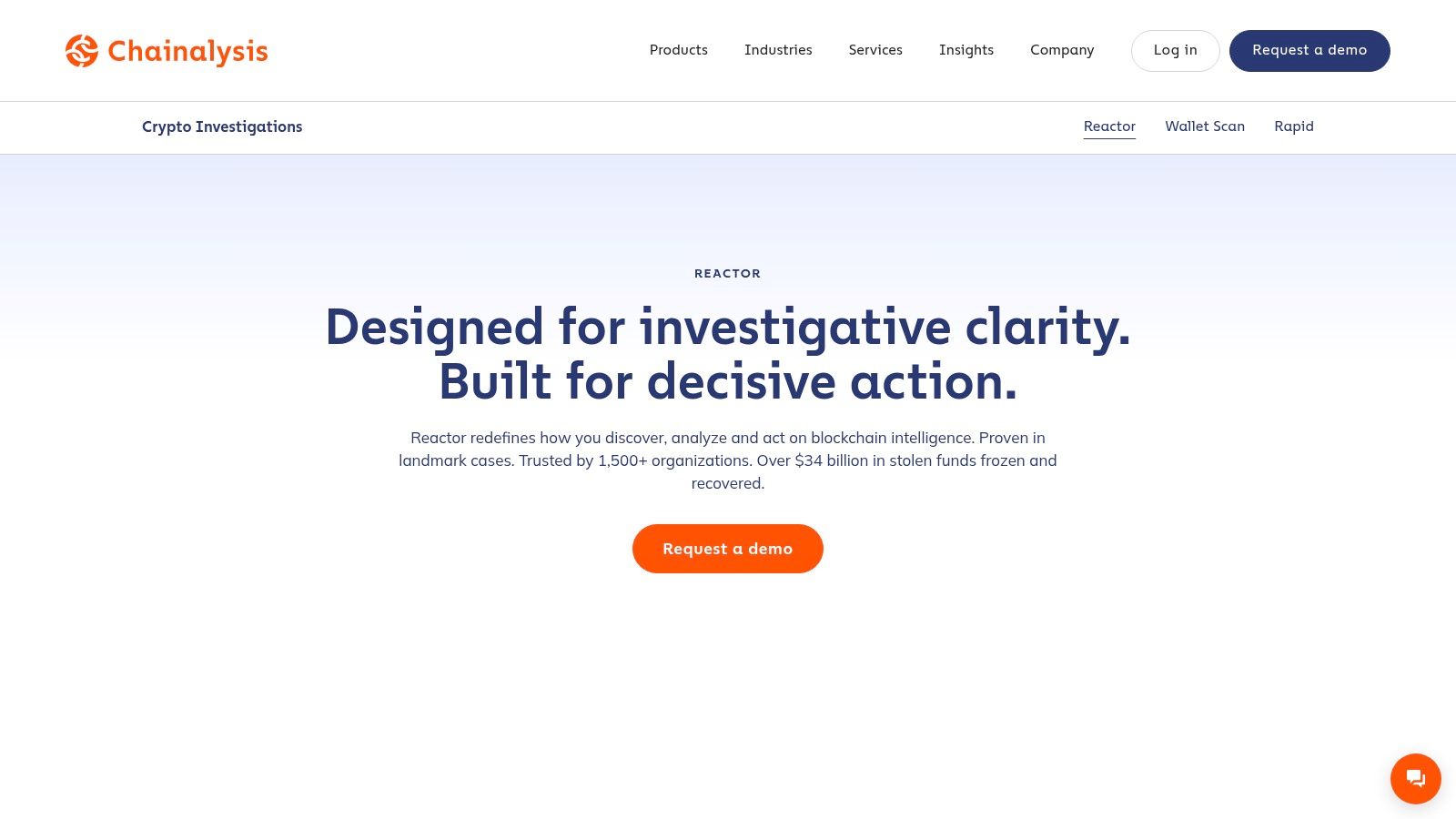
The platform excels at visualizing the flow of funds across multiple blockchains, allowing users to follow money trails through mixers and chain-hopping services. For DeFi traders and analysts, Reactor can be invaluable for due diligence, helping to identify wallets connected to known scams or hacks before interacting with a protocol. While not a typical smart-money signal tool, understanding its capabilities is crucial for risk management. For a deeper dive into these tracing methods, you can learn more about crypto transaction tracking.
Pros:
Cons:
Website: https://www.chainalysis.com/chainalysis-reactor/
TRM Labs offers a comprehensive investigations stack that stands out for its cross-chain capabilities and government-ready deployment options. Its platform is designed for professional investigators, providing a suite of blockchain forensics tools to trace illicit funds, analyze wallet origins from seed phrases, and respond to incidents in real-time. TRM Forensics excels at visualizing complex fund flows across more than 30 blockchain networks, making it a powerful asset for unraveling sophisticated laundering schemes.

A unique aspect of TRM's offering is Triage, a mobile-first tool enabling on-the-go incident response, a critical feature for field agents. For DeFi analysts, the platform's ability to trace funds through chain-hopping and mixers is invaluable for risk assessment and identifying wallets involved in exploits or exit scams. Understanding these flows is essential to avoid interacting with entities linked to malicious activities, such as those detailed when you explore the meaning of a rug pull.
Pros:
Cons:
Website: https://www.trmlabs.com/blockchain-intelligence-platform/forensics
Elliptic offers a sophisticated suite of blockchain forensics tools designed for comprehensive risk management and investigative work. The platform is structured into three core products: Investigator for deep-dive tracing, Navigator for real-time transaction monitoring, and Lens for quick, single-wallet screening. This modular approach allows organizations to select the specific capabilities they need, from proactive compliance to reactive incident response. Elliptic’s strength lies in its holistic coverage of the entire risk lifecycle.

The platform provides clear, court-ready visualizations for tracing funds across multiple chains and services. For DeFi traders, Elliptic's real-time risk screening can be a powerful asset for vetting counterparties or smart contracts before engagement, helping to avoid interaction with sanctioned entities or known illicit wallets. The company also stands out by offering formal product and investigator certification programs, providing a structured pathway for professionals to validate their expertise in blockchain analytics.
Pros:
Cons:
Website: https://www.elliptic.co/blockchain-forensics-tools
Crystal Intelligence, developed by the team at Bitfury, is a comprehensive blockchain analytics and surveillance platform designed for financial institutions, law enforcement, and crypto businesses. It excels at providing AI-supported investigations and real-time risk monitoring. The platform's core value proposition is its ability to deliver actionable intelligence by classifying entities and flagging high-risk transactions, streamlining the compliance and investigation workflow.

For traders and analysts, Crystal provides a powerful lens for due diligence and counterparty risk assessment. Its interactive network mapping allows users to visualize connections between wallets and known entities, helping to avoid engagement with addresses linked to illicit activities. While enterprise-focused, its capabilities are a key part of the broader ecosystem of professional blockchain forensics tools that shape market integrity.
Pros:
Cons:
Website: https://crystalintelligence.com/
Coinfirm specializes in enterprise-grade Anti-Money Laundering (AML) and Counter-Financing of Terrorism (CFT) analytics, positioning itself as a key regulatory technology provider for exchanges and financial institutions. Its platform is designed to deliver automated risk assessments on crypto addresses and transactions, helping businesses meet stringent compliance obligations. The core of its offering is the C-Score, a proprietary risk rating that evaluates wallets based on their connections to illicit activities and high-risk entities.

For traders and analysts, Coinfirm provides a valuable layer of due diligence, particularly when assessing the risk profile of counterparties or new DeFi protocols. Unlike more purely investigative blockchain forensics tools, Coinfirm’s strength lies in its automated, scalable risk-scoring engine. The platform also offers investigative services for more complex cases, combining on-chain data with traditional intelligence. Transparency is a notable feature, with the company publicly publishing its operational status and detailed token coverage information, which is useful for operational planning.
Pros:
Cons:
Website: https://www.coinfirm.com/
Merkle Science positions itself as a predictive risk and intelligence platform, bridging the gap between investigative forensics and proactive compliance. Its flagship product, Tracker, provides robust transaction tracing capabilities, but the platform's key differentiator is its focus on behavior-based analytics. Instead of relying solely on known addresses, it uses proprietary algorithms to detect suspicious patterns and emerging threats, making it a valuable tool for identifying previously unknown illicit actors.

This dual focus makes Merkle Science one of the more versatile blockchain forensics tools for both investigators and compliance teams. For traders and analysts, its wallet screening APIs can be integrated into risk management workflows to score addresses before transacting. The platform also offers structured training and certification courses, which is a significant advantage for organizations looking to build in-house expertise in crypto investigations and Anti-Money Laundering (AML) procedures.
Pros:
Cons:
Website: https://www.merklescience.com/
Scorechain stands out in the blockchain forensics tools landscape with its strong focus on European regulatory compliance, including frameworks like MiCA and FATF. It offers a suite of products designed for continuous transaction monitoring, wallet screening, and VASP risk assessments, making it particularly useful for regulated entities. Its unique selling proposition is its flexibility, offering services that range from a simple "buy-a-report" option for individual wallet checks to a full enterprise-grade monitoring platform.

This platform provides AI-assisted screening to enhance accuracy and efficiency, along with real-time alerts for suspicious activity. For traders and analysts, Scorechain's exploration tools can help identify high-risk counterparties or track the origin of funds before engaging with a new protocol or wallet. The availability of a Telegram bot for quick checks adds a layer of convenience for on-the-go risk assessment, distinguishing it from more rigid enterprise solutions.
Pros:
Cons:
Website: https://www.scorechain.com/
Breadcrumbs offers a highly accessible entry point into the world of professional blockchain forensics tools, balancing powerful investigative features with transparent, manageable pricing. The platform is designed for both on-chain sleuths and businesses needing compliance solutions, providing web-based tracing graphs, collaborative case management, and real-time alerts. Its key differentiator is its straightforward approach to access, particularly its priced Risk API, which allows developers and smaller teams to integrate risk scoring into their applications without committing to an enterprise-level contract.

This makes Breadcrumbs a practical choice for growing DeFi projects, analysts, or smaller investigative firms that need robust tools without the significant upfront investment required by legacy providers. The platform also provides dedicated training and licensing programs for law enforcement, making it a versatile solution for a wide range of users. For traders, its API can be a cost-effective way to programmatically check wallet risk profiles before engaging in high-value transactions or following a "smart money" wallet.
Pros:
Cons:
Website: https://www.breadcrumbs.app/pricing
MistTrack is a comprehensive on-chain analytics and AML compliance platform developed by the security firm SlowMist. It provides a suite of blockchain forensics tools designed for investigators, compliance officers, and analysts to trace funds, assess risk, and monitor addresses across an extensive range of blockchains. Its key differentiator is its broad and early support for newer L2s and non-EVM chains like TON, making it highly relevant for investigations that span beyond the main Ethereum ecosystem.
The platform combines powerful on-chain tracing with a user-friendly interface that includes a collaborative case management workspace. For traders and analysts, MistTrack is particularly useful for proactive risk assessment, allowing you to check the AML risk score of an address before interacting with it. The real-time monitoring and alerting features can also serve as an early warning system for wallets you are tracking, notifying you of suspicious inflows or outflows connected to illicit activities.
Pros:
Cons:
Website: https://misttracks.com/
GraphSense is a powerful, open-source blockchain forensics tool designed for organizations that prioritize data sovereignty, transparency, and cost-effectiveness. As a self-hosted analytics stack built on scalable technologies like Apache Spark and Cassandra, it provides a no-license alternative to commercial enterprise solutions. Its core strength lies in its transparent, academically-backed algorithms, allowing investigators and researchers to have full control and understanding of their analytical processes.

This platform is ideal for research institutions, privacy-focused organizations, or any team with the technical resources to manage their own infrastructure. It offers robust features for tracing funds and identifying connections across both UTXO and account-based blockchains. While it operates at a lower level than a standard block explorer, understanding the fundamental data it processes is key; you can learn more about what a blockchain explorer is to appreciate how tools like GraphSense build upon that foundation for deeper analysis.
Pros:
Cons:
Website: https://graphsense.org/
Bitquery is a developer-first platform that provides granular blockchain data through a suite of powerful APIs, distinguishing itself from UI-focused blockchain forensics tools. Its Coinpath APIs are specifically designed for fund-flow tracing, allowing engineering teams to build custom internal tooling or integrate on-chain intelligence directly into trading and operational pipelines. This approach is ideal for quant funds or data-driven analysts who need to programmatically trace assets or monitor wallet activities without a graphical user interface.

The platform offers unparalleled access to mempool data, event logs, and DEX trades through SQL and streaming interfaces, complete with webhooks for real-time alerts. For DeFi traders, this means you can build bespoke systems to track smart money movements or get notified when a wallet of interest interacts with a new protocol. While it requires technical expertise to leverage fully, its flexible, API-centric model empowers users to create highly customized forensic and analytics solutions tailored to their specific strategies.
Pros:
Cons:
Website: https://bitquery.io/products/coinpath
AnChain.AI provides a suite of AI-powered blockchain forensics tools focused on investigations, AML screening, and professional training. Its platform combines multi-chain tracing capabilities with automated risk scoring and sanctions screening, offering a practical solution for both compliance teams and investigators. What sets AnChain.AI apart is its transparent, API-first approach, with public pricing for its AML services, making it more accessible for evaluation and integration than many enterprise-only competitors.

The platform’s "Auto-Trace" feature simplifies the complex task of following illicit funds, while its API delivers rapid risk assessments for wallets and transactions. For analysts and traders, this can be used to programmatically screen counterparty wallets for connections to sanctioned entities or hacks before executing a trade. The inclusion of structured investigator training and certification programs also makes it a valuable resource for teams looking to build in-house expertise in on-chain analysis.
Pros:
Cons:
Website: https://www.anchain.ai/
Navigating the complex, pseudonymous world of blockchain requires more than just a block explorer. As we've detailed, the landscape of blockchain forensics tools is vast and varied, moving from enterprise-grade compliance suites to developer-friendly APIs and open-source platforms. The key takeaway is that no single tool is a silver bullet; the real power lies in a strategic, multi-layered approach that transforms raw on-chain data into actionable, alpha-generating intelligence.
We've explored the titans of the industry like Chainalysis Reactor and TRM Labs, which offer unparalleled entity attribution and are indispensable for AML compliance and law enforcement. These platforms provide the high-level, court-admissible certainty required by institutions. On the other hand, tools like Bitquery's Coinpath APIs and the open-source GraphSense offer the raw building blocks for developers and researchers to construct bespoke analytical systems, providing flexibility at the cost of requiring more technical expertise.
For traders and on-chain analysts, the goal is different. It’s not about convicting a fraudster but about understanding and anticipating market movements. This is where combining tools becomes a critical strategy. The journey from a promising wallet address to a comprehensive trading thesis requires a specific workflow, one that leverages both discovery and deep-dive analysis.
Selecting the right blockchain forensics tools hinges entirely on your specific objectives, technical skill, and budget. Your decision should be guided by a clear understanding of what you need to accomplish.
To simplify this choice, consider these user profiles and their ideal toolsets:
For the DeFi Power User & Smart Money Follower: Your goal is to deanonymize and map the networks of profitable wallets. Start with a discovery engine like Wallet Finder.ai to identify high-potential addresses. Then, use tools like Breadcrumbs or MistTrack for their strong visualization capabilities and user-friendly interfaces to trace fund flows, identify connected CEX deposit addresses, and map out an entity's complete on-chain footprint. This combination helps you understand how smart money operates, not just that it's profitable.
For the Quant Researcher & Data Scientist: You need granular, programmatic access to on-chain data to backtest strategies and build predictive models. Your primary tools will be API-centric platforms like Bitquery and Coinfirm. These services allow you to pull structured transaction graphs, risk scores, and entity data directly into your analytical environment (like a Python script or R), enabling sophisticated, large-scale analysis that visual interfaces cannot support.
For the Crypto Fund & Institutional Desk: Your needs are dominated by compliance, risk management, and operational security. Enterprise-level solutions are non-negotiable. Platforms like Chainalysis, TRM Labs, and Elliptic are the gold standard. They provide the necessary AML/CFT risk scoring, sanctions screening, and detailed investigative reports required for regulatory adherence and to protect firm capital from illicit fund flows.
The true art of on-chain analysis is synthesis. It's about taking a signal from one platform and enriching it with data from another. You might identify a "whale wallet" accumulating a new token on a discovery platform, but a forensics tool will reveal if that whale is funded by a major venture capital firm or a known market maker. This context is the difference between blindly following a trade and making an informed strategic decision.
By mastering this workflow, you elevate your analysis from simple transaction tracking to genuine on-chain intelligence. You gain the ability to see the hidden connections, understand the capital flows that precede major market events, and ultimately, position yourself ahead of the curve. The blockchain is a transparent ledger, and with the right set of blockchain forensics tools, it becomes a strategic map to navigating the future of digital assets.
Ready to find the smart-money signals that forensic tools help you investigate? Wallet Finder.ai uses advanced AI to scan millions of wallets, identifying top traders and high-potential alpha signals before they go mainstream. Start your analysis with the best wallets by visiting Wallet Finder.ai today.