Bullish Abandoned Baby: Candlestick Pattern Mastery
Master the powerful bullish abandoned baby pattern. Learn identification, backtested reliability, and trading rules with on-chain examples.

April 12, 2026
Wallet Finder

April 12, 2026

You know the setup. A token has been bleeding for days, sentiment is dead, the timeline is calling for lower prices, and then the market snaps higher without giving a clean second chance. Most missed reversals don’t happen because traders can’t see weakness in sellers. They happen because the entry trigger is fuzzy.
That’s where the bullish abandoned baby earns attention. It’s not common, and that’s part of the appeal. When it appears correctly, it shows a very specific shift in control. Sellers press price down, momentum stalls into a doji, then buyers gap price back up and take over.
Used alone, it’s still just a chart pattern. Used with structure, volume, and on-chain confirmation, it becomes a serious reversal framework for crypto traders who care about timing and conviction.
Most traders recognize exhaustion only after price has already moved. The chart looks washed out, momentum feels weak, and support starts attracting bids, but none of that tells you exactly when to act.
The bullish abandoned baby does.
It’s one of the few reversal patterns that gives a clean visual handoff from sellers to buyers. That is important in crypto, where fake bounces are common and “bottom fishing” can turn into repeated losses if you enter too early.
The strength of this setup comes from its structure, not from wishful interpretation.
You want to see three things at once:
That combination is what separates this from weaker bottoming patterns.
Practical rule: If the market is chopping sideways, skip it. The bullish abandoned baby is a reversal pattern, not a range pattern.
Most mistakes happen before the trade is even placed.
Common errors include:
The edge comes from being strict. If the structure is messy, it’s not the setup.
The bullish abandoned baby is a rare three-candlestick reversal pattern that forms at the end of a downtrend. It consists of a large red bearish candle, then a doji that gaps down, then a large green bullish candle that gaps up. The gaps around the doji are mandatory. Without them, the pattern is invalid and starts to look like a weaker formation instead, as described by The Trading Analyst’s bullish abandoned baby guide.
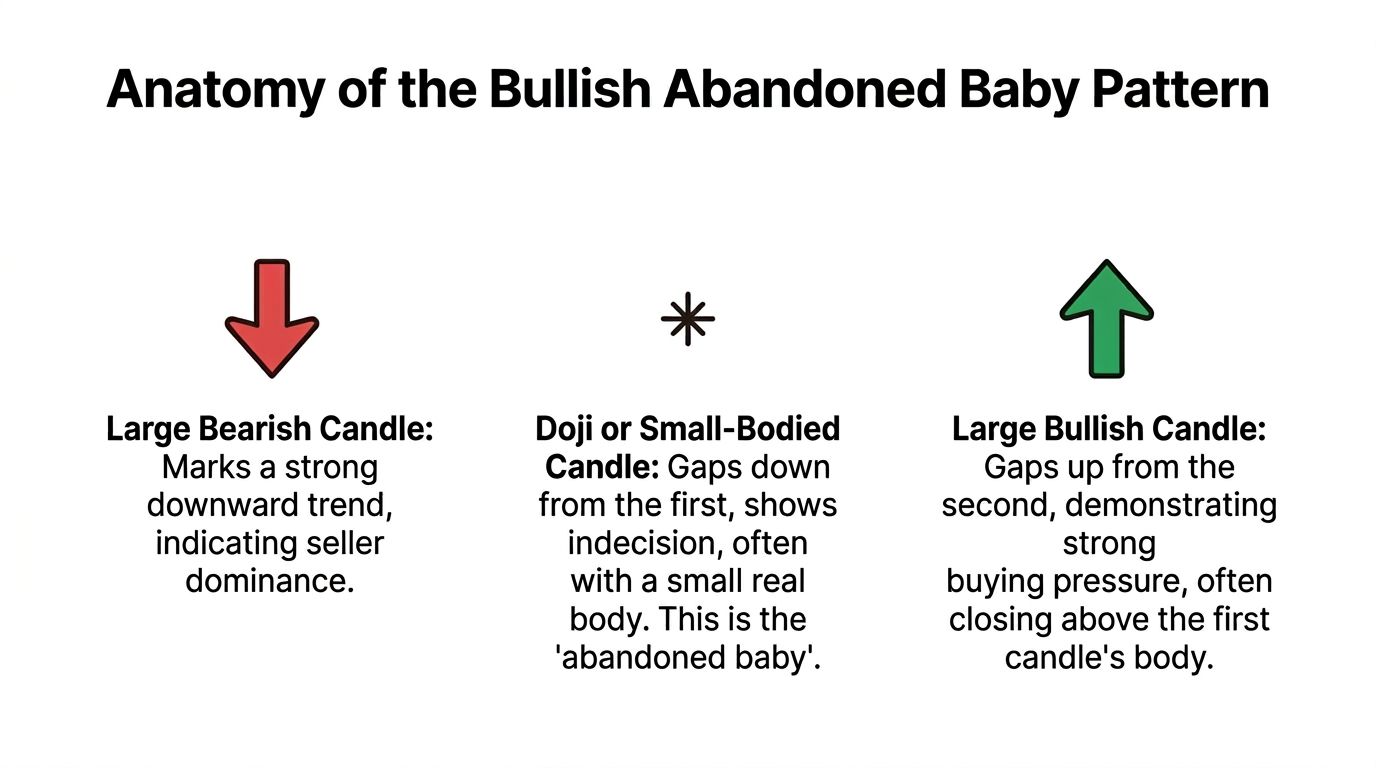
If you need a quick refresher on candle structure before applying this setup, this candlestick chart for cryptocurrency guide is a useful companion.
The first candle should be clearly bearish.
This isn’t a random red candle in a flat market. It should look like continuation, the kind of candle that makes late shorts feel comfortable and early buyers feel trapped.
What matters psychologically is simple. Sellers still believe they’re in control. The market agrees, at least for one more push lower.
The second candle is the heart of the pattern.
It’s a doji, or at minimum a very small real body, and it must sit below the first candle with a gap. That isolation is what gives the pattern its name. Price has been pushed lower, but instead of extending the selloff with confidence, the market stalls.
That stall matters more than many traders think.
A doji at the bottom of a downtrend says neither side is pressing with conviction at those lower prices. Sellers no longer have the same urgency. Buyers haven’t fully taken over yet, but they’re no longer backing away.
The doji isn’t the reversal by itself. It’s the point where downside momentum stops behaving like strong momentum.
The third candle is where the signal becomes actionable.
It must gap up from the doji and print a strong bullish body. In a clean version of the pattern, that candle doesn’t just bounce. It reclaims territory with intent and closes deep enough into prior damage to show that buyers are now the side dictating price.
That upward gap is the tell.
In weaker reversal structures, buyers improve price gradually. In a bullish abandoned baby, they reject the lower area so aggressively that the market leaves another gap. That’s a much stronger statement.
Many traders identify the color sequence correctly but miss a key requirement.
The pattern only deserves the name if the doji is flanked by gaps. Those gaps create a small “island” in price action. Visually, the market abandons the lower area and then abandons it again on the way back up.
That’s why the pattern carries more weight than a standard bullish engulfing or an ordinary three-candle recovery.
The easiest way to understand it is:
The market isn’t negotiating. It’s changing its mind fast.
When scanning crypto charts, use a tight filter:
| Element | What you want to see | What weakens it |
|---|---|---|
| Prior trend | Clear downtrend with repeated lower movement | Sideways chop |
| First candle | Strong bearish body | Small mixed candle |
| Middle candle | Doji or tiny body, isolated | Overlap with nearby candles |
| Third candle | Strong bullish candle with clear reclaim | Weak green candle or hesitation |
| Gap structure | Visible gap below and above the doji | No real separation |
Several patterns get confused with the bullish abandoned baby.
That’s why this setup is rare. The rules are strict.
A pattern can look great on a chart and still be useless in live trading. The only reason to care about the bullish abandoned baby is that its backtested record gives it real credibility.
Thomas Bulkowski’s testing found that the Bullish Abandoned Baby ranks 13th in effectiveness for bullish reversals among 103 candlestick types, with a 70% success rate. It was also rare, ranking 92nd in frequency, with only 293 examples out of 4.7 million candle lines analyzed, according to The Pattern Site’s bullish abandoned baby research.

For traders who like to pair reversal patterns with participation metrics, this guide to volume analysis in crypto is worth keeping nearby.
Ranking 13th out of 103 doesn’t mean every trade is a winner. It means the pattern has held up better than most candlestick formations tested in the same framework.
That’s important because candlestick education often treats patterns as equal. They aren’t.
Some formations are common but weak. Others are visually appealing but unreliable. The bullish abandoned baby stands out because it combines a strong ranking with a very specific structure that traders can verify quickly.
This setup doesn’t show up often. Bulkowski’s frequency numbers make that clear.
That creates two practical consequences:
A rare pattern often gets overlooked by traders who want constant action. That’s a mistake. Some of the best setups aren’t useful because they’re frequent. They’re useful because they force patience and selectivity.
What works: waiting for a clean print in a meaningful location.
What doesn’t: hunting for “almost” versions to create more trades.
The backtest supports the pattern. It doesn’t remove the need for judgment.
A few trade-offs matter:
The pattern is stronger when the prior downtrend is obvious. In a drifting market with no real impulse lower, the reversal signal means less.
True gaps are easier to trust on cleaner, more liquid charts. On thin tokens, price can print odd candles that look dramatic but reflect poor market quality rather than real sentiment change.
The pattern is best treated as a trigger, not as a complete thesis. If the broader market is unstable, BTC is weak, or the asset sits under heavy overhead supply, the reversal may stall quickly.
The 70% success rate is strong. It is not permission to overbet.
Many traders misuse win-rate data. They see a strong number and assume they’ve found a shortcut. That’s usually where discipline breaks down.
A better way to use the data is this:
You’re not looking for certainty. You’re looking for a repeatable edge.
The best practical use of this setup is in markets where downside momentum has become crowded.
That’s where the structure helps. Shorts feel validated by the first candle. Indecision enters through the doji. Then buyers seize control before the crowd can adjust. If your entry plan is disciplined, you can often define risk tightly while leaving room for a larger rebound.
That’s the core appeal. Not high frequency. Not perfection. Good asymmetry.
| Metric | Historical result |
|---|---|
| Effectiveness rank | 13th among 103 candlestick patterns |
| Reversal success rate | 70% |
| Frequency rank | 92nd |
| Observed examples | 293 |
| Sample analyzed | 4.7 million candle lines |
Those numbers tell a clean story. The bullish abandoned baby is uncommon, but it isn’t a novelty pattern. It has a tested edge, and that edge is strong enough to matter if you stay selective.
Theory gets easier when you map it onto real market behavior. In crypto, the bullish abandoned baby tends to matter most when a liquid asset has already seen heavy directional selling and sentiment is stretched.

LuxAlgo notes that backtested performance shows a 70% bullish turnaround rate and 71% price target accuracy after downward breakouts, while also stressing that the pattern is rare and stronger with rising volume, in its discussion of evening stars and abandoned babies.
On an ETH daily chart, this pattern is easiest to trust after a visible selloff into a known support region or after a broad market flush.
The sequence usually reads cleanly:
What matters in practice is how the third candle behaves by the close. If buyers hold the reclaim and don’t give back most of the move, the signal is far more useful.
On ETH, I’d treat this as a swing setup first, not a scalp. Large-cap charts tend to respect cleaner reversal structures when the broader market is stabilizing.
A four-hour SOL chart can produce a sharper version of the same idea, especially after a fast liquidation event.
This version trades differently from the daily chart:
That means execution has to tighten up. If the third candle breaks and then loses momentum immediately, I’d be less patient than I would be on a daily signal.
A good four-hour bullish abandoned baby should feel like demand arrived fast. If the chart starts dragging right after confirmation, that’s already a warning.
BTC doesn’t always print textbook gaps the same way traditional markets do, but when a similar isolated doji structure appears around a washed-out move, it deserves attention.
The key on BTC is context.
A reversal pattern during broad panic means more if:
BTC also acts as a filter for the rest of the market. If BTC prints a convincing reversal and then holds, alts have a better shot of following through.
The LuxAlgo data explicitly notes that the pattern is stronger when confirmed with rising volume. That tracks with live trading experience.
A third candle that prints on weak participation is easier to fade. A third candle that expands with clear interest is harder for sellers to suppress.
When reviewing examples, I pay attention to three volume tells:
Not every crypto chart deserves equal trust.
| Asset type | How I treat the signal |
|---|---|
| BTC and ETH | Best for context and cleaner confirmation |
| Large liquid alts | Good swing candidates when trend is stretched |
| Mid-caps | Tradable, but need stricter structure |
| Thin memecoins | High caution, because odd prints can fake the pattern |
The strongest chart examples share a few traits, even across different assets.
The practical takeaway is simple. Don’t memorize the pattern as artwork. Read it as behavior. The pattern works when it captures a real shift in control, not when three candles happen to resemble the textbook.
A pattern without execution rules is just chart trivia. The bullish abandoned baby becomes useful only when you know exactly where to enter, where the trade is wrong, and how you’ll manage the position after confirmation.
The cleanest entry is usually above the high of the third candle.
That approach does two things. First, it forces the market to prove there’s still demand after the visual pattern forms. Second, it reduces the number of trades taken on candles that look bullish at the close but lose momentum immediately after.
Some traders enter at the close of the third candle. That can work, but it gives you less confirmation. In crypto, I prefer letting price trade through the confirmation level unless the market is moving fast and liquidity is strong.
The most logical stop is below the low of the doji.
That level matters because the doji represents the point where selling pressure stalled. If price breaks back through it after confirmation, the core premise of the reversal is weakening.
There are only two reasons I’d widen that stop:
If you have to widen the stop too far to make the trade survivable, the better choice is often to reduce size or skip the setup.
Execution note: Good setups don’t need heroic stop placement. If the chart requires too much interpretation, it probably isn’t clean enough.
The bullish abandoned baby works best as a reversal entry, not as a promise of a full trend change.
That’s why profit-taking should be grounded in nearby structure. The first places I look are prior support-turned-resistance zones, local breakdown areas, and any overhead level where trapped longs might sell into strength.
There are a few practical approaches:
The mistake is expecting every reversal to become a major trend expansion. Some do. Many don’t.
Even high-quality patterns fail.
That’s why the best trading plan starts with risk first, not with upside dreams. The setup gives you a useful technical invalidation point, which is valuable, but your size still needs to reflect liquidity, volatility, and market regime.
On cleaner large-cap charts, the signal is easier to trust. On fast-moving alts, I’d size more conservatively even if the pattern looks perfect. Crypto reversals can become chaotic quickly.
When I’m evaluating whether to trade this setup, I want mostly “yes” answers to these questions:
If several answers are weak, I pass.
| Component | Rule / Guideline | Rationale |
|---|---|
| Market context | Trade it after a real downtrend, not inside random chop | Reversal patterns need prior seller control to matter |
| Pattern quality | Require a bearish first candle, isolated doji, and strong bullish third candle | Loose interpretations reduce edge |
| Gap requirement | Keep the setup only if the doji is flanked by genuine gaps | The gaps are what separate it from weaker reversals |
| Entry trigger | Enter on a break above the third candle’s high, or use the close only when confirmation is very strong | Waiting for continuation filters weak closes |
| Stop-loss | Place the stop below the doji low | That level marks the point where the reversal thesis breaks |
| First target | Use the nearest resistance or breakdown reclaim area | Reversals often stall at the first overhead supply zone |
| Trade management | Scale partials if the move reaches the first objective quickly, then trail the rest if structure improves | This keeps gains while preserving upside |
| Position sizing | Size by stop distance and asset volatility, not by confidence in the pattern | Strong setups still fail |
| Confirmation filter | Favor charts where the third candle shows stronger participation and cleaner price reclaim | Better confirmation reduces false starts |
| Skip conditions | Avoid thin markets, messy overlap, weak third candles, or hostile market backdrop | Pattern quality collapses fast in poor conditions |
Here’s the blunt version.
What works
What doesn’t
A trader’s edge doesn’t come from spotting the name of the pattern. It comes from trading the cleanest version of it with discipline.
A strong chart setup gets better when you can see who is buying. That’s the missing layer for many crypto traders. They stop at technical confirmation and never ask whether on-chain behavior supports the reversal.

On-chain analysis gives you a second lens. The chart tells you that control may be shifting. Wallet behavior tells you whether informed participants are acting on that shift.
For traders who want the mechanics behind that process, this primer on on-chain analysis lays out the core concepts well.
The highest-conviction bullish abandoned baby setups usually have at least one of these on-chain signals behind them:
A reversal pattern can form from nothing more than short covering, making this observation important. On-chain accumulation helps you separate a reflex bounce from genuine positioning.
The sequence is simple.
First, identify the pattern on a liquid chart. Then check whether smart wallets are entering, adding, or holding through the reversal area. If they are, the trade has more substance. If they’re selling into strength, I trust the chart less.
That doesn’t mean on-chain data overrides price. It means it sharpens the read.
Not all wallet activity matters equally.
Focus on behavior that fits the reversal thesis:
| On-chain behavior | Why it matters |
|---|---|
| Fresh buys from consistently profitable wallets | Suggests conviction, not random activity |
| Multiple wallets entering around the same zone | Shows interest clustering near the reversal |
| Lack of immediate distribution after the bounce | Supports continuation rather than exit liquidity |
| Token-level inflow into the same narrative pocket | Confirms broader appetite |
On-chain confirmation improves selectivity, but it can also slow you down.
If you wait too long for perfect wallet evidence, the best part of the move may already be gone. If you ignore wallet behavior completely, you may take technically clean setups that lack real sponsorship.
That’s why I treat on-chain data as a filter, not as a reason to hesitate forever.
The chart gives the trigger. On-chain flow tells you whether the move looks supported or hollow.
Use a repeatable process:
Here, traditional chart reading and crypto-native intelligence fit together. The pattern helps with timing. On-chain data helps with conviction.
If you want to turn that process into a repeatable workflow, Wallet Finder.ai is built for it. You can track profitable wallets across ecosystems like Ethereum, Solana, and Base, inspect complete trading histories, monitor entries and exits in real time, and set alerts when smart money starts buying the same token that’s printing a bullish reversal on your chart. That combination makes it easier to stop trading patterns in isolation and start trading them with context.