Fix a Coinbase Restricted Account

Wallet Finder

Blank calendar icon with grid of squares representing days.

February 14, 2026

When you log into Coinbase and see the dreaded “Account Restricted” banner, it’s easy to feel a jolt of panic. In simple terms, it means you've temporarily lost the ability to buy, sell, or move your funds. This is usually Coinbase's automated system hitting the brakes to protect you from what it perceives as a threat.

Think of it as a digital security guard. It might be reacting to something as simple as you logging in from a new coffee shop or making a much larger trade than usual.

Getting to the Bottom of Why Coinbase Restricted Your Account
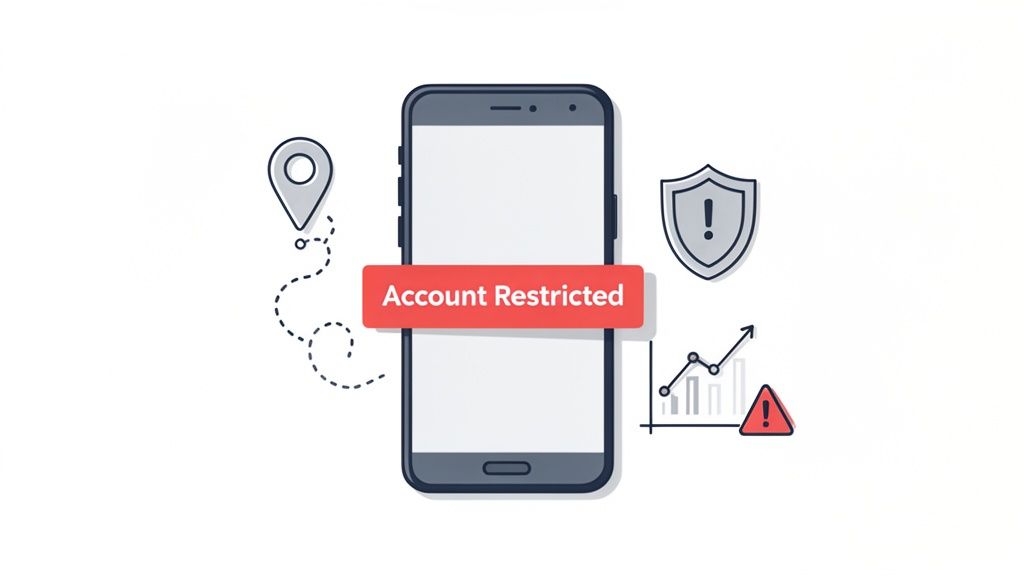
A smartphone displaying an 'Account Restricted' message with surrounding icons representing location, security, and financial activity warnings.

That sinking feeling is universal, especially when the crypto market is on the move. But that notification isn't just a generic error—it’s a specific security measure. The first step to getting things back on track is figuring out why it happened in the first place.

Most restrictions fall into two buckets: temporary security holds and more serious compliance reviews. A temporary hold is often just an automated hiccup, a quick check to make sure it's really you. A compliance review, on the other hand, is more involved and usually means a human at Coinbase needs to take a closer look at your account.

How Coinbase's Automated Risk Scoring Actually Works

Every action you take on Coinbase — logging in, making a trade, initiating a withdrawal, changing settings — feeds into an automated risk scoring system that's constantly evaluating whether your account behavior looks legitimate or suspicious. This isn't a simple checklist where one wrong action triggers a restriction. It's a weighted scoring model where multiple factors combine to push your risk score higher or lower. Once your score crosses a certain threshold, the restriction happens automatically without any human reviewing your case first.

The system uses machine learning trained on millions of accounts to identify patterns associated with compromised accounts, fraud, money laundering, and other prohibited activities. Individual factors might be completely innocent in isolation — using a VPN, making a large deposit, logging in from a new location. But when several of these factors happen in combination within a short timeframe, the cumulative risk score spikes and triggers the automated lock.

Understanding this scoring system helps you avoid innocent actions that accidentally combine into a high-risk profile. The most common pattern that creates false positives is: new device login + VPN or foreign IP + immediate large withdrawal attempt. Each factor individually might only raise your score slightly, but stacked together they create the exact signature of an account takeover, where an attacker gains access and immediately tries to drain funds before the real user notices.

The second dangerous pattern is: sudden activity increase after dormancy. If your account has been quiet for months and suddenly logs in, updates payment information, and attempts large trades all in one session, that looks like an account that got compromised during the inactive period and is now being exploited. The system flags this aggressively because dormant account takeovers are a known attack vector.

Minimizing Your Risk Score Through Behavioral Patterns

The defensive strategy is building a consistent, low-risk behavior pattern over time that trains the system to recognize your legitimate activity. Start conservatively with new accounts — small trades, familiar locations, no VPN for the first few months. As your account ages and builds history, the system becomes more tolerant of variations because it has baseline data showing what your normal looks like.

When you need to do something that might trigger flags — logging in from a new country while traveling, making an unusually large trade, moving funds to a new wallet address — prepare the account by doing it gradually rather than all at once. Whitelist the new withdrawal address first and wait 24 hours before actually sending funds to it. Log into the account from your normal location before your trip, then again from the travel location, so the system sees the gradual shift rather than a sudden unexplained location change.

For VPN users, the safest approach is disabling the VPN specifically for Coinbase logins while keeping it active for other browsing. The login itself is what gets geolocation-checked most aggressively. Once you're logged in, the session is already authenticated and subsequent actions carry less location-risk weight. Alternatively, use a dedicated VPN server in your actual home region rather than routing through random international exit nodes, which minimizes the location anomaly the system sees.

Common Triggers for Account Restrictions

Coinbase’s security is built to be aggressive, which sometimes means it flags perfectly legitimate activity. The platform itself has noted that a rise in user activity led to a 2-3x surge in fraudulent attempts, which forced them to tighten their fraud prevention models.

This led to what they described as a "minor increase" in restricted accounts, but for users, it felt like getting frozen for simple things like using a VPN or logging in while on vacation. You can get the full story on these security updates in the Coinbase user activity report.

Here are the usual suspects that can trigger an automated lockdown:

  • New Device or Location: Logging in from your new laptop or a different country is a classic red flag for their system.
  • VPN Usage: While not always a deal-breaker, using a VPN can sometimes make it look like you're logging in from a high-risk location, triggering a block.
  • Unusual Transaction Patterns: If you normally trade a few hundred dollars and suddenly move thousands, the system takes notice.
  • Failed Login Attempts: Too many wrong password guesses can temporarily lock your account to stop a potential brute-force attack.

The key thing to remember is the difference between intent and perception. You see a normal transaction, like moving funds to a new hardware wallet. Coinbase’s algorithm might see a potential security breach and slam the gates shut.

A Quick Diagnostic Tool

To get a head start on resolving this, retrace your recent actions. Did you travel? Connect to public Wi-Fi? Execute a massive trade? Answering these questions is your first move toward getting your access back.

This table breaks down the most common restriction scenarios and tells you exactly what to do first.

Common Coinbase Restriction Triggers and First Steps

Restriction TypePotential CauseRecommended First ActionLogin DisabledUnrecognized IP address, multiple failed login attempts, or new device.Reset your password and check your email for a security notification from Coinbase.Send/Withdraw DisabledLarge or unusual transaction, interaction with a flagged address.Review your transaction history for accuracy and prepare to verify your identity.Buy/Sell DisabledOutdated identity documents or need for updated source of funds info.Navigate to your account settings and look for prompts to re-verify your ID.Full Account FreezeSerious compliance concern or potential violation of Terms of Service.Immediately check your email for a detailed message from the Coinbase compliance team.

Use this as your starting point. Identifying the likely cause helps you gather the right information before you even contact support, which can dramatically speed up the resolution process.

Preparing Your Documentation for a Smooth Appeal

When Coinbase freezes your account, your first instinct might be to fire off an angry email to support. I get it. But take a breath and pause. A strategic approach that starts with gathering the right evidence can turn a months-long headache into a quick fix.

Think of yourself as building a case file. The goal is to hand the compliance team an organized, undeniable package that makes it easy for them to say "yes" and lift the restriction. Showing up with a messy, incomplete submission is like going into a meeting unprepared—it rarely ends well. A solid set of documents proves who you are and that your funds are legit, answering their questions before they even have to ask.

Your Core Documentation Checklist

Before contacting support, prepare high-quality digital copies of these essentials. Vague, blurry, or incomplete documents are one of the top reasons appeals get stuck in limbo.

  • Type: Driver’s license or passport.
  • Condition: Must be valid (not expired).
  • Photo Quality: Crystal clear, no glare, with all four corners of the ID visible.
  • Type: A recent utility bill (gas, electric) or a bank statement.
  • Date: Must be dated within the last 90 days.
  • Match: The name and address must exactly match your Coinbase profile.
  • Action: Take a clear photo holding your ID next to your face.
  • Environment: Use a well-lit room.
  • Legibility: Ensure both your face and every detail on the ID are perfectly readable.

Submitting sloppy or hard-to-read documents is the fastest way to get your ticket pushed to the bottom of the pile. Make it easy for the reviewer, and they'll resolve your issue faster. It’s that simple.

Handling More Complex Scenarios

Sometimes, the standard ID check isn't enough, especially if a large transaction or unusual login triggered the restriction. In these cases, you’ll need to provide more context to prove your funds are legitimate and your actions aren't a security risk.

Be ready to explain these situations with solid proof:

ScenarioRequired Documentation & ExplanationLarge Deposit or TradeProvide transaction screenshots from the sending exchange or your bank account. Include a brief, clear explanation for the transaction, like "Consolidating assets from another platform where I am also fully verified."Use of Privacy Tools/VPNDon't hide it. Acknowledge that you use a VPN for general online security. Then, confirm the physical location you were actually in during the flagged activity. Honesty is crucial here.Unusual Login LocationWere you on vacation? If you logged in from a different country or state, offer proof like a flight confirmation or hotel receipt to verify your location and explain why it looks out of the ordinary.

Getting ahead of these potential red flags shows the compliance team that you're transparent and have nothing to hide. By giving them a complete story backed by clear evidence, you remove any doubt and dramatically boost your chances of getting your account back quickly.

How to Talk to Coinbase Support and Actually Get Help

Getting your account unlocked really boils down to how you communicate with Coinbase's support team. Sending a vague, frantic message is a one-way ticket to delay-ville. But a clear, well-documented support ticket can cut through the noise and get you a much faster resolution.

The trick is to give them everything they need right from the start.

When you open that first support ticket, think of it as filing a clean, organized report. Lead with your case number if you already have one, state the problem clearly, and attach all the documents you've already gathered. This simple step can eliminate the painful back-and-forth emails that turn a quick review into a multi-week headache.

Crafting the Perfect Support Message

For the best results, you need to be professional but direct. Ditch the emotional language and just stick to the facts. It doesn't have to be complicated; something simple and clear works best.

Here’s a template I’ve seen work well. Feel free to adapt it.

Subject: Account Restriction Inquiry - Case #[Your Case Number, if you have one]

Body:

  • Account Email: [Your Coinbase Account Email]
  • Full Name: [Your Full Name as it appears on your ID]
  • Issue: My account is restricted, and I can't [mention specific actions, e.g., send crypto, withdraw funds, trade].
  • Timeline: The restriction started on [Date]. I think it might be because [mention a possible reason, e.g., I logged in from a new device, I made a large deposit].
  • Attached Documents: I've attached my government-issued ID, proof of address, and other documents you might need to speed up the review.

This structure gives the support agent a complete picture right away. You're making their job easier, which in turn makes your life easier.

Your first message should make it so easy for the support agent to help you that they can solve it in one touch. Give them everything they need upfront.

Understanding the Internal Queue System: Why Some Cases Resolve in Hours and Others Take Weeks

Not all restricted accounts enter the same support queue. Coinbase operates a tiered case management system where restriction appeals get categorized and prioritized based on specific criteria that determine how quickly they get reviewed. Understanding this system lets you optimize your submission to land in the faster queues rather than the slow ones.

The primary categorization factor is restriction type. A temporary security hold triggered by a single suspicious login gets routed to a different queue than a compliance hold triggered by a large cash deposit from an unfamiliar source. Security holds are often automated and can be cleared by an automated system once you re-verify identity, which is why some users report restrictions lifting within hours. Compliance holds require human review and sit in a queue that compliance officers work through during business hours, which immediately adds days to the timeline.

The second factor is documentation completeness at initial submission. Cases that arrive with all required documents already attached get prioritized over cases where support has to request documents, wait for the user to respond, then restart the review. This is why the article emphasizes preparing everything before your first message — you're not just being helpful, you're literally jumping the queue by arriving ready for immediate review.

The third factor is account value and history. This isn't officially published, but patterns in user reports suggest that accounts holding larger balances or with longer account histories get slightly faster review times than brand new accounts with minimal funds. The logic is triage: a user locked out of fifty thousand dollars is experiencing more harm than a user locked out of five hundred dollars, so the higher-value case gets addressed first when resources are limited. You can't change your account value or history, but knowing this exists helps set realistic expectations.

How to Position Your Case for Priority Review

The actionable optimization is frontloading your submission with everything the compliance officer needs to make a decision immediately. Don't just submit your ID and wait for them to ask for proof of address — include both in your first upload. Don't make them ask why you logged in from Thailand — proactively explain in your initial message that you were traveling and include flight confirmation. Every question you answer before they ask is one less delay cycle in the review.

The second optimization is using precise language that matches Coinbase's internal categorization. When you explain your situation, explicitly state which type of restriction you believe you have ("My account appears to have a temporary security hold due to login from a new device" versus "My account is under compliance review due to a large deposit"). This helps the support agent route your case to the correct specialized queue faster than if they have to read through a vague description and guess where it belongs.

The third factor is timing your submission. Compliance reviews happen during business hours in the compliance team's timezone, which appears to be US Pacific time based on when users report movement on their cases. Submitting your appeal Monday morning Pacific time gets it into the queue at the start of the workweek. Submitting Friday afternoon Pacific means it sits untouched through the weekend and starts Monday already buried under newer cases. This won't make a huge difference but every edge helps when you're trying to regain access to your funds.

What to Do When Support Goes Silent: The Escalation Plan

So, what happens if your ticket gets a generic, robotic reply or, worse, no reply at all? Don't just send the same email over and over. It's time to escalate.

Before you do anything, make sure your own documentation is rock-solid. This is the foundation of your case.

Flowchart illustrating the three-step documentation prep process for identification, address, and funds verification.

This process—verifying your identity, address, and source of funds—is non-negotiable. Without it, any attempt to escalate is likely to fail.

If you’ve waited a reasonable amount of time, say 7-10 business days, it's time to take it public. The official @CoinbaseSupport account on X (formerly Twitter) is your next stop. Post a short, polite message that includes your case number. This often gets your ticket moved to a higher-priority queue.

Coinbase knows this has been a massive pain point for users. They've actually shared a public plan to cut down on unnecessary account restrictions by 90%. They’re working on adding self-service fixes in the app, bringing in voice support, and giving users more detailed activity logs to troubleshoot issues from VPNs or strange logins. You can read more about Coinbase's plans to improve the user experience on Phemex.com.

Even with these improvements, getting an account unrestricted requires patience. If you're stuck and need access to your money, take a look at our guide on how to safely cash out of Coinbase once you get your access back.

Advanced Strategies When Standard Support Fails

It's a sinking feeling. You've sent in your documents, filed support tickets, and waited... only to be met with silence. When your account is still locked and standard support seems to have vanished, it’s easy to feel like you've hit a dead end. But you haven't.

If you've done everything right and are getting nowhere, it's time to stop playing by their standard rules and apply a different kind of pressure. This is where you pivot from customer service to formal escalation.

Your next move is filing a formal complaint directly with Coinbase. Think of this less as a support ticket and more as a direct line to their legal or compliance departments. These teams operate under a much higher level of scrutiny, especially when a user's funds are on the line.

Filing a Formal Complaint with Coinbase

To get their attention, your complaint needs to be professional, factual, and impossible to ignore. This isn't the time to vent your frustration—it's about building a clear, undeniable case that they have failed to act.

Here is an actionable checklist for your complaint:

  • Build a Rock-Solid Timeline: Start with the exact date your account was restricted. Methodically list every single contact attempt, complete with ticket numbers and the dates you sent them.
  • Show Them the Money: Clearly state the total value of the assets frozen in your account. Be specific. If this lockdown caused you to miss out on a key financial opportunity, state it as a fact. For example, "This restriction has prevented me from accessing approximately $X,XXX in assets since [Date]."
  • Bundle All Your Proof: Gather every email, every screenshot of the restriction notice, and all the documents you've already submitted. Package it all into a single, organized file.

You're essentially building a case file for an impartial reviewer. The goal is to make it painfully obvious that you have been compliant, patient, and are now suffering a direct financial consequence because of their inaction.

Permanent Versus Temporary Restrictions: Why the Distinction Changes Everything

The initial "Account Restricted" notification doesn't tell you whether your restriction is temporary and resolvable or permanent and final. This is a critical information gap because your entire strategy should change based on which category you're in, but Coinbase often doesn't clarify until deep into the appeal process.

A temporary restriction means Coinbase identified something that needs verification or clarification but they're willing to restore full access once you provide it. These restrictions are almost always about security concerns or standard compliance checks — verifying you're a real person, confirming your identity documents are current, checking the source of a large deposit. They're annoying and stressful but fundamentally resolvable if you cooperate with the process.

A permanent restriction means Coinbase has decided you violated their terms of service or applicable law in a way they consider too serious to allow continued use of their platform. Common triggers include attempting to use the platform from a sanctioned country, depositing funds that compliance determines came from prohibited sources, or repeated pattern violations after previous warnings. Permanent restrictions typically come with account closure, meaning your access is revoked permanently but you're given a window to withdraw your funds to an external wallet.

How to Determine Which Category You're In

The first indicator is the language in any email Coinbase sent about the restriction. Temporary restrictions usually include phrases like "please verify your identity" or "complete these steps to restore access" or "provide additional information." Permanent restrictions include phrases like "we can no longer support your account" or "you may withdraw your funds" or "account closure." If the email mentions withdrawal but not restoration, you're likely dealing with permanent closure.

The second indicator is whether your restriction allows withdrawals. Log into your account and check whether you can still initiate withdrawals to external addresses even though buying, selling, and depositing are blocked. Withdrawal-only access is the hallmark of account closure, not a temporary hold. Coinbase's policy on closed accounts is allowing users to withdraw their funds even after closure, which prevents the situation where your money is permanently locked. If you can withdraw, you're probably facing closure rather than a temporary lock.

The third indicator is support's response to your initial appeal. When you submit documentation to lift a temporary restriction, support usually responds with either "under review" or requests for specific additional documents. When you submit documentation to appeal a permanent closure, support's response often includes language like "the decision to close your account is final" or "we are unable to provide specific details about why your account was closed due to security and compliance policies." This finality language signals permanent closure.

Strategy Changes Based on Restriction Type

If you determine you're dealing with a temporary restriction, your strategy is cooperation and patience. Provide every document they request promptly and accurately. Follow up if you don't hear back within the expected timeframe. Escalate through official channels if necessary. Your goal is demonstrating that you're legitimate and compliant so they restore access.

If you determine you're facing permanent closure, your strategy changes entirely. Arguing for restoration is usually futile because the decision has been made by compliance officers based on criteria they don't share. Your priority becomes ensuring you can withdraw your funds before any withdrawal window closes. Immediately attempt to withdraw to a self-custody wallet you control. If withdrawals are temporarily disabled even in a closure situation, escalate urgently because that's when funds are actually at risk of becoming inaccessible.

Understanding this distinction early saves you from wasting weeks appealing a decision that was already final, and ensures you focus on the right objective — restoration for temporary restrictions, fund recovery for permanent closures.

Escalating to External Regulatory Bodies

If another 10-15 business days pass after you've filed your formal complaint and you still haven't heard back, it’s time to take it outside the company. Regulatory bodies are in place for exactly this reason: to protect consumers when a financial institution drops the ball.

For U.S. residents, two agencies are particularly effective at getting a response:

  1. Consumer Financial Protection Bureau (CFPB): This is a federal agency. When you file a CFPB complaint, Coinbase is legally required to provide a formal written response, typically within 15 days. This forces them to assign someone to your case and officially address the situation.
  2. Better Business Bureau (BBB): While the BBB isn't a government entity, it's a public forum that companies like Coinbase monitor closely. They are often motivated to resolve BBB complaints to protect their public rating, which can add a layer of social pressure.

When you submit your case to these agencies, just reuse the same evidence-based complaint you sent to Coinbase. A consistent, well-documented paper trail shows you've exhausted every option and are now seeking third-party intervention to resolve your Coinbase restricted account.

Once you finally regain access, it might be time to think about a long-term strategy that puts you in control. Learning how to move crypto from Coinbase to a personal wallet is a great first step toward ensuring this never happens again.

Preventing Future Restrictions with Self-Custody

A hardware wallet with Bitcoin coins and a secure shield with a padlock, symbolizing cryptocurrency security.

Getting your account back is a massive relief, but the real win is ensuring you never end up in that situation again. Going through a Coinbase restricted account ordeal is often a harsh but necessary lesson on the inherent risks of centralized platforms. The best solution isn't just about being more careful—it's about achieving true financial sovereignty through self-custody.

Centralized exchanges like Coinbase are incredibly convenient for buying and selling crypto. But leaving your assets there long-term means you're trusting a third party with your funds, always subject to their rules, security protocols, and compliance checks. By moving your funds to a non-custodial wallet, you eliminate that counterparty risk entirely.

Best Practices for Using Centralized Exchanges

If you need to use a CEX for trading, adopting a few proactive habits can dramatically lower your risk of getting flagged. Think of this as your personal risk management checklist.

  • Whitelist Your Personal Addresses: Go into your security settings and whitelist the withdrawal addresses for your own non-custodial wallets. Automated systems often view transactions to pre-approved, familiar addresses as much lower risk.
  • Give Support a Heads-Up: Planning to travel internationally? About to move a significant sum off the exchange? Sending a quick message to support can prevent an algorithm from mistaking your legitimate activity for a security threat.
  • Keep Your Login Routine Consistent: Try to avoid constantly jumping between different devices, Wi-Fi networks, and VPN locations. Building a consistent, trusted activity pattern for your account helps their systems recognize you.

The old saying has never been more true: "Not your keys, not your crypto." A centralized exchange holds assets on your behalf. A self-custody wallet makes you the undisputed owner.

Why Self-Custody Is the Ultimate Solution

The real difference between using Coinbase and a self-custody wallet boils down to one thing: who holds the private keys.

On Coinbase, the platform controls the keys. With a self-custody wallet—whether it's a hardware wallet like a Ledger or a software wallet like MetaMaskyou and only you hold the keys.

This distinction is everything. When you control the keys, no third party can freeze, restrict, or seize your assets without your consent. You become your own bank. For anyone serious about holding crypto for the long haul, this isn't just a good idea; it's essential.

If you're curious about the technical side, you can explore our deep dive into how secure the Coinbase Wallet really is, which itself operates on self-custody principles.

To make it crystal clear, here’s a breakdown of the trade-offs.

Centralized Exchange vs Self-Custody Wallet Comparison

FeatureCoinbase (Centralized Exchange)Self-Custody Wallet (e.g., MetaMask, Phantom)Asset ControlCoinbase holds your private keys and can freeze your funds.You hold your private keys and have absolute control.Access RiskYour access can be restricted due to security or compliance flags.Your access is guaranteed as long as you have your seed phrase.Security ResponsibilityYou rely on Coinbase's security infrastructure.You are fully responsible for securing your own seed phrase.RecoveryPassword resets are handled through customer support.Recovery is done solely with your seed phrase; lose it, and your funds are lost.

Transitioning to self-custody is the single most powerful step you can take to prevent ever dealing with a restricted account again. It shifts the power from the platform back to you, ensuring your financial freedom isn't at the mercy of an unexpected account lockdown.

Common Questions About Coinbase Account Restrictions

Finding your Coinbase account restricted triggers a wave of panic and a ton of questions. When your money is stuck, you need straight answers, fast. Let's tackle the most common things people worry about so you know what to expect.

A big one is always, "How long will this take?" Coinbase doesn't give a fixed timeline, but for simple stuff like re-verifying your ID, you're often looking at 24-72 hours. But if it's a more serious compliance review, be prepared to wait. These can stretch from several days to a few weeks, especially if they need to dig into your account history or trade messages back and forth with you.

Can I Get a Restricted Account Unrestricted by Opening a New Account?

No, and attempting this is one of the worst moves you can make. Coinbase's terms of service explicitly prohibit operating multiple accounts to circumvent restrictions. If they detect that you created a new account while your original account is restricted, both accounts get permanently closed and you lose access to funds in both.

Coinbase links accounts through multiple data points — your ID documents, bank accounts, credit cards, IP addresses, device fingerprints, and behavioral patterns. Even if you use different email addresses and try to make the accounts look separate, the moment you verify identity with the same ID or link the same bank account, the system connects them. The restriction that applied to account A now applies to account B, and account A's restriction often gets upgraded to permanent closure because you violated terms by trying to circumvent it.

The only legitimate scenario for having multiple Coinbase accounts is if you're operating separate accounts for separate legal entities you control, like a personal account and a business account for your registered company. Even then, you need to properly document the distinction and ensure each account is fully compliant independently. Using this structure to bypass a personal account restriction still violates terms because the beneficial owner is the same person.

What Happens to My Crypto If Coinbase Permanently Closes My Account?

Coinbase's stated policy is that even permanently closed accounts retain withdrawal access for a period of time to allow users to remove their funds. However, the implementation of this policy varies and users have reported situations where withdrawal access was restricted or complicated even after account closure.

The safest approach when you receive account closure notice is immediately withdrawing everything to an external wallet you control — ideally a hardware wallet or well-secured software wallet like MetaMask. Don't wait to see if the restriction gets reversed or if you can negotiate restoration. Treat closure notice as your signal to extract funds immediately while withdrawal functionality is confirmed to be working.

If your withdrawal access is blocked even after closure — which sometimes happens if the closure is related to suspected fraud or sanctions violations — your options become limited and time-sensitive. Document everything, file formal complaints with Coinbase and potentially regulatory bodies, and consult with a lawyer who specializes in cryptocurrency if the amount is substantial. Some users have successfully recovered funds in these situations through legal pressure, but it's expensive and time-consuming with no guarantee of success.

The prevention strategy is never keeping more funds on Coinbase (or any centralized exchange) than you'd be comfortable losing access to for months during a dispute. Use the exchange as a temporary on-ramp and off-ramp, not as long-term storage. Move significant holdings to self-custody wallets where restrictions and account closures aren't possible because you control the keys.

Can I Get My Money Out During a Restriction?

This is the million-dollar question, and the answer really depends on why you're restricted. For temporary security holds, Coinbase often just blocks you from buying, selling, or sending crypto. You might still be able to withdraw your cash to a linked bank account.

But if the account is under a heavy compliance review or completely frozen, everything gets locked down—including withdrawals. Your best bet is to check your account dashboard, as it will usually specify exactly what you can and can't do.

Is Using a VPN Guaranteed to Get My Account Flagged?

A VPN won't automatically get you restricted, but it definitely puts you on thin ice. The problem is that a VPN can make it look like you’re logging in from a high-risk country or even a sanctioned region, which sets off all sorts of automated alarms in Coinbase’s system.

To stay safe, try to log in from a consistent, known location. If you have to use a VPN for general privacy, think about getting a dedicated IP address so your digital location doesn't jump all over the map.

It's not the VPN itself that's the issue; it's the erratic behavior it creates. If your account logs in from Chicago one minute and Tokyo the next, the system flags it as a potential hack and locks things down to protect you.

What if I Just Ignore the Restriction Notice?

Ignoring the problem is the absolute worst thing you can do. An unresolved flag won't just go away—it’ll escalate into a longer, or even permanent, account freeze. Think of the restriction notice as Coinbase tapping you on the shoulder, asking for information to make sure everything is secure and compliant.

The only way out is through. Respond quickly, provide whatever documents they ask for, and engage with the process. The longer you wait, the more complicated it gets and the longer you're separated from your funds. Act fast to get it resolved.

Ready to turn on-chain data into your next big trade? With Wallet Finder.ai, you can track the smartest wallets in DeFi, get real-time alerts on their moves, and find profitable strategies before the market catches on. Start your 7-day trial and trade with an edge. Discover more at https://www.walletfinder.ai.