Find My Wallet Tracker: Your 2026 Guide
Use this guide to find my wallet tracker to uncover alpha. Learn to find, analyze, and mirror profitable crypto wallets on-chain to boost your trading ROI.

April 2, 2026
Wallet Finder

April 2, 2026

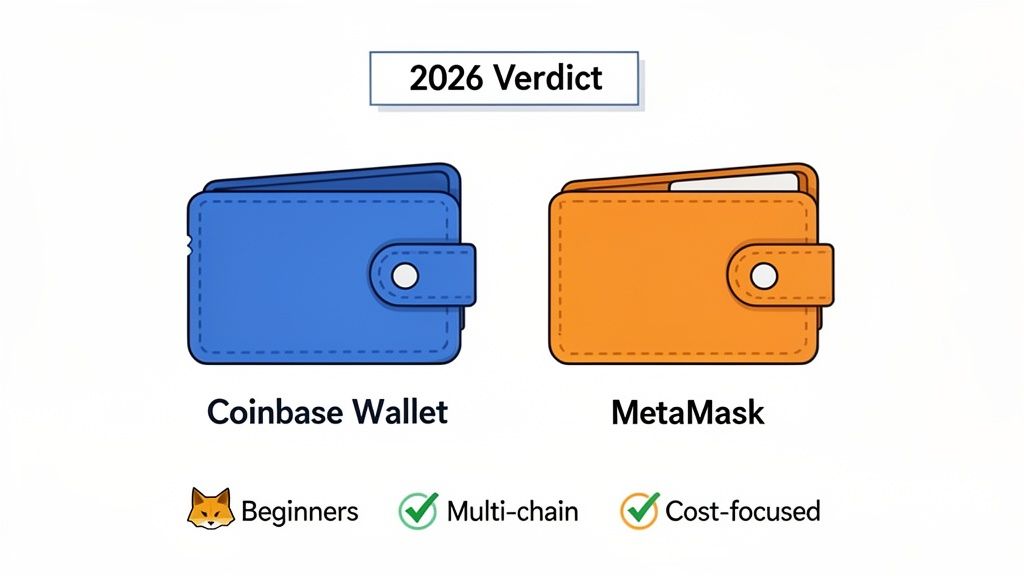
Choosing between Coinbase Wallet vs MetaMask often boils down to one key question: do you want simplicity or total control? For newcomers or those who just want to get things done across multiple chains, Coinbase Wallet is often the path of least resistance. But for DeFi veterans who live and breathe the EVM, MetaMask’s deep, granular control is hard to beat.

Before we get into the weeds, let's start with a high-level look. Your choice here has a real impact on your daily workflow, especially when using tools like Wallet Finder.ai to spot and act on alpha. The right wallet removes friction, while the wrong one adds it.
Think of it this way: Coinbase Wallet is the intuitive, all-in-one tool that just works. It natively supports big players like Bitcoin and Solana right out of the box. MetaMask, on the other hand, is the professional-grade power tool for the Ethereum ecosystem. It’s the default for a reason, offering unmatched dApp access and control.
For copy-traders, this choice matters. A wallet that’s slow or clunky on a specific chain could mean missing a profitable entry pointed out by Wallet Finder.ai. Speed and compatibility are everything.
To help you see the differences clearly, this table breaks down the core features that matter most to active traders.
| Feature | Coinbase Wallet | MetaMask |
|---|---|---|
| Ideal User | Beginners and multi-chain traders seeking simplicity. | Experienced DeFi users and developers needing control. |
| Blockchain Support | Native support for Ethereum, Bitcoin, Solana, and more. | Primarily Ethereum and EVM chains; non-EVM via Snaps. |
| Swap Fee Structure | Tiered model, often between 0.05% to 0.60%. | A flat 0.875% fee on most swaps. |
| Security Focus | User-friendly options like cloud backup and biometrics. | Open-source foundation and robust hardware wallet support. |
| Unique Selling Point | Seamless integration with Coinbase exchange and Base L2. | Advanced gas controls and unparalleled dApp compatibility. |
While this table gives you a quick snapshot, the real story is in how these features affect your day-to-day trading. The next sections will dig deeper, giving you the context to decide which wallet truly fits your strategy and helps you navigate DeFi more efficiently.
When you pit Coinbase Wallet against MetaMask, you're really looking at two different philosophies. One is all about a polished, intuitive journey for the user. The other gives experts powerful, fine-grained control. This difference isn't just cosmetic—it directly shapes your daily workflow, especially when a trade is on the line.
Coinbase Wallet is built from the ground up for simplicity. Its interface is clean and gets straight to the point, which makes it a fantastic starting point for anyone just dipping their toes into DeFi. If you're already using the Coinbase exchange, the wallet feels like a natural next step, letting you move assets between the two almost instantly.
This tight integration is a massive plus. Imagine spotting a hot trading opportunity on Wallet Finder.ai and needing to fund your wallet fast. With a linked Coinbase account, you can push crypto to your wallet in seconds. It feels less like a clunky blockchain transaction and more like an internal bank transfer.
The entire Coinbase Wallet experience is designed to hide the messy parts of crypto. It holds your hand through setup and transactions with clear instructions and a simple, clean look for your portfolio.
Key Insight: Coinbase Wallet's goal is to get you from A to B with the least amount of friction. It automates a lot of the technical stuff, like gas fee estimates, to create a smooth ride. The trade-off? You give up some of the granular control.
MetaMask, on the other hand, is built for the power user. For any seasoned DeFi trader, its browser extension is as familiar as their own keyboard. Its real power is in its deep customizability.
When the market goes wild and network fees (gas) are through the roof, this is where MetaMask earns its keep. A trader can manually crank up the gas limit and priority fee for a transaction. This level of control is absolutely critical—it can be the difference between your swap executing instantly or failing, causing you to miss a perfect entry or exit point.
This control comes at a price: a much steeper learning curve. Newcomers can easily feel overwhelmed by the options for gas fees and network settings. The interface is all about function over form, packing in a ton of information rather than aiming for simple aesthetics. For a detailed walkthrough on setting up your wallet, our guide on getting started with Coinbase Wallet offers practical steps.
Looking at user numbers, it’s a tight race that shows how both wallets serve different needs. Both Coinbase Wallet and MetaMask scored an impressive 8.7/10 on TrustRadius in 2026, confirming their status as go-to tools for DeFi traders who rely on platforms like Wallet Finder.ai.
MetaMask, launched by ConsenSys back in 2016, boasts over 30 million monthly active users and once had a staggering 70% market share of wallet connections on Ethereum. Meanwhile, Coinbase Wallet, with 15 million MAUs, is a multi-chain powerhouse, capturing 25% of Solana's wallet activity during the 2024 memecoin craze. You can dive deeper into what users think about this wallet rivalry on TrustRadius.
Here's how each wallet handles a common, high-pressure trading scenario:
| Scenario: Executing a Swap During High Volatility | Coinbase Wallet Approach | MetaMask Approach |
|---|---|---|
| User Action | Selects tokens to swap and confirms. Gas fees are set automatically. | Selects tokens, then clicks into advanced gas settings to manually set a higher priority fee. |
| Underlying Process | The wallet tries to find a "recommended" gas fee that balances speed and cost. | The user can intentionally "outbid" other transactions to get their swap processed first by network validators. |
| Outcome | Generally gets the job done, but it can be slower during peak congestion. Simple, but less adaptable. | Higher chance of a lightning-fast execution, assuming the user sets an aggressive gas fee. More control, but it'll cost you. |

A wallet’s worth isn't just about how it performs on one chain. For serious DeFi traders, the real test is how fast you can jump between ecosystems like Ethereum, Solana, and Base. This is where the Coinbase Wallet vs MetaMask battle gets heated, as their philosophies on multi-chain support couldn't be more different.
If you’re using a tool like Wallet Finder.ai to track smart money, cross-chain agility is everything. An alert that a top trader is aping into a new memecoin on Solana is worthless if your wallet is stuck on Ethereum. This is exactly where Coinbase Wallet carves out a massive lead, thanks to its native, out-of-the-box support for multiple blockchains.
Coinbase Wallet was built from day one to be a multi-chain aggregator. That means it has native, built-in support for totally different blockchain architectures, no extra steps required.
This native integration is a game-changer for speed and convenience. You aren’t hunting down RPC URLs or installing plugins. Everything just works, all in one clean interface.
MetaMask, on the other hand, was born and raised in the Ethereum ecosystem. By its very nature, it’s an EVM-first wallet. It’s brilliant at connecting to any EVM-compatible chain (like Base or Arbitrum), but stepping outside that world has always been a more manual process.
This difference is critical for copy traders. Coinbase Wallet’s early support for Solana back in 2022 gave its users a head start on countless DeFi opportunities on a network that exploded to over $4.5 billion in TVL by mid-2025. You can find more details on their feature differences in CoinTracker's blog post.
MetaMask hasn't been sitting idle. Its answer to the multi-chain problem is MetaMask Snaps, an open system that lets third-party developers build plugins to extend the wallet's capabilities. This is how MetaMask now supports non-EVM chains like Bitcoin and Solana.
The user experience, however, is a world away from Coinbase Wallet's native approach.
While Snaps make MetaMask incredibly versatile, they add friction. For a trader needing to move fast, those extra clicks can be the difference between catching a trend and missing it entirely. If you want to get more comfortable with this, check out our guide on using a cross-chain wallet.
Connecting to a dApp is one thing, but how smooth is the interaction when you’re executing a trade under pressure? The experience varies wildly depending on the network.
| Blockchain Scenario | Coinbase Wallet Experience | MetaMask Experience |
|---|---|---|
| Interacting with a DeFi protocol on Base | Excellent. Since Base is an EVM L2, both wallets are flawless. Coinbase Wallet gets a slight nod for its tight integration with the broader Coinbase ecosystem. | Excellent. As the default wallet for most EVM dApps, MetaMask connects perfectly. Its advanced gas controls are a huge plus for experienced traders. |
| Trading NFTs on Solana | Smooth and Native. You connect directly to marketplaces like Magic Eden and manage your SOL and NFTs right alongside your ETH assets. It just works. | Possible, but with a Snap. You need to install a Solana Snap first. The process can feel clunky and less fluid compared to the native experience. |
| Receiving Bitcoin from an exchange | Simple and Direct. The wallet has a native Bitcoin address ready to go, making the process as easy as receiving ETH. | Possible, but with a Snap. You have to install a Bitcoin Snap just to generate a BTC address and manage funds, which adds an annoying setup step. |
Ultimately, the right wallet depends on your battlefield. If your strategy is laser-focused on Ethereum and its vast landscape of Layer 2s, MetaMask remains the undisputed king of dApp connectivity.
But if your strategy—powered by intel from platforms like Wallet Finder.ai—demands you stay agile across both EVM and non-EVM chains, Coinbase Wallet’s native multi-chain support gives you a clear advantage in speed and simplicity.

When you’re choosing between Coinbase Wallet and MetaMask, nothing is more important than security. It’s the one area where you absolutely cannot compromise. Both are non-custodial wallets, which means you—and only you—are in charge of your keys.
This is the golden rule of self-custody. But how each wallet helps you manage that responsibility reveals two completely different ways of thinking.
At the heart of it all is the 12-word secret recovery phrase. This is what gives you total control. The real difference lies in how they help you protect this phrase, presenting a classic choice: convenience or complete self-sovereignty.
Coinbase Wallet is built to make self-custody feel less scary for the everyday user. It does this by using security features that feel just like your banking app.
Its standout feature is an optional encrypted cloud backup. You can save your private keys to your personal Google Drive or iCloud account. This backup is encrypted with a password only you know, so neither Coinbase nor your cloud provider can ever touch your funds.
This approach is all about easy recovery. While backing up to the cloud introduces a small element of trust—you have to keep your cloud account secure—it massively reduces the risk of losing your assets forever just because you lost a piece of paper.
This model is perfect for users who are already familiar with good digital security habits and want a safety net. It lowers the stakes of self-custody without taking away your control. To get a better handle on this key concept, check out our guide on what a seed phrase wallet actually is.
MetaMask takes a purist’s stance on security. Its philosophy is simple: give the user maximum control and trust no one else. It hands you your 12-word secret recovery phrase and makes it crystal clear that keeping it safe is entirely on you.
You won’t find any cloud backups or other convenience features here. Why? Because each one could be a potential weak point. This is security in its rawest form, the "not your keys, not your coins" mantra taken to its logical extreme.
Instead, MetaMask's biggest security upgrade comes from its bulletproof hardware wallet integration. It works flawlessly with top-tier hardware wallets from companies like Ledger and Trezor. This setup gives you the best of both worlds:
Being open-source is the other critical piece of MetaMask's security. Its code is out there for the whole world to inspect, meaning a massive community of developers is constantly checking it for flaws. This transparency builds a ton of trust, especially with more technical users.
Here's a practical look at how their security models compare.
| Security Scenario | Coinbase Wallet | MetaMask |
|---|---|---|
| Lost Phone | Restore your wallet in minutes using your encrypted cloud backup and password. | You must have your 12-word seed phrase written down. If you lose it, your funds are gone for good. |
| Phishing Attack | Vulnerable if you’re tricked into sharing your password or seed phrase. Biometrics offer some on-device protection. | Extremely vulnerable if you paste your seed phrase into a fake site. But with a hardware wallet, your funds are safe even if your PC is compromised. |
| Threat Model | Assumes you're more likely to lose your seed phrase than to have your cloud account hacked. | Assumes you can secure your own seed phrase and need maximum protection against online threats like malware and phishing. |
For any active trader, transaction costs aren't just some small detail—they're a direct hit to your bottom line. When you put Coinbase Wallet vs MetaMask head-to-head on fees, you see a classic trade-off: do you want simplicity or do you want total control? Figuring out which one suits you is key to keeping more of your profits.
Coinbase Wallet is all about making things easy by handling most of the fee calculations for you. When you initiate a swap inside the wallet, it neatly bundles the network gas fees and its own service fee into a single, clear estimate. That service fee works on a tiered model, usually falling between 0.05% and 0.60%, which can be a great deal for bigger trades.
The catch? This simplicity means you're not in the driver's seat when it comes to gas. Coinbase Wallet picks what it thinks is the "best" fee to get your transaction through reliably. That's fine for beginners, but it can be a real headache when the network is jammed and you need to manually push a transaction through faster.
This is where MetaMask shines—it puts you right in command of gas management. While its standard 0.875% swap fee might look higher on paper, the wallet's advanced gas settings are a powerful tool for smart traders looking to cut costs or speed things up.
When network traffic is heavy, you get to manually tweak two critical settings:
This kind of control is a game-changer for DeFi power users. You can dial down the gas for a low-priority transfer or pay up to make sure a time-sensitive trade gets executed instantly—an absolute must when you're acting on signals from a platform like Wallet Finder.ai.
For DeFi copy traders focused on cost efficiency when mirroring smart money, the fee differences are stark. MetaMask's flat 0.875% swap fee often works out better than Coinbase Wallet's tiered model, especially for the frequent, smaller swaps that are common in copy-trading. With over 100 million monthly active users by 2025, it's clear MetaMask's fee structure has been a major driver of its success. You can dig into more details about this wallet fee analysis at ebutemetaverse.com.
Let's see how these fee models actually perform in a few real-world situations. The right choice really hinges on your trading style and transaction size.
| Scenario | Coinbase Wallet | MetaMask | Verdict |
|---|---|---|---|
| Small, Frequent Swaps (e.g., $100) | The tiered fee might be low, but you're stuck with automated network costs and can't optimize gas across multiple trades. | The 0.875% fee is simple. You can lower gas on non-urgent swaps, potentially saving you a lot over time. | MetaMask gives you more potential to save money through its granular gas control. |
| Large, Infrequent Swaps (e.g., $10,000) | A low-tier fee (like 0.1%) would be much cheaper than MetaMask's flat rate. | The 0.875% fee becomes a significant cost here, eating into any savings you might make on gas. | Coinbase Wallet is usually the more cost-effective option for large, one-off trades. |
| Executing a Trade During High Congestion | You're basically hoping the wallet's automated fee is good enough, but it might be too slow and cause you to miss your entry. | You can manually crank up the priority fee to jump the line, ensuring your trade executes when you need it to. | MetaMask delivers the control you need to perform under pressure in volatile markets. |
At the end of the day, Coinbase Wallet is built for investors who want predictable, easy-to-understand costs. It’s perfect if you value simplicity above all else. MetaMask, on the other hand, gives active traders the tools they need to micromanage their expenses and transaction speeds, which often translates to better long-term cost efficiency.
Deciding between Coinbase Wallet vs. MetaMask isn't about which one is universally "best"—it's about picking the right tool for the job. Your trading style, how comfortable you are with technical details, and what you're trying to accomplish in crypto will point you to the right choice.
Think of it this way: are you building a simple portfolio or are you a degen-in-training? Let's break it down based on who you are and what you need.
You're just getting your feet wet. You want to buy some crypto, hold it, and maybe try a few swaps without a steep learning curve or complicated jargon. Security and simplicity are your top priorities.
For anyone new to the space, Coinbase Wallet makes the jump to self-custody feel safe and manageable.
You see opportunity everywhere—from Ethereum DeFi and Solana NFTs to even older chains like Bitcoin. You’re likely using a tool like Wallet Finder.ai to sniff out alpha across different ecosystems, so you need a wallet that can keep up.
You live on EVM-compatible chains. Yield farming, minting brand-new dApps, and fighting gas wars are just part of your daily routine. You need absolute control and don't mind a more complex interface to get it.
Your main goal is keeping your assets safe for the long haul. You view every convenience feature as a potential security risk and want the "coldest" hot wallet experience possible.
This flowchart gives you a simple decision-making path if you're an active trader weighing simplicity against fee control.

As you can see, traders who need to fine-tune every penny of gas should stick with MetaMask. If you’d rather have a straightforward experience and not worry about the details, Coinbase Wallet is the better fit.
Still on the fence? Let's tackle some of the common questions that pop up when comparing Coinbase Wallet and MetaMask.
Absolutely. In fact, many savvy traders run both, and it's often the smartest move. You can import the same wallet into both apps using your secret recovery phrase, giving you access to one pool of assets through two different lenses.
This lets you play to their strengths. A common workflow looks something like this:
This dual-wallet approach means you never have to compromise. You get the best features of both worlds.
The ability to use both wallets with the same seed phrase is a powerful technique. It means you can use Coinbase Wallet for a fast, multi-chain overview and then switch to MetaMask for granular control during a critical trade, all while managing the same portfolio.
Both wallets are non-custodial and built on a solid security foundation—as long as you guard your secret recovery phrase like your life depends on it. The real difference is their philosophy on how to help you do that.
Coinbase Wallet leans towards user-friendly security. It offers convenient features like optional encrypted cloud backups and Face ID. While this makes recovery easier, it does add a tiny bit of trust in your cloud provider (like Google or Apple).
MetaMask is more of a purist. It puts 100% of the security burden on you, relying on its open-source code and deep integration with hardware wallets. For most people, both are more than safe enough. It really boils down to a personal choice: do you prefer the convenient guardrails of Coinbase Wallet or the absolute self-sovereignty of MetaMask?
Nope. Downloading the apps and using them to store, send, or receive crypto is completely free. The only costs you can't avoid are the network fees (gas), which go to the blockchain validators, not the wallet company.
However, you will run into fees when you use their built-in services.
For standard wallet-to-wallet transfers, you're only paying the network's gas fee.
Ready to turn on-chain data into actionable alpha? Wallet Finder.ai helps you discover profitable wallets and mirror their strategies in real time. Start your 7-day trial today and find the smart money before the market does. Learn more at https://www.walletfinder.ai.