
Top 10 Copy Trading Apps for Crypto in 2026
Explore the best copy trading apps for crypto in 2026. Compare centralized, DeFi & on-chain tools to find the right app for your strategy and skill level.
The crypto market doesn't wait for you to finish your research. A wallet rotates into a new token, a perp trader flips bias, or a social feed starts celebrating a move after the easy entry is gone. Most traders know that feeling. You spot the trend late, chase it, and then spend the next hour pretending it was part of the plan.
That's why copy trading apps keep pulling in users. The category is already large. The global copy trading platform market reached USD 4.27 billion in 2024 and is projected to grow at a 17.8% CAGR from 2025 to 2033, reaching USD 15.42 billion by 2033. That kind of growth tells you two things. First, the demand is real. Second, more platforms will keep appearing, which makes choosing the right one harder, not easier.
The mistake I see most often is treating all copy trading apps as the same product. They aren't. Some are centralized broker products where the platform handles custody and execution. Some are API-driven layers that sit on top of your exchange account. Others are on-chain systems where you follow wallets, vaults, or public portfolios directly in DeFi.
That difference matters more than the leaderboard.
If you want something simple, a centralized app can get you started fast. If you want more control, API tools are usually better. If you want transparency and faster insight into smart money behavior, on-chain tools are where the key edge starts to show. This guide breaks the field into those buckets and focuses on what matters in live use: execution quality, risk controls, visibility into the leader you're following, and whether the product helps you build a repeatable process instead of blind dependence.
1. eToro CopyTrader (US)
If you want the easiest on-ramp into copy trading apps, eToro is still one of the cleanest options. It's a regulated US brokerage with a mature social investing interface, and its CopyTrader product is built for people who don't want to wire together bots, APIs, and wallet tracking on day one.
The biggest strength is simplicity. You pick an investor, allocate a dollar amount, and mirror the portfolio. That's a very different experience from crypto-native tools where you still need to think about exchange permissions, webhook logic, or wallet execution.
A useful adoption benchmark is that eToro's CopyTrader can replicate trades from more than 2.5 million investors, according to independent broker research. That scale matters because it usually translates into better profile discovery, more strategy variety, and a smoother social UX.
Where eToro works best
eToro is strongest for beginners who want:
- Broker-managed custody: You don't have to manage exchange API keys or DeFi wallet permissions.
- Portfolio-level copying: You're following an investor's broader allocation, not just isolated signals.
- Cross-asset exposure: The platform supports stocks, ETFs, forex, CFDs, and crypto, which is useful if you don't want your entire copy setup tied to one asset class.
The weak point is cost and granularity. The US crypto fee model is straightforward at 1% per buy and 1% per sell, but that can add up fast if the trader you copy rotates often. Small fragmented positions also make exits messier.
Practical rule: eToro is better for lower-turnover investors than hyperactive crypto traders. The more often your lead trader churns, the more those fees start to matter.
If you're new to the category, start with a small allocation and learn the mechanics first. A basic primer on copy trading for beginners helps before you fund multiple leaders at once.
Use eToro if your priority is easy onboarding, regulated access, and social discovery. Skip it if you want tight control over execution and crypto-native flexibility.
2. 3Commas
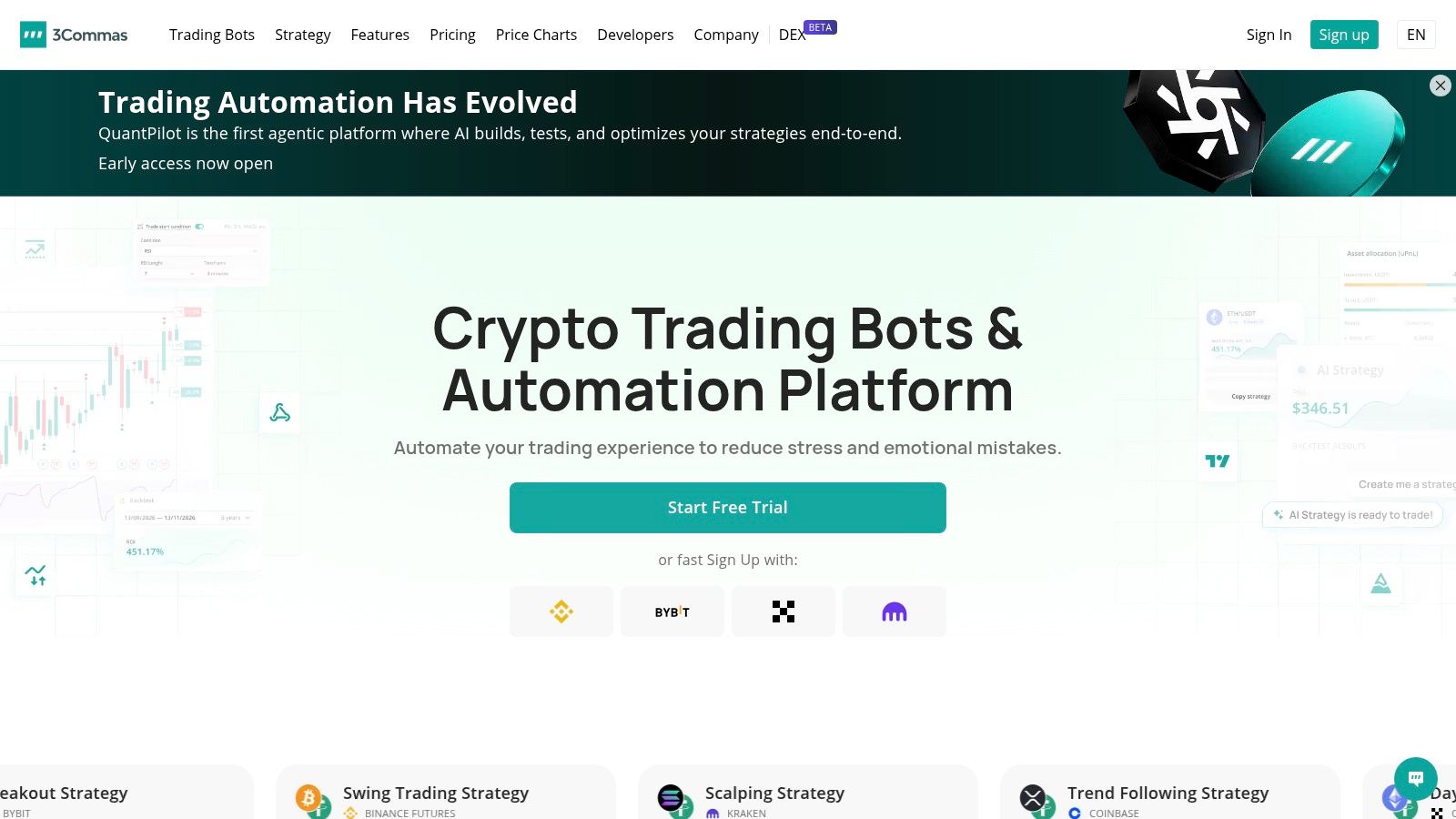
3Commas sits in a different bucket. It isn't just a place to click “copy.” It's an automation layer for traders who want to keep funds on their own exchange accounts and run signals, bots, and rule-based execution from one place.
That setup changes the trade-off immediately. You keep custody at your exchange, which many traders prefer, but you also inherit more setup work. If you misconfigure sizing, safety orders, or bot logic, the platform won't save you from your own bad process.
Why traders graduate to 3Commas
3Commas makes the most sense when one-click social copying starts to feel too limiting. It supports multiple exchanges through API connections and gives you several ways to automate:
- Signal marketplace: Follow external strategy signals rather than manually placing every trade.
- Bot framework: DCA, Grid, and SmartTrade tools give you more control over entries and exits.
- Risk caps: You can set position sizing rules and account-level limits instead of blindly mirroring somebody else's aggression.
What works in practice is the flexibility. You can run a conservative DCA bot on one account and a more aggressive signal-driven system on another, all without moving funds into a single third-party custody layer.
What doesn't work is treating it like a beginner app. 3Commas has a real learning curve. Traders who rush setup tend to over-automate before they've defined any rules worth automating.
Don't buy 3Commas because it has a lot of features. Buy it because you already know what you want your automation stack to do.
Another thing to keep in mind is recurring software cost. Unlike pure social platforms where the economics are mostly embedded in trading fees or profit sharing, 3Commas adds a subscription layer on top of exchange fees.
For experienced crypto traders, that can still be worth it. For casual users, it often becomes one more dashboard they log into for two weeks and then ignore.
If you want custody at your own venue and more control than most copy trading apps offer, 3Commas is a strong step up.
3. WunderTrading
WunderTrading is one of the more practical middle-ground tools in this category. It covers the trader who wants a copy marketplace but also wants enough flexibility to route signals, mirror multiple accounts, and connect TradingView alerts without building a custom stack.
That combination is rare. A lot of platforms force you to choose between social simplicity and strategy control. WunderTrading gets closer to both in one interface.
Best use case for WunderTrading
This is a good fit if your workflow looks like this: you follow a few traders, run your own alerts, and manage multiple exchange accounts from one place. The platform supports that kind of hybrid setup well.
The parts that tend to matter most in live use are:
- Marketplace visibility: You can review trader metrics before committing capital.
- TradingView integration: Useful if you want alerts to turn into actual orders.
- Multi-account control: Good for traders splitting capital across sub-accounts, strategies, or clients.
The weak point is the same weak point most marketplace-driven products have. The tool can surface trader stats, but it can't do the thinking for you. You still need to decide whether a leader's style fits the current regime, your risk tolerance, and your preferred holding period.
That matters because copy trading performance varies widely across platforms and timeframes. One industry summary says the market could exceed 10 million users worldwide by 2026, while the same summary cites a 2023 Bitget report where 93% of futures copy traders and 82% of spot copy traders were profitable during that period, but also notes a 90-day multi-exchange study of more than 100,000 outcomes where about 48% of copy traders were profitable. The lesson is simple. Labels like “top trader” don't tell the whole story.
WunderTrading is solid when you treat it as a control panel, not a shortcut. Use WunderTrading if you want one dashboard for copying, alert execution, and multi-exchange management.
4. Cornix
Cornix is for traders who already live inside Telegram. If your signal flow comes from Telegram groups, private channels, or your own alerts, Cornix turns chat into execution fast.
That speed is the entire appeal. You connect supported exchange accounts through API keys, feed signals into the platform, and let Cornix handle the order logic. For some traders, that cuts a real bottleneck. For others, it just automates bad inputs faster.
Where Cornix earns its keep
Cornix works when the signal source is disciplined and the user is disciplined. The platform gives you templates, automation rules, and fast translation from message to trade. That can be useful in momentum-heavy environments where a delayed entry ruins the setup.
A few strengths stand out:
- Telegram-native workflow: Good fit for traders who already use chat channels as their market feed.
- Risk presets: You can predefine order templates rather than typing everything manually.
- Exchange connectivity: It works as an execution layer rather than a full custody destination.
The problem is quality control. Telegram is noisy. The average signal channel has no shortage of hindsight posts, selective screenshots, or overtrading disguised as activity. Cornix won't filter that for you.
The platform isn't the edge here. The edge is whether the channel you're following has real discipline, real exits, and risk rules that survive a bad week.
This is one of those copy trading apps where your process matters more than the software itself. Keep copied size small at first, use hard caps, and avoid subscribing to multiple signal channels that all chase the same narrative at the same time.
If chat-first execution is your workflow, Cornix is one of the more direct ways to automate it.
5. Zignaly
Zignaly is a better fit for investors than tinkerers. Instead of forcing you to wire together APIs and bot logic, it leans into managed copy infrastructure and profit-sharing arrangements with strategy managers.
That changes the psychology of the product. You're not trying to mirror every click of a trader's mouse. You're allocating capital to a manager structure and judging them on how they handle that mandate over time.
Why some traders prefer the profit-sharing model
The strongest part of Zignaly's approach is alignment. Managers are generally paid on new profits under a high-watermark structure, which is cleaner than paying fixed subscription fees to somebody whose incentives don't change whether you make money or not.
This style works best for users who want:
- Simpler onboarding: Less configuration than API-heavy bot platforms.
- Manager alignment: Success-fee economics can be more attractive than flat monthly costs.
- A less hands-on experience: Better for users who don't want to control every position.
The trade-off is control. You usually get less granularity than you would with direct copy systems. You're buying access to a managed process, not micro-managing each order.
That can be a feature or a flaw depending on your temperament. Traders who need to inspect every fill often hate pooled or manager-led structures. Investors who just want exposure without building their own execution stack usually find them easier to live with.
One caution here: product emphasis can shift over time on platforms like this, so always review the current structure, custody model, and fee logic directly before allocating.
For a manager-aligned take on copy trading apps, Zignaly is worth a close look.
6. Kryll
Kryll appeals to a narrower kind of user, but the people it fits tend to stick with it. It combines a marketplace of community strategies with a visual strategy builder, which means you can start by renting a system and later modify or rebuild the logic yourself.
That's a meaningful step up from passive copying. Instead of only asking, “Who should I follow?” you can ask, “Which parts of this system are worth keeping?”
What makes Kryll useful
Kryll is strongest when you're halfway between copy trader and system builder. You don't want a blank coding environment, but you also don't want a black-box leaderboard where you never learn what drives the performance.
The practical advantages are:
- Marketplace plus customization: You can run an existing strategy, then adapt it.
- Visual builder: Useful for traders who think in rules but don't want to code from scratch.
- Backtests and live stats: Better than pure social products that show performance without much structure.
The downside is that marketplaces attract uneven quality. A strategy can look polished, present a convincing backtest, and still fail in live conditions when the regime changes. That's not unique to Kryll, but it's a real risk here.
This type of platform also suits traders who care about process documentation. If you change a strategy, you can track what changed and why. That habit matters. Blindly renting strategies without logging assumptions is how people end up paying for churn.
Kryll isn't the best first stop for beginners. It's better for traders who've already realized that copying alone won't teach them enough. If that sounds like you, Kryll is a good bridge between marketplace execution and actual system design.
7. Nested Finance

Nested Finance pushes copy trading apps into proper DeFi territory. Instead of copying a centralized trader account, you're copying on-chain portfolios and structured baskets through a non-custodial setup.
That changes what you can verify. On a centralized platform, you usually trust the leaderboard and the platform's reporting. On Nested, the on-chain footprint is part of the product.
Why on-chain social portfolios matter
Nested is useful for traders who want transparent portfolio construction and self-custody. Creators build original portfolios, other users copy them, and the incentive layer rewards creators when their baskets get followed.
That structure has a few real advantages:
- Non-custodial access: You keep wallet-level control.
- Visible transaction history: You can inspect what the creator did on-chain.
- Composable baskets: Better fit for DeFi-native users who want exposure across EVM assets and themes.
The downside is execution friction. Gas costs, liquidity, and slippage can all create a gap between the creator's apparent performance and your actual result. That gap is one of the biggest weak spots in retail copy trading coverage. A lot of content explains how to pick a trader, but far less explains how much performance can disappear after fees, slippage, and latency, which is a key gap highlighted in AvaTrade's discussion of copy trading mechanics and risk.
That's why risk management matters more in DeFi than is commonly assumed. Before copying any on-chain portfolio, review a solid guide to risk management for traders. Smart contract exposure, liquidity holes, and chain-specific execution problems can punish even a good thesis.
Use Nested Finance if you want transparent social portfolios and self-custody. Don't use it if you expect the experience to feel as simple as a broker app.
8. Enzyme Finance
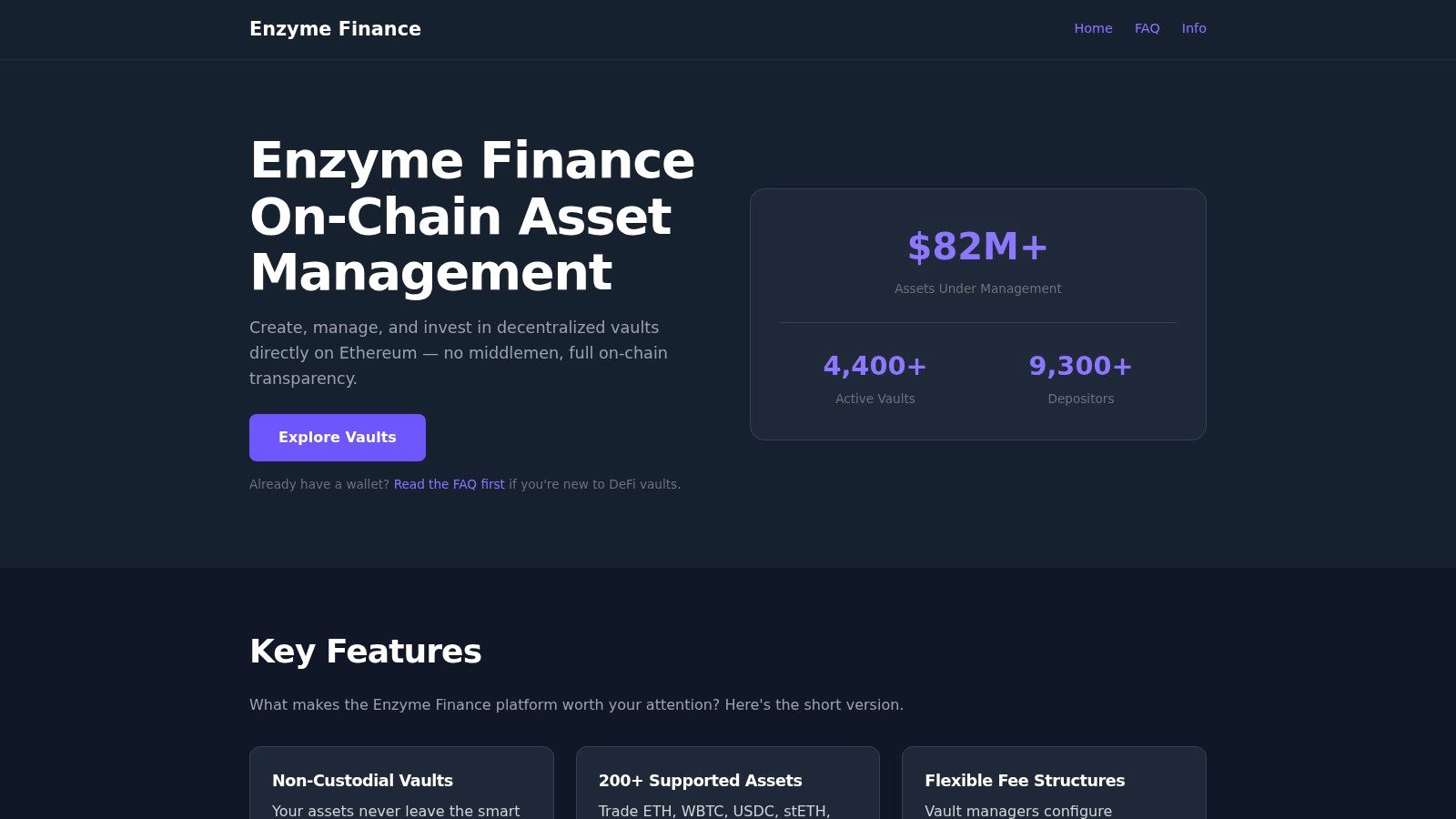
Enzyme Finance is less “follow this trader” and more “allocate to this on-chain manager and inspect the vault logic.” That makes it one of the more advanced entries on this list, but also one of the most serious for DeFi users who care about auditability.
The core object here is the vault. A manager runs it on-chain, sets policies and fee logic, and investors deposit to gain exposure. In function, that can absolutely serve as copy trading. It just happens at the vault level instead of the single-trade level.
When Enzyme makes sense
Enzyme is best for users who already understand DeFi operations and want transparent managed exposure. It offers a more structured framework than watching a wallet and manually aping trades.
What stands out:
- Programmable policies: Risk and fee logic can be embedded at the vault level.
- On-chain transparency: You can inspect activity rather than relying on screenshots or platform summaries.
- DeFi integrations: Vaults can access a wider strategy set than plain spot token rotation.
The hard part is operational complexity. You need to understand not only the manager, but also the protocol stack they're interacting with. A vault can be transparent and still be risky if the underlying strategy depends on fragile integrations or poor liquidity.
This is not beginner territory. It's for traders and allocators who care about how a strategy is implemented, not just how the curve looks on a leaderboard. For those users, Enzyme Finance offers one of the cleaner on-chain manager frameworks available.
9. dHEDGE
dHEDGE is one of the better examples of on-chain managed vaults done in a trader-friendly way. You get public vault leaderboards, visible fee structures, and on-chain high-watermark logic that aligns manager incentives better than a lot of opaque off-chain products.
It's not frictionless, but it is legible. And in DeFi, legibility is often worth more than convenience.
What makes dHEDGE different
The main benefit is that managers don't just market themselves with social proof. They operate inside a protocol structure where fees, announcements, and performance logic are visible on-chain.
That creates a stronger evaluation process:
- Public vault discovery: You can compare managers in one place.
- High-watermark fee logic: Better alignment than flat subscription-style following.
- Parameter visibility: Notice periods and codified changes reduce some governance ambiguity.
The challenge is that even a transparent vault doesn't eliminate execution reality. Manager conditions and investor conditions can still diverge because of liquidity, timing, and market impact. That issue becomes even more important in post-2024 crypto, where mainstream copy-trading content still lags behind actual on-chain fragmentation across ecosystems like Ethereum, Solana, and Base, a gap discussed in WallStreetZen's overview of copy trading platform coverage.
If you want to improve manager selection, combine vault research with wallet-level tracking of smart money crypto. The best copy trading process often starts before the vault leaderboard, by finding who consistently moves early and survives regime changes.
dHEDGE is a strong option for DeFi users who want transparent managed exposure without giving up the ability to inspect what's really happening.
10. Wallet Finder.ai
A trader sees a wallet print three strong wins on Solana, jumps in on the fourth move, and buys the top. The problem was never access to the trade. The problem was weak research before execution.
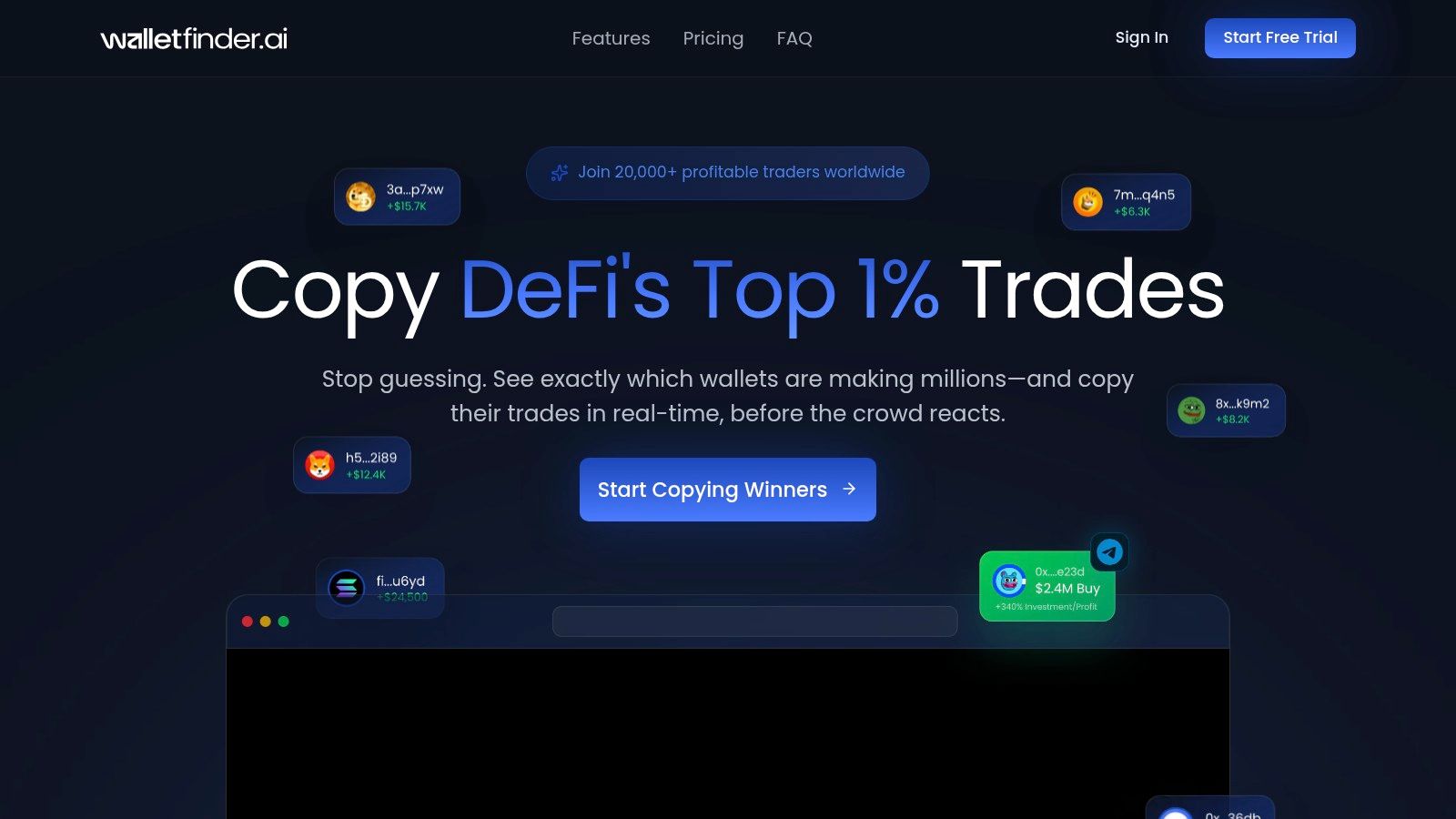
Wallet Finder.ai sits in that research layer. Instead of offering a one-click mirror product, it helps traders find wallets worth watching across major chains, then examine how those wallets trade. That distinction matters in this article's broader framework. Centralized copy apps handle execution inside a platform. DeFi vaults wrap manager activity inside a protocol. Wallet Finder.ai fits the third category more closely, on-chain signal generation and trader discovery.
That makes it useful for a different job.
The core value is wallet-level analysis that goes beyond a leaderboard badge. Traders can study realized behavior: PnL patterns, entry timing, hold duration, position sizing, rotation speed, and whether results come from a repeatable style or one brief run in a favorable market. For anyone trying to build a copy process with an edge, that is more actionable than a glossy profile page.
What stands out in practice is the workflow:
- Find wallets by behavior: Screen for traders that match your style, such as fast momentum rotation, swing holds, or tighter sizing discipline.
- Check the trading pattern: Review how those wallets enter, add, trim, and exit. A high return alone is not enough.
- Build a watchlist: Keep a focused list of wallets you want to monitor instead of re-running the same search every day.
- Use alerts as triggers: Telegram and push alerts help you catch activity in time to decide, not after the move is over.
- Export the data: Useful if you track traders in a spreadsheet, score them manually, or feed signals into a separate process.
That flexibility is the point. Wallet Finder.ai does not lock the user into one manager, one custody model, or one protocol wrapper. It helps answer the harder question first: who is worth copying?
My own rule is simple. Separate research from execution whenever possible. Research tools should help identify signal quality. Execution tools should handle order placement, risk limits, and trade management. Mixing those jobs inside one product is convenient, but convenience often hides weak selection.
Best for building a full copy trading system
Wallet Finder.ai works well at the front of a modern DeFi copy workflow. Start with wallet discovery. Cut the list down to traders with consistent behavior across different conditions. Then choose the execution path that fits the market and your risk tolerance. Manual mirroring works for selective trades. Alerts-only works if you want confirmation without blind copying. A more advanced setup can route those signals into exchange bots, position caps, and post-trade review.
That approach matches the current state of copy trading. As noted earlier, the category is growing fast, but product quality still varies widely. A true advantage rarely comes from copying faster than everyone else. It comes from choosing better traders, filtering their activity properly, and knowing when not to follow them.
Wallet Finder.ai is a strong fit for traders who want context before they commit capital. If your goal is to build a full copy trading system rather than just subscribe to a leaderboard, this is the tool in the list that fills that role most clearly.
Top 10 Copy Trading Apps: Quick Feature Comparison
| Platform | Core features ✨ | UX & Trust ★ | Value & Pricing 💰 | Ideal users 👥 | Unique edge ✨ |
|---|---|---|---|---|---|
| eToro – CopyTrader (US) | CopyTrader portfolios; regulated brokerage; stocks, ETFs, crypto | ★★★★, US‑regulated; visible Popular Investors | 💰 Crypto ~1% buy / 1% sell; platform custody | 👥 Beginners wanting custody + social trading | ✨ One‑click portfolio copying with broker custody |
| 3Commas | Automated bots (DCA, Grid, SmartTrade); copy marketplace; multi‑exchange API | ★★★★, mature UX; active community | 💰 Monthly subscription; keep custody at exchanges | 👥 Traders wanting granular automation + multi‑exchange | ✨ Granular bots & position/risk controls |
| WunderTrading | Copy marketplace; TradingView webhook integration; multi‑account support | ★★★★, demo APIs; marketplace metrics | 💰 Subscription tiers; marketplace fees | 👥 Strategy builders and one‑click copiers | ✨ TradingView → trade webhooks + multi‑account UI |
| Cornix | Telegram‑centric auto‑execution; templates & risk presets | ★★★, fast chat‑to‑trade; signal quality varies | 💰 Tiered plans; depends on signal group costs | 👥 Telegram community traders needing rapid execution | ✨ Direct Telegram signal automation to exchanges |
| Zignaly (Profit Sharing) | Profit‑sharing managers; high‑watermark; curated managers | ★★★★, KYC, manager metrics | 💰 Performance‑only (profit sharing) fees | 👥 Investors preferring managed, aligned managers | ✨ Manager incentives: pay only on new profits |
| Kryll (KryllOS) | Visual/AI strategy editor; marketplace; backtests | ★★★, customizable; transparency via backtests | 💰 Token/credit model + per‑run costs | 👥 Users who want to build & customize marketplace strategies | ✨ Visual + AI-assisted strategy builder and rentals |
| Nested Finance | On‑chain social portfolios (NFTs/baskets); non‑custodial | ★★★★, on‑chain transparency, royalties | 💰 Gas costs; creator royalties on copies | 👥 DeFi‑native users wanting non‑custodial copies | ✨ One‑click on‑chain portfolios with creator royalties |
| Enzyme Finance | On‑chain vaults; programmable policies; DeFi integrations | ★★★★, protocol auditability; vault‑level transparency | 💰 Vault management fees + gas | 👥 Advanced DeFi users and institutions | ✨ Programmable vaults with verifiable trade history |
| dHEDGE | On‑chain manager vaults; public leaderboards; timelocks | ★★★★, on‑chain fees & high‑watermarks | 💰 Manager performance fees + gas | 👥 Investors seeking on‑chain manager exposure | ✨ Public leaderboards + codified fee/high‑watermark logic |
| 🏆 Wallet Finder.ai | Real‑time cross‑chain wallet discovery; PnL, win‑streaks, position sizing; instant Telegram & push alerts; exports & charts | ★★★★★, 20k+ users; 4.9/5 (200+ reviews); Product Hunt recognition | 💰 7‑day trial; Basic | 👥 Retail copy traders, pro desks, quant researchers | ✨ Real‑time smart‑money signals + deep wallet‑level analytics & exportable datasets (ideal for timely copy trading) |
Start tracking smart money today
Join thousands of traders using WalletFinder.ai to find profitable wallets and copy their trades.
Start Free Trial →

