Risk Management for Traders: A Crypto & DeFi Guide

Wallet Finder

Blank calendar icon with grid of squares representing days.

You're probably here because you've already felt it. A trade starts green, your conviction grows, you size up a little more than planned, and then a fast move against you wipes out days or weeks of progress. In crypto and DeFi, that spiral happens even faster because liquidity can vanish, slippage can widen, and a wallet you're following can rotate before you've even finished thinking.

Most blown accounts don't die from a lack of ideas. They die from one oversized mistake, then a second emotional one, then a third trade placed to “make it back.”

That's why risk management for traders matters more than prediction. Good traders can survive bad reads. Undisciplined traders can't survive their own sizing. In DeFi copy-trading, that difference gets even sharper because you're not just managing market risk. You're managing signal risk, execution risk, correlation risk, and the temptation to outsource judgment to someone else's wallet.

Why Most Traders Lose Money and How You Can Avoid It

A trader catches a strong move early, books a few wins, then decides the next setup is the one to press. No stop. Size too large. Maybe trading on margin. The market snaps back, and one trade undoes everything that came before it.

That story is common because new traders usually focus on entries first and capital protection second. The order should be reversed. A major industry source reports that about 40% of day traders quit within their first month because of losses, which shows how quickly mistakes pile up when risk controls are weak (Earn2Trade on trading risk management).

The lesson isn't that markets are impossible. It's that survival is a separate skill.

The real problem isn't bad picks

You can be directionally right and still lose if your position is too large, your stop is undefined, or your trade sits inside a crowded theme that can unwind all at once. That's especially true in DeFi, where a wallet alert can create urgency and urgency often leads to sloppy execution.

New traders usually blow up in one of these ways:

  • They trade too big: One idea carries enough size to damage the account.
  • They move the stop: The original loss was manageable. The revised loss isn't.
  • They stack similar bets: Several “different” tokens end up driven by the same narrative.
  • They chase someone else's conviction: A copied trade feels safer than it is.

Small losses are workable. Large losses change behavior, and once behavior breaks, the strategy usually follows.

What professionals do differently

Professionals don't aim to avoid all losses. They aim to keep losses ordinary. That sounds simple, but it changes everything. If a bad trade is small, the next decision can still be rational. If a bad trade is large, the next decision usually comes from frustration, fear, or FOMO.

That's the core mindset behind risk management for traders. Your job isn't to win every trade. Your job is to make sure no single trade gets a vote on whether you stay in the game.

The Three Pillars of Trading Survival

A DeFi wallet you follow buys a token at 9:12 a.m. By 9:18, the chart is already stretched, Telegram is loud, and the temptation is to copy the trade at full size before it runs again. That is how traders inherit someone else's entry, someone else's timing, and often someone else's risk.
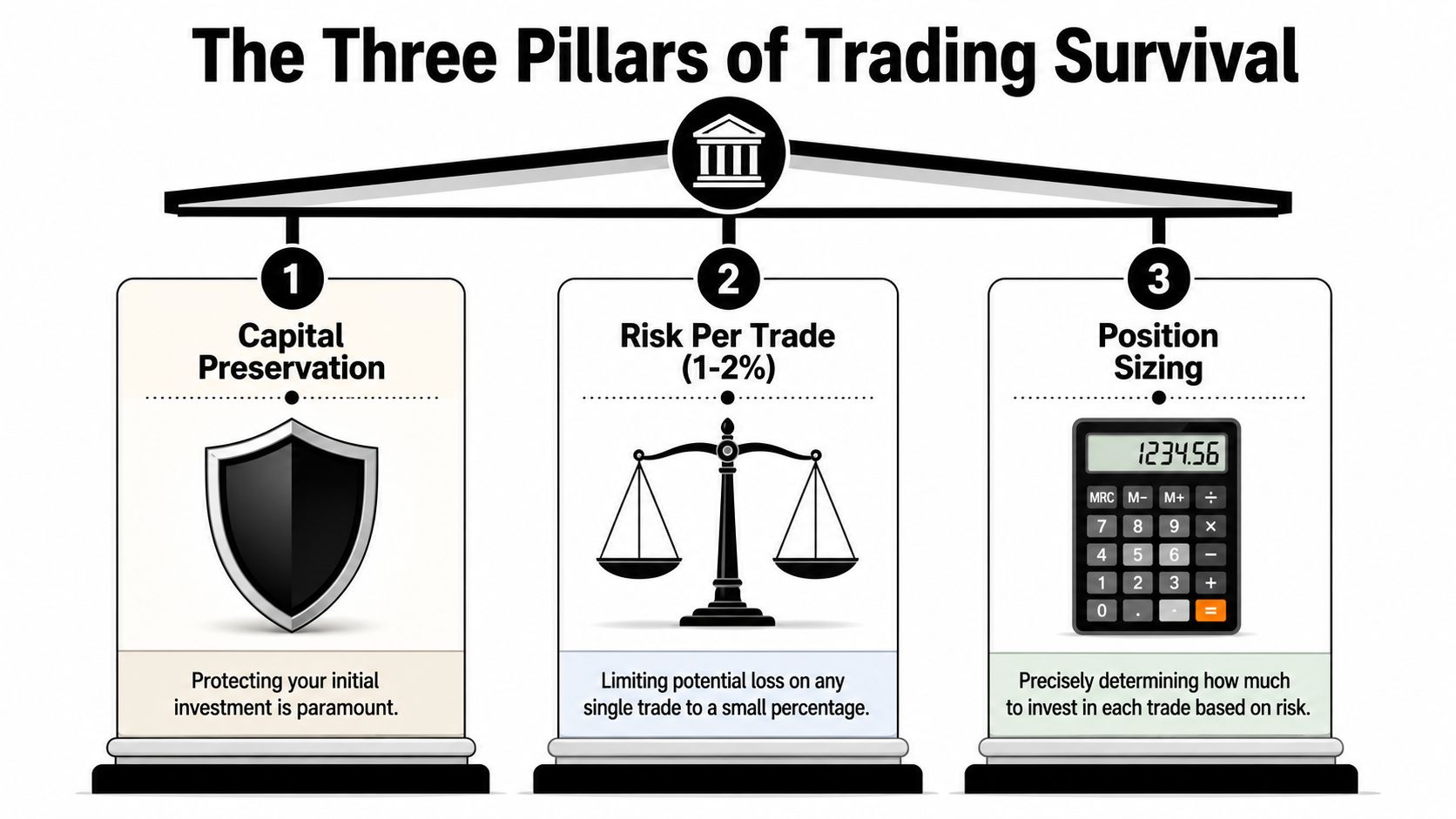
An infographic titled The Three Pillars of Trading Survival, displaying capital preservation, risk per trade, and position sizing.

The three pillars that keep you in the game are simple: protect capital, cap risk on each trade, and size the position from the stop, not from excitement. The old 1% rule still matters. In DeFi copy-trading, it matters more because the signal can be good while the execution is worse than the wallet you are following.

The CME Group guide to managing drawdown and risk makes the point clearly. Large drawdowns require disproportionately larger gains to recover. That is why survival starts with avoiding deep damage, not with chasing upside.

Capital preservation comes first

Capital preservation is account defense. If the account takes a 30% hit, you do not just need better trades. You need a recovery phase, and recovery trading often leads to forcing setups that were easy to ignore when the account was healthy.

This gets missed in DeFi because traders focus on wallet quality, token momentum, and speed. Those matter. But none of them protect you if correlated positions unwind together, liquidity disappears, or a copied trade was already half over before you entered.

Set loss limits that assume you will be wrong sometimes, late sometimes, and trapped in noise more often than you expected.

Risk per trade keeps mistakes ordinary

Per-trade risk is the firewall between a bad idea and a bad month. Many experienced traders use the 1% rule as the starting point because it gives enough room to stay active without letting one trade dictate the account. Newer traders copying volatile on-chain moves are often better off below that until their execution is stable.

A useful test is simple. If a stopped-out trade changes your mood, your next decision, or your willingness to follow the plan, the size is too large.

That matters with Wallet Finder.ai signals. The tool can help you find smart-money activity faster, but it should never decide your dollar risk for you. The wallet may have a different entry, deeper liquidity access, a wider tolerance for drawdown, or a portfolio that offsets the trade elsewhere. You do not see all of that from the alert alone.

Position sizing is where discipline becomes real

Position sizing connects theory to execution. The process is straightforward. Decide how much of the account you are willing to lose if the trade fails. Mark the price that proves the trade is wrong. Then let those two numbers determine size.

If you want a practical framework for that math, use a position sizing calculator for crypto trades before you place the order. In fast DeFi markets, this removes the usual mistake of deciding size first and justifying it later.

Here is how the three pillars work together:

PillarWhat it doesWhat breaks without it
Capital preservationLimits account damage during bad streaksDrawdown gets deep enough to change behavior
Risk per tradeKeeps one loss from dominating resultsA single mistake distorts the month
Position sizingTranslates risk rules into exact exposureStops are arbitrary and size is emotional

I tell new traders the same thing every time. The goal is not to copy the best wallet perfectly. The goal is to use good signals without borrowing catastrophic risk from the person who generated them.

Calculating Position Size The Professional Way

You get a Wallet Finder.ai alert. The wallet looks strong, the chart is moving, and the instinct is to size up before the move runs. That is where accounts get hurt. Good traders slow down long enough to answer one question first. How much am I willing to lose if this trade is wrong?

An infographic detailing the four-step professional process for calculating optimal position size when trading financial assets.

Professional position sizing starts with risk, not conviction. A common framework is to cap per-trade risk at 1% to 2% of account capital and keep total open risk around 5% or less. Trade Nation explains the core math clearly. Position size comes from dividing your dollar risk budget by the distance between entry and stop-loss (Trade Nation on risk management).

That sounds basic. In DeFi copy-trading, it is the line between using a strong signal and inheriting someone else's blowup.

The formula that matters

Use this sequence every time:

  1. Set your account risk
  2. Define your entry and stop
  3. Measure the distance between them
  4. Divide account risk by trade risk per unit

The result is your maximum size. Not your ideal size. Not the size that feels exciting. The largest size the account can carry without one mistake doing serious damage.

For a $10,000 account, the 1% rule gives a $100 risk budget on the trade. If you stretch to 2%, the risk budget is $200. You do not need a copied wallet to tell you that number. You set it before the trade exists.

A simple crypto example

Say Solana is trading at $150 and your stop belongs at $145.

Your trade risk per coin is $5.

If your risk budget is $100, your maximum position size is:

$100 / $5 = 20 SOL

If your risk budget is $200, your maximum position size is:

$200 / $5 = 40 SOL

Same setup. Same stop. Different account risk.

That distinction matters because many copy-traders reverse the process. They see the wallet size first, then force the stop and the math to justify following it. That is not risk management. That is rationalizing size after the fact.

If you want to speed up the calculation without skipping the discipline, use a crypto position sizing calculator for trade risk and stop distance. In fast markets, that helps cut down avoidable sizing errors.

Why sizing matters more than entry quality

A slightly imperfect entry with correct sizing is usually survivable. A perfect entry with oversized exposure can still wreck the week.

That is why experienced traders care less about copying the exact fill from a wallet and more about whether the stop is valid, the size fits the account, and the trade still makes sense after slippage. Wallet Finder.ai can help surface smart wallets and early signals. It cannot know your drawdown limit, your portfolio overlap, or the size that fits your account. That part stays your job.

The stop defines when the idea failed. Position size defines what that failure costs you.

One more mistake shows up often in crypto portfolios. A trader sizes one position correctly, then adds three more trades that all depend on the same market rotation. Each trade looks small alone. Together they can put the account in a hole fast. The 5% total open-risk cap exists to stop that kind of clustering.

Borrowed capital punishes sloppy math

Borrowed capital increases exposure before the trade proves itself. That is why size has to be built from the stop outward, not from available buying power backward.

Use a simple operating rule:

  • Start with spot-style sizing logic. Build the trade as if extra buying power does not exist.
  • Keep the stop honest. Do not move it closer just to fit a bigger position.
  • Check correlated exposure. Several positions tied to the same theme can behave like one large bet.
  • Cut size in unstable conditions. Thin liquidity and fast rotations make clean exits harder.

Here's the quick reference I want traders to memorize:

StepQuestionOutput
Account riskHow much can I lose on this trade?Dollar risk budget
Trade riskWhere is the stop?Entry-to-stop distance
Position sizeHow many units fit the budget?Maximum units to trade
Portfolio checkWhat am I risking across all open positions?Total open risk

Before the order goes out, every row in that table should already be filled in. If it is not, the trade is not ready.

A short walkthrough can help if you want to see the process visually:

Navigating Crypto Specific Risks

A trade can be sized perfectly on paper and still lose more than planned in DeFi.

A cartoon trader standing on a blockchain block holding an ATR compass while viewing market charts.

Classic risk rules such as the 1% rule still apply. The problem is execution. In crypto, especially on-chain, the risk often comes from how the market trades, not just from where your stop sits. Thin pools, sudden wallet-driven rotations, and copy-trading crowding can turn a normal setup into an expensive lesson fast.

Volatility needs smarter stops

Crypto does not respect tidy fixed-percentage stops. Many tokens swing hard even when the trade idea is still intact, so a stop that looks disciplined can sit inside ordinary noise.

A practical baseline is to place the stop about 2x ATR below the entry for long positions, as outlined by For Traders in its guide to day trading risk strategies. That ties the stop to actual recent movement instead of a random round number.

The trade-off is simple. Wider stops survive noise better, but they force smaller size. Traders who ignore that trade-off usually get stopped out repeatedly or hold positions that are too large for the token they chose.

Slippage changes the real risk

This is the part newer DeFi traders underestimate.

Your planned loss assumes you can exit near the quoted price. In thin liquidity, that assumption breaks. If the pool is shallow, your stop can become a much larger realized loss once the order hits the market. That matters even more if you are reacting to a wallet alert after the first move has already happened.

Before entering, check the mechanics:

  • Review pool depth: If liquidity is thin, exits will not be clean.
  • Scale the order to the venue: A position that fits your account may still be too large for that token.
  • Avoid panic entries and exits: Urgent clicks usually pay the worst price.
  • Map the exit route first: If there is no realistic way out, skip the trade.

For a broader review of execution hazards around on-chain trading, read this breakdown of risk factors in DeFi liquidity pool timing.

Wallet Finder.ai helps here because it can surface wallet activity quickly, but speed is only useful if you still check whether the market can absorb your order. Good signal discovery does not fix bad liquidity.

Correlation hides inside narratives

DeFi traders rarely blow up from one isolated position. They get hit by several trades that were really the same bet.

Different tickers can still share the same risk driver. Five memecoins on one chain, three AI tokens that move with the same narrative, or several wallets piling into one ecosystem can unwind together. The screen looks diversified. The book is not.

The CFA Institute explains correlation as a measure of how assets move in relation to each other, which is why highly correlated positions increase portfolio risk even when they appear separate (CFA Institute on correlation). In practice, once two trades are moving for the same reason, I treat them as one idea and cut size accordingly.

That rule matters even more when using wallet-based signals. If Wallet Finder.ai shows several smart wallets buying related names, that can be useful. It can also tempt you into stacking the same exposure through different wrappers. The safer move is to group those trades by chain, narrative, and liquidity profile before you commit capital.

Diversification only works when positions can fail for different reasons.

A Safe Workflow for Copy Trading with Wallet Finder ai

You get an alert that a high-performing wallet just bought a token that is already running. Two minutes later, three more tracked wallets hit related names on the same chain. That is the moment copy traders usually make their biggest mistake. They copy the wallet. A safer process is to copy the research trail, then build a trade that fits your own risk limits.

Wallet Finder.ai is useful because it shortens the time between on-chain activity and your review. In DeFi, that speed matters. It does not remove the need to screen the trade, define the risk, and decide whether you can still enter without inheriting someone else's bad setup.

Screenshot from https://www.walletfinder.ai

Start with wallet quality, not excitement

A wallet with one massive winner is interesting. A wallet with repeatable behavior is useful.

Start by asking what kind of operator you are looking at. Some wallets buy early and scale out fast. Some sit through deep drawdowns that followers cannot stomach. Some only work in hot narrative conditions. If you cannot describe the wallet's style in plain language, you are not ready to copy it.

Focus on a few practical questions:

  • Is the wallet consistent: Repeated behavior matters more than one outlier gain.
  • What does the wallet trade: Memecoins, majors, ecosystem rotations, and event trades all create different kinds of risk.
  • How fast does it act: A strategy that depends on instant execution can fall apart for followers.
  • How hard does it size: Large swings in wallet exposure often hide a level of downside you do not want in your own book.

If you are still building the basics, this guide to copy trading for beginners gives a useful foundation for evaluating wallet signals before you act on them.

Vet the strategy behind the wallet

Headline PnL does not tell you enough. Two wallets can show similar returns with completely different risk profiles.

One may buy breakouts and cut quickly if momentum fades. Another may average into weakness and survive only because it has deeper capital and more patience than you do. A third may be heavily concentrated in one chain or one narrative. Those differences matter because your job is not to admire the result. Your job is to survive the path.

Use a review framework like this:

QuestionWhy it mattersRisk implication
Holding periodShows whether timing and reaction speed are part of the edgeShort holding periods punish slow followers
Token universeReveals whether the wallet is concentrated by chain, sector, or liquidity bucketConcentration raises drawdown risk
Entry behaviorShows whether the wallet buys expansion, pullbacks, or early accumulationYour fills may be much worse than theirs
Exit behaviorReveals whether the wallet cuts losses or tolerates heatLoose exits create risk you may not accept

Apply your rules, never theirs

Here, copy-trading either becomes a controlled process or turns into outsourced gambling.

A wallet signal is only an idea source. The account owner has a different balance, different access to liquidity, different tax constraints, and a different tolerance for volatility. Their position size tells you almost nothing about what you should do.

Use a fixed sequence every time:

  1. Receive the signal
  2. Check whether the setup matches your own market view
  3. Define the price level that invalidates the trade
  4. Size the position from your own maximum loss
  5. Check whether it overlaps with current exposures
  6. Enter only if the trade still fits the full plan

That is how classic risk management survives in DeFi copy-trading. The 1% rule still matters. The difference is that wallet alerts create more temptation to ignore it.

Good wallets help with idea generation. Risk control still has to come from you.

Reduce risk when copied trades cluster

The biggest hidden danger in wallet-following is overlap. Five different wallets can produce what looks like five separate opportunities while all of them are really the same bet.

If several tracked wallets are buying the same ecosystem, the same meme complex, or the same low-float momentum pocket, treat that as clustered exposure. Portfolio theory reaches the same conclusion. The CFI explanation of correlation shows that assets moving together reduce diversification benefits and raise portfolio risk when they are combined (CFI on portfolio correlation and diversification).

Use that in a practical way:

  • If two wallets are trading the same theme: Count them as one source of risk.
  • If alerts stack into one chain or narrative: Cut total size across the group.
  • If the wallet's edge depends on speed you do not have: Skip the trade.
  • If you cannot explain the setup and invalidation clearly: Do not take it.

I usually group copied ideas by chain, catalyst, and liquidity profile before I place anything. That catches a lot of fake diversification.

Build a copy-trading routine that survives bad days

Good routines feel repetitive. That is the point. You do not want to invent your process while a token is ripping and Telegram is screaming.

A workable routine looks like this:

  • Before the session: Review open risk by theme, chain, and catalyst.
  • During alerts: Label the setup. Momentum, rotation, breakout, mean reversion, or speculation.
  • Before entry: Check stop placement, slippage, liquidity depth, and overlap with existing positions.
  • After execution: Log what you copied, why you took it, and whether your fill quality matched the original signal.

That last part is where the process improves. Over time, you will find that some wallets are excellent for spotting new themes but poor for direct copying, while others are slower, cleaner, and easier to trade with discipline. In DeFi, that distinction can be the difference between using smart money as a source of ideas and using it as a fast route into someone else's blow-up.

Executing the Trade Without Emotion

An alert is not a command. It's a prompt to think.

That distinction protects you from the most expensive behavior in DeFi copy-trading, which is reacting to someone else's move before you've checked whether the trade still makes sense for you. By the time you see a wallet entry, the context may already have changed. Liquidity may be thinner. Price may be extended. Your own book may already be loaded with similar exposure.

A short execution checklist

Before you click buy, run through this:

  • Does the trade still fit your plan: If it conflicts with your own read, skip it.
  • Is the market stable enough to enter cleanly: Chaotic order flow usually punishes late reactions.
  • Can you place the stop where the trade is invalidated: If not, the setup isn't defined.
  • Will slippage distort the risk: If likely, reduce size or don't take it.

What discipline looks like in practice

Discipline at execution doesn't mean being slow. It means being pre-committed. You already know your maximum loss, your stop, your size, and what other positions this trade interacts with.

That turns the moment from emotional to procedural.

The best trade to skip is the one that only looks good because someone else already took it.

FOMO is expensive because it makes traders negotiate with their own rules. They widen entries, ignore slippage, abandon sizing, and tell themselves they'll manage it later. They usually won't. Good execution comes from shrinking the number of decisions you make in real time.

Make Risk Management Your Superpower

Risk management for traders isn't about playing scared. It's about staying dangerous for longer.

Anyone can have a hot streak. The skill that matters is surviving the cold one without doing something stupid. That's what position sizing, drawdown control, volatility-aware stops, and correlation checks do. They keep your edge alive long enough to matter.

In DeFi, that discipline matters even more because copied signals, wallet alerts, and fast narratives can create false confidence. Tools can speed up discovery, but they also speed up bad decisions if you don't bring structure to the process.

The traders who last aren't the ones who avoid losses. They're the ones who keep losses controlled, keep their judgment intact, and refuse to let one idea become an account-level event.

Build that habit until it feels automatic. Then protect it like it's your best strategy, because it is.


If you want a practical way to turn on-chain activity into tradable research without blindly inheriting someone else's risk, Wallet Finder.ai helps you track profitable wallets, review trading histories, and monitor smart money movement in real time. Use it as a signal engine, then apply the framework in this guide so every copied idea still passes your own sizing, correlation, and execution rules.