Drawdown Analysis: A Trader's Guide to Crypto Risk

Wallet Finder

Blank calendar icon with grid of squares representing days.

June 17, 2026

A wallet can look brilliant for months, then hand back most of its gains in a few ugly sessions. That's the part many DeFi traders learn too late. The equity curve looks smooth enough on social posts, the realized wins look impressive, and the copied entries feel smart until the strategy hits stress.

What matters then isn't the screenshot. It's how deep the strategy falls, how long it stays underwater, and whether you still have the nerve and capital to stick with it. That's where drawdown analysis stops being theory and starts becoming survival.

Why Your PnL Chart Is Lying to You

A rising PnL chart hides a lot. It hides the path. It hides the pain between peaks. It hides whether the trader made money cleanly or only by absorbing repeated air pockets that would've forced most followers out at the worst moment.

I've seen traders fixate on total return and ignore how that return was earned. That's backwards. In crypto, two wallets can finish in roughly the same place while taking very different roads. One compounds through controlled pullbacks. The other survives only because it happened to catch a late winner after a stretch of brutal underwater trading.

What a smooth result can hide

A wallet with a flashy top-line gain can still be a bad copy-trading candidate if its history includes:

  • Deep collapses: Big peak-to-trough losses that would've made most followers cut risk.
  • Long underwater periods: Capital stuck below its old high for so long that better opportunities pass by.
  • Violent loss cadence: A pattern of sudden breaks that tells you the strategy can unravel fast.
  • Positioning mismatch: Trade sizing that works for the original trader but not for anyone mirroring with less tolerance.

PnL is a summary. Risk lives in the path.

If you're already looking at realized gains and wallet performance, pair that with a proper profit and loss analysis workflow. A gain without context is marketing. A gain with drawdown context is decision-useful.

A wallet isn't safe because it finished green. It's safer only if it stayed survivable on the way there.

The real question

The question isn't "Did this wallet make money?"

The question is "What did it demand from the person following it?"

If the answer is repeated panic, forced exits, and long recovery waits, then the PnL chart is flattering a strategy difficult to maintain through live conditions. Drawdown analysis corrects that distortion. It tells you the historical worst pain, the time profile of that pain, and whether the wallet's style fits your capital preservation rules.

What Is Drawdown Analysis The Core Concepts

Drawdown analysis is easiest to understand if you think like a mountain climber. Your portfolio climbs to a summit, drops into a valley, and then either climbs back to the old summit or finds a new one later. The key risk question is simple. How deep was the valley, and how long were you stuck in it?
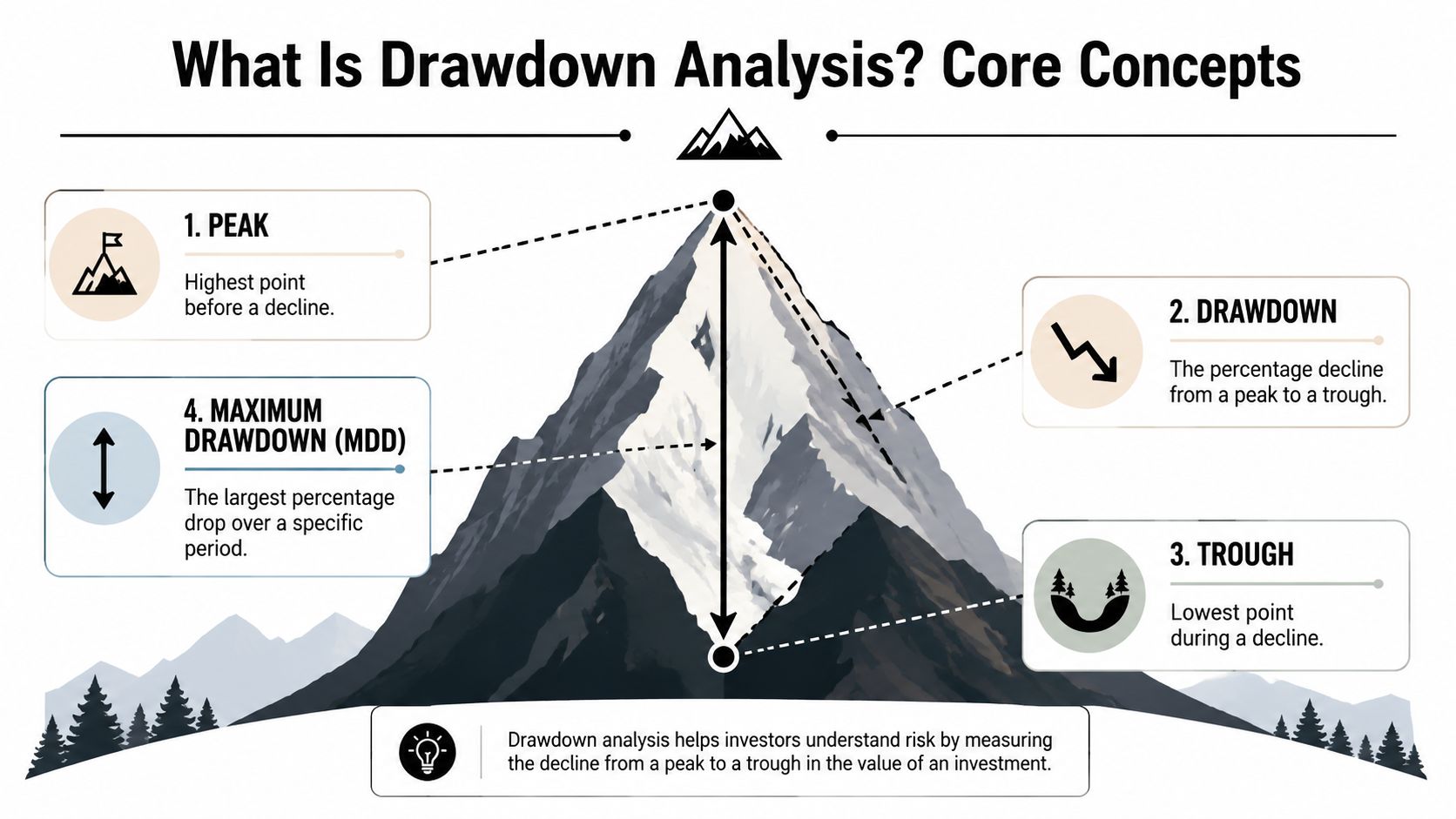
An educational infographic explaining drawdown analysis, featuring peak, drawdown, trough, and maximum drawdown concepts on a mountain.

The four terms that matter

  • Peak: The highest portfolio value reached before a decline starts.
  • Trough: The lowest point reached during that decline.
  • Drawdown: The percentage drop from the peak to the trough.
  • Maximum drawdown: The single largest observed peak-to-trough decline over the period you're measuring.

Core definition: Maximum drawdown is the historical worst-case pain a strategy imposed from a prior high to a later low.

That last point matters because maximum drawdown is the largest observed decline from a portfolio's peak to its subsequent trough, and it's measured over a specific period, not as some timeless property of the strategy. In practice, a 25% maximum drawdown means the asset fell one-quarter from its highest recent value. Robeco's explanation also highlights Morgan Stanley's recovery framing: about four in five stocks with a 0–50% drawdown eventually regain their prior peak, while only about one in six stocks that fall 95–100% do so (Robeco on maximum drawdown and recovery odds).

Drawdown isn't just depth

Most traders stop at the size of the drop. Professionals don't.

A complete drawdown analysis also looks at the shape of the event:

TermWhat it tells youWhy it matters in trading
Current drawdownHow far below the latest peak you are nowHelps judge live stress, not just history
Drawdown lengthHow long the portfolio stayed underwaterShows how much patience the strategy demands
Recovery periodHow long it took to reclaim the old peakReveals whether losses heal fast or linger
Path or cadenceHow the losses arrived over timeDistinguishes grind-downs from sudden breaks

Why DeFi traders should care

This matters more on-chain than in textbook portfolio examples. Wallets don't trade in neat monthly intervals. They rotate fast, size inconsistently, and can look stable until a bad sequence hits an illiquid market.

If you're evaluating a wallet to follow, maximum drawdown is your first filter, not your final answer. It tells you the worst historical hole. Duration and recovery tell you what kind of person has any chance of surviving that hole without making a bad decision in the middle of it.

Key Drawdown Metrics and How to Calculate Them

Drawdown analysis gets useful when you stop treating it as a label and start calculating it directly from a wallet equity series. You don't need institutional software for that. You need a clean sequence of portfolio values over time and a few straightforward formulas.

A professional man explaining the financial concept of drawdown and max drawdown using an illustrated chart.

The formulas worth tracking

Use these in order:

  1. Running peak
    Track the highest portfolio value seen so far.

  2. Drawdown at each point
    Drawdown = (Current Value - Running Peak) / Running Peak

  3. Maximum drawdown
    Maximum drawdown = the minimum value of the drawdown series

That gives you the worst peak-to-trough decline over the sample. But a real risk review shouldn't stop there.

Two Sigma's Venn notes that useful drawdown work includes current drawdown percentage, drawdown length, and recovery period, and that traders often pair drawdown with CAGR and volatility to judge whether returns were earned efficiently or by tolerating large hidden losses (Two Sigma Venn on drawdown use cases).

A simple Python example

If you export wallet-level portfolio values into a pandas Series called equity, this is enough to compute the core metrics:

import pandas as pd# Example equity curveequity = pd.Series([100, 108, 112, 105, 98, 101, 95, 99, 115, 110])# Running peakrunning_peak = equity.cummax()# Drawdown seriesdrawdown = (equity - running_peak) / running_peak# Maximum drawdownmax_drawdown = drawdown.min()# Current drawdowncurrent_drawdown = drawdown.iloc[-1]# Drawdown lengthunderwater = drawdown < 0drawdown_groups = (underwater != underwater.shift()).cumsum()drawdown_lengths = underwater.groupby(drawdown_groups).sum()max_drawdown_length = drawdown_lengths.max()print("Max Drawdown:", max_drawdown)print("Current Drawdown:", current_drawdown)print("Max Drawdown Length:", max_drawdown_length)

This code won't tell you whether the strategy is good. It will tell you whether the strategy's pain profile is tolerable.

Why one ratio often matters more than Sharpe in DeFi

For non-linear DeFi returns, a useful companion metric is the Calmar Ratio, which is:

Calmar Ratio = Annualized Return / Maximum Drawdown

I like it for wallet evaluation because it penalizes strategies that post strong returns only by surviving brutal drops. Sharpe can still help, especially if you're comparing volatility-adjusted performance, but Calmar is often easier to interpret when returns are lumpy, concentrated, and path-dependent. If you want a volatility-focused comparison point, use a Sharpe ratio calculator for trading performance alongside drawdown metrics rather than instead of them.

A short explainer helps if you want to see the mechanics visually.

Practical rule: Never trust a high-return wallet until you've seen the return divided by the pain it took to get there.

What works and what doesn't

What works is calculating drawdown from a time series that reflects actual portfolio value changes. What doesn't is estimating risk from isolated trade screenshots, win rate, or average winner size. Those metrics can all look healthy while the equity curve hides a strategy that's one bad regime shift away from a severe break.

Interpreting Drawdown What The Numbers Really Mean

A drawdown figure isn't good or bad by itself. It becomes meaningful only when you map it to strategy style, follower behavior, and recovery demands.

A stablecoin carry strategy and a hyperactive memecoin wallet shouldn't be judged by the same tolerance band. But the same principle applies to both. The deeper the drawdown, the harder it becomes to keep following the plan without overriding it at exactly the wrong time.

The psychological side is real

Most traders overestimate their tolerance in calm markets. They say they can handle volatility, then a hard down-leg hits and they stop copying, cut size, or revenge trade into a bounce. That behavior turns a temporary drawdown into a permanent impairment because they no longer participate in the recovery.

Deep drawdowns also distort judgment. You stop evaluating whether the strategy still has edge and start asking how fast you can get back to even. That mindset usually leads to worse decisions.

A strategy only works for you if you can actually hold it through its normal pain.

A practical risk table

Use this as a decision aid, not as a universal law. Different DeFi niches produce different path profiles.

Risk ProfileTypical MDD RangeImplication for Traders
ConservativeShallowUsually easier to stick with. Better fit for capital preservation and steady mirroring.
ModerateNoticeable but controlledOften acceptable if returns are consistent and the strategy recovers in a reasonable way.
AggressiveDeep and uncomfortableRequires strong conviction, smaller sizing, and strict rules for when to reduce exposure.
ExtremeSevereUsually unsuitable for most copy traders, even if total return looks attractive on paper.

What to ask when you see a big MDD

Don't ask only whether the wallet recovered. Ask better questions:

  • Was the loss part of the style? Some wallets always swing hard. Others broke character.
  • Did the drawdown happen in one shock or a string of bad decisions? Those are different failure modes.
  • Would you have stayed in? If the honest answer is no, then the historical return isn't your return.
  • Did the wallet earn enough after the drawdown to justify the pain? Some strategies recover, but too slowly to be worth the opportunity cost.

Interpretation is where most copy traders go wrong. They compare headline gains and skip the survivability test. The more realistic approach is to assume you won't perfectly mimic the original trader's emotional control. Size your risk around that truth.

Drawdown Analysis for DeFi A Wallet Finder.ai Use Case

Drawdown analysis becomes much more valuable when you're evaluating a live wallet history instead of a generic portfolio chart. That's especially true in copy trading, where the core decision isn't "Was this trader profitable?" It's "Can I follow this trader through the way they lose?"

Most commentary treats drawdown as a static report card. For active management, that's too limited. CFA Institute research argues that traditional drawdown analysis misses benchmark-relative behavior, and Western Asset notes that an underwater graph helps reveal the cadence of losses over time, which matters when judging manager behavior rather than just the single worst drop (CFA Institute digest on active return drawdown framing).

Screenshot from https://www.walletfinder.ai

How to review a wallet before copying it

Start with the wallet's historical equity behavior, not its best trade.

  1. Pull the wallet history

    Export or reconstruct a time series of wallet value or cumulative PnL from its trades.

  2. Mark each local peak

    You need the running high-water mark. Every drawdown starts from there.

  3. Measure each underwater phase

    Note the decline, the time spent below the peak, and whether the wallet recovered cleanly or chopped sideways.

  4. Compare loss cadence

    A wallet that drops in controlled steps behaves very differently from one that suddenly cascades.

  5. Check consistency against your own execution reality

    If the wallet trades illiquid names or rotates too fast for you to mirror, the historical drawdown is probably understated relative to your live experience.

Comparing two profitable wallets

Suppose two wallets are both profitable over the sample.

The first wallet compounds with smaller pullbacks, shorter underwater stretches, and fewer periods where you would've felt forced to override the strategy. The second wallet ends with a higher top-line return but gets there through repeated violent drawdowns and ugly recoveries.

For most copy traders, the first wallet is the better candidate.

Why? Because copy trading isn't a trophy for picking the mathematically highest ending number. It's an execution problem. The best wallet for a follower is usually the one that preserves behavior under stress. If the second wallet repeatedly pushes followers into panic, missed fills, or discretionary exits, then its posted return is less relevant than its inability to be mirrored consistently.

What traders miss in live conditions

The biggest miss is treating wallet selection like a leaderboard exercise.

Use drawdown analysis to separate:

  • Resilient operators: Traders who lose in ways that are understandable and recoverable.
  • Fragile operators: Traders who look elite until a regime change exposes unstable sizing or poor exits.
  • Uncopyable operators: Traders whose path might work for them but breaks down once slippage, timing lag, and follower psychology enter the equation.

A wallet history isn't just a list of wins and losses. It's a behavioral stress test. Read it that way.

Advanced Risk Management Techniques

Maximum drawdown is a good start. It's not a full risk framework. If you stop at one worst-case number, you miss the pattern of losses that usually matters more in live trading.

A bar chart showing the frequency of different drawdown magnitudes in financial risk management analysis.

Use a drawdown distribution, not just one number

A drawdown distribution chart shows all historical drawdowns, not only the biggest one. That's useful because some strategies suffer one freak event and then trade cleanly, while others repeatedly produce medium-sized damage that grinds followers down.

A distribution view helps answer questions like:

  • Are losses frequent or rare?
  • Does the wallet usually dip modestly, or does it regularly enter ugly territory?
  • Is the worst drawdown an outlier, or just the tail end of a bad habit?

That picture is often more actionable than maximum drawdown alone.

Add speed to the analysis

Depth matters. Speed matters too.

A useful analogy comes from geotechnical engineering, where rapid drawdown is treated as a multi-stage problem because stability changes with the speed of the event. For DeFi traders, the lesson is direct: a slow, grinding loss has different liquidity and recovery implications than a liquidation-style collapse of the same size, so the right question isn't only "how much?" but also "how fast?" (Rocscience tutorial on rapid drawdown).

A wallet that loses slowly gives you options. A wallet that breaks fast often takes those options away.

Build rules before the stress arrives

The best drawdown controls are set in advance. Not during a crash.

A practical framework looks like this:

  • Set a strategy risk budget: Decide how much portfolio pain this wallet is allowed to contribute before you cut size.
  • Use drawdown thresholds as kill switches: If the wallet exceeds your predefined tolerance, stop mirroring first and ask questions second.
  • Track context, not only damage: Separate market-wide stress from wallet-specific mistakes. Both hurt, but they imply different responses.
  • Review recovery behavior: A strategy that bounces back in an orderly way is different from one that recovers only by doubling down on unstable exposures.

If you want a broader framework for turning those thresholds into execution rules, this guide to risk management for active traders pairs well with drawdown work.

What doesn't work is improvising after the pain starts. Traders who haven't defined a kill switch in advance usually replace process with hope. Hope isn't risk management.

Conclusion Putting Drawdown Analysis to Work

Drawdown analysis isn't an academic extra. It's the part of performance analysis that tells you whether a strategy is built to survive.

The traders who last in crypto don't just chase upside. They study the path, the underwater time, the recovery pattern, and the speed of losses. They know a wallet can be profitable and still be a terrible copy-trading candidate if its drawdown profile is too violent to follow in real life.

Use maximum drawdown as the first gate. Then go deeper. Check duration, recovery, cadence, and whether the strategy's pain profile fits your own behavior under pressure. If it doesn't, the wallet isn't wrong for everyone. It's wrong for you.

That mindset changes how you allocate capital. You stop rewarding flashy curves and start backing survivable ones. That's a much better way to stay in the game long enough to compound.


If you want to apply these ideas to real on-chain histories, Wallet Finder.ai makes it easier to inspect wallet performance, review trading behavior, and compare candidates before you mirror them. Use it to look past headline returns and focus on the part that decides long-term results: how a wallet behaves when things go wrong.