Edge Crypto Price: A Trader's 2026 Guide

Wallet Finder

Blank calendar icon with grid of squares representing days.

June 2, 2026

You search Edge crypto price, open three tabs, and get three different answers. One screen shows a live-looking quote, another shows barely any volume, and a third makes the token look more liquid than it probably is. This is a significant problem with trading smaller assets. The chart is only part of the job. The harder part is deciding whether the price you're seeing is genuinely tradeable.

With Definitive (EDGE), that confusion matters more than usual. This isn't the kind of token where you can glance at one aggregator, place a market order, and assume the tape is telling the full story. Venue coverage looks fragmented, reported liquidity can vary sharply, and short-term moves can come from order flow and breakout dynamics more than broad market trend.

If you're evaluating the Edge crypto price as a trader, the useful question isn't just “what is EDGE trading at?” It's “where is that price coming from, how much real volume is behind it, and what would execution look like if I enter now?”

Untangling the Edge Crypto Price Puzzle

Most searches for Edge crypto price are really searches for Definitive (EDGE), not a generic token named “edge.” That sounds minor, but it creates a practical problem fast. Traders end up mixing data from different pages, different tickers, and different exchanges, then wonder why the numbers don't line up.

The bigger issue is fragmented liquidity. CoinMarketCap's Definitive page shows EDGE around $0.079 with $3.68M in 24-hour volume, while Coinbase and Binance show prices around $0.08 to $0.10, and Binance reports $0 market cap plus only $1,030 in 24-hour volume, according to CoinMarketCap's Definitive market page. That kind of mismatch tells you the simple spot quote is not enough.

Why this happens

For low-liquidity tokens, the “market price” is often an aggregate abstraction, not a clean executable level. Different venues can have different books, different participant bases, and different update quality. One exchange might show a move that looks meaningful on a chart, while another shows almost no trading behind it.

That creates two separate markets:

  • The displayed market where price pages publish a quote
  • The executable market where your order gets filled

Practical rule: On small-cap tokens, treat every quoted price as a starting point, not a conclusion.

What traders should do first

Before reading momentum into any EDGE move, check these basics:

  • Confirm the token identity: Make sure the page refers to Definitive (EDGE), not another similarly named asset.
  • Compare venue quotes: If major platforms disagree materially, assume liquidity is patchy.
  • Check whether the move is actionable: A green candle without dependable volume context can be noise.
  • Estimate position realism: If the venue is thin, your planned size may move the book against you.

If you need a quick framework for translating token supply and price into something more usable, this guide on how to calculate coin value is a useful companion to the execution side of the puzzle.

Reading the Current EDGE Price Chart

The current EDGE chart is more useful when you stop asking whether it's bullish or bearish in absolute terms and start asking whether it's tradable. On independent technical dashboards, EDGE is currently classified as neutral, with a 14-day RSI of 54.335 near the midpoint. Key pivot-based support levels sit at $0.08982 and $0.08826, while resistance sits at $0.09315 and $0.09491, according to Investing.com's Definitive technical page.
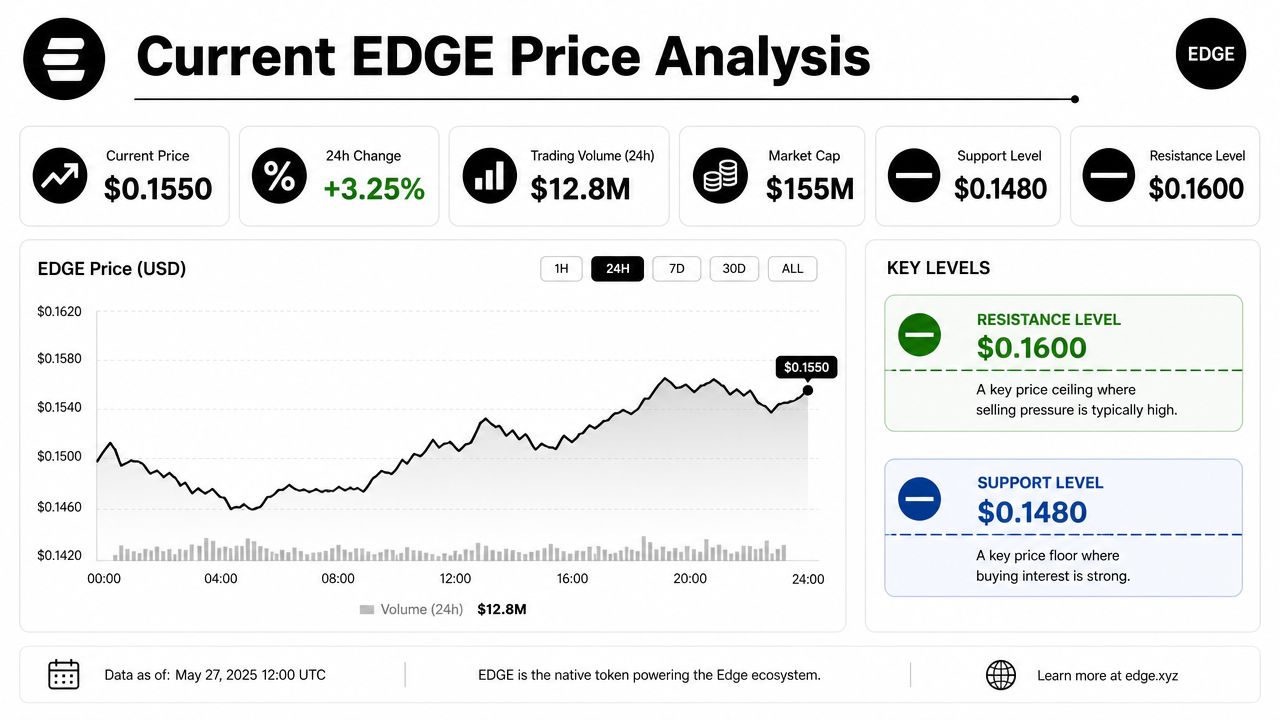
A financial dashboard showing the current EDGE crypto price, market cap, and trading trends for May 2025.

Start with structure, not prediction

An RSI near the middle usually tells me one thing. Momentum isn't stretched enough to make the chart obvious. You're not looking at a clean exhaustion extreme. You're looking at a market where reaction around levels matters more than broad interpretation.

That makes the nearby pivots more important than generic momentum talk.

Level typePrice
Support$0.08982
Support$0.08826
Resistance$0.09315
Resistance$0.09491

How I'd read this setup

If price closes cleanly above the resistance band, continuation becomes the higher-quality short-term scenario. If price rejects there and volume doesn't confirm, mean reversion back toward support is the more practical read.

That's not glamorous, but it's how these charts usually pay. Not through heroic prediction. Through disciplined reaction.

A neutral RSI doesn't mean “do nothing.” It means your edge comes from waiting for confirmation instead of front-running a move that hasn't proven itself.

What matters on the chart

Focus on three things:

  1. Candlestick behavior at resistance
    Long wicks and repeated failure near resistance usually tell you sellers are active and breakout buyers are getting trapped.

  2. Volume bars during pushes
    A resistance break without clear volume expansion is lower quality. For EDGE, that filter matters more than it does on deep majors.

  3. Closing behavior, not intraday spikes
    Thin tokens can print sharp moves that don't hold. The close tells you more than the excursion.

A practical chart routine

Use a simple routine instead of stacking indicators:

  • Mark the pivots first: Those are your decision levels.
  • Watch for acceptance above resistance: One brief poke above isn't enough.
  • Track rejection quality: If price fails quickly, don't argue with it.
  • Size smaller when the chart is neutral: Neutral structure doesn't justify aggressive exposure.

For EDGE, the chart read is straightforward. It's not in a clean trend state. It's in a decision zone.

Decoding the Historical Price of EDGE

The long-term chart tells you what kind of asset you're dealing with. In EDGE's case, the history is a reminder that low-liquidity altcoins can go through enormous expansion, deep compression, and long stretches where the quote alone tells you very little about risk.

CoinGecko reports an all-time high of $1.52 on Mar. 2, 2025 and an all-time low of $0.007968 on May 1, 2020 for EDGE. At its peak, the token had traded more than 190 times above its low, and CoinGecko also states it is currently about 93.45% below its all-time high and 1,153.43% above its all-time low, as shown on CoinGecko's EDGE page.

A timeline chart illustrating the historical price movements and key development milestones of the EDGE crypto token.

What that history actually means

A lot of traders look at the range and see opportunity. That's only half right. The range also tells you this token can punish bad timing hard.

When an asset can trade that far off its low and still sit that far below its peak, you're dealing with a market that runs in violent cycles. Price compression can last longer than traders expect. Recovery phases can be sharp enough to pull in late buyers who then end up holding the retrace.

Three ways to interpret the long-term chart

  • Compression phase
    During this phase, the token trades far below prior highs and interest fades. Traders who confuse inactivity with safety often get trapped here because liquidity can thin out even more.

  • Expansion phase
    This is the phase everyone notices after the move has already started. Breakouts look easy in hindsight, but entries become harder because spreads, slippage, and emotional chasing all increase.

  • Reset phase
    This is the uncomfortable middle. The token isn't dead, but it isn't in a clear trend either. Most altcoin traders lose money here by overtrading every small bounce.

A wide historical range doesn't just signal upside potential. It signals that risk control matters more than conviction.

How to use history without becoming a historian

The historical chart is useful for setting expectations, not for predicting exact repeat patterns. Here's the practical use:

Historical clueTrading implication
Huge distance from low to highExpect outsized swings and avoid oversized positions
Deep drawdown from peakDon't assume previous highs are “likely” to be revisited soon
Strong recovery from the lowRespect momentum when it appears, but wait for confirmation

The best use of EDGE history is simple. Let it shape your risk model.

If a token has already shown that it can trade over 190 times above its lowest point while also remaining more than 90% below its high, then your approach should assume instability, fragmented participation, and sudden changes in character. That doesn't make it untradeable. It makes it a specialist market.

Key Drivers That Move the Edge Crypto Price

With some assets, the main question is macro. With EDGE, the better question is often microstructure. You can have a session where the broader crypto market is weak, but EDGE still trades higher because buyers push through a technical level and volume follows.

CoinMarketCap's AI price analysis noted one example where EDGE rose 9.23% to $0.0976 in 24 hours during a technical breakout and surging volume, even while the broader crypto market was falling, according to CoinMarketCap AI's Definitive price analysis.

A diagram illustrating factors influencing the EDGE cryptocurrency price including demand, supply, news, and technology updates.

Microstructure matters more than macro here

That example says a lot. It suggests that for EDGE, relative strength and volume confirmation can overpower general market direction in the short run. Traders who only ask whether Bitcoin is green or red can miss the trade completely.

That doesn't mean macro is irrelevant. It means macro is often the background condition, not the immediate trigger.

The signals worth watching

When I'm evaluating a smaller token like EDGE, I care about a short list:

  • Breakout quality
    Not every move through resistance matters. I want to see whether buyers can keep price above the level after the initial push.

  • Volume expansion
    A thin breakout can reverse fast. If participation doesn't increase, the move is more likely to fail.

  • Relative strength versus the tape
    If the broad market is soft and EDGE still attracts bids, that's information. It suggests the move is being driven internally by positioning, liquidity, or token-specific order flow.

  • Reaction speed after a breakout
    Strong moves usually don't linger indecisively right after they trigger. If the breakout stalls immediately, the market may have already exhausted the impulse.

What doesn't work well

A lot of standard altcoin habits work poorly here:

Weak approachWhy it fails on EDGE
Buying just because the whole market is bouncingEDGE can decouple from broad beta
Trusting a breakout without volumeThin books can produce fake strength
Chasing a fast green candle lateSlippage and reversal risk increase quickly
Using a single venue price as truthFragmented liquidity can distort the read

Watch the token's own tape first. General market direction helps with context, but it won't replace confirmation on the actual asset you're trading.

A better decision framework

If you want a cleaner workflow, think in this order:

  1. Is EDGE showing strength relative to the broader market?
    If yes, it deserves attention even on a weak day.

  2. Did the move break a clear technical level?
    If the move happened in the middle of nowhere, quality is lower.

  3. Is volume supporting the break?
    If not, don't upgrade the setup just because the percentage move looks large.

  4. Can you validate broader context with sentiment tools?
    A framework like this crypto market sentiment analysis guide helps separate token-specific strength from market-wide noise.

For EDGE, the takeaway is practical. The Edge crypto price often moves when its own order flow shifts, not only because crypto as a whole moved up or down. That changes how you time entries. You need confirmation from the token itself.

How to Navigate EDGE Liquidity and Exchanges

The biggest mistake traders make with EDGE is treating all reported prices as equally useful. They aren't. On fragmented tokens, the important question isn't “what's the price?” It's “where can I realistically trade size without getting a bad fill?”

The available market data already points to a liquidity split. Some pages show a healthy-looking quote and volume profile. Other venues show much thinner activity. That gap is exactly where traders get trapped.

Why one quote can mislead you

If one venue reports meaningful activity and another reports almost none, then the token may have patchy executable liquidity. In practice, that leads to:

  • Slippage risk: Your fill may land far from the screen price.
  • Fake urgency: A move can look explosive because the book is thin.
  • Poor stop execution: Stops can trigger into low-depth conditions and fill badly.
  • Bad signal quality: A “breakout” on one venue may not reflect broad participation.

EDGE Data Comparison Across Platforms Illustrative

PlatformReported Price24h VolumeNotes
CoinMarketCaparound $0.079$3.68MAggregated page suggests materially higher activity
Coinbasearound $0.08 to $0.10not specifiedPrice appears in the same general range, but liquidity context still matters
Binancearound $0.08 to $0.10$1,030Reported volume is very low and market cap is shown as $0
Other dashboardsvariesvariesDifferent update methods can create conflicting reads

The point of the table isn't that one platform is right and another is wrong. The point is that the market is not presenting a single clean picture.

A practical exchange checklist

Before placing an order in EDGE, run through this:

  • Check where real trading is happening: A quote is only useful if participants are transacting there.
  • Avoid blind market orders on thin books: Use tighter execution controls when liquidity looks uneven.
  • Compare spread behavior across venues: If spread widens unpredictably, your risk increases even before price moves.
  • Scale down when data disagrees sharply: Uncertain market structure is a reason to reduce size, not a challenge to overcome with confidence.

If the venue can't support your exit, it doesn't matter how good your entry looked.

What works better

For tokens like EDGE, traders usually do better when they think like execution managers, not chart tourists. The chart can attract you. Liquidity decides whether the trade is viable.

That means waiting for better confirmation, checking venue depth, and keeping position size realistic for the market you have, not the market you wish you had.

Find Your Edge Trading with Wallet Finder.ai

Low-liquidity tokens get easier to read when you stop relying on price pages alone and start tracking who is trading them on-chain. That's where wallet-level analysis becomes useful. Instead of guessing whether a move has conviction, you can watch which wallets are entering, how they size, whether they scale in, and how they manage exits.

A person analyzing complex blockchain transaction data on a computer screen for a crypto platform.

Wallet Finder.ai is built for that workflow. It tracks DeFi wallets across major ecosystems, surfaces trading histories, and helps traders monitor token activity, wallet performance, and entry or exit behavior in real time.

A workable EDGE workflow

For a token like EDGE, the process is less about prediction and more about verification. I'd structure it like this:

  1. Find the token and inspect wallet activity
    Start in a token discovery view and isolate wallets that have interacted with EDGE recently. The first question isn't whether they bought. It's whether the buyers look deliberate. Repeated entries, coherent sizing, and sensible exits matter more than random one-off activity.

  2. Check whether the wallets are worth following
    A wallet can catch one good move and still be useless to mirror. Review trade history, consistency, and how the trader behaves after entry. If the wallet constantly buys spikes and dumps into weakness, that tells you something about style and risk.

  3. Build a focused watchlist
    Don't track every active wallet. Track the handful whose behavior matches your own timeframe. Swing traders should avoid copying hyperactive flow they can't realistically execute.

A more general framework for that process is in this guide to the best wallet tracker for active crypto research.

Turn observation into alerts

Advantage comes from speed and selectivity. Once you've identified useful wallets, set alerts for buys, swaps, and sells. That keeps you from camping on a chart waiting for a move that may never matter.

Good alert use is narrow, not noisy:

  • Track wallets with a consistent style: Similar behavior is easier to interpret.
  • Separate entries from trims: A small add and a full rotation out are not the same signal.
  • Watch clusters: One wallet move can be random. Several aligned wallets are more interesting.
  • Use alerts as prompts, not commands: You still need to check chart context and venue liquidity.

Here's a quick visual walkthrough of the broader process:

What copying well actually looks like

Most traders overcomplicate copy trading. The practical version is simpler:

StepWhat to doWhy it matters
Identify active walletsFilter for wallets interacting with EDGECuts through noisy public price data
Validate behaviorReview trading history and PnL pattern qualitativelyHelps avoid copying random luck
Set alertsGet notified when tracked wallets actImproves reaction time
Execute selectivelyOnly take trades that also fit liquidity and chart contextReduces blind imitation

The traders who use wallet tracking well don't mirror everything. They use wallet activity as a signal layer on top of technical levels, liquidity checks, and execution discipline. That's especially important on tokens like EDGE, where a visible price move can still be hard to trade cleanly.

If you're trading the Edge crypto price seriously, wallet-level tracking gives you a way to confirm whether a move is attracting informed participation or just flashing on a thin screen.


Wallet-level data is often the missing layer between a chart that looks interesting and a trade worth taking. If you want to monitor active wallets, inspect trading histories, and set alerts around token activity, Wallet Finder.ai offers a structured way to do that without relying only on fragmented price pages.