IoTeX Price Prediction 2026: Bull, Base, Bear Scenarios

Wallet Finder

Blank calendar icon with grid of squares representing days.

May 2, 2026

IoTeX forces traders to hold two ideas at once. It has one of the cleaner DePIN narratives in crypto, and it also has one of the messier price histories. That combination is exactly why a serious iotex price prediction can't stop at target numbers.

Most prediction articles give you a terminal price and move on. That's not enough. If the range of plausible outcomes is wide, true advantage comes from learning how to test each scenario in real time through market structure, network traction, and wallet behavior.

Decoding the IoTeX Price Puzzle

A move from a cycle high near $0.26 to a price area measured in fractions of a cent is not a normal altcoin pullback. It is a repricing that changes how IOTX should be analyzed. Traders who model IoTeX as a simple recovery trade usually miss the central question. What would have to improve on-chain for the market to pay a higher multiple again?
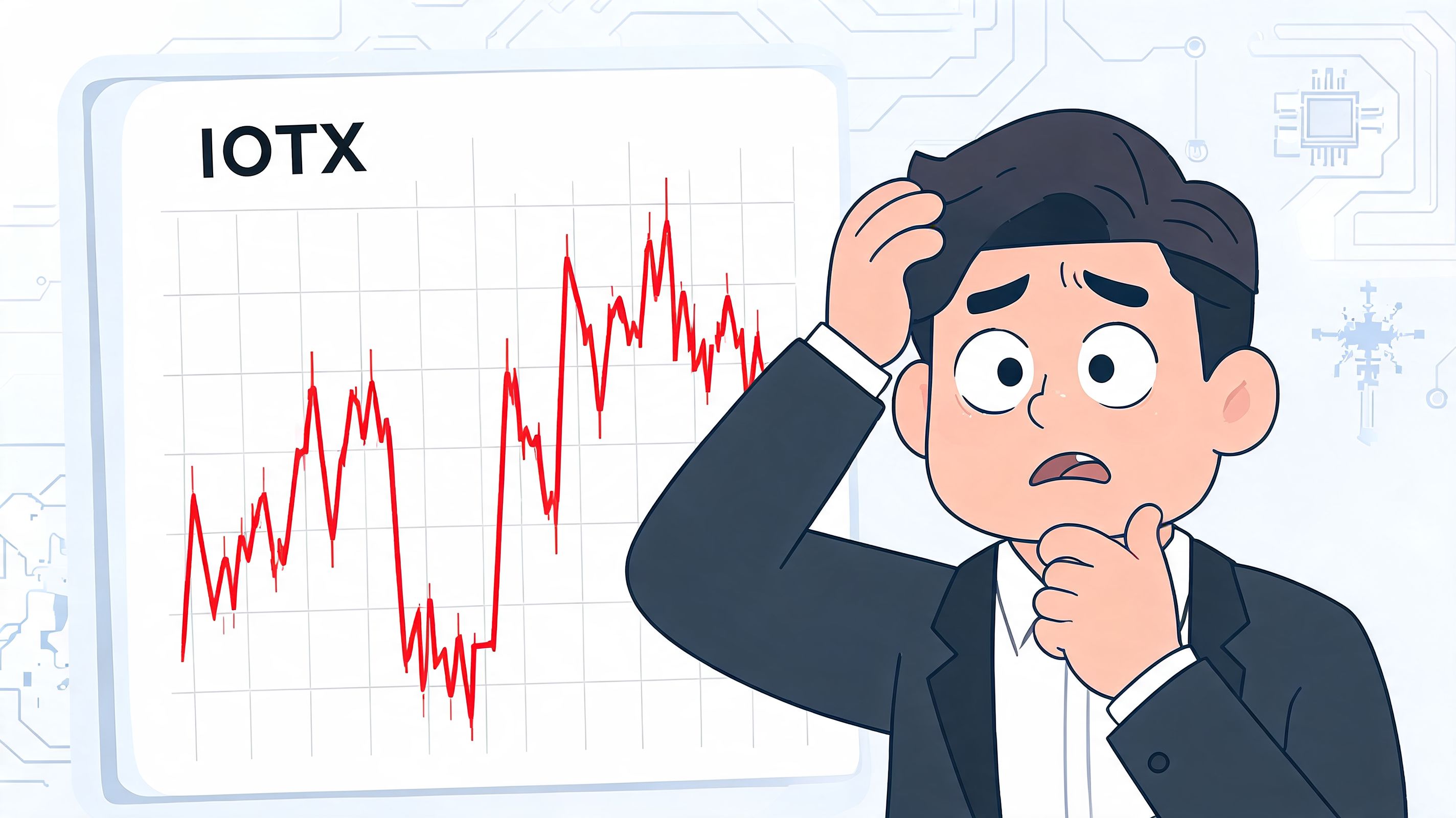
A confused businessman looking at an IOTX price chart with a fluctuating red trend line.

The chart captures only the outcome. It does not tell you whether sellers are exiting a failed thesis, whether long-term holders are absorbing supply, or whether informed wallets are positioning before broader attention returns. That distinction matters more than any headline target.

IoTeX is difficult to price because its narrative sits between infrastructure and real-world adoption. Markets tend to reward that mix only when progress becomes visible in wallet activity, protocol usage, and capital rotation. A strong story can support interest for a while. Sustained upside usually needs proof.

That is why a serious iotex price prediction should be treated as a set of testable conditions rather than a fixed number. Wallet Finder.ai users can approach IOTX the same way an on-chain desk would. Start with a valuation framework, then check whether wallet flows and accumulation behavior support it. If you need a baseline for that framework, this guide on how to calculate coin value is a useful starting point.

A practical way to read the setup is through three filters:

  • Fundamentals show whether IoTeX is building something the market may eventually value.
  • Technical structure shows where sentiment, liquidity, and trend are currently aligned.
  • On-chain signals show whether higher-conviction participants are entering, exiting, or waiting.

The third filter is where most prediction content falls short. Price targets are presented as opinions, but traders need a way to verify them in real time. If a bullish 2026 scenario is valid, Wallet Finder.ai should help you see early signs of it through smart money accumulation, exchange flow shifts, and improving wallet concentration trends. If those signals do not appear, the scenario stays speculative.

What Drives IoTeX Value Fundamentally

IoTeX only deserves a premium valuation if it converts a niche thesis into observable token demand. For traders, the core question is not whether machine-linked infrastructure sounds compelling. It is whether that infrastructure produces usage, fees, staking demand, and wallet behavior that can be tracked before price reprices higher.

The infrastructure layer

IoTeX was designed for connected devices, trusted data, and applications that need machine-generated inputs on-chain. That gives it a narrower addressable market than a general-purpose Layer 1, but it also gives analysts a cleaner framework. A focused chain is easier to evaluate because the gap between narrative and real adoption is easier to spot.

Its technical design supports that thesis. IoTeX combines high-throughput architecture with EVM compatibility, which lowers the friction for developers who already build in the Ethereum stack. For valuation, that matters less as a branding point and more as a filter. If developers still do not ship despite familiar tooling, the problem is demand, not accessibility.

Why specialization can help or hurt value

Specialization cuts both ways.

If DePIN, machine identity, and verified real-world data continue attracting users and capital, IoTeX has a clearer role than many broad "do everything" chains. If those themes cool or fail to turn into recurring network activity, IOTX can trade like a story token rather than an infrastructure asset.

That distinction matters for Wallet Finder.ai users. A bullish view should be tied to evidence that the token is gaining relevance inside the network, not just attention on social media. Wallet concentration changes, accumulation by higher-conviction cohorts, and reduced exchange sell pressure can help confirm whether the market is starting to price that relevance in.

A practical valuation framework for IOTX

The simplest way to value IOTX is to separate the thesis into three moving parts: utility, adoption, and market sponsorship. This framework for calculating coin value is useful because it forces that separation instead of treating narrative and value as the same thing.

Fundamental pillarWhat to verify in IOTX
UtilityDoes the token sit inside staking, fees, security, or application activity in a way that creates recurring demand?
AdoptionAre builders, users, devices, or node operators increasing in a way that can later show up in wallet and transfer behavior?
Market sponsorshipIs capital rotating into DePIN and infrastructure tokens, and are stronger wallets choosing IOTX over competing themes?

This framework leads to a more useful conclusion. Good technology alone does not support a higher token price. Demand has to become visible in blockchain activity and capital flows.

What strengthens the bull case

The strongest fundamental setup for IOTX would come from a combination of product progress and on-chain confirmation:

  • More application activity tied to real device or data usage, not just ecosystem announcements
  • Steadier developer deployment in areas where machine data directly changes how an app works
  • Clear token utility linked to network actions such as staking, settlement, or access
  • Smart money accumulation patterns that appear before broad retail participation returns

The last point is where prediction content usually falls short. Traders get price targets, but not a method to test them. Wallet Finder.ai closes that gap by letting users watch whether higher-quality wallets are accumulating into weakness, whether large holders are distributing into rallies, and whether exchange-facing flows support the thesis.

A credible iotex price prediction starts with that discipline. If the network attracts real usage and stronger wallets begin positioning early, upside scenarios gain weight. If usage stays shallow and capital does not confirm the narrative, any long-term target remains a speculative estimate.

Historical Price Action and Technical Analysis

IOTX has spent the last year trading in a very wide band relative to its current price. That matters less as a prediction headline and more as a market signal. Wide ranges in smaller-cap infrastructure tokens usually reflect unresolved sponsorship, uneven liquidity, and repeated failure at key reclaim levels.

A candlestick chart representing IOTX price action with a dashed arrow indicating a predicted future upward trend.

What the chart is actually saying

The long-term chart still looks like a post-cycle repair structure, not a confirmed new uptrend. IOTX experienced a sharp repricing after the 2021 expansion phase, then moved into a prolonged base. Assets in that state can produce strong percentage rallies, but those rallies often fail unless volume, trend strength, and wallet behavior improve at the same time.

That distinction matters for traders. A token can look cheap after a large drawdown and still remain trapped in a low-conviction range for months.

The current technical split

Coinpedia's technical read on IOTX shows the kind of mixed setup that usually frustrates reactive traders. Some longer-term moving averages still lean constructive, while shorter-term trend signals and momentum readings remain weaker. In plain terms, the market has started to stabilize on higher timeframes, but buyers have not yet shown enough urgency to turn that stabilization into a clean breakout.

That is often where false starts happen. Swing traders see a base. Momentum traders see dead air. Both can be right for different timeframes.

For readers refining entries and invalidation levels, this guide on how to read crypto charts is useful because IOTX is a good example of why timeframe alignment matters more than headline price targets.

Key levels and signals that matter

The technical picture is more useful when grouped by decision type rather than by indicator alone:

Indicator or levelSignalWhat it implies
Longer-term moving averagesConstructive biasThe broader trend is trying to form a floor rather than extend a full breakdown
Shorter-term moving averagesWeak momentumBuyers have not yet established control in the near term
Weekly MACD trendMomentum still softA durable reversal is harder to trust before medium-term momentum improves
50-day SMATactical referenceUseful for judging whether short-term recoveries are gaining traction
200-day SMAStructural thresholdReclaiming and holding this area would strengthen the recovery case materially

How to read the conflict without forcing a forecast

Mixed signals are common near turning points, but they also appear in prolonged sideways markets. The job is not to force certainty. The job is to identify which signal deserves more weight for your holding period.

For IOTX, the non-obvious conclusion is that technical analysis only becomes actionable when paired with confirmation rules. If price reclaims higher trend thresholds and holds them while volatility compresses, the setup starts to support a higher-probability swing long. If price rallies into resistance and momentum fades again, the chart is still behaving like a range asset, not a trend asset.

That is where Wallet Finder.ai becomes more than a screening tool. A chart breakout in IOTX is more credible if stronger wallets are adding exposure during the retest, not sending tokens toward exchanges into strength. If that confirmation is absent, traders should treat bullish targets as scenarios, not evidence.

The technical case for an iotex price prediction remains conditional. Using the chart effectively is not about declaring a specific number. Instead, its purpose is to define the critical levels and then use on-chain behavior to test whether capital is validating the move.

Tracking Smart Money with On-Chain Signals

Most retail traders use predictions backward. They start with a target, then search for reasons to believe it. Better traders start with wallet behavior and ask which scenario capital is positioning for.

That's especially important with IOTX because the story is easy to like and difficult to validate. Price can stay disconnected from fundamentals for a long time. Wallet behavior often closes that gap earlier than headlines do.

What to monitor before price reacts

On-chain analysis for this setup isn't about one giant transaction. It's about pattern recognition. You want to know whether capable wallets are building exposure in a way that suggests conviction rather than noise.

A good working framework comes from understanding crypto on-chain analysis, then narrowing it to token-specific behavior. For IOTX, the highest-signal behaviors are usually:

  • Accumulation that persists across several sessions instead of one burst buy.
  • Rotation into the theme from wallets already active in adjacent infrastructure or DePIN names.
  • Entry discipline near support rather than panic chasing after vertical moves.
  • Reduced distribution from holders who previously sold strength.

Separate informed buying from random activity

Not every wallet that buys early is smart money. Some are early. The distinction comes from behavior.

Use this checklist:

  1. Review realized history. Has the wallet shown a habit of entering narratives before wider participation arrives?
  2. Check position sizing. A meaningful allocation carries more information than a small exploratory trade.
  3. Look for repeat interactions. One swap can be noise. Repeated involvement with similar sectors is more revealing.
  4. Track exits as carefully as entries. Skilled wallets often scale out before the crowd notices weakening momentum.

Good on-chain work doesn't ask, "Who bought?" It asks, "Who bought, with what size, after what prior track record, and what did they do next?"

Scenario validation through wallet behavior

Under such conditions, iotex price prediction becomes practical. Each forecast should map to observable behavior.

Prediction thesisOn-chain behavior that would support it
Bullish reratingRepeated accumulation by strong historical performers and less immediate selling after local rallies
Base-case stabilizationMixed flow, selective entries, and shorter holding periods with no broad conviction build
Bearish continuationWeak follow-through, frequent exits into relief bounces, and a lack of sustained accumulation

What traders often miss

The biggest edge isn't spotting the first buy. It's spotting whether a cohort of high-quality wallets is clustering around the same thesis. When multiple capable traders express the same view independently, the probability of a tradable move improves.

That matters more in IOTX than in highly liquid majors. A token with thinner participation can move sharply when a relatively small set of committed buyers aligns around a narrative. Conversely, if those buyers never show up, optimistic forecasts remain unconfirmed.

For traders, this is the missing bridge between DePIN theory and market reality. A prediction isn't useful because someone published it. It's useful when wallet activity starts behaving as if that prediction is becoming consensus among informed capital.

IoTeX Price Prediction Scenarios for 2026

A 2026 range of roughly -11% to more than +400% from current levels is not a forecast you buy blindly. It is a dispersion map. According to CoinCheckup's IoTeX predictions page, bearish models place IOTX near $0.004037 by year-end 2026, while more optimistic cases reach $0.02874, with an average target around $0.012.

An infographic showing three price prediction scenarios for IoTeX cryptocurrency in 2026, ranging from bullish to bearish.

For Wallet Finder.ai users, the practical question is different. Which scenario is gaining confirmation now, and which one is still only a published estimate? That distinction matters more in IOTX than in large-cap assets because conviction from a relatively small group of capable wallets can change market structure quickly.

Scenario map for 2026

Scenario2026 Price TargetKey DriversOn-Chain Signals to Watch
Bear caseAround $0.004037DePIN interest fails to convert into sustained capital flows, rallies keep getting sold, and the token remains a low-conviction altShort holding periods, weak follow-through after accumulation, repeated distribution into rebounds
Base caseAround $0.012Moderate ecosystem traction, improving sentiment across infrastructure tokens, and technical stabilization without a full reratingSelective accumulation, longer hold times, shallower sell pressure after local highs
Bull caseUp to $0.02874Stronger market appetite for DePIN exposure, clearer demand for machine-data narratives, and broad altcoin risk-on conditionsClustered buying by high-quality wallets, repeated adds on pullbacks, lower exchange-bound flows from conviction holders

Bear case

The bear case assumes IoTeX remains interesting at the product level but underowned in the market. That usually produces a familiar pattern. Brief relief rallies attract short-term traders, then supply returns before a trend can build.

For execution, Wallet Finder.ai users should treat this scenario as a low-duration environment. If wallets with strong prior hit rates enter and then reduce exposure quickly into strength, that behavior supports the same forecast rather than contradicting it. A bearish market in IOTX can still offer trades, but it favors shorter holds and tighter invalidation.

Base case

The same forecast places the midpoint near $0.012, which is the most realistic rerating path if adoption improves modestly and broader alt sentiment stops deteriorating. This outcome does not require category leadership. It requires the market to assign IoTeX a higher probability of relevance than it does today.

That is why the base case is often the best setup for risk-adjusted trades. It tends to emerge before headlines turn decisively positive and before price targets get revised higher. Traders can look for steady accumulation by skilled wallets, fewer fast exits after green days, and repeated buying on retracements instead of one-off speculation.

Later in the section, this video offers additional market context:

Bull case

The upper end of the same forecast reaches $0.02874. For that scenario to move from theoretical to tradable, capital has to treat IOTX as more than a lagging altcoin rebound. It has to begin trading like a preferred infrastructure expression inside the DePIN and machine-data theme.

Price usually does not announce that shift first. Wallet behavior often does. If Wallet Finder.ai shows a cluster of higher-quality addresses building exposure across multiple pullbacks, while sell pressure into strength falls, the probability of a bullish rerating improves materially. That is the point where a published target starts becoming a live thesis.

The best bull setups often look underconfirmed on the chart early. Wallet clustering is what helps separate early accumulation from random noise.

Which scenario is most actionable

The base case is the most tradeable because it demands evidence of improving participation, not euphoric assumptions. The bull case offers the highest upside, but only if smart-money behavior starts confirming that stronger narrative rotation is underway.

A useful iotex price prediction is not a number on a page. It is a scenario tied to observable wallet behavior. If upside targets stay unchanged while high-quality wallets keep selling into rebounds, the market is rejecting the thesis. If those wallets accumulate before sentiment catches up, traders get an earlier read on which 2026 path is gaining probability.

Key Risks and Actionable Trade Strategies

IOTX is the kind of token that can tempt traders into oversized bets because the upside range looks dramatic from depressed prices. That's exactly where discipline matters most.

Long-term 2030 predictions range from $0.04 to $5.00, a spread of 3,200%, while IOTX also shows 5.54% volatility and sits in an Extreme Fear backdrop with a Fear & Greed Index of 10, according to StealthEX's analysis of IoTeX prediction risk. That spread isn't just an interesting statistic. It's a warning that uncertainty is massive and point estimates can create false confidence.

The major risks

RiskWhy it matters
Narrative riskDePIN can stay conceptually attractive without producing enough capital inflow into IOTX itself
Execution riskReal-world infrastructure stories need visible adoption, not just technical credibility
Market structure riskVolatile altcoins can stay undervalued for longer than traders expect
Copy-trading riskMirroring a wallet without understanding timeframe and sizing can turn a good signal into a bad trade

Three practical trade approaches

  • For long-term believers. A staggered accumulation approach makes more sense than all-in entries. The logic is simple. If the thesis is right, you'll still get exposure. If the thesis is early, you preserve flexibility.

  • For swing traders. Use the technical conflict to your advantage. Wait for price behavior to align with improving momentum instead of front-running every local bounce. The goal isn't to buy the exact bottom. It's to enter once the market starts proving your thesis.

  • For copy traders. Treat wallet mirroring as a filter, not a substitute for judgment. A strong wallet entering IOTX matters more when the position is meaningful, repeated, and held through volatility. If the same wallet exits quickly, that may tell you the trade was tactical rather than a conviction bet.

How to size risk better

A token with this much forecast dispersion doesn't deserve casual sizing. If you're trading scenario uncertainty, your position size should reflect the chance that your preferred scenario is wrong.

Risk note: In a market with wide target dispersion, the smartest leverage is usually restraint.

That means setting invalidation in advance, reducing size when signals conflict, and adding only when price action and wallet behavior start telling the same story. Traders who do that won't catch every move. They also won't get trapped by every narrative.

Frequently Asked Questions about IoTeX's Future

Can IOTX reach $1

It isn't impossible, but there's no verified data in the current source set that supports a near-term path to that level. The more responsible answer is that $1 would require a far stronger adoption and valuation regime than the one reflected in current 2026 projections. For now, scenario analysis around published 2026 ranges is more useful than anchoring to round-number milestones.

Is IoTeX better viewed as an IoT token or a DePIN token

From a market perspective, DePIN is the more actionable frame. IoT is the technology domain. DePIN is the investable narrative that helps traders compare IoTeX with other infrastructure stories. That distinction matters because narratives drive capital rotation, and capital rotation drives repricing long before broad fundamental consensus forms.

Is IOTX a good investment or just a trading vehicle

Right now, it's more useful to think of IOTX as a conditional investment and an active trading vehicle. The investment case depends on whether real-world device participation and trusted data infrastructure translate into durable token demand. The trading case depends on whether wallet behavior and technical structure begin validating that thesis sooner than the crowd expects.

If you're a long-horizon investor, you need evidence of durable network relevance. If you're a trader, you need confirmation that informed capital is acting on the thesis now, not six months from now.


Wallet Finder.ai helps traders move beyond static forecasts by tracking profitable wallets, real entries, position sizing, and trade timing across major chains. If you want to validate an iotex price prediction with actual on-chain behavior instead of guesswork, explore Wallet Finder.ai.