Leash Coin Price: A Trader's Guide to LEASH

Wallet Finder

Blank calendar icon with grid of squares representing days.

April 24, 2026

The leash coin price doesn’t just move fast. It breaks the assumptions most traders bring to a chart.

One data point reframes the whole asset: LEASH fell from $266.00 at the start of 2025 to $0.0165 by year-end, a 1,609,481% decline according to CoinLore historical data. When an asset can print a move like that after a prior year that was positive, standard chart reading stops being enough.

That’s the core problem with LEASH. A clean candle setup can mean very little if the order book is thin, the quoted price differs wildly between venues, and a handful of wallets can move the market merely by showing up. Traders who treat LEASH like a liquid large-cap usually learn the hard way. Traders who treat it like an on-chain microstructure puzzle have a better chance.

Decoding the LEASH Coin Price Puzzle

Most traders look at three things first: price, chart, and market cap. With LEASH, that stack can mislead you.

The quoted leash coin price is often less a single truth and more a rough snapshot from a fragmented market. If you only watch one exchange ticker or one aggregator, you can end up trading a headline number instead of tradable reality. That’s a bad setup in any market. In LEASH, it’s dangerous.

A better starting point is to think in layers:

  • Surface layer: the current quoted price
  • Structure layer: supply, liquidity, and holder concentration
  • Behavior layer: what active wallets are doing on-chain

That last layer matters most. In very thin markets, the wallets often tell the story before the chart does. A chart shows what printed. Wallet flows show who acted, when they acted, and whether a move came from broad participation or just a few addresses shifting inventory.

Practical rule: If an asset is hard to price consistently across venues, don't trust the chart alone. Verify the underlying activity.

LEASH also punishes lazy position sizing. Traders often assume they can “test” a setup with a small order and scale later. In low-liquidity tokens, scaling later can be the hardest part. Entry, exit, and even price validation all become execution problems.

If you want a framework for thinking about token valuation before you even touch the trade, this guide on how to calculate coin value is a useful companion to the LEASH puzzle.

What Is Doge Killer LEASH Anyway

LEASH sits inside the Shiba Inu ecosystem, but traders who treat it like another meme token usually misread it. The setup is different. Supply is tight, liquidity is uneven, and a few active wallets can shift the market faster than any clean chart pattern suggests.

A cute Shiba Inu cartoon character holding three circular crypto tokens labeled LEASH, SHIB, and BONE.

Why LEASH behaves differently

LEASH was built to be scarce, and that scarcity changes how price forms. In high-liquidity majors, chart structure often reflects broad participation. In LEASH, one wallet rotating size, one LP shift, or one cluster of buys across fragmented venues can distort the tape.

That creates a practical problem for traders. Candles may look decisive while the underlying move is thin, isolated, or driven by inventory transfers rather than fresh conviction. Standard support and resistance levels still matter, but they carry less weight when market depth is shallow.

A better read comes from combining market structure with wallet behavior. Traders who rely only on a meme coin chart setup can end up reacting to prints that were never broadly validated on-chain.

Scarcity is the feature and the risk

Scarcity can support higher per-token pricing, but it also makes execution worse. Spreads can widen fast. Slippage can turn a decent entry into a poor one. Exits are often harder than entries, especially when momentum stalls and bids thin out.

That is why LEASH trades more like a specialist on-chain asset than a retail momentum coin.

The edge usually comes from identifying who is accumulating before the chart looks obvious. In practice, that means tracking wallet clusters, watching transfers into liquidity venues, and separating real positioning from noise. With LEASH, fragmented liquidity makes pure chart analysis incomplete. On-chain wallet tracking gives a cleaner view of whether stronger hands are building, distributing, or rotating exposure.

If you approach LEASH with a standard altcoin playbook, you will miss what actually moves it.

The Wild Ride of the LEASH Price History

LEASH has traded from near five figures to fractions of a dollar. That range is the first clue that its history is less useful as a clean chart and more useful as a stress test for how this market functions.

The headline extremes matter because they keep pulling traders back in. A prior peak creates reflexive upside targets, while a brutal collapse creates the illusion that every bounce is a bargain. In LEASH, both instincts can be expensive if they are based only on candles.

From premium pricing to unstable repricing

Early LEASH price action built the core narrative fast. Limited supply, strong ecosystem attention, and speculative demand pushed traders to treat it like a scarce asset that could command premium valuations. That framing still shapes positioning today. Traders see the old range and assume the token can revisit it if sentiment returns.

The problem is that historical pricing in LEASH says very little about current executable demand. In a market this thin, a sharp move can reflect a short burst of aggressive buying, a rotation by a small cluster of wallets, or weak order books across fragmented venues. Traditional pattern traders often read those moves as broad confirmation when they are really reacting to a narrow flow event.

That distinction matters.

The collapse changed how serious traders should read the chart

LEASH later moved from a constructive period into a severe breakdown. The lesson was straightforward. Prior strength did not create reliable support, and scarcity did not stop repricing once liquidity thinned and conviction disappeared.

For active traders, standard chart interpretation begins to falter. A breakout on LEASH can look clean and still have weak follow-through because the move was never widely sponsored. A support retest can fail even after a strong bounce because a few wallets are distributing into thin bids. The chart records the result. It does not always reveal who caused it or whether that flow is still active.

That is why LEASH price history should be used carefully. It helps identify where traders are likely to anchor, where old bag holders may look to exit, and where momentum buyers may overreact. It does not, by itself, explain whether stronger hands are accumulating again.

A practical read of LEASH history leads to three trading rules:

  1. Old highs are reference points, not targets. They show where speculation once peaked, not where fair value sits today.
  2. Violent drawdowns reset market structure. After a collapse, prior support zones often lose relevance because the wallet base and available liquidity have changed.
  3. Confirmation needs on-chain context. In LEASH, wallet flows often matter more than a textbook setup on the chart.

Traders who want better signal should treat chart history as a map of crowd psychology, then verify it with wallet activity. A setup that looks attractive on a meme coin chart pattern becomes far more credible when the same period shows accumulation by wallets that have historically entered before major repricings.

That shift in process is where the edge is. In LEASH, the tape is often too thin and too fragmented to trust on its own. Wallet tracking through tools like Wallet Finder.ai gives a better chance of spotting real positioning before the move looks obvious on the chart.

Fundamental Drivers Behind LEASH Price Swings

LEASH doesn’t swing because it’s “just volatile.” It swings because its market structure is fragile.

The most useful way to read LEASH is to stop asking whether the chart looks bullish or bearish and start asking whether the market can absorb real buying or selling without breaking. In LEASH, that answer is often no.
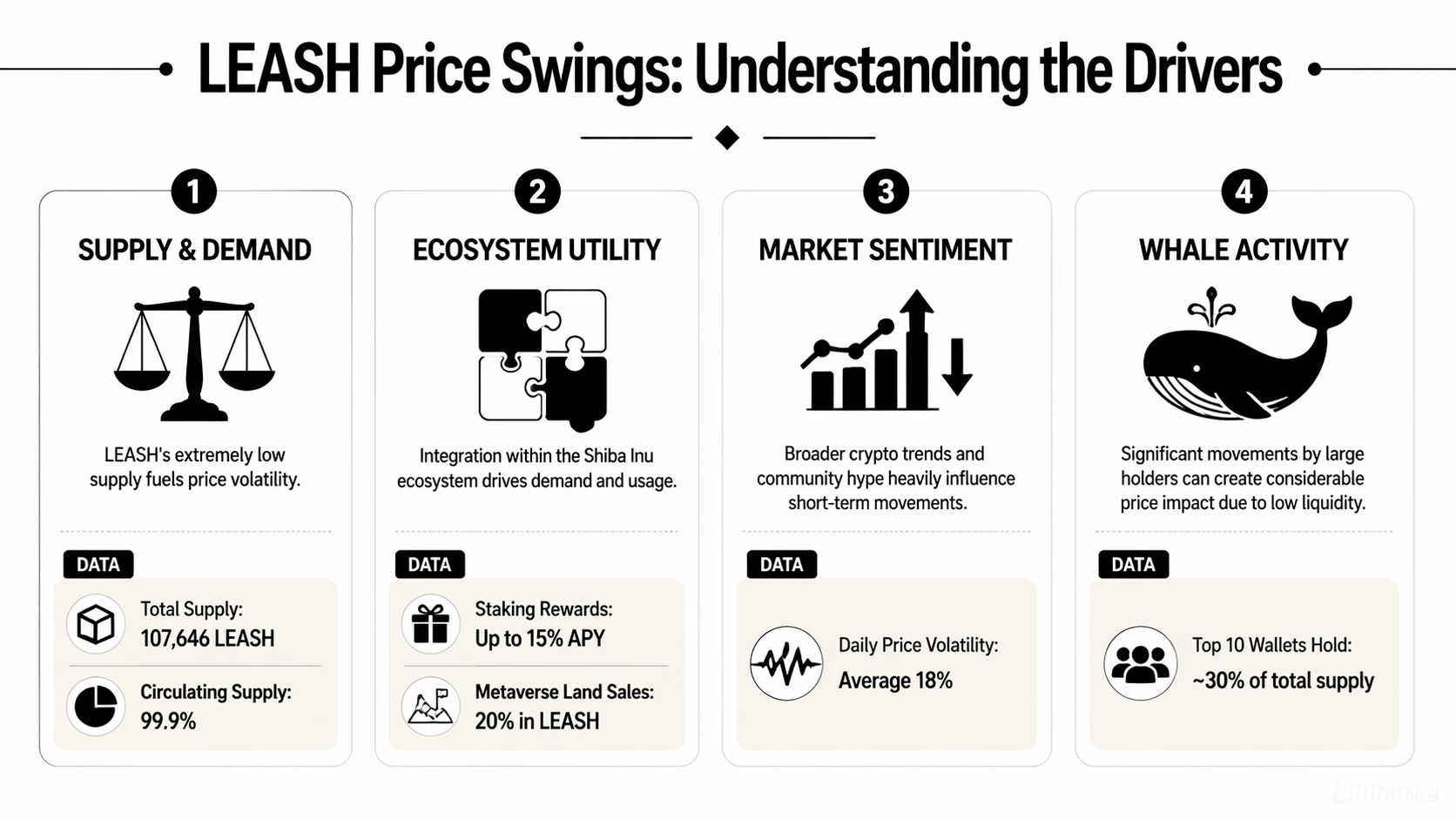
An infographic titled LEASH Price Swings illustrating four main factors including supply, utility, sentiment, and whale activity.

The mechanics that matter

CoinMarketCap’s LEASH listing identifies the core setup clearly. LEASH has a total supply of 107,646 tokens. Its market is also highly illiquid, with 24-hour trading volume often below $10,000 and a volume-to-market-cap ratio frequently under 0.5%.

For traders, those aren’t background stats. They are the market.

MetricValueImplication for Traders
Total supply107,646 tokensScarcity magnifies price impact from relatively small flows
24-hour trading volumeOften below $10,000Even modest orders can face weak depth and poor fills
Volume-to-market-cap ratioFrequently under 0.5%Daily liquidity is thin relative to headline valuation

Why traditional TA keeps failing here

A support line matters less when there aren’t enough bids behind it. A breakout matters less when one wallet can punch through the book. That’s why LEASH often produces moves that look irrational to traders used to deeper markets.

Here’s what usually works better than standard indicator stacking:

  • Watch liquidity conditions first. If the market is thin, every setup should be discounted.
  • Treat size as a strategy variable. You’re not just trading direction. You’re trading your own market impact.
  • Map likely whale zones. In concentrated ownership structures, wallet behavior can outweigh textbook chart levels.

Execution beats prediction in LEASH. You can be right on direction and still lose on entry quality, slippage, or inability to exit.

What traders should infer from the structure

LEASH is best approached as a low-liquidity instrument where price is highly sensitive to participation. That means there are periods when no signal is actionable because the market itself is too thin to trust.

It also means the best opportunities often appear when the visible chart looks unconvincing, but wallet behavior suggests stronger hands are positioning. In other words, the chart is often a lagging summary of a market that was already moved by a few decisive actors.

How to Accurately Track and Trade LEASH

The first mistake traders make with LEASH is assuming there is one reliable market price. There often isn’t.

LEASH price data is extremely fragmented, with discrepancies of over 10,000x observed simultaneously across exchanges, including examples such as $0.000017 on one venue versus $0.000000001114 on another, according to Gate.io’s LEASH price page. Once you accept that, your process has to change.

A confused young man looking at computer monitors displaying cryptocurrency charts and the Leash coin price.

What not to do

If you trade LEASH off a single app widget, you’re flying blind. Aggregators can show a number that looks precise but still isn’t useful for actual execution. Thin books, stale quotes, and isolated venue prints all distort the picture.

Avoid these habits:

  • Don’t use one ticker as truth. Cross-check venue pricing before entering.
  • Don’t hit large market orders. In fragmented books, quoted price and filled price can diverge fast.
  • Don’t assume “cheap” means value. A low displayed price on one venue may reflect broken liquidity, not opportunity.

A better operating routine

A practical LEASH workflow looks more like this:

  1. Check multiple venue quotes. You’re validating tradable price, not admiring a chart.
  2. Inspect depth before entry. If the order book is thin, reduce size or skip the trade.
  3. Use limit orders where possible. They won’t solve everything, but they reduce the chance of panic fills.
  4. Hold in self-custody if you’re not actively trading. Wallets like MetaMask or Trust Wallet give you control over timing and routing.
  5. Set alerts, but don’t outsource judgment to them. Alerts are triggers to investigate, not orders to act.

A LEASH chart can look stable while the tradable market underneath is anything but stable.

Why on-chain tracking becomes mandatory

Fragmented exchange pricing creates a simple problem. If venue data can’t be trusted on its own, you need a cleaner signal. That signal is on-chain behavior.

Wallet flows won’t remove risk, but they can tell you whether the move is backed by actual accumulation, rotation, or distribution. In LEASH, that’s often more useful than another oscillator, another moving average, or another “support” level drawn on a chart that thin liquidity can ignore in a single transaction.

Mirror Smart Money in LEASH with Wallet Finder.ai

The bearish chart doesn’t always tell the full story. LEASH is one of those tokens where the useful signal can show up first in wallet behavior.

Bybit’s LEASH page notes an extreme volatility reading of 88.56%, and also highlights that on-chain data can reveal contrarian opportunities, including smart-wallet accumulation patterns similar to those seen before the 2021 pump to over $4,500. It also notes that platforms can help traders filter for wallets with recent high gains on LEASH to spot pre-pump activity on-chain. That context comes from Bybit’s LEASH market page.

Screenshot from https://www.walletfinder.ai/

The contrarian setup to watch

A classic LEASH trap is waiting for the chart to “confirm” strength. In a thin market, confirmation often arrives after the best entries are gone. Smart wallets don’t wait for retail confidence. They build when liquidity allows.

That doesn’t mean every accumulation is bullish. It means wallet activity gives you earlier evidence than a delayed chart print.

Use this workflow:

  1. Find LEASH in token discovery tools. Start with token-level views so you can isolate wallet activity tied to LEASH itself.
  2. Open the top-wallet view. Focus on addresses with visible consistency, not just one lucky trade.
  3. Review complete trade history. Entry timing matters more than a vanity win rate.
  4. Study position sizing. A wallet risking small exploratory size sends a different signal than one committing meaningfully.
  5. Track follow-through. One buy is noise. Repeated adds, disciplined exits, and re-entries are process.

For traders who want a deeper framework for identifying those wallets, this guide to a smart money tracker is worth reviewing.

What a high-quality LEASH wallet signal looks like

Not every profitable wallet is worth mirroring. In low-liquidity assets, a good signal has context.

Look for a combination of:

  • Consistency across tokens. A wallet that manages risk well elsewhere is more credible in LEASH.
  • Clean timing. Strong wallets often enter before broad social chatter spikes.
  • Measured scaling. Skilled traders rarely ape into illiquid names all at once.
  • Realized discipline. Exits matter. A wallet that never sells may just be trapped.

The edge isn’t copying every wallet buy. The edge is learning which wallets understand illiquid entries and which ones only look smart in hindsight.

How to use alerts without becoming reactive

Real-time alerts are useful, but only if you define what counts as actionable before the alert arrives. Otherwise, you’ll chase every wallet ping.

A workable process is simple:

  • Create a shortlist of wallets that have handled LEASH well before.
  • Separate exploratory buys from conviction buys.
  • Require a second layer of confirmation, such as repeated buys or coordinated behavior from more than one quality wallet.
  • Decide your maximum acceptable slippage before placing any order.

That last part matters. If the alert is fast and the market is thin, reacting blindly can turn a good signal into a bad trade.

Understanding the High Risks of Trading LEASH

LEASH can offer asymmetric upside. It can also punish basic mistakes harder than most traders expect.

The first major risk is slippage. In practical terms, that means you click buy at one displayed price and get filled much worse because the available liquidity at that level was too small. In LEASH, this happens easily. Thin books don’t forgive urgency.

The risks that matter most

  • Slippage risk: Large orders relative to available liquidity can move the market against you during execution.
  • Manipulation risk: Illiquid markets are easier to influence. Small coordinated activity can create fake strength or fake panic.
  • Narrative risk: LEASH still depends heavily on attention, belief, and rotation. If that attention fades, price can gap lower without much resistance.

Why discipline matters more than conviction

A trader can be completely right about the broad thesis and still lose money by using the wrong order type, entering too early, or sizing too large. LEASH is not the place for emotional averaging down or oversized “starter” positions.

A few hard rules help:

  1. Use only capital you can afford to lose.
  2. Avoid large market orders.
  3. Plan the exit before the entry.
  4. Assume liquidity will be worse when you need it most.

In LEASH, risk management isn’t a defensive extra. It’s the strategy.

Another common mistake is confusing scarcity with safety. Limited supply can support violent upside, but it doesn’t protect you from poor market depth, wallet concentration, or sudden sentiment collapse. Scarcity is just one variable. Execution is the one you control.

Conclusion Is Trading LEASH Worth the Risk

For most retail investors, probably not.

LEASH asks for more than bullish conviction. It asks for comfort with fragmented pricing, weak liquidity, whale-sensitive order books, and a chart that often lags the underlying signal. If you trade it like a normal altcoin, the leash coin price will often look random because the market structure underneath is unstable.

For specialized traders, the answer is different. If you think in terms of execution, wallet behavior, and liquidity conditions first, LEASH can offer setups that don’t exist in cleaner markets. But that edge doesn’t come from staring harder at candles. It comes from reading on-chain footprints before the visible chart catches up.

The traders most likely to do well here are the ones who can wait, verify, size carefully, and act only when wallet activity and execution conditions line up.


If you want to trade assets like LEASH with better context, Wallet Finder.ai helps you track profitable wallets, study full trading histories, and monitor real-time on-chain moves across major ecosystems so you can act on wallet behavior instead of relying only on noisy price feeds.