Market Structure Diagram: A Trader's Guide for 2026
Learn to read and draw a market structure diagram for trading. This guide explains trends, liquidity, and orderflow for DeFi and on-chain analysis.

June 8, 2026
Wallet Finder

June 8, 2026

You open a chart, draw two lines, and five minutes later the setup is gone. Price wicks above a high, dumps into your stop, then rips in the original direction. If that feels familiar, you're not bad at trading. You're probably reading motion without reading structure.
That's where a market structure diagram helps. In economics, it's a way to classify industries by competition and market power. On a trading chart, it's a way to organize price swings so you can tell whether buyers or sellers are in control. Both meanings matter. One explains the environment an asset lives in. The other helps you decide whether to enter, wait, or get out.
Most traders only need the second meaning day to day. But if you skip the first one entirely, you miss why some markets trend cleanly, why some chop, and why some assets behave like they have gravity around key levels. The useful path is to learn the textbook version first, then translate it into chart logic you can use on-chain.
A new trader often sees the same chart in three different ways within one hour. First it looks bullish. Then a red candle makes it look bearish. Then a bounce makes it look like a breakout again. That kind of flip-flopping usually comes from watching candles one by one instead of reading the sequence they create.
Think about a volatile token after a launch. Price pushes up fast, pulls back hard, reclaims the prior high, then sweeps below a local low before moving higher again. If you're focused on single candles, that chart looks random. If you're focused on structure, it starts to read like a story. You can ask better questions. Is price making higher highs and higher lows? Did it break a meaningful swing? Was that move expansion or just noise?
Markets become easier to read when you stop asking what the last candle means and start asking what the last sequence means.
That's the trading use of market structure. It acts like grammar for price action. Instead of treating every move as a fresh mystery, you start grouping moves into trends, pullbacks, breaks, and reversals.
There's another reason this matters in DeFi. Crypto traders borrow language from several worlds at once. An economist says “market structure” and means competition between firms. A chart trader says “market structure” and means highs, lows, and trend shifts. If you mix those up, the advice sounds contradictory when it really isn't.
Here's the clean way to approach it:
In economics, a market structure diagram is a map of how a market is organized. The textbook version usually starts with three questions. How many sellers are active? How easy is entry or exit? How similar or differentiated are the products? Those questions sit behind the standard four market types summarized in Wikipedia's overview of market structure.
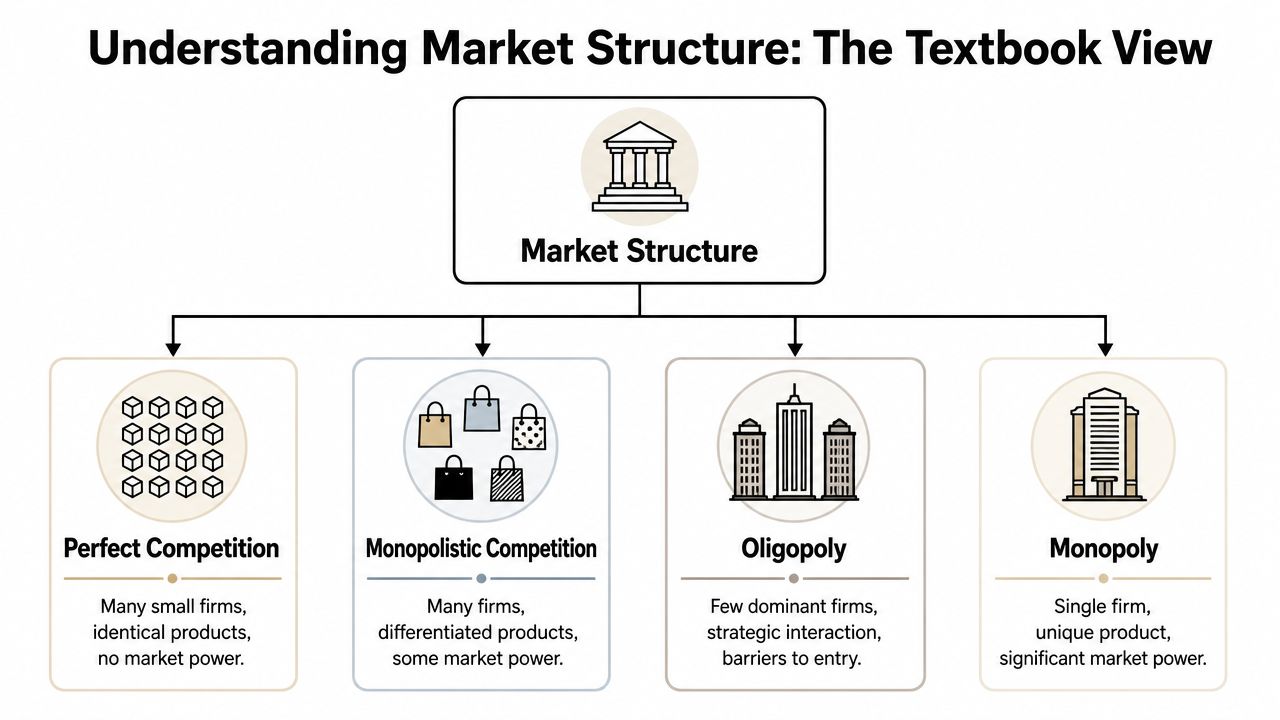
That is the classroom definition.
For traders, the value of that definition is not the labels themselves. The value is that it teaches you to ask who has power, where that power comes from, and how hard it is for new competitors to change the balance. On a chart, those questions later turn into a different kind of structure reading.
A simple way to read the four categories is as a spectrum of pricing power.
| Structure | Core traits | Practical intuition |
|---|---|---|
| Perfect competition | Many small firms, homogeneous products, low barriers to entry and exit | No single seller has meaningful control over price |
| Monopolistic competition | Many firms, but products are differentiated | Firms can influence demand for their own version of the product |
| Oligopoly | A small number of large firms dominate | A few players can shape the market and must react to each other |
| Monopoly | One firm, no close substitutes, blocked entry | One seller holds substantial market power |
A perfectly competitive market is the cleanest benchmark. A firm there is a price taker. It sells at the market price because raising its own price sends buyers elsewhere, and cutting price is unnecessary. Corporate Finance Institute's explanation of market structure lays out that logic clearly.
Entry and exit matter just as much as firm count. In long-run perfect competition, short-run profits attract new firms, supply increases, and prices tend to move back toward normal profit. Losses push firms out, supply contracts, and prices adjust the other way. The Curious Economist's discussion of market structure diagrams explains how that same broad mechanism also shows up in monopolistic competition, even though firms differentiate their products.
Economists also ask a second layer of questions. Even if a market has several firms, is control still clustered near the top?
Two common tools are the N-firm concentration ratio and the Herfindahl-Hirschman Index, often shortened to HHI. The concentration ratio adds up the market share of the largest firms. HHI goes further by squaring each firm's share, which gives more weight to dominant players.
A quick example helps. If the top five firms produce most of a market's output, economists read that as concentrated, not broadly competitive. The U.S. Department of Justice describes concentration measures and the role of HHI in merger analysis in its Horizontal Merger Guidelines.
That sounds abstract, but the idea is simple. Firm count alone can mislead. Ten firms do not always mean a decentralized market if two of them control most of the volume, liquidity, distribution, or user attention.
This textbook view gives you context. It helps explain why some markets stay fragmented while others become dominated by a few large operators, gatekeepers, or platforms.
That matters in crypto and DeFi more than many traders expect. A token can trade in an open market and still sit inside an ecosystem shaped by concentrated exchange liquidity, a protocol treasury, a handful of whales, or strong network effects. In economic terms, the market may look more concentrated than the raw participant count suggests.
So the academic definition is not useless for traders. It is the wide-angle lens. It tells you how the arena is built before you study the swings inside it.
When traders talk about a market structure diagram, they usually aren't classifying industries into perfect competition or monopoly. They're talking about the pattern of price swings on a chart. Specifically, they're watching whether price is printing higher highs and higher lows or lower highs and lower lows.
That shift in meaning isn't sloppy. It's practical.
Real markets often don't fit textbook boxes neatly. Platform markets, network effects, regulated systems, and high switching costs create gray zones that simple firm-count models miss. A more useful approach is to focus on market boundaries and price behavior rather than just firm count, as discussed in this analysis of where textbook categories become misleading.
A chart trader needs answers to immediate questions:
The four textbook categories don't answer those. They tell you about the broader competitive structure around a market, not the actual path price is taking through time.
That's why traders use a different form of diagramming. They reduce the market to structure points. Swing highs. Swing lows. Breaks. Failures. Reclaims. Once those are marked, the chart becomes less emotional and more mechanical.
For chart work, market structure means the ordered relationship between recent highs and lows.
A simple version looks like this:
That's why a trader's market structure diagram is less like an economics flowchart and more like a map of control. It shows where buyers proved themselves, where sellers interrupted them, and where the last valid trend might have broken.
If a market doesn't fit a tidy textbook category, price still leaves a structure trail on the chart.
For DeFi traders, that's especially useful. On-chain markets can be distorted by incentives, liquidity fragmentation, whale activity, and venue-specific behavior. You won't solve that by arguing whether a token market is “really” monopolistic competition. You'll solve it by reading what price is confirming right now.
The first useful chart markup is usually much simpler than people think. You don't need a screen full of labels. You need a clean way to identify swing points, then decide whether price is continuing or shifting.
Start with the process below.

First, mark swing highs and swing lows.
A swing high is a point where price pushed up and then turned down. A swing low is the opposite. Don't mark every tiny fluctuation. Mark the turns that clearly changed short-term direction.
Next, connect the meaningful points.
Once you've marked several swings, connect them mentally or with simple lines. You're looking for the sequence, not the decoration. If price is forming higher lows into higher highs, that's an uptrend. If rallies keep failing lower and lows keep breaking, that's a downtrend.
A quick charting habit helps here. Keep one color for highs and another for lows. Your eye will start spotting the sequence faster.
The next job is identifying whether structure is holding.
| Label | What it means | What you're looking for |
|---|---|---|
| BOS | Break of Structure | A move that confirms trend continuation |
| CHOCH | Change of Character | A move that hints the prior trend may be ending |
A Break of Structure, or BOS, usually confirms continuation. In a bullish trend, that often means price takes out a prior swing high after respecting a higher low. In a bearish trend, it means price breaks a prior swing low after failing at a lower high.
A Change of Character, or CHOCH, is different. It suggests the sequence may be shifting. For example, a market that has been making higher lows might suddenly break a meaningful prior low. That doesn't guarantee a full reversal, but it tells you the old trend is no longer clean.
Below is a video walkthrough if you want to see that process on a live chart.
If you want a repeatable workflow, use this sequence every time:
A bad diagram is usually too busy. A good one only marks the points that change your decision.
Traders usually get tripped up in three places:
The goal isn't perfect labeling. The goal is to make the chart legible enough that your entries stop depending on hope.
A basic market structure diagram tells you what price has done. Advanced layers help you think about why price may react at specific locations next. With this insight, chart reading becomes less about naming swings and more about understanding positioning, trapped traders, and imbalances.

A good advanced diagram is dynamic. Static diagrams struggle when market conditions change over time. The significant value of an advanced view is that it helps interpret reactions to live developments such as shocks or regulation, which static equilibrium models don't capture well, as noted in the IAIS discussion of dynamic market behavior.
Liquidity usually gathers where traders place obvious orders. In practice, that often means above visible highs and below visible lows. Why? Breakout traders place entries there, and many other traders place stops there.
When price moves through those areas and quickly snaps back, traders often call it a liquidity sweep. The point isn't the label. The point is what it tells you. Price visited a zone where orders were clustered, filled them, and then reacted.
A simple way to add liquidity to your diagram:
An order block is usually treated as the last opposing candle or small area before a strong directional move. Traders use it as a reference zone where larger positioning may have entered.
A fair value gap, or FVG, is an imbalance on the chart where price moved so quickly that it left a visible gap in trading activity between candles. Traders often watch those zones because price may revisit them before continuing.
| Advanced layer | What it adds to structure |
|---|---|
| Liquidity zone | Shows where stops and breakout orders may be resting |
| Order block | Highlights a possible origin area for aggressive buying or selling |
| Fair value gap | Marks an imbalance that price may revisit |
| Breaker block | Shows a failed support or resistance area that may flip roles |
You don't need to believe these are magical levels. Treat them as context. If bullish structure holds and a pullback returns into an order block that overlaps an imbalance, you've found a more interesting area than a random mid-range entry.
A breaker block forms when a previously respected area fails and later acts in the opposite role. Old support can become resistance. Old resistance can become support. This isn't new. The useful part is combining it with structure so you know whether the flip happened before or after a genuine shift in control.
Volume helps here. If you want to study whether aggressive buying or selling supported the move, compare your structure map with cumulative volume delta. That won't replace structure, but it can confirm whether the break had real participation behind it.
Advanced concepts matter most when they line up with structure. On their own, they're just chart annotations.
Don't add everything at once. Work in layers:
That sequence keeps your diagram readable. If you reverse it, the chart becomes a collection of theories with no backbone.
A market structure diagram on one timeframe is only part of the story. A five-minute uptrend can be a small bounce inside a four-hour downtrend. A daily pullback can be a healthy reset inside a weekly uptrend. Traders get chopped up when they treat one chart as the whole truth.
The better model is nested structure. Think of timeframes like stacked containers. The larger one sets the environment. The smaller one shows the entry path.
Begin with the highest timeframe that matters for your holding period. If you swing trade, that may be the weekly and daily. If you scalp, you still want to know what the four-hour and daily are doing before you care about the five-minute chart.
Use a top-down sequence like this:
That approach cuts down on impulsive entries. You stop buying every local break in a larger bearish environment.
A strong setup often has alignment across layers.
| Timeframe role | What you want to see |
|---|---|
| Higher timeframe | Clear bias or key structural level |
| Middle timeframe | Pullback or setup area inside that bias |
| Lower timeframe | BOS or CHOCH that gives a precise trigger |
For example, suppose the daily chart is bullish. The four-hour chart pulls back into a meaningful zone. On the fifteen-minute chart, price stops making lower lows and starts breaking local highs. That's structure alignment. You're no longer buying because a green candle appeared. You're buying because the lower timeframe is turning in the direction of the higher timeframe.
Disagreement doesn't mean “don't trade” every time. It means be honest about what kind of trade you're taking.
The lower timeframe gives the signal. The higher timeframe tells you how much trust to place in it.
That framing keeps expectations realistic. You stop expecting a scalp to become a swing trade just because the first entry worked.
In DeFi, structure matters most when it becomes a routine rather than a theory. You want a short process you can repeat before opening a position, checking a wallet, or reacting to a sudden move.

Keep this next to your chart:
| Question | Yes or no |
|---|---|
| Is the higher timeframe clear? | |
| Did I mark recent swing points correctly? | |
| Is this BOS, CHOCH, or just noise? | |
| Am I entering at a structural area? | |
| Does the wallet activity support the same idea? | |
| Do I know where the setup fails? |
Most bad trades break down before entry. The trader sees movement, mistakes it for structure, then follows someone else's wallet without checking where price sits in the sequence.
A market structure diagram won't remove uncertainty. It will make your reasoning visible. That alone is a big edge, because visible reasoning can be tested, improved, and repeated.
Wallet Finder.ai helps you turn that structure-based workflow into action. You can track profitable wallets, inspect full trading histories, monitor entries and exits around key chart areas, and set alerts so you're not discovering moves after the crowd. If you want to pair cleaner chart structure with live on-chain behavior, try Wallet Finder.ai.